Home charging: what to check before installing a charger
The advertised power of a wallbox is only one part of the decision. This guide explains which documents to review for the car, the home and the shared garage in order to design home charging that fits your real routine.
Key points
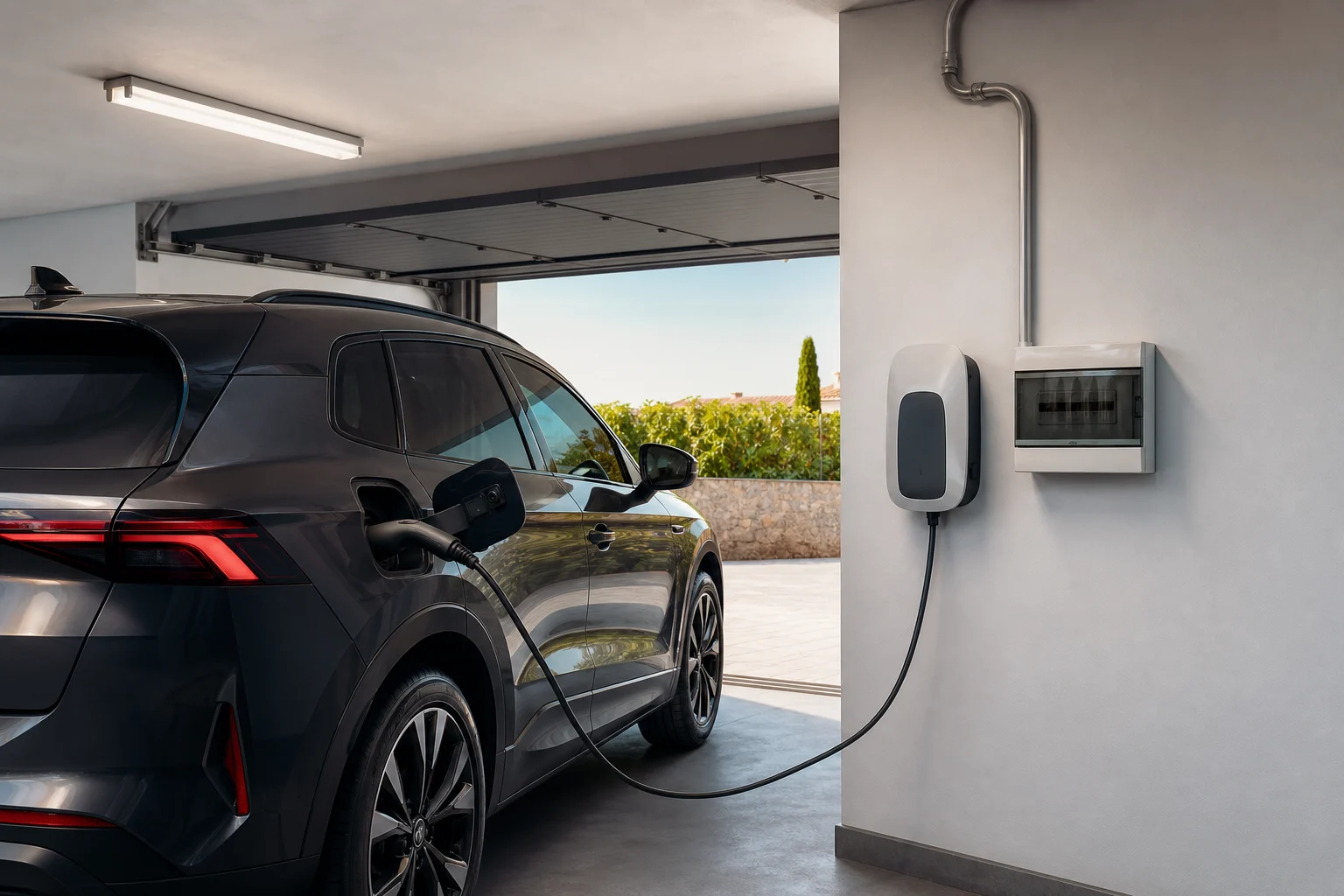
Before installing home charging, check the available supply, the installation’s capacity, the connection arrangement and the route to the parking space. The wallbox must be selected to match the technical documentation—either a technical design report or a project, as applicable—and the planned charging mode.
The short answer: the five details that determine whether charging will work
The installation starts long before choosing a wallbox. To find out whether home charging will suit your routine, gather five details: the planned supply, the available capacity in the installation, the connection arrangement and the physical route to the parking space.
ITC-BT-52 applies both to parking areas in single-family homes and to shared car parks in buildings or property developments under horizontal property ownership. A space in a shared garage should therefore not be treated as an informal exception: the charging point and its supply must be designed within the regulatory framework.
The first practical conclusion is simple: do not buy a charging point based on the highest figure printed on its specification sheet. Before requesting quotes, prepare a bill or the supply details, plus photographs or a simple plan of the route between the electrical panel and the parking space.
Section references: ITC-BT-52: infraestructura para la recarga de vehículos eléctricos ↗
- The single-phase or three-phase supply available or feasible.
- The capacity of the individual service line in a home, or of the main supply line in an existing building.
- The planned connection arrangement.
- Distance, conduits, electrical panel and route to the parking space.
Contracted power, wallbox and installation design: three different things
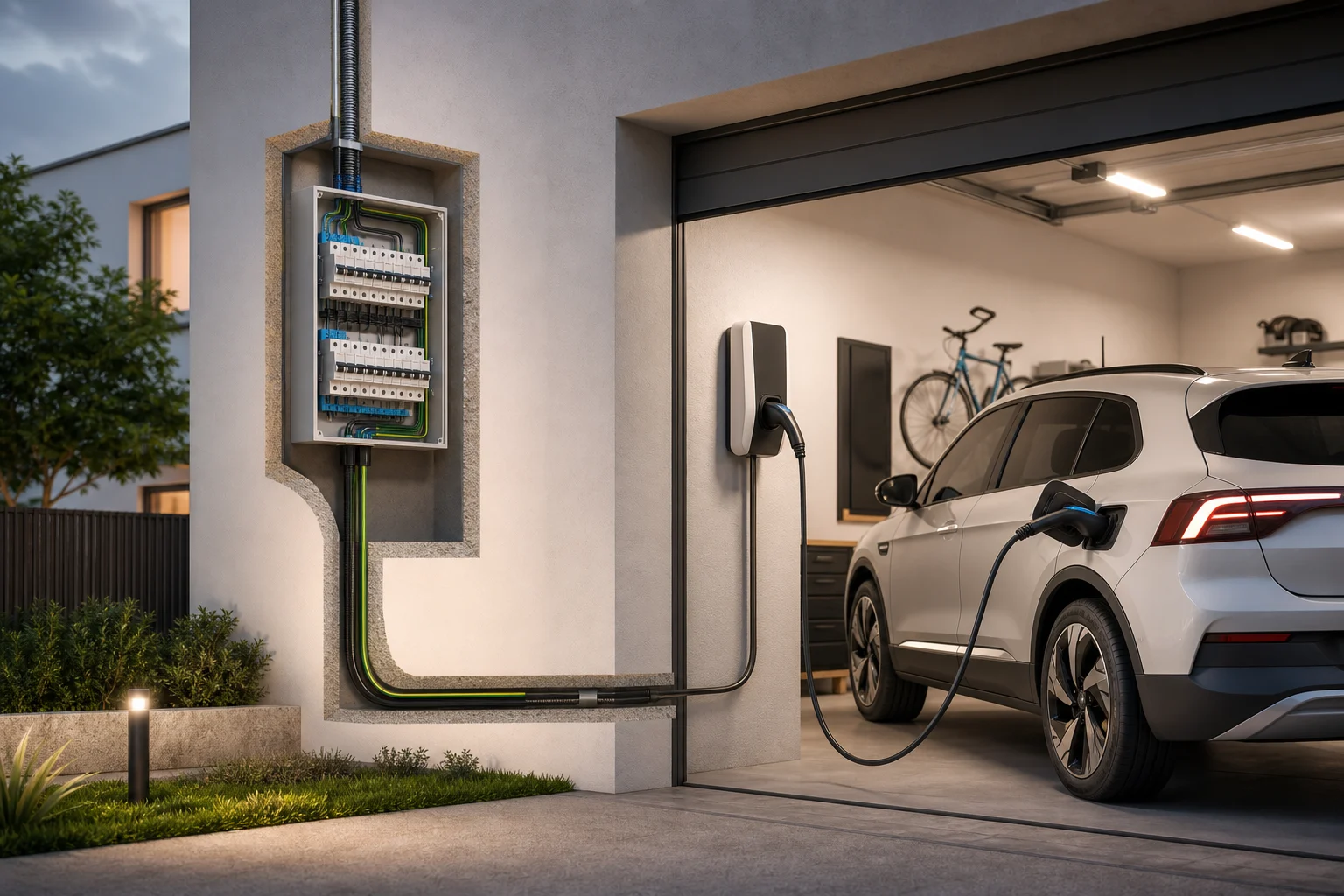
These figures answer different questions. Contracted power is part of the home’s electricity supply; the charging point has a planned power rating and supply; and the installation design must determine a compatible solution. Only after reviewing the whole set-up can you assess which configuration makes sense to request.
The regulations require the vehicle load and all other loads to be considered together in individual arrangements and additional circuits, using a simultaneity factor of 1.0. In other words, the design must not be based on the assumption that household use and charging will never coincide. The installer or designer must check the installation as a whole and determine the applicable solution.
A wallbox is not a roadside fast charger simply because it has a high power rating or a three-phase supply. ITC-BT-52 defines mode 3 as a direct AC connection through a SAVE permanently connected to the fixed installation. Mode 4 includes an external charger and uses a different architecture. For AC charging above 3.7 kW and up to 22 kW, the standard requires at least a type 2 socket outlet or connector.
| Element | What ITC-BT-52 establishes | Pre-installation check |
|---|---|---|
| Supply | The standard distinguishes between single-phase and three-phase supply at connection points. | Confirm it with the installer before choosing the equipment. |
| Charging mode | Mode 3 is a direct AC connection through a SAVE; mode 4 includes an external charger. | Identify the planned charging mode. |
| Connection arrangement | The technical documentation must state the selected connection arrangement. | Review the arrangement stated in the technical documentation. |
| Charging-point circuit | It must be dedicated and must not supply other equipment, except auxiliary loads of the system itself. | Check that the quote identifies the dedicated circuit. |
Section references: ITC-BT-52: infraestructura para la recarga de vehículos eléctricos ↗
- Do not confuse contracted power with the charging point’s rated power.
- Ask for the quote to identify the planned charging mode, supply and connector.
- Check that the point is compatible with the planned charging mode and supply.
Vehicle documentation does not replace installation design
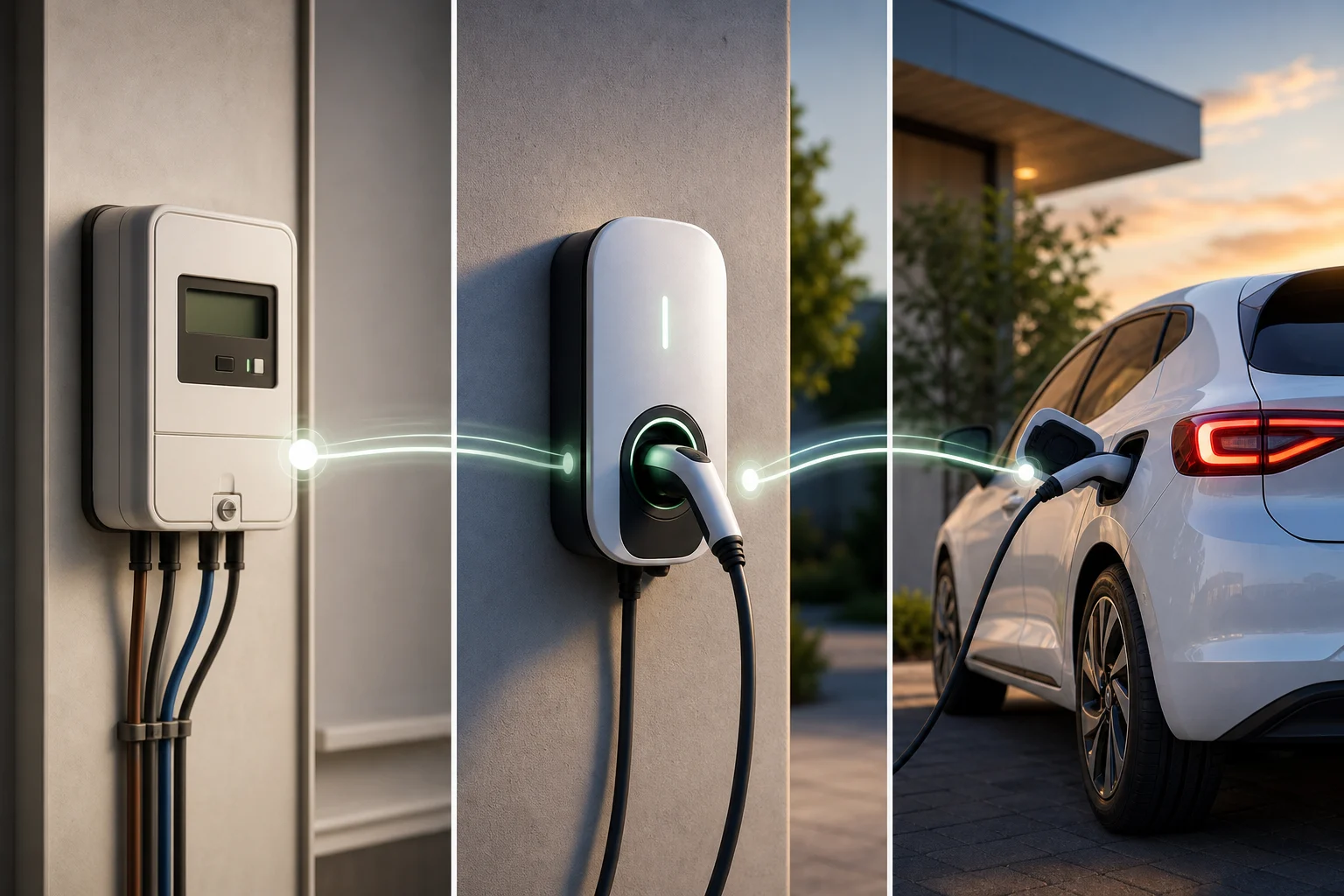
To help guide the choice of charging point, it may be useful to gather the car’s technical specification sheet, owner’s manual or commercial documentation. Before work is carried out, ITC-BT-52 requires the installer or designer to prepare technical documentation in the form of a technical design report or a project, as applicable, and to state the selected connection arrangement.
When comparing quotes, focus your review on the proposed charging solution and its consistency with the installation’s technical documentation.
Section references: ITC-BT-52: infraestructura para la recarga de vehículos eléctricos ↗
- Gather the vehicle information available to compare the proposed options.
- Ask for the technical documentation to state the selected connection arrangement.
- Check that the quote identifies the planned charging solution.
Single-phase, three-phase and fast charging are not synonyms
Single-phase and three-phase describe the supply planned for AC charging. ITC-BT-52 distinguishes between both options at connection points and sets a nominal voltage of 230/400 V AC for modes 1, 2 and 3. The installer must determine which one applies to the installation and the selected arrangement, rather than inferring it from the charging point’s advertising.
Fast charging is not a label equivalent to “three-phase”. Under the regulations, mode 4 includes an external charger and has direct current at the converter output. Therefore, a mode 3 home installation can be single-phase or three-phase without becoming a fast-charging point.
Section references: ITC-BT-52: infraestructura para la recarga de vehículos eléctricos ↗
- Request explicit identification of the supply: single-phase or three-phase.
- Do not use fast-charging power to size home AC charging.
- Check the connector required for the planned AC power.
Consider the time available when comparing options
Before choosing the charging point, note how long the car is usually parked and how you expect to use it. Together with the available vehicle information and the installation conditions, these details can help you compare charging options.
Do not base the decision solely on a generic promise about charging time. Also consider a higher-use day when comparing the proposed configurations.
The charging time and cost tool can help you organise the information before requesting quotes.
- Note the time the car is usually parked.
- Prepare a typical scenario and another with higher demand.
- Gather the available information about the vehicle.
- Compare the proposed configurations before choosing the charging point.
Single-family home and shared garage: what to check and how to proceed
In a single-family home, the design must verify that the allowable current of the individual service line is not exceeded. In an existing building, the check concerns the main supply line. These are different verifications and explain why two apparently similar parking spaces may require different solutions.
ITC-BT-52 allows charging to be planned as an extension of the existing low-voltage installation, or through an independent direct supply from the distribution network with its own connection installation. It also includes arrangements with a common meter for the home and charging station, a meter per station, and additional circuits. Do not choose between them based only on apparent convenience: ask the installer to explain which one is adopted and why.
According to the consolidated text consulted for Article 17.5 of Spain’s Horizontal Property Law, a private charging point in an individual space in a shared garage requires prior notification to the community. The cost of the installation and the electricity consumed are to be borne entirely by the person or persons directly interested.
Section references: ITC-BT-52: infraestructura para la recarga de vehículos eléctricos ↗ · Ley de Propiedad Horizontal, artículo 17.5 ↗
- Home: locate the electrical panel, individual service line, route and charging-point location.
- Shared garage: review the regulations applicable on the installation date before giving prior notification to the community for a private point in an individual space.
- Request the connection arrangement and justification for the conduit route.
- Check that the charging-point line will be dedicated and will not supply other equipment.
- Verify that a protective conductor and earth connection exist in the general installation.
Power management, quotes and documents worth keeping
When available capacity is tight compared with loads that may coincide, ITC-BT-52 provides for main supply line protection systems that prevent a supply failure by temporarily reducing the power allocated to charging, disconnecting loads or regulating charging current in modes 3 or 4. The installer or designer must check the installation and determine the applicable solution.
Before work is carried out, the installer or designer must prepare technical documentation in the form of a technical design report or a project, as applicable, and state the selected connection arrangement. Ask for the quote to be consistent with that documentation and to identify the elements planned for the installation.
Keep the accepted quote, technical documentation, any required notifications to the community, where applicable, and the final installation documents. This will allow you to check which documentation was prepared for the work.
Section references: ITC-BT-52: infraestructura para la recarga de vehículos eléctricos ↗ · Índice oficial de guías técnicas del Reglamento Electrotécnico para Baja Tensión ↗
- Which connection arrangement is proposed, and which meter will be used?
- Will the supply be single-phase or three-phase, and why?
- How is the allowable current of the relevant line or service line checked?
- Which installation elements does the quote identify?
- Will there be current regulation or temporary power reduction, and under which conditions?
Do I need to increase my contracted power to install a home charger?
ITC-BT-52 requires the vehicle load and all other consumption to be considered together in individual arrangements and additional circuits, with a simultaneity factor of 1.0. It also provides for temporarily reducing the power allocated to charging or regulating its current to prevent a supply failure.
Is a three-phase wallbox fast charging?
Not necessarily. A three-phase supply can be part of AC charging. ITC-BT-52 defines mode 4 as the mode that includes an external charger; it should not be confused with a mode 3 home installation.
What procedure do I need in a shared garage?
According to the consolidated text consulted for Article 17.5 of Spain’s Horizontal Property Law, a private point in an individual space requires prior notification to the community. Before installing it, it is advisable to review the regulations applicable on that date.
Why is it not enough to choose the most powerful charging point?
The choice must be based on the installation’s technical documentation, the planned supply and the charging mode. The technical documentation must state the selected connection arrangement.
What documentation must the installer prepare?
Before the installation is carried out, the installer or designer must prepare a technical design report or a project, as applicable, and state the selected connection arrangement.