Front-wheel drive or all-wheel drive: what changes and which suits your use best
All-wheel drive does not replace suitable tyres. Compare front-wheel-drive and AWD versions based on your journeys, snow conditions and used-car checks.
Key points
When comparing a front-wheel-drive version with an all-wheel-drive one, check how the system works, the tyres and the documentation for the exact version. All-wheel drive can help with acceleration on low-grip surfaces, but it does not replace suitable tyres or the need for braking margin.
Quick answer: choose based on your journeys, not a 4x4 label
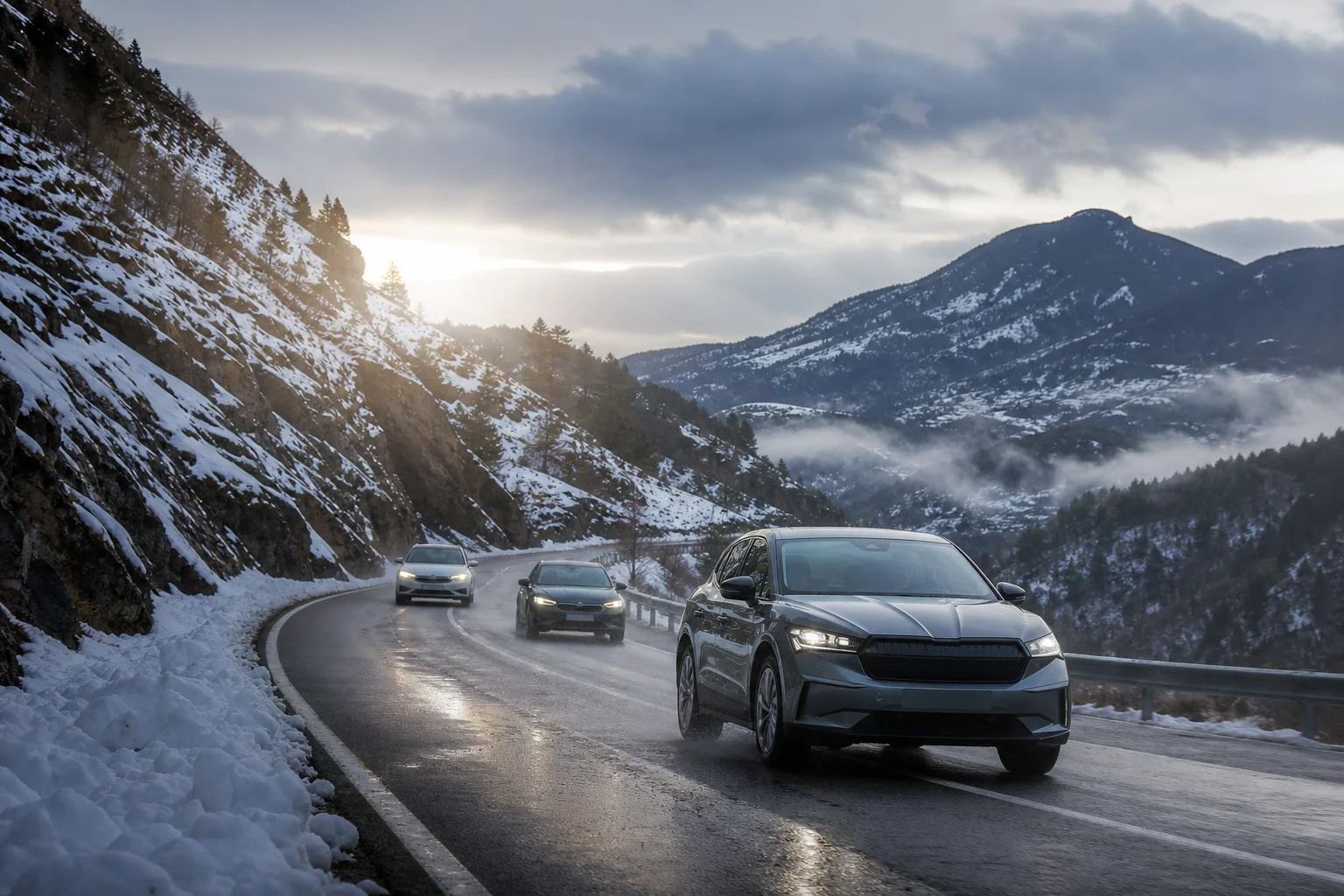
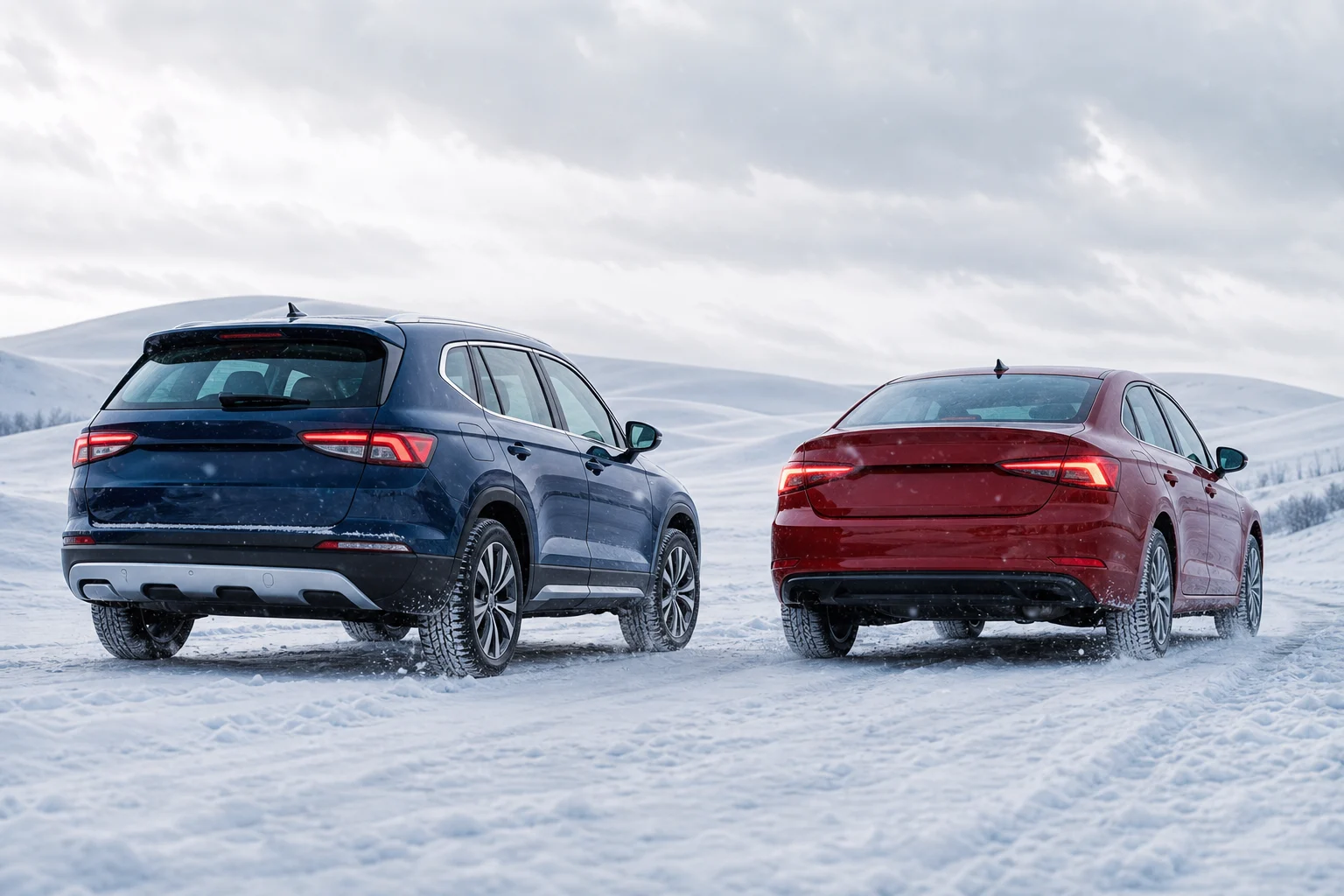
For everyday use, the question is not simply whether a car has front-wheel drive or all-wheel drive. You need to identify the exact version being compared, the tyres it is fitted with and the conditions in which it will actually be driven. In Spain, the DGT explicitly warns that an SUV with all-wheel drive and summer tyres can have more difficulty maintaining grip and being driven safely on snow than the same front-wheel-drive SUV fitted with winter or all-season tyres.
All-wheel drive can provide the ability to accelerate on low-grip surfaces. As a manufacturer-specific example, the UK Ford Transit AWD manual, applicable to vehicles built between 17 January 2022 and 5 April 2024, notes that it will not make the vehicle stop sooner than a two-wheel-drive one. In rain, tyres also lose grip and more distance is needed to brake for an unexpected event. This does not remove the need for more braking margin, whatever drivetrain you choose.
When comparing a front-wheel-drive version with an all-wheel-drive one, check the price, declared consumption figures in the documentation for the exact Spanish version, mass, towing capacity, space and maintenance of the exact versions. If you will be driving on snow, ice or surfaces with compromised grip, also consider suitable tyres, equipment permitted or specified in the vehicle manual and adapted driving.
Section references: Conducción con hielo y nieve: adherencia y neumáticos ↗ · Seguridad vial para el invierno ↗ · Manual Ford Transit AWD, mercado Reino Unido, vehículos fabricados entre el 17 de enero de 2022 y el 5 de abril de 2024 ↗
- Do not assume that 4x4, AWD or a particular commercial name means permanent all-wheel drive.
- Do not assess snow capability without looking at the type and condition of the tyres.
- When braking and turning in low-grip conditions, keep the same safety margins even if the car has all-wheel drive.
How some all-wheel-drive systems work
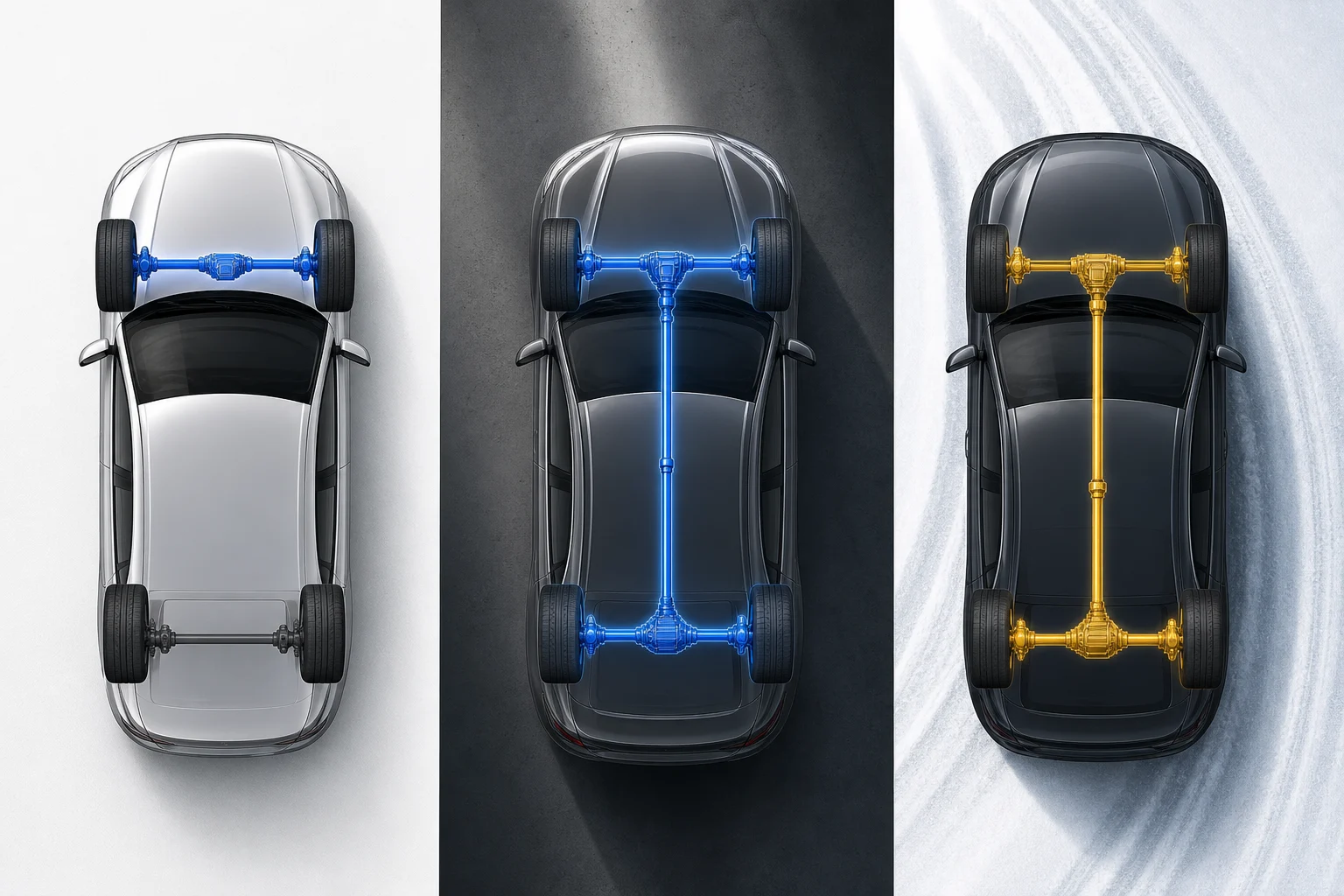
In front-wheel drive, the front wheels receive the engine’s power. All-wheel-drive systems require careful precision: they do not all work in the same way.
Volkswagen illustrates two approaches under its 4MOTION name. In transverse-engine vehicles with a Haldex system, power is initially transmitted to the front axle and the rear axle receives torque when a loss of traction occurs. In the Touareg cited by the brand, with a Torsen differential, power is distributed to all four wheels at all times. Volkswagen also described a multi-plate clutch for the Tiguan that engages the rear axle when there is a risk of traction loss.
The lesson for a new or used purchase is clear: it is not enough to read “AWD”, “4x4” or “all-wheel drive” in an advert. Ask for the specification sheet, manual or documentation for the version, year and market you are considering. This will tell you how the system works and what maintenance and use guidance the manufacturer sets out.
| Criteria | What to check before choosing | Why it matters |
|---|---|---|
| Urban use and travel | Check the price, declared consumption figures, mass and dimensions in the documentation for the exact Spanish versions | It lets you compare only the specific versions you are considering. |
| Snow, ice and rain | The fitted tyres and how often you actually make those journeys | All-wheel drive can help with acceleration, but it does not by itself shorten braking distances. |
| Towing | The authorised towable mass in the specification sheet for the version | Capacity must be verified vehicle by vehicle. |
| Space and boot | Check the layout, declared volume and interior configuration of the specific version | Check the figures for the version you are considering. |
| Maintenance | Service book and operations specific to the system | Some all-wheel-drive systems have their own maintenance procedures. |
| Buying used | Exact version, tyres, dashboard warnings and history | It prevents you from buying based only on a 4x4 or AWD label. |
Section references: 4MOTION: Haldex frente a Torsen ↗ · Tiguan 4MOTION con embrague multidisco ↗ · Plan de mantenimiento Volkswagen 2025 ↗ · Manual Ford Transit AWD, mercado Reino Unido, vehículos fabricados entre el 17 de enero de 2022 y el 5 de abril de 2024 ↗
- Front-wheel drive: the front wheels receive the engine’s power.
- The all-wheel-drive systems documented by Volkswagen do not all operate in the same way.
- The vehicle documentation takes precedence over the commercial name.
How to compare a front-wheel-drive version with an all-wheel-drive one
In a front-wheel-drive passenger car or compact SUV, the front axle receives the engine’s power. For anyone comparing this layout with an all-wheel-drive version, the useful method is to compare equivalent units: the same model where possible, comparable engine, transmission, year, equipment and tyres. Then review the Spanish specification data and the documentation for each unit.
It is not correct to automatically attribute advantages or disadvantages in town, on the road, when towing, in fuel consumption, mass or space to either option without the specification sheets for two specific versions. These factors must be checked for the vehicle, its generation, engine, equipment and documentation being considered.
Before deciding, turn your use into verifiable questions: will you drive in urban areas almost all the time? Do you travel fully loaded? Do you tow? Do you access a home or workplace with recurring snow? Does the used car retain the prescribed maintenance? With the answers, compare purchase costs, tyres and expected maintenance, as well as the performance or space stated in the documentation.
Section references: Cadenas en nieve: eje de tracción y consulta del manual ↗ · Plan de mantenimiento Volkswagen 2025 ↗
- Ask for the specification sheet and equipment list for both versions you are comparing.
- Consult the manual for each version to understand its tyre and use guidance.
- For a used car, cross-check the advert against the VIN, documentation and available history.
- Do not extrapolate a solution from one model to another, even if both are advertised as SUVs, estates or sports cars.
Snow and rain: tyres still set the limit
In winter conditions, the priority is the grip available. In Spain, the DGT advises that, if snowfall does not ease, you should not drive without snow chains or winter tyres, and reminds drivers that grip on ice is critical, even lower than on snow. Having four driven wheels does not remove these limitations.
According to the DGT, chains must always be fitted to the driven wheels. But for all-wheel-drive vehicles, do not apply a quick rule of thumb: consult the manual for instructions concerning chains and electronic driver aids.
The driving guidance is the same for any drivetrain: reduce speed, increase your following distance and avoid harsh acceleration and braking. Plan the journey and do not turn a traction aid into a promise of unlimited braking or control.
Section references: Conducción con hielo y nieve: adherencia y neumáticos ↗ · Cadenas en nieve: eje de tracción y consulta del manual ↗ · Seguridad vial para el invierno ↗
- Before a journey with snow forecast, consult the manual and check which equipment is permitted or specified for the vehicle.
- Reduce speed, increase your following distance and avoid harsh acceleration and braking.
- On ice or in persistent snowfall, adapt your travel plans; do not rely on 4x4 to overcome a lack of equipment.
- In rain, leave more room to brake and avoid abrupt manoeuvres.
What to check when buying a used 4x4 or AWD
An all-wheel-drive system adds inspection points, but the exact scope depends on the manufacturer and model. Start by identifying the version unambiguously: chassis number, year of manufacture, engine and market. Then request the service book, invoices and manual. As an example of a specific operation, Volkswagen’s 2025 Spanish service plan includes an oil change for the 4MOTION system on 4MOTION vehicles every three years, although it refers to the specific requirements of each model. Do not turn this interval into a rule that applies to every AWD vehicle.
Tyres deserve particularly careful inspection. Consult the manufacturer’s manual for the requirements of the specific version. As a manufacturer-specific UK-market example, the Ford Transit AWD manual, applicable to vehicles built between 17 January 2022 and 5 April 2024, warns that size differences between axles can damage the AWD system. This is a documented warning for that vehicle and market, not a rule that should be attributed to every car.
During the inspection, check for traction-related warning lights or messages and ask for any warning to be explained. The UK Ford Transit AWD manual, applicable to vehicles built between 17 January 2022 and 5 April 2024, states that the system may temporarily disengage to protect itself from overheating and that an AWD Off message requires a visit to an authorised repairer. This manufacturer-specific UK-market example should not be applied to Spanish-market cars without consulting their own documentation. Do not diagnose a fault from an advert or a photo: if there are warnings, incomplete history or tyres incompatible with the manual, make the purchase conditional on a professional inspection and satisfactory documentation.
Section references: Plan de mantenimiento Volkswagen 2025 ↗ · Manual Ford Transit AWD, mercado Reino Unido, vehículos fabricados entre el 17 de enero de 2022 y el 5 de abril de 2024 ↗ · Información de neumáticos para AWD/4WD ↗
- Confirm the version, year and drivetrain system with documentation, not just the advert.
- Check that all four tyres meet the manufacturer’s instructions for that version.
- Request invoices for all-wheel-drive-specific work where applicable.
- Note warning lights, messages or behaviours reported by the seller and request a professional check.
- Use a used-car buying checklist to organise the documentary and physical inspection.
Final decision: a simple sequence to get it right
First, define the approximate proportion of your journeys in town, on the road and in low-grip areas. Second, decide which situations are genuinely recurring—for example, winter access to a mountain area—and not merely occasional. Third, find two or three specific versions and compare their Spanish specification sheet, price, tyres, maintenance and, where relevant, towing.
Front-wheel drive and all-wheel drive should be assessed according to the vehicle and exact version. All-wheel drive can help with acceleration when grip is low, but it does not replace suitable tyres or adapted driving. For either option, these remain decisive when the surface loses grip.
Section references: Conducción con hielo y nieve: adherencia y neumáticos ↗ · 4MOTION: Haldex frente a Torsen ↗ · Plan de mantenimiento Volkswagen 2025 ↗ · Manual Ford Transit AWD, mercado Reino Unido, vehículos fabricados entre el 17 de enero de 2022 y el 5 de abril de 2024 ↗
- Define your usual driving conditions.
- Consult the manual and specification sheet for the exact version.
- Compare approved figures and documented costs, not generalisations.
- Prioritise suitable tyres in good condition.
- If buying a used AWD, require a consistent history and resolve warnings before signing.
Does all-wheel drive brake better on snow?
Not simply because it has four driven wheels. As a manufacturer-specific example, the UK Ford Transit AWD manual applicable to vehicles built between 17 January 2022 and 5 April 2024 says it will not stop sooner than a two-wheel-drive vehicle. Tyres and adapting your speed are decisive.
Does a 4x4 always need snow chains?
The need depends on the conditions and applicable guidance. In Spain, the DGT advises that, if snowfall persists, you should not drive without snow chains or winter tyres. Consult your version’s manual to find out which equipment is permitted or specified.
Do all AWD systems operate permanently?
No. Some systems initially send power to one axle and engage the other when they detect a risk of traction loss, while others distribute power to all four wheels at all times. Consult the documentation for the exact version.
Which tyres should I check on a used AWD?
Consult the manufacturer’s manual for the requirements of the exact version. Check that the fitted configuration matches the one specified for that vehicle.