Professional inspection before buying a used car: when it is worth it and what to request in the report
An independent used-car inspection is not a complete guarantee. This guide explains when it is worthwhile, what scope to request and how to turn the report into a buying decision.

Key points
A professional pre-purchase inspection can be useful if you want to reduce uncertainty before buying a used car. It does not replace the vehicle history, DGT report or ITV (Spain’s vehicle inspection): it should help you decide whether to buy, negotiate or walk away.
Short answer: when a pre-purchase inspection is usually worthwhile
A professional inspection before buying a used car can make sense if you prefer to reduce uncertainty before deciding. You may give it greater weight if the car's price is high for your budget, its age or mileage raises questions, it has complex mechanical components, modifications, declared damage, missing invoices, or the advert provides little information.
It should not be understood as an absolute guarantee that the vehicle will not develop faults. Its usefulness will depend on the checks you agree before booking it. Ask for it to be put in writing what you want inspected and what document or conclusion you expect to receive before paying a deposit or signing.
Before spending money on it, also request a full DGT report. The DGT itself recommends requesting one before acquiring the vehicle to check for encumbrances that may affect the transaction. If the administrative report, documents and what the car shows do not match, it is advisable to clarify the discrepancy before proceeding.
Section references: DGT — Informe de un vehículo ↗
- You may prioritise it if the maintenance history is incomplete, there is conflicting information or visible damage.
- You may request it if you want an additional check on an imported vehicle, one with modifications, long periods out of use or poorly explained provenance.
- It may be of interest for a vehicle whose price is significant for your budget, even if it appears well maintained and has passed its ITV.
- It may carry relatively less weight for a low-cost car if you accept the financial risk; even so, do not skip the basic document checks.
Do not confuse the DGT report, ITV and documentation
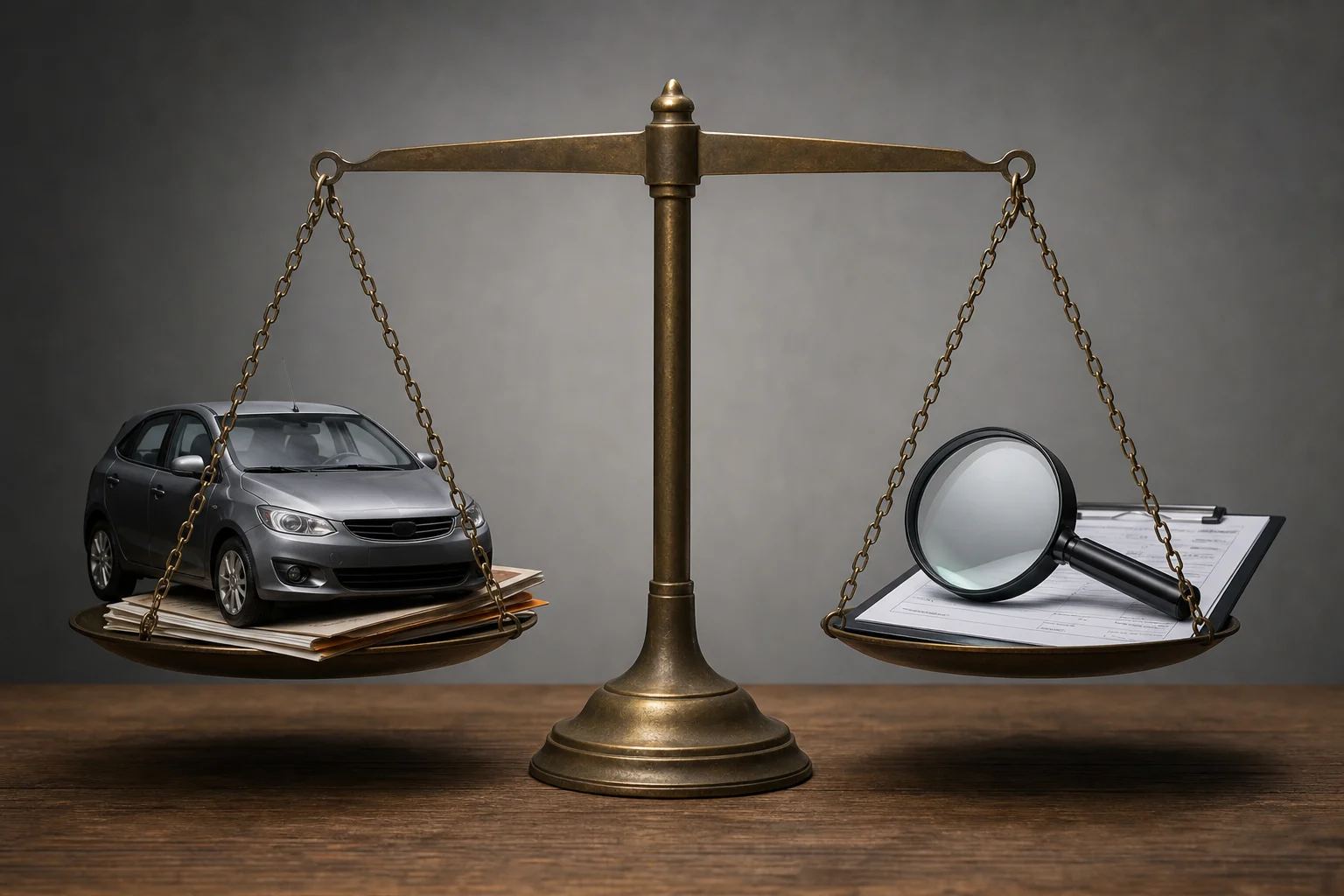
A pre-purchase check that you choose to commission is not equivalent to an ITV or a full DGT report. Before arranging it, specify in writing what you want checked and what document or conclusion you expect to receive.
The ITV is a regulatory check of the vehicle's fitness to be driven in relation to mandatory safety and environmental protection requirements. A favourable result may be issued where no defects are detected or only minor defects are found; therefore, it does not allow you to conclude that the car is free from wear, maintenance needs or issues that cannot be detected during that test.
Do not treat a single document or an isolated check as though it alone answered every question about the car. Available invoices can help you verify the seller's account, but they should be compared with the condition you observe and the other documents.
The full DGT report adds a different layer: it brings together available administrative and historical data, such as ITV history, mileage, number of keepers, encumbrances, technical data, outstanding recalls and available maintenance data. It is an essential part of checking the declared history, not a physical inspection of the mechanical condition.
| Document | What it can provide | Limit to bear in mind |
|---|---|---|
| Full DGT report | Available administrative and historical data: ITV history, mileage, keepers, encumbrances, technical data and outstanding recalls. | It is not a physical check of the car's current condition. |
| ITV | Regulatory fitness to be driven in relation to mandatory safety and environmental protection requirements. | A favourable ITV may coexist with minor defects and is not equivalent to a mechanical guarantee. |
Section references: DGT — Informe de un vehículo ↗ · Real Decreto 920/2017 consolidado — regulación de la ITV ↗
Signs that suggest requesting a check before buying
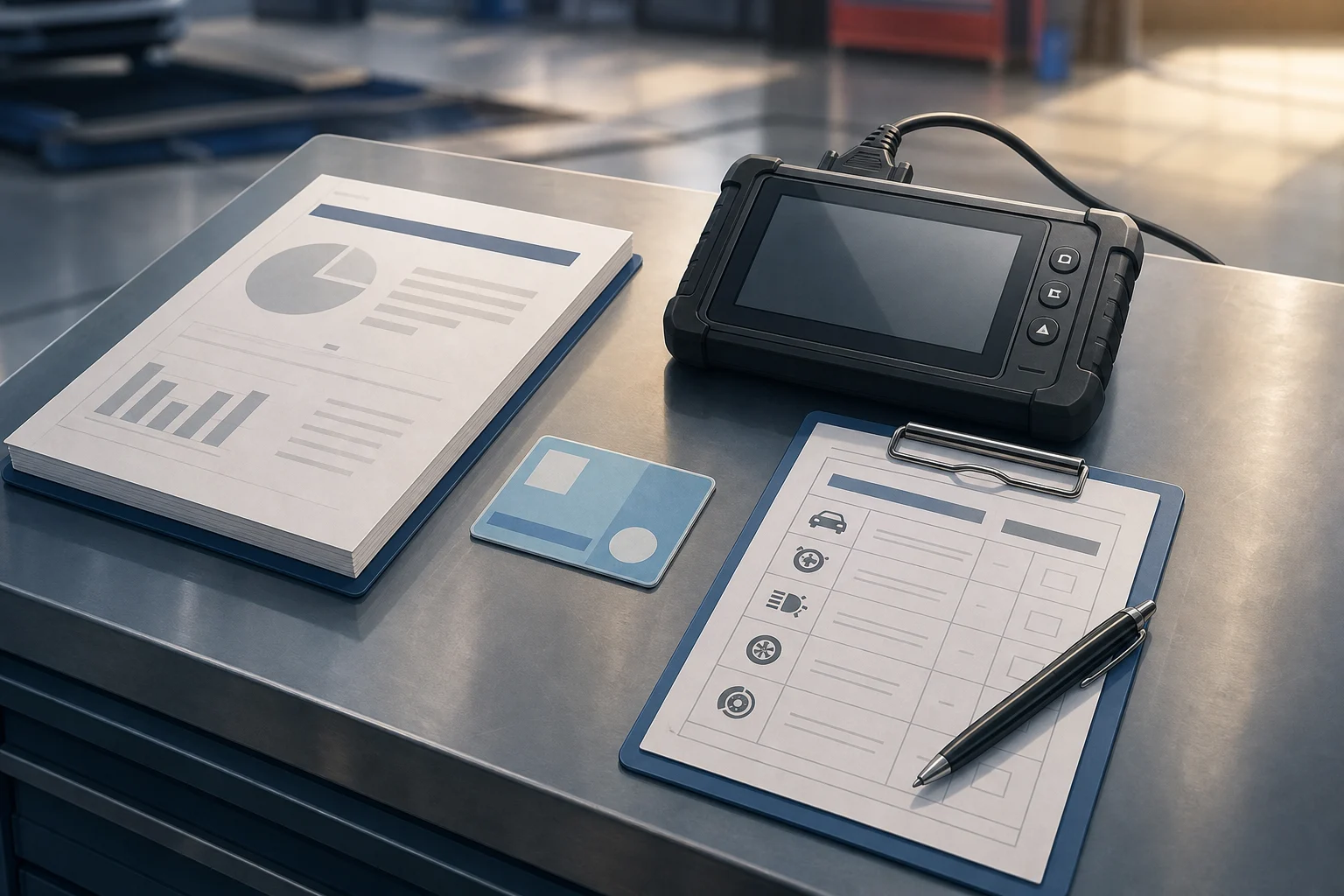
You do not need to wait until you spot an obvious problem. You can consider an additional check if you have a specific question that the documentation does not answer. For example, if it is difficult to put the mileage into context, compare the current figure with available records. The odometer reading is recorded during the ITV when available, and inconsistencies suggesting possible tampering are to be reported.
Pay attention to differences between the advert, Spanish circulation permit, ITV certificate, DGT report and vehicle. The Spanish circulation permit identifies the registered holder and, since 2015, includes mileage and ITV validity information. These items should be cross-checked, not read in isolation. If there is a reasonable explanation, ask for it to be supported by documents; if there is not, do not turn a hypothesis into a reason to buy.
If an imported or modified vehicle, or one that has been unused for long periods, raises doubts, first clarify its identification, version and documentation. An additional check can accompany that decision, but it does not replace the need for the papers to correspond to the vehicle being transferred.
Section references: DGT — Informe de un vehículo ↗ · Real Decreto 920/2017 consolidado — regulación de la ITV ↗ · DGT — Documentación de un vehículo ↗
- The registration number or VIN is not provided, or does not clearly identify the vehicle you are going to view.
- The mileage, ITV dates or ownership cannot be put into context with consistent documentation.
- Invoices are missing, an impact is declared or damage requiring an explanation can be seen.
- There are accessories or modifications whose documentary status is unclear.
- The seller pressures you to reserve the car without allowing reasonable checks.
What to request in writing before booking it
Do not arrange a check based only on a generic label such as “comprehensive” or “certified”. As part of your personal buying criteria, ask for a proposal that identifies the vehicle by registration number or VIN where appropriate and sets out the scope you want. You can request clarity on who will carry out the work, which items you want checked, where it will take place, how much it costs, and what document or conclusion you will receive.
Ask specifically about access limitations. ITV regulations establish that the regulatory inspection is carried out without dismantling or removing components, except for the access essential to connect a reading tool under the manufacturer's conditions. That rule applies to the ITV itself: it does not allow you to infer what a different service will check. Therefore, ask the person or company you commission to state in writing what they will and will not agree to inspect.
Request a deliverable document, not just a verbal conclusion. The regulated ITV report identifies the vehicle and records scope and traceability, measurements, defects and outcome. These are not equivalent services, nor are those fields obligations for another type of check, but they can serve as a reference when asking for a clear document.
Section references: Real Decreto 920/2017 consolidado — regulación de la ITV ↗
- As a buying criterion, request vehicle identification: registration number and/or VIN, plus the inspection date and place.
- Request a detailed scope: included checks and explicit exclusions.
- Ask for limitations, items not examined and the reasons to be stated.
- Distinguish between findings and observations that do not allow a definitive conclusion.
- Agree on the document format and, if you request them, photographs or measurements, as well as the delivery time.
- Confirm the total price and ask whether there is any relationship with the seller or a subsequent repair.
How to read the report and turn it into a decision
Organise findings by their impact on your decision, not by the number of notes. First, identify any issue that may affect safety, driving the vehicle or its transfer. In a Spanish ITV result, serious defects limit use to travel to a workshop or ITV station for reinspection, while very serious defects require transport by means other than the vehicle itself. These restrictions arise from the Spanish ITV result; a pre-purchase check does not itself classify ITV defects or trigger those consequences. If you receive a significant observation, seek the appropriate clarification and consider walking away.
Secondly, separate foreseeable wear from necessary repairs. The document you receive should allow you to identify what has been observed, without automatically turning every note into a confirmed fault. Ask for clarification of the actual scope, what information is missing to confirm it and which estimate would need to be checked. Do not authorise repairs in your own name to resolve doubts about a purchase you have not yet completed.
Negotiation is only sound when it is based on documented facts and comparable estimates. If the seller explains the issue with consistent paperwork or accepts a verifiable correction, decide whether the final price and remaining risk work for you. If they do not allow clarification, relevant inconsistencies remain, or the available information exceeds your tolerance for cost and uncertainty, the prudent option is not to proceed.
Keep the advert, offer, communications, DGT report, provided documentation and the report from any check you commissioned together. This file does not make the transaction risk-free, but it allows you to decide with traceability and prevents a verbal promise from carrying more weight than the available evidence.
Section references: DGT — Informe de un vehículo ↗ · Real Decreto 920/2017 consolidado — regulación de la ITV ↗
- Proceed: consistent documentation, understood scope and risks that are manageable for your budget.
- Negotiate: a documented specific defect or need, a verifiable explanation and a proportionate price adjustment.
- Request a second check: a significant observation without a sufficient conclusion for deciding, or a poorly substantiated estimate.
- Walk away: unresolved encumbrances or issues, inconsistent identity or documentation, or a risk you cannot quantify with confidence.
Final checklist before paying a deposit
An inspection can be more useful when it is part of a simple sequence: first identify the vehicle and review the documentation; then cross-check the available history; finally, commission a check with a scope proportionate to the risk. Before paying a deposit, try to know which vehicle will be inspected and under what conditions, so that you can decide on the available information.
If you are not going to commission an inspection, apply at least the same documentary standard: confirm the identity, review the full DGT report, compare the available ITV and mileage data, request the vehicle documents and keep the seller's explanations. The DGT offers a free reduced report, but it only states the first registration in Spain and whether there are issues preventing transfer or driving; it does not replace the full report.
Section references: DGT — Informe de un vehículo ↗ · DGT — Documentación de un vehículo ↗
- Request the full DGT report before committing to buy.
- Cross-check the registration number or VIN, Spanish circulation permit, ITV and information in the advert.
- Request the available history and invoices, without assuming what they do not prove.
- Agree the inspection's scope, price and limits in writing.
- Read the document received before paying a non-refundable deposit or signing.
- Negotiate using documents and verifiable estimates; walk away if relevant doubts remain unresolved.
Is a favourable ITV enough to buy a used car with confidence?
No. The ITV confirms regulatory fitness to be driven at the time of inspection in relation to mandatory requirements. It can be favourable where no defects are detected or where only minor defects are found, so it is not equivalent to a guarantee of the car's overall mechanical condition.
Which DGT report should I request before buying?
The full report. The DGT recommends requesting it before acquiring the vehicle, and it brings together available administrative and historical information such as ITV records, mileage, keepers, encumbrances, technical data and outstanding recalls. The free reduced report has a more limited scope.
Can a professional inspection detect every future fault?
You should not assume that a pre-purchase check covers every future fault. Before booking it, request in writing what you want checked and what document or conclusion you expect to receive.
What should I do if the report mentions an observation but does not confirm a fault?
Ask for clarification of what was observed, which check is still needed to confirm it and, where appropriate, a verifiable estimate. Do not negotiate or authorise a repair as though the diagnosis were definitive without that confirmation.