What to ask a seller before viewing a used car
The information and documents worth requesting before a viewing, how to check them against the DGT, and when to rule out a used car.
Key points
Before travelling to see it, ask for the registration number, the car’s documented identification, version, date of first registration in Spain, declared mileage, number of owners, reason for sale, and images of the registration certificate and ITV card. With this information, request the DGT report yourself: the reduced report is free and can identify issues; the full report adds information such as ITV, mileage, owners, charges, outstanding campaigns and recorded maintenance. Compare this information with the vehicle when you view it.
Pre-screening starts before the viewing
Your first conversation with the seller is for deciding whether the advert is worth travelling for, not for certifying that the car is in good condition. Ask for specific information in writing or in a message you can keep: registration number, exact make and version, date of first registration in Spain, declared mileage, number of owners and reason for sale. Also request legible photographs of the registration certificate and ITV card so you can compare them when you see the vehicle.
Using the registration number, you can request a report from Spain’s Directorate-General for Traffic (DGT) yourself. The reduced report is free and lets you confirm the vehicle’s identification, check that it is active, and flag issues, charges or restrictions. If an issue appears, the DGT itself recommends obtaining a detailed report or visiting its offices before continuing with the purchase.
Do not mistake a quick reply from the seller for verification. Providing documents reduces documentary uncertainty, but the official report and an in-person check remain separate steps.
Section references: Informe de un vehículo ↗ · Comprar un vehículo de segunda mano ↗
- Ask for mileage as a figure, not expressions such as “low mileage”.
- Keep the advert, replies and documents received; they will help you compare later information.
- If the seller avoids providing the registration number or sends illegible images, consider whether to continue with the viewing.
Documents and sources: which information helps you decide
The seller’s documentation lets you compare what was advertised with what appears on the paperwork, while the DGT report adds an administrative cross-check. The ITV card records the inspection result, its date, the report number and its expiry date. In addition, ITV results are sent electronically to the Vehicle Register on the same day as the inspection.
The DGT’s full report is particularly useful before formalising the transaction: among other items, it includes ITV history, mileage, number of owners, charges, technical data, outstanding recall campaigns and recorded maintenance. This last section is not a universal service history: it refers to repairs and servicing carried out by workshops enrolled in the DGT electronic maintenance book.
Ask for invoices and the maintenance book, if they exist, and compare them with the available dates and mileages. A documentation gap does not by itself prove tampering or a fault; it does justify asking for an explanation and increasing the level of inspection before deciding.
| Information requested | Document or source to check it against | Decision before the viewing |
|---|---|---|
| Registration number and vehicle identification | DGT reduced or full report; registration certificate | Confirm identification, active status and initial issues |
| Date of first registration in Spain | DGT reduced report; seller’s documentation | Check that it matches the advert |
| Declared mileage | DGT full report, ITV history and available invoices | Ask for an explanation if its progression is inconsistent |
| Number of owners | DGT full report | Assess ownership history alongside the other information |
| Valid ITV | ITV card and DGT full report | Check inspection status before viewing |
| Charges or restrictions | DGT full report | Stop the transaction or require a prior documentary solution |
| Maintenance and campaigns | DGT full report and supporting documents provided | Identify gaps and matters still requiring confirmation |
Section references: Informe de un vehículo ↗ · Real Decreto 920/2017, por el que se regula la inspección técnica de vehículos ↗
- Check that the make, model, registration number and dates are consistent across the advert, registration certificate, ITV card and report.
- Review the mileage progression and ask about any jump or figure that does not fit.
- Ask whether there are outstanding campaigns and request proof that they have been completed; the full report may show outstanding recalls.
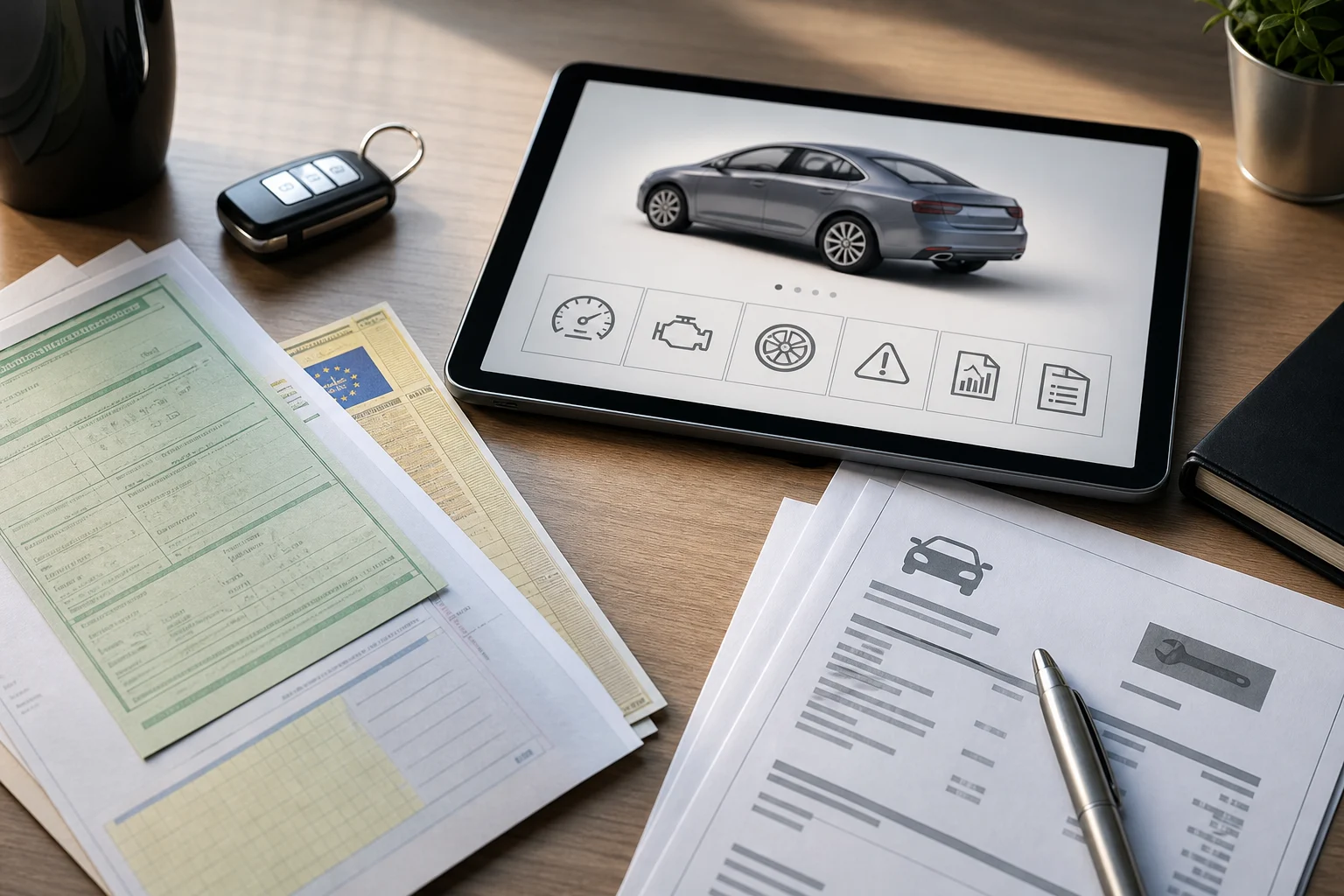
Charges, deregistration and reservations: issues not to downplay
A vehicle report is not an optional formality. The DGT recommends requesting the full report before acquiring a used car to check for attachments (embargos), vehicle holds (precintos), insolvency proceedings or other administrative or judicial charges. These situations may decisively affect the transfer.
There are three situations that justify stopping the transaction until they are clarified. First, temporary deregistration: the vehicle cannot be transferred until the seller re-registers it. Second, outstanding local taxes or unpaid fines: according to the DGT, these prevent the transfer. Third, a registered retention-of-title clause: this may prevent the change of ownership until full payment is proven, a cancellation letter is obtained from the finance company, and the charge is cancelled in the Register of Movable Property.
An attachment (embargo) or vehicle hold (precinto) should not be left to a verbal explanation. The DGT states that the buyer must be informed and, if they proceed with the purchase, sign a document confirming that they are aware of the situation. Before proceeding, ask which issue is recorded, who must resolve it and what written documentation is available.
Section references: Informe de un vehículo ↗ · Comprar un vehículo de segunda mano ↗
- Do not treat urgency as an argument for accepting a charge you do not understand.
- Do not accept a seller’s promise to resolve a retention-of-title clause after receiving payment without a clear written condition.
- If the reduced report flags an issue, obtain the full report before setting a viewing or negotiating the price.
Ask about repairs, accidents and modifications with verifiable evidence
Ask directly whether the car has suffered an accident, significant repairs or modifications. Request that the answer be backed by available invoices, reports or documentation, rather than just general statements. The periodic ITV inspection is intended to check fitness for use on the road, and the rules also provide for voluntary inspections and checks on accident-damaged vehicles with significant damage to the structure or safety components.
Modifications deserve an additional check. When a modification is classified as a regulated vehicle alteration, its processing may require, depending on the case, a technical project, conformity report and workshop certificate. After the alteration, the owner must present the vehicle for technical inspection within a maximum of fifteen days; if the result is favourable, the ITV card is updated or a new one is issued.
Before going, ask what was modified, when, who carried it out and which documents the seller still has. When you see the car, compare the documentation provided with the actual vehicle. If there is a significant alteration without sufficient documentary support, postpone the purchase until you know its administrative status.
Section references: Real Decreto 920/2017, por el que se regula la inspección técnica de vehículos ↗ · Real Decreto 866/2010, por el que se regula la tramitación de las reformas de vehículos ↗
- Request copies of invoices for significant repairs declared by the seller.
- Ask about modifications to vehicle components and their associated documentation.
- Do not assume a car has not been damaged simply because there are no invoices.
What cannot be checked remotely and what to check when you view the car
Documents, administrative history and photographs should be compared with the car when you view it. Check that the vehicle identification, equipment and visible condition of the car match what you received before the viewing.
Postpone the purchase if there are inconsistencies between the advert, documents and report; if supporting documents are missing for a major repair or alteration; if the seller prevents you from checking the car carefully; or if they try to close the transaction before you can consult the DGT. The aim is not to prove that there is a problem, but to avoid deciding with insufficient information.
If you ultimately buy, the contract must identify the buyer and seller, make, model and registration number, price, date and time of signing, and it must be signed by both parties on every page. After signing, the buyer has 30 days to apply for the change of ownership. If the ITV has expired, the vehicle cannot be driven: it must be taken to the inspection station by tow truck or another authorised means.
Section references: Informe de un vehículo ↗ · Comprar un vehículo de segunda mano ↗
- View: consistent documentation and a report showing no transfer restrictions, charges or DGT-recorded incidents affecting circulation.
- Request more information: invoices are missing, there are mileage gaps, or modifications need clarification.
- Rule out or stop: temporary deregistration, unresolved charges, a restriction on transfer, or pressure to hand over money without written conditions.
- If a deposit is proposed, ask for written terms covering the amount, conditions, repayment grounds and what happens if a documentary or technical issue appears.
Can a buyer request a DGT report if they are not the registered owner?
Yes. Except for the report on vehicles registered in the applicant’s name, which requires you to be the owner or authorised by them, the DGT states that any person can request the other reports.
Is the DGT reduced report enough to buy a car?
No. It is free and lets you check identification, active status and initial issues, but the full report provides additional information such as ITV, mileage, owners, charges, outstanding campaigns and recorded maintenance.
What happens if the car is temporarily deregistered?
It cannot be transferred until the seller, as the registered owner, re-registers it. This is a situation that should be resolved before continuing with the purchase.
Can I drive the car to its ITV inspection if the ITV has expired?
No. The DGT states that it cannot be driven and must be taken to the ITV station by tow truck or another authorised means.