Petrol, diesel or electric? Calculate your cost per 100 km
A guide to comparing the energy spend of petrol, diesel and electric cars using your own consumption figures, receipts, bills and charging habits, without confusing it with the total cost of owning a car.
Key points
Energy cost per 100 km is calculated by multiplying consumption by the price you actually pay per litre or kWh. For an electric car, also check whether consumption comes from the vehicle or the charging meter, and state charging losses if they are not already included.
The quick answer: consumption multiplied by price
To compare only the energy needed to drive, the calculation is straightforward. For a petrol or diesel car: cost per 100 km = consumption in l/100 km × price actually paid in €/l. For an electric car: cost per 100 km = consumption in kWh/100 km × price actually paid in €/kWh.
The key is for both figures to relate to the same use and an identifiable period. Do not multiply your usual consumption by a price you saw months ago, or treat a promotional charging tariff as though it were permanent. Keep the date and proof of each price so that you can repeat the calculation when your tariff, filling station or travel pattern changes.
An example using variables, without assuming current prices: if a petrol car consumes G l/100 km and you paid Pg €/l, its result is G × Pg €/100 km. If a diesel car consumes D l/100 km and the litre cost Pd, it will be D × Pd. The comparison is valid only if G, D, Pg and Pd describe the vehicles and refuelling transactions you want to compare.
Section references: Geportal y comunicación de precios de carburantes ↗
- Petrol: l/100 km × €/l = €/100 km.
- Diesel: l/100 km × €/l = €/100 km.
- Electricity: kWh/100 km × €/kWh = €/100 km.
- Round only at the end, not at every step, and keep the units alongside every figure.
What this figure compares and what you should leave out
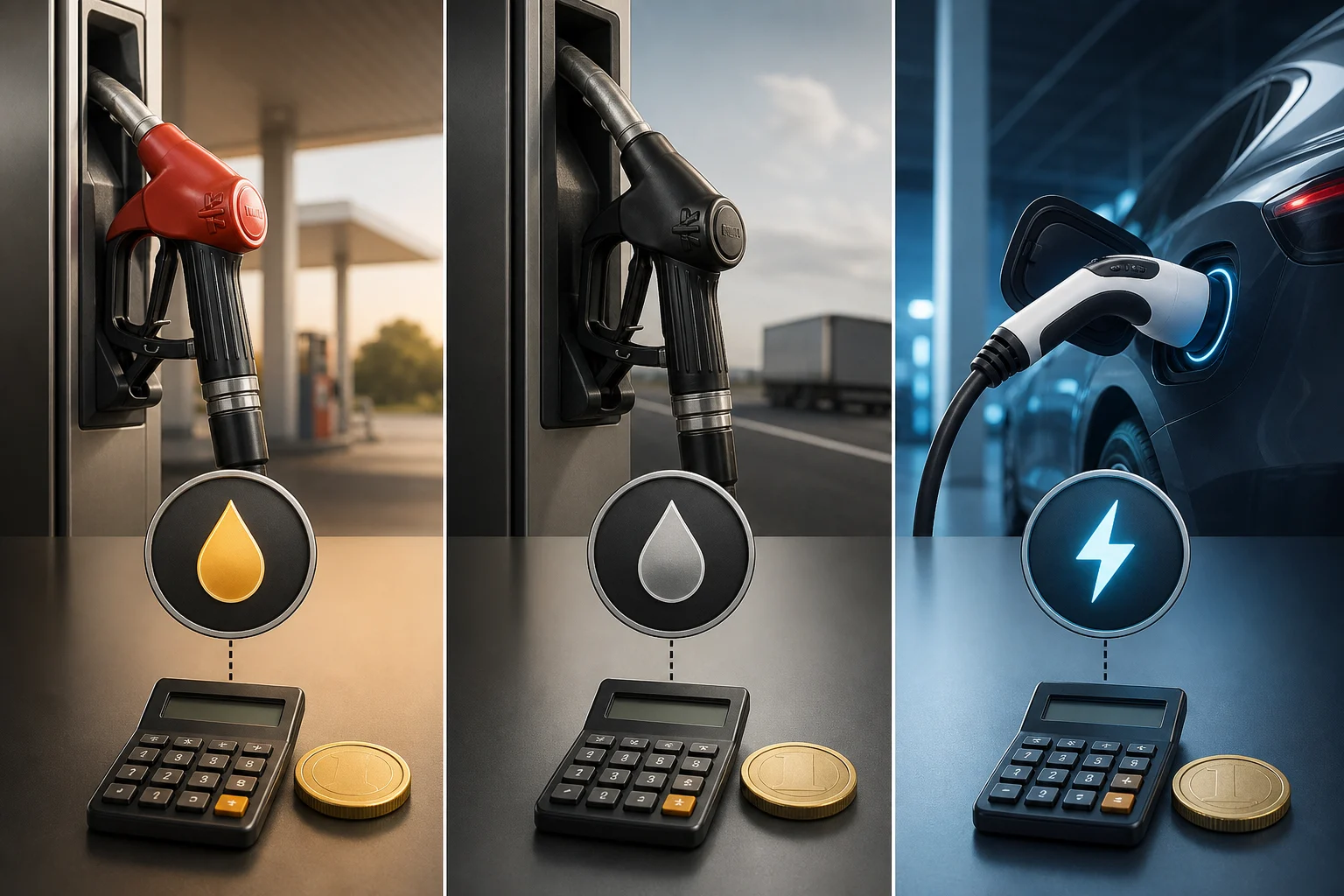
The result is a variable energy cost: the money attributable to the fuel or electricity used to travel 100 km. It is useful for planning journeys and comparing technologies on a common basis, but it is not the total cost of owning the car.
At home, the electricity bill separates the energy charge, which depends on the kWh consumed, from components such as the fixed charge linked to contracted power, regulated costs, taxes and possible services. You can make two valid calculations as long as you label them: a marginal one, using the variable amount per kWh you would pay when charging; and an average household one, allocating the fixed items and taxes you decide to include. Do not mix them or compare them with a pump price without explaining it.
Before choosing a car, assess insurance, maintenance, taxes, finance, depreciation and parking separately. They can substantially change the annual budget, but adding them without a common method would turn this simple energy comparison into a different model.
Section references: Factura eléctrica y comparador de ofertas ↗
- Include: litres or kWh associated with driving and their effective price.
- State separately: contracted power, equipment rental and bill services if you allocate them.
- Do not attribute the entire financial difference between two technologies to the cost per 100 km.
- For the full budget, add annual costs on a separate sheet.
Gather comparable data before opening the calculator
For petrol and diesel, record the litres refuelled, kilometres driven and final receipt amount. Divide litres by kilometres and multiply by 100 to obtain your observed consumption in l/100 km; the unit price can come from the same receipt. The ministry portal makes it possible to compare public pump prices by fuel and location, but it does not replace your personal price if you used a card, voucher or discount.
For an electric car, as an editorial method for organising the calculation, record separately the kWh and amount for each home, public or rapid-charging session. At home, the bill and its billing period are the documentary reference; the CNMC states that the bill includes consumption information and the billed period. For public charging, keep the session receipt. You can present home, public-network and travel results separately; if you choose to summarise them in an average, state that it is weighted by the kWh from each setting.
Do not confuse power and energy. kW describe rated power or delivery rate; kWh are the energy used in the cost calculation. A more powerful charger does not, by itself, tell you how much a kilometre costs.
| System | Input data | Formula | What can change the result | Record |
|---|---|---|---|---|
| Petrol | l/100 km and €/l | l/100 km × €/l | Price and discounts | Fuel receipt |
| Diesel | l/100 km and €/l | l/100 km × €/l | Price and discounts | Fuel receipt |
| Electric at home | kWh/100 km, efficiency where applicable and €/kWh | (kWh/100 km ÷ efficiency) × €/kWh | Tariff, losses and method for fixed costs | Bill and meter or charger reading |
| Public or rapid electric charging | Session kWh, final amount and kilometres driven | If an effective price per kWh is chosen: final amount ÷ session kWh; then, kWh/100 km × that price | Non-energy charges, price of each session and source of the kWh | Session receipt |
Section references: Factura eléctrica y comparador de ofertas ↗ · Geportal y comunicación de precios de carburantes ↗ · Movilidad sostenible y vehículos eléctricos ↗
- Record the date, kilometres, consumption, unit price and final amount.
- Keep petrol 95, diesel and any non-equivalent product separate.
- For an electric car, identify whether the kWh come from the meter, charger, bill or vehicle display.
- If you summarise sessions with different prices using an average, state the weighting method used.
Electric cars: include losses without making up a percentage
First determine what your consumption measures. If the car displays, for example, energy used while driving, it may represent useful energy in the vehicle. If the charger or meter measures kWh drawn from the grid, that reading may include part of the charging losses. Do not apply a correction twice: compare the source of the kWh with the source of the price.
When your consumption is useful energy in the vehicle and you want to estimate energy bought from the grid, apply: electric cost per 100 km = (useful consumption in kWh/100 km ÷ assumed charging efficiency) × €/kWh. It is essential to record that efficiency, the charging type and the source of the data. IDAE notes that the accumulator returns energy with certain losses, and technical documentation shows different results with and without charging losses.
There is no single percentage applicable to all electric cars, chargers and power levels. As a limited illustration, a JRC/EUCAR/CONCAWE report modelled losses in a 3.x kW, 1×16 A charger: in one BEV configuration in its table, consumption rose from 11.38 to 14.49 kWh/100 km when they were included. That case helps to understand the importance of the assumption; it is not a basis for applying its difference to your car.
The strongest option is to measure, across several comparable charging sessions, the kWh from the meter or charger and the energy recorded by the vehicle, if both figures are available. If you cannot do this, present the result as an estimate and review the assumption when you change installation or charging method.
Section references: Movilidad sostenible y vehículos eléctricos ↗ · Evaluación técnica de consumos y pérdidas de recarga ↗ · Eficiencia de ida y vuelta en V2G/V2H ↗
- Choose one side of the measurement only: energy in the vehicle or energy drawn from the grid.
- If you start from grid kWh, do not normally add losses again.
- If you start from kWh shown by the vehicle, state the assumed efficiency before calculating.
- Do not use V2G/V2H round-trip efficiency as one-way charging efficiency.
WLTP, real-world consumption and scenarios worth recalculating
WLTP consumption is an approved reference that is useful for comparing specific versions, especially before buying. The European Commission recommends using WLTP values in consumer information and warns that optional equipment can affect the figures. Therefore, check that the figure corresponds exactly to the version, battery, trim and configuration you are considering.
For your budget, gradually replace that figure with your own records: kilometres and litres, or kilometres and kWh, on representative journeys. Keep the approved figure—useful for comparing specifications—separate from the observed figure—useful for anticipating your spending. Neither range nor another driver's consumption is a cost per 100 km.
Repeat the calculation according to the charging setting. Where most charging is done at home, use your household kWh and the variable or average price you have defined. For mixed use, you can calculate home and public-network kWh separately and add the amounts before dividing by kilometres. For frequent trips, create a specific calculation using en-route charging receipts; do not let one exceptionally cheap or expensive session represent the entire year.
Update the sheet when energy prices, seasonal consumption, your tariff or the share of charging done away from home changes. Do this as well after a change in electricity contract, vehicle or habits.
Section references: Factura eléctrica y comparador de ofertas ↗ · Recomendación sobre información de consumo WLTP al consumidor ↗
- For a purchase: compare WLTP only between exact versions.
- For a personal budget: compare the approved figure with your own refuelling or charging sessions.
- For a charging mix: total energy cost for the period ÷ kilometres in the same period × 100.
- For trips: create a separate column and do not dilute it with usual home charging.
Final checklist and mistakes that distort the comparison
A simple sheet with date, source and unit prevents most mistakes. For every result, write down whether it is a marginal or average cost, which period it comes from and what consumption it represents. This will allow you to explain why the same electric car has one figure for home charging and another for trips, without presenting either as universal.
Common mistakes include comparing prices from different months, using euros per session without correctly converting them to energy when the receipt allows it, confusing kW with kWh, applying losses to kWh already taken from the meter and using advertised range as though it were a cost. It is also common to contrast promotional rapid charging with an annual domestic price without weighting how many kWh are bought in each case.
Once the energy cost has been calculated, the next buying step is to build a separate total cost of ownership. Add insurance, expected maintenance, taxes, finance, depreciation and parking in different columns. Only then can you decide whether the energy saving or extra cost fits your mileage and your real charging options.
Section references: Factura eléctrica y comparador de ofertas ↗ · Geportal y comunicación de precios de carburantes ↗ · Movilidad sostenible y vehículos eléctricos ↗
- Check that price and consumption relate to comparable dates and use.
- Verify every unit before multiplying.
- Label the source of the kWh and whether losses are included.
- Keep receipts, bills and records until the next review.
- Keep the energy calculation separate from the complete ownership analysis.
Can I use WLTP consumption to calculate the cost per 100 km?
Yes, as a comparable estimate before buying, provided it is the WLTP figure for the exact version. For a personal budget, it is advisable to replace it or compare it with your recorded consumption, because optional equipment can change the result.
What electricity price should I use?
Use the price actually paid for the kWh in the setting you want to analyse. For marginal household cost, state the variable component per kWh; for a full average cost, say that you have also allocated fixed charges, taxes or other items. For public charging, keep the final receipt for each session.
Does rapid charging always make each kilometre more expensive?
That cannot always be stated without the receipts and kWh from each session. Calculate its cost as a separate scenario using its effective price, and do not extrapolate it to all your driving if you use it only on trips.
How often should I update the calculation?
Update it when prices, your electricity tariff, charging location, car or habits change. Keep the records so you can compare equivalent periods.