ULM, certified light aircraft or light sport aircraft: what changes before buying
Before starting a licence, renting a slot at a flying club or buying a share, it is worth separating ULMs, certified light aircraft and supposed light sport aircraft: they do not always share licences, limits, paperwork or ownership costs.
Key points
Before starting a licence, renting a slot at a flying club or buying a share, it is worth separating ULMs, certified light aircraft and supposed light sport aircraft: they do not always share licences, limits, paperwork or ownership costs.
| Topic | Key point |
|---|---|
| Categories: ULM, certified light aircraft and the confusing “light sport aircraft” | Royal Decree 765/2022 defines Spanish ULMs within their own regime. |
| Licences, ratings and medical certificate | To obtain a ULM pilot licence in Spain, you must complete theoretical training at an authorised school and pass a theoretical exam and a practical exam. |
| Common uses and limits worth checking | A ULM can be a very good fit for local recreational use, introductory training, flying club flights or simple co-ownership, as long as its limits and the operating field suit the project. |
| Maintenance, airworthiness and documentation: where many costs begin | Royal Decree 765/2022 does not regulate only ULM operation: it covers the design, production, maintenance and operation of these aircraft, as well as engines, propellers, components, organisations and personnel involved in those activities. |
Why not all light aircraft are bought or flown in the same way
The question “ULM or certified light aircraft differences” often comes up when someone starts looking at courses, flying club shares or used aircraft. From the outside, two fixed-wing, two-seat aircraft can look similar. In practice, the important thing is not only size: the regulatory framework, the licence required, the documentation that must be available, the way the aircraft is maintained and the costs that should be budgeted before putting money down all change.
In Spain, a ULM is a specific national category. Royal Decree 765/2022 regulates ultralight motorised aircraft excluded from the scope of Regulation (EU) 2018/1139. A certified light aircraft used for training, leisure or cross-country flying normally operates within the EASA environment, with licences such as LAPL(A) or PPL(A). And the expression “light sport aircraft” should be used with care: Spanish rules mention Light Sport Aircraft as a category that exists in some countries and as the industrial origin of certain modern ultralights, but in Spain the defined ULM categories are different.
The first decision, therefore, should not be “which one is faster” or “which one looks more like an aeroplane”, but what you want to do with it: local flights, training, cross-country trips, co-ownership, occasional use or maintaining flight hours. From there, you need to check whether the licence, rating, medical certificate, insurance, maintenance and operating restrictions fit that plan.
- Do not compare purchase price alone: compare the legal regime, licence, documentation and annual cost.
- Before paying a deposit or buying a share, ask for the registration, exact category and airworthiness documentation.
- If the goal includes travelling outside Spain, check the destination State’s regulations in the case of ULMs.
Categories: ULM, certified light aircraft and the confusing “light sport aircraft”
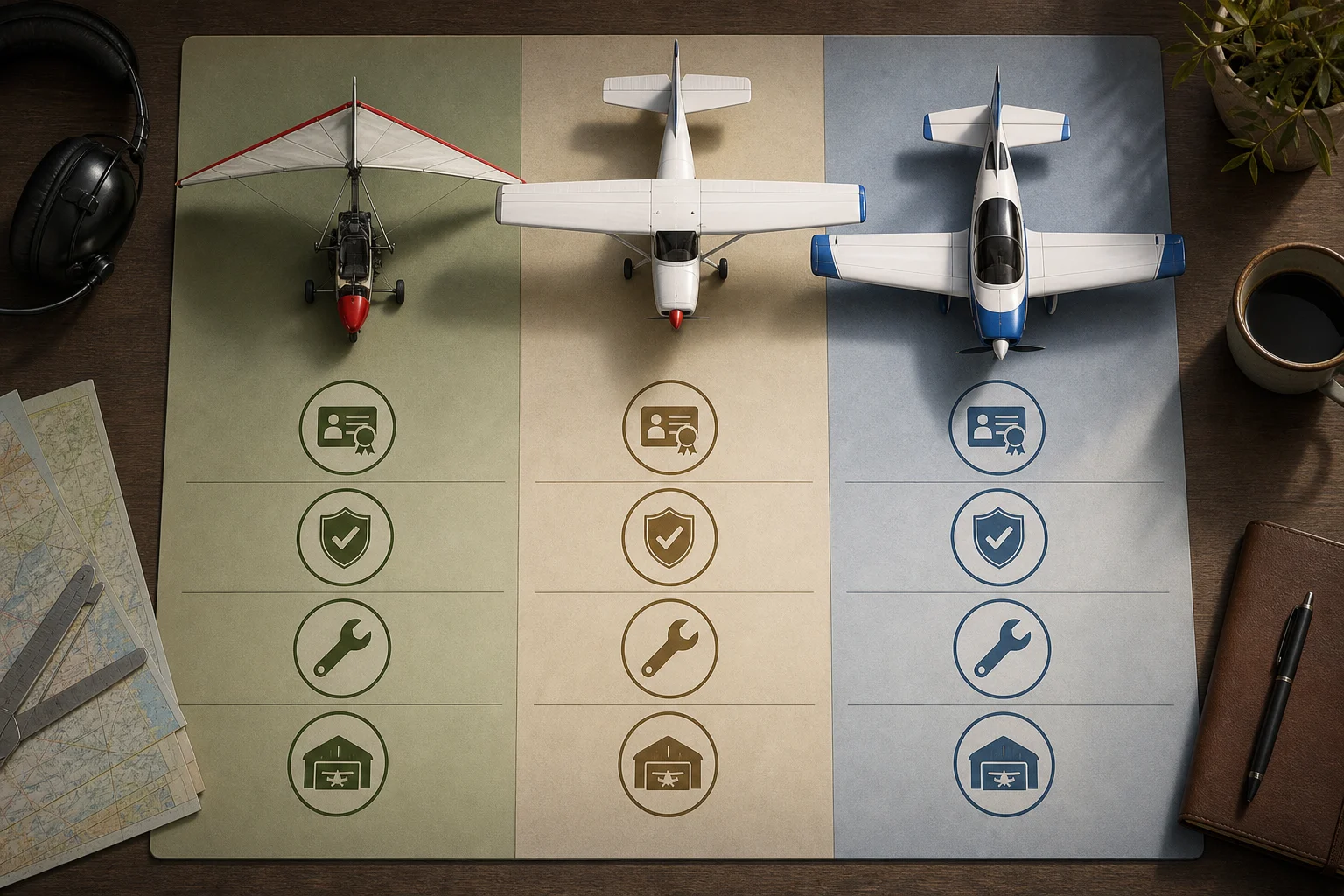
Royal Decree 765/2022 defines Spanish ULMs within their own regime. For category A ULM aeroplanes, it sets general features such as no more than two seats, a stall speed no higher than 45 knots in landing configuration and a maximum take-off mass of 600 kg in landplane version or 650 kg if it is a seaplane or amphibian. The same rule also covers category B ULM helicopters, with up to two occupants and 600 kg for land aircraft or 650 kg for water or amphibious aircraft, and category C powered gyroplanes, with up to two occupants and 600 kg.
This explains why a modern ULM may have an enclosed cockpit, advanced instrumentation and apparent certified-light-aircraft performance, while still being a ULM for licensing, maintenance and operating purposes. It is not enough to look at the shape of the aircraft: the administrative category and the aircraft documentation prevail.
“Certified light aircraft” is not a single technical category in everyday language. In the context of a private buyer, it usually refers to single-engine piston aeroplanes or TMGs certified under the EASA framework, operated with Part-FCL licences such as LAPL(A) or PPL(A). By contrast, “Light Sport Aircraft” can be misleading in Spain: it should not be assumed that a foreign LSA automatically fits as a Spanish ULM or that it shares the same permissions, limits or use. The check must be made on the registration and applicable framework, not on the commercial label.
- ULM in Spain: national regime and categories A, B and C.
- Certified light aircraft: check the EASA framework, class or type and required licence.
- LSA: a commercially useful term, but not a substitute for the Spanish legal category.
Licences, ratings and medical certificate
To obtain a ULM pilot licence in Spain, you must complete theoretical training at an authorised school and pass a theoretical exam and a practical exam. AESA states that the theoretical exam is multiple-choice and that the practical exam consists of a flight test. In addition, Royal Decree 123/2015 requires you to be at least 18 years old and to hold a medical certificate in accordance with the LAPL certificates of Regulation (EU) 1178/2011.
The ULM licence allows you to act as pilot in command only in ultralights for which the pilot is duly rated and with a valid medical certificate. This is one of the most important checks when buying a share: the rating must match the type of aircraft. Spanish rules include, among others, MAF for fixed-wing multi-axis aircraft, AG for gyroplanes, H for helicopters, FI for instructor and RTC for radiotelephonist.
ULM ratings, except the instructor rating, are valid indefinitely, but that does not mean you can fly without recent experience. Their privileges are only effective if the requirements of the previous 24 months have been met, such as at least 12 flight hours, 12 take-offs and 12 landings, or a proficiency check with an authorised examiner, according to Article 9 of Royal Decree 123/2015. AESA also requires an up-to-date logbook or flight time record to be kept.
For certified light aircraft under Part-FCL, the route usually goes through LAPL(A) or PPL(A). EASA establishes LAPL(A) privileges in land SEP, sea SEP or TMG aircraft of up to 2,000 kg maximum certificated take-off mass, with a maximum of three passengers and four people on board. For LAPL(A), at least 30 hours of flight instruction in aeroplanes or TMGs are required, with minimum amounts of dual instruction and supervised solo flight. The PPL(A), for its part, allows the holder to act without remuneration as pilot in command or co-pilot in aeroplanes or TMGs in non-commercial operations, as well as to exercise the privileges of LAPL(A). AESA lists the Class 2 medical certificate for PPL and the Class LAPL medical certificate for minimum light aircraft privileges, including ULM.
- Ask which exact licence the aircraft requires, not only which course the school offers.
- Check the rating, medical certificate and recent experience before assuming you will be able to fly.
- If you come from ULMs and want a certified light aircraft, do not treat the licences as equivalent without checking the Part-FCL framework.
Common uses and limits worth checking
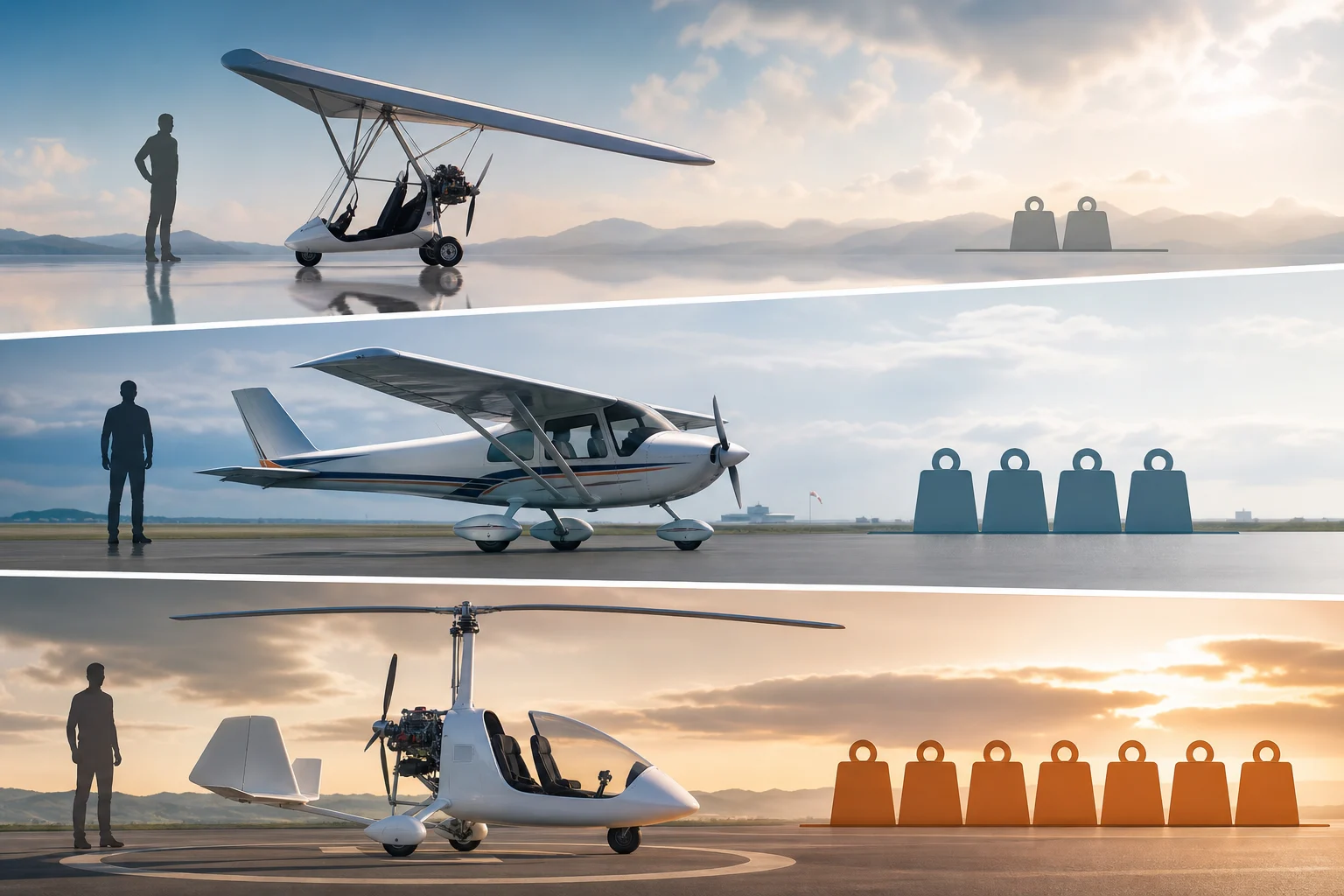
A ULM can be a very good fit for local recreational use, introductory training, flying club flights or simple co-ownership, as long as its limits and the operating field suit the project. The key is not to buy based on visual excitement: a 600 kg two-seater does not cover the same needs as a certified light aircraft capable of carrying more occupants within the privileges of the relevant licence.
For LAPL(A), EASA sets the limit at a maximum of three passengers and four people on board in SEP or TMG aircraft of up to 2,000 kg MCTOM. In ULMs, Royal Decree 765/2022 starts from aircraft with no more than two seats in the categories mentioned. This completely changes family or travel use: if you want to carry more than one companion, a ULM is not the right tool within those parameters.
Cross-border use must also be reviewed. AESA recalls that, if a ULM with EC- registration flies to another EU State, Spain does not issue authorisation for other States and the regulations of the State where the aircraft is flown must be complied with. AESA itself warns that ULMs are regulated within each country’s national framework. That is why anyone thinking about international cross-country trips should ask beforehand, not after they have already bought the share.
- For local flights and two seats, a ULM can be a logical option if the licence fits.
- For more occupants or certain trips, review LAPL(A) or PPL(A) and a certified aircraft.
- To leave Spain with a ULM, confirm the destination State’s requirements and do not assume automatic recognition.
Maintenance, airworthiness and documentation: where many costs begin
Royal Decree 765/2022 does not regulate only ULM operation: it covers the design, production, maintenance and operation of these aircraft, as well as engines, propellers, components, organisations and personnel involved in those activities. For a buyer, the practical consequence is simple: it is not enough for the aircraft to start and look good; there must be documentary traceability consistent with the applicable framework.
In a certified light aircraft or a ULM, maintenance should not be assessed like that of a used car. As due diligence, it is advisable to check that the work carried out, components, engine, propeller and documentation fit the applicable regime and the available records. If history is missing, if the hours do not match the records or if it cannot be shown who has worked on the aircraft, the economic risk appears even before talking about breakdowns.
For ULMs, AESA lists onboard pilot documentation such as a valid licence with the corresponding rating and a Class II or LAPL medical certificate. That requirement serves as a reminder: in light aviation, the “paperwork” is part of the vehicle. In a used purchase or entry into co-ownership, the document review is not a bureaucratic formality, but a defence against groundings, restrictions or unforeseen expenses.
- Ask for the maintenance history, airframe, engine and propeller hours, and consistency with the records.
- Verify the registration, category and applicable airworthiness regime before paying a deposit.
- Be wary of phrases such as “everything is fine” if they are not accompanied by documentation you can review.
Costs that are often forgotten before entering co-ownership
Without uniform official figures provided by the regulations, the prudent approach is to work by cost item and ask the flying club, school or owner for real amounts. The acquisition price or share price is only one part. There are fixed costs, hourly costs, documentation costs and possible special contributions for maintenance or updates.
Items worth requesting in writing include hangarage or parking, insurance, scheduled inspections, work on the engine, propeller and components, fuel, airfield fees or operating costs, document renewal or updating, and any requirement associated with the licence or recent experience. In ULMs, it must also be verified that the owner or manager clearly understands the applicable national regime and the required documentation. In a certified light aircraft, the question must be directed at the EASA framework and the aircraft’s specific conditions.
The most common mistake is calculating only “price divided by partners” and forgetting real availability. A cheap share can be a poor purchase if there are calendar restrictions, if the insurance limits pilots, if recent hours are missing, if the aircraft is close to significant inspections or if there is no written agreement on special contributions. Recreational aviation is more enjoyable when the likely cost is agreed before the first flight.
- Request the fixed monthly fee, hourly cost and special contribution policy.
- Ask whether the insurance covers new pilots, students or members with little experience.
- Check whether the aircraft has upcoming engine, propeller or documentation inspections.
Checklist before buying a used aircraft or a share
Before committing money, separate three reviews: legal, economic and use-related. The legal review confirms that the aircraft belongs to the advertised category, that the registration and documentation are consistent and that your licence or training plan works for that aircraft. The economic review clarifies recurring costs and foreseeable expenses. The use review checks whether you will be able to fly when you need to and under what restrictions.
Minimum questions for the flying club, owner or school: what is the exact registration and category?, is it a category A, B or C ULM, or an aircraft certified under another framework?, what licence and rating does it require?, what medical certificate is required?, what history exists for airframe, engine and propeller hours?, what applicable inspections or documentation are pending?, what insurance is in place and which pilots does it cover?, are there limitations on operating outside the usual airfield?, what happens if a partner does not meet recent experience requirements?
The warning sign is not only a visible fault. Incomplete documentation, missing logbooks, refusal to show history, confusion between ULM and LSA, the promise of international flights without checking the destination country’s regulations, or a co-ownership contract without rules on maintenance, availability and a partner’s exit are also warning signs.
- Do not pay without seeing basic documentation and the share agreement.
- Do not accept verbal equivalences between ULM, LSA and certified light aircraft.
- If you cannot explain which licence you need and what limits it has, it is not yet time to buy.
Is a modern ULM the same as a certified light aircraft?
Not necessarily. In Spain, the ULM is a national category regulated by Royal Decree 765/2022. It may look very advanced, but its limits, licence, ratings and documentation are not those of a certified light aircraft under the EASA framework.
What licence do I need to fly a ULM in Spain?
The ULM pilot licence requires theoretical training at an authorised school, a multiple-choice theoretical exam, a practical flight test, at least 18 years of age and a medical certificate in accordance with the LAPL framework. You also need the appropriate rating for the type of ULM.
Do LAPL(A) and PPL(A) serve the same purpose?
No. LAPL(A) has privileges limited to SEP or TMG aircraft of up to 2,000 kg MCTOM, with a maximum of three passengers and four people on board. PPL(A) allows the holder to act without remuneration as pilot in command or co-pilot in non-commercial operations and to exercise LAPL(A) privileges.
Can I travel abroad with a ULM registered in Spain?
This must be checked country by country. AESA states that it does not issue authorisation to operate in other States and that the regulations of the State where the aircraft is flown must be complied with, because ULMs are regulated within each country’s national framework.
What should I check before buying a share in a ULM or certified light aircraft?
Ask for the registration, category, required licence and rating, required medical certificate, history of hours, maintenance, engine, propeller, insurance, fixed costs, hourly cost, planned special contributions and operating or availability restrictions.