SUV or estate car: which body style suits your use, space and costs?
Choosing between an SUV and an estate car is not simply about body height. This guide explains which details to compare, how to test both cars and what to check on a new or used vehicle.
Key points
An SUV does not guarantee a larger boot or a more practical purchase than an estate car. Compare equivalent versions, assess your real needs—garage, child seats and luggage—and check dimensions, mass in running order (MOM), tyres and WLTP consumption before deciding.
The short answer: choose by version and routine, not by the SUV label
An SUV may suit you if, in the individual vehicle, the driving position, access and seating position make getting in, sitting down and getting out more comfortable. However, a taller body alone does not prove that it has greater load capacity, better rear-seat space, lower running costs or that it will fit more easily in your garage space. An estate car can be a very sensible alternative if you prioritise travelling with luggage, a restrained overall height or dimensions compatible with your parking space.
The comparison must be between genuinely equivalent cars: a similar segment, five seats if that is the requirement, similar engine and drivetrain, and the same year or generation. You must also get down to the exact version. Volkswagen’s current example shows why: the Passat claims 690 litres of boot space, while the eTSI, TSI and TDI Tiguan claims 652 litres up to the seat-back height. But the plug-in hybrid Tiguan claims 490 litres. You cannot extrapolate one version’s volume to an entire range or conclude that every SUV has a larger boot than every estate car.
A useful decision starts with three questions: how many people usually travel, which items must fit without folding the seats, and which physical limitation your garage imposes. Then compare those needs with the technical specification, the Spanish configurator for the version and an in-person test.
Section references: Medidas y maletero del Volkswagen Passat en España ↗ · Presentación técnica de la tercera generación del Volkswagen Tiguan ↗ · Ficha declarada del Volkswagen Tiguan híbrido enchufable ↗
- Prioritise the SUV if the individual vehicle test confirms that its access, seating position and interior layout meet a specific need.
- Prioritise the estate car if its dimensions, stated boot capacity and overall height better suit your trips and parking space.
- Rule out any candidate whose specification sheet belongs to a different engine, trim, year or market.
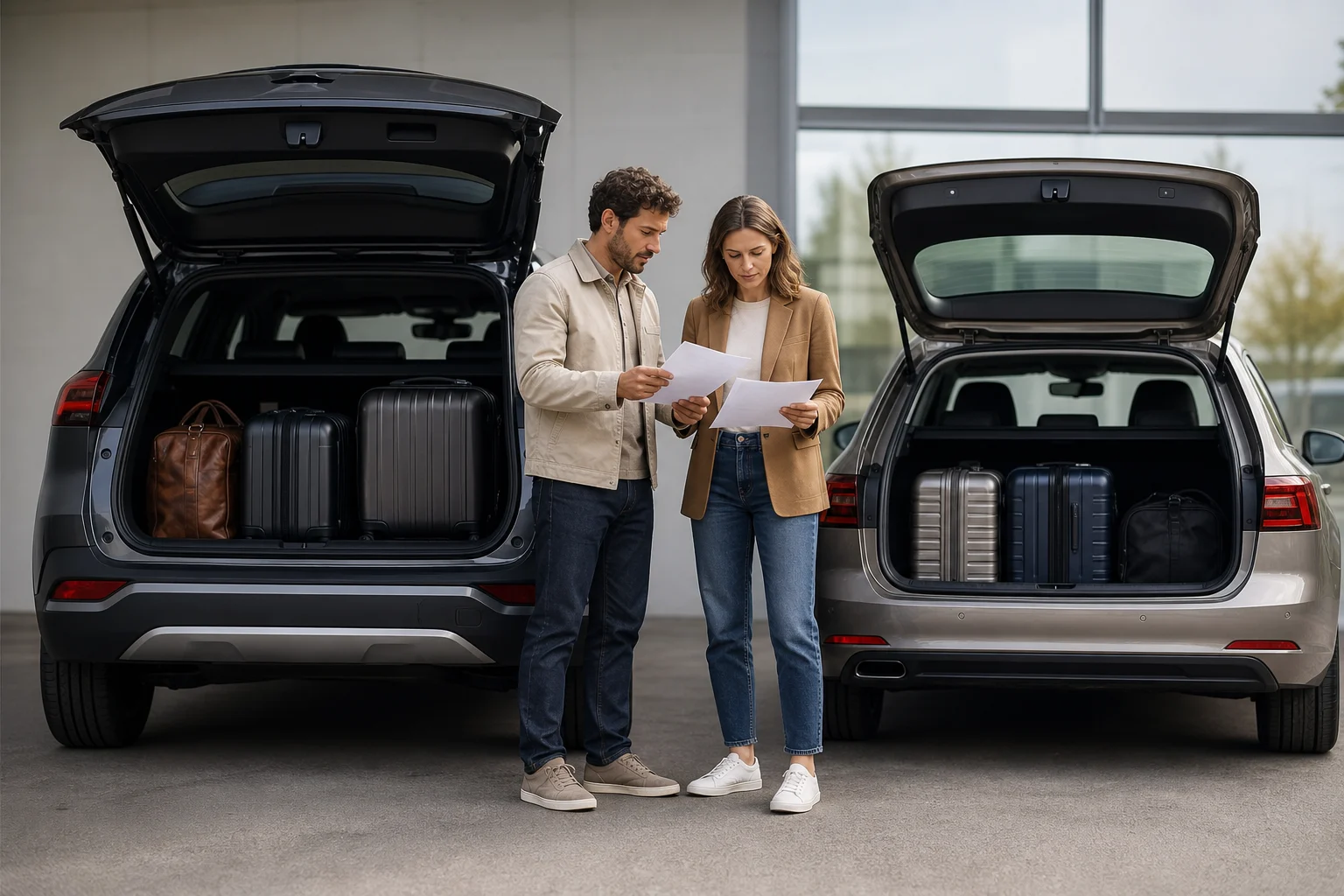
Which dimensions and capacities to compare side by side
Do not stop at length. To find out whether a car fits and works well for you, note its overall length, width and height. For a car registered in Spain, the ITV vehicle document identifies overall height in field F.4, width in F.5 and length in F.6. For a used car, ask for a legible photograph of the document or check the paperwork before travelling to view it. The registered keeper can also consult the vehicle’s technical details through the DGT and download a copy of the electronic ITV document, although that copy is not valid for driving.
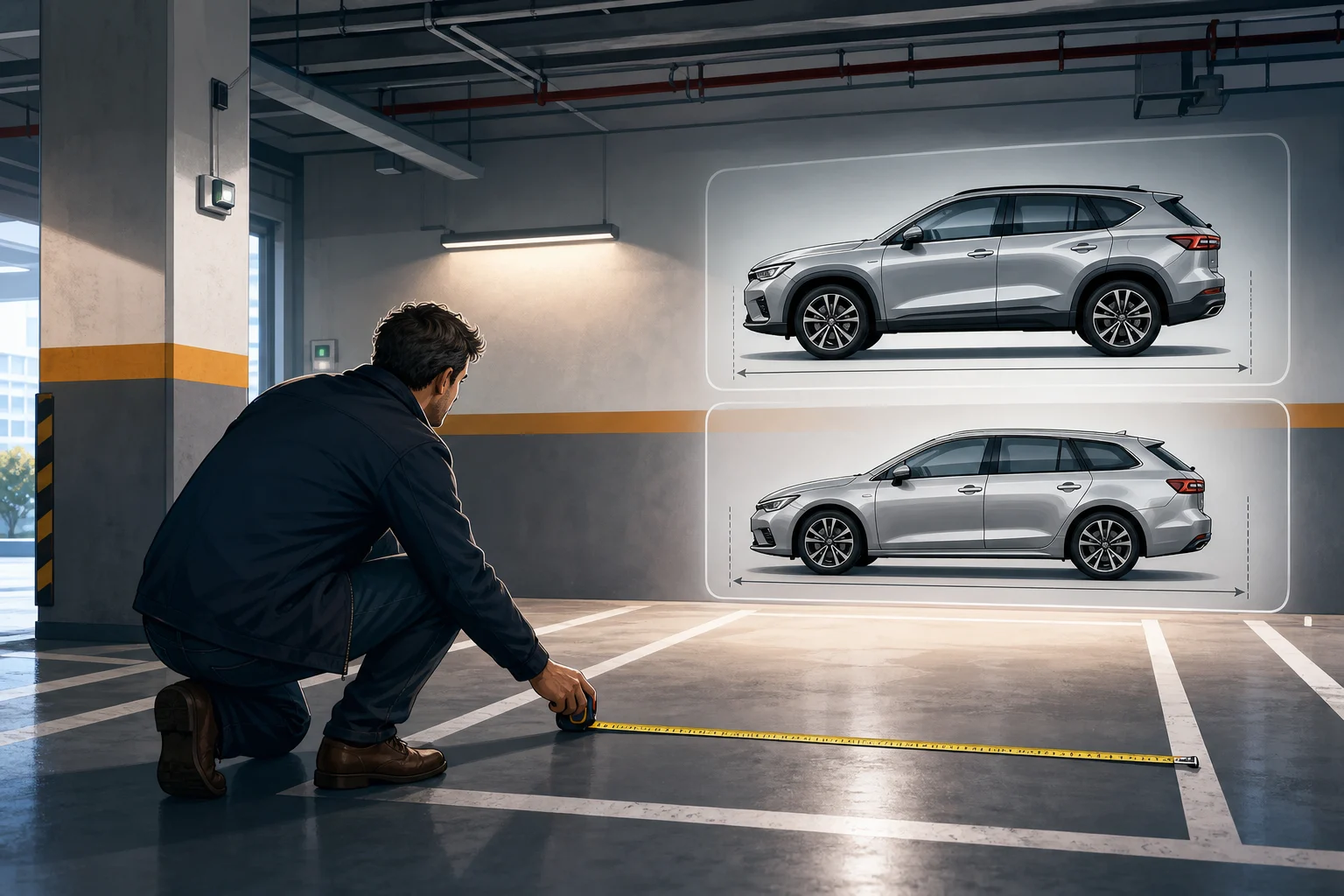
Measure your parking space and access properly: width between walls, pillars and the door; headroom at the lowest point; depth; ramp angle; and the room available to open the doors. The stated width should be checked against the vehicle specification, and it is advisable to check width including mirrors separately in the manufacturer’s configurator or documentation where available. Do not infer it from the overall width on the ITV document.
For the boot, ask for the stated volume and the measurement condition. The isolated figure does not show whether a wide, tall or long item will fit. Check the width between wheel arches, the length to the seat backs and the length available with the seats folded, as well as the shape of the space and tailgate. For example, the plug-in hybrid Tiguan claims 1.003 metres between the wheel arches and different loading lengths depending on whether they are measured to the first or second row. These are more actionable dimensions than debating litres alone.
Section references: Datos de la tarjeta ITV: masas y dimensiones ↗ · Consulta de datos y tarjeta electrónica ITV ↗ · Ficha declarada del Volkswagen Tiguan híbrido enchufable ↗
- Exterior dimensions: length, width, width including mirrors if published, and height.
- Passenger compartment: number of seats, the space needed to fit your child seats and access to the second row.
- Load space: litres and stated method, width between wheel arches, length, load lip and the ability to fold seat backs.
- Documentation: the specification for the exact vehicle, not a generic range document.
Access, children and luggage: what the specification sheet cannot replace
Ergonomics must be checked in person. In both candidates, simulate getting in and out from the parking space you use most; open the doors with the space you will have at home; adjust the seat and steering wheel; and check the visibility you get from that position. If you travel with children, fit—or at least bring—the child seat you will use. Compatibility should not be assumed because of the car’s size or the presence of ISOFIX anchor points.
Euro NCAP’s child occupant protection protocol considers installations in all passenger seats and distinguishes between seat-belt and ISOFIX configurations. It also considers features such as a support leg and top tether. This is a practical reminder: a child seat may require a particular combination, so you must check the car manual, the child-seat manual and the actual location of the anchor points. Also verify that you can place the child in the seat, tighten the harness and close the door without forcing the manoeuvre.
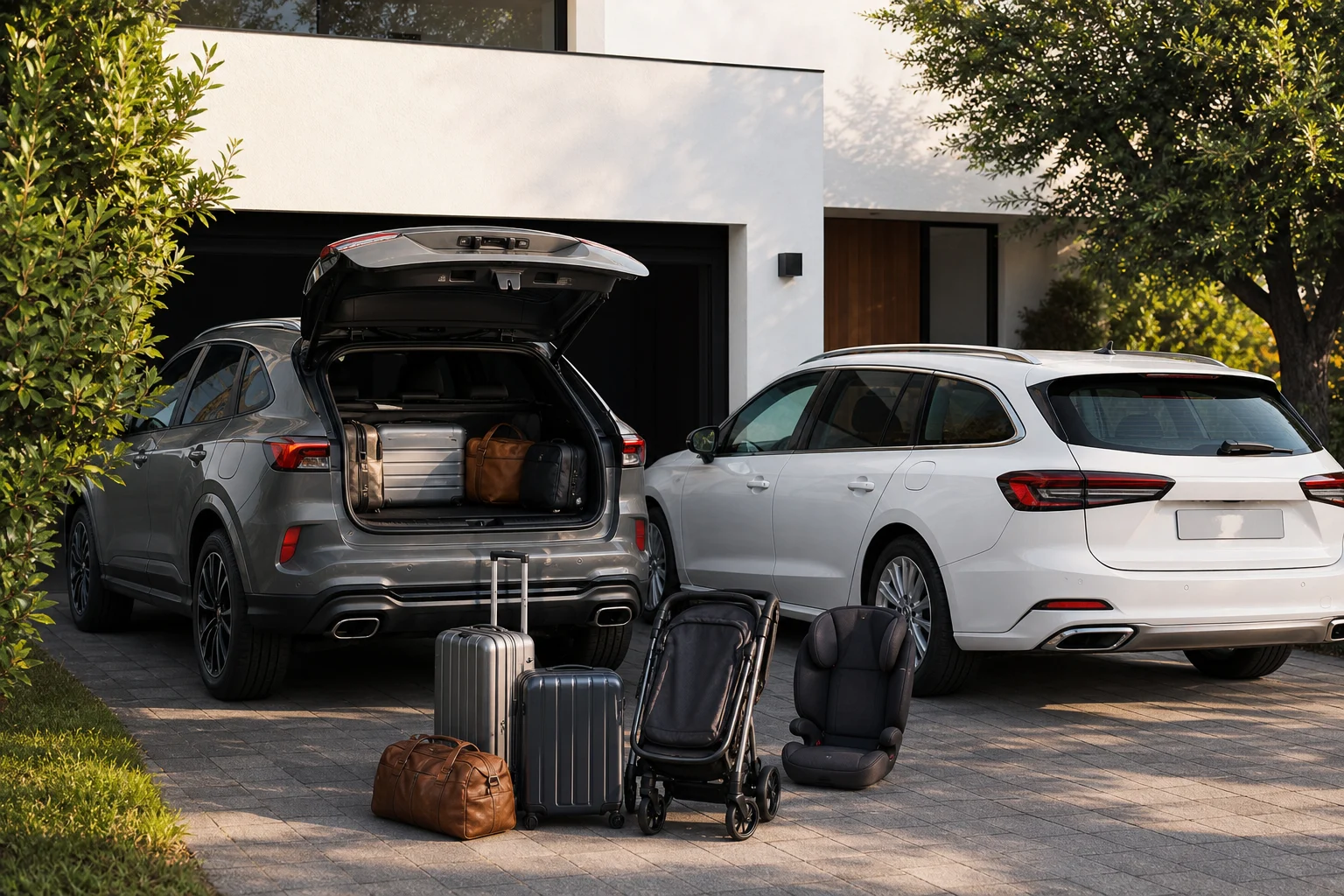
Repeat the test with your usual luggage. A pushchair, hard-shell suitcase or pet carrier do not behave like a volume figure. Load them first with all five seats in use. Folding the second row can increase capacity, but it does not solve a family journey in which those seats are occupied. Also check whether the load lip and the reach to the back are manageable for the person who will load the car most often.
Section references: Protocolo de protección de ocupantes infantiles ↗
- Take the child seat, pushchair and a representative suitcase or box to the test.
- Check every seat you might use, not just the most accessible outer rear seat.
- Read the vehicle and child restraint instructions before relying on an installation.
- Test the tailgate, door opening and loading with the car in the environment where it will be used.
City driving, trips, consumption and costs: a cautious comparison
For city driving, do not attribute manoeuvrability to body shape. Compare length, width, height and the space you have measured against your streets, parking and garage. Carry out a parking manoeuvre during the test drive, if the seller allows it, and check in particular the available view and how much room the doors take up when opened. For journeys, test every occupant’s seating position and load the equipment you actually take; the best evidence is that it fits and can be used without sacrificing necessary seats.
For fuel-consuming versions, compare only WLTP fuel-consumption values using the same methodology and for each exact version. European rules state WLTP fuel consumption in l/100 km. It is a consistent reference for ranking candidates, not a promise of identical spending on every journey. Do not turn body style into an automatic rule: the documented Tiguan examples show that declared figures and boot capacity can differ between versions, so compare the exact version.
Also check mass in running order (MOM), identified as G on the ITV document, and do not confuse it with F.1 Masa Máxima en carga Técnicamente Admisible (MMTA, technically permissible maximum laden mass) or F.2 Masa Máxima en carga Admisible del Vehículo en circulación (MMA, maximum laden mass permitted for the vehicle in circulation): they are different fields. For the ownership budget, ask for the price and tyre size for each version, and compare insurance and maintenance quotes for the exact vehicle. The European label helps you read rolling resistance, wet grip and external rolling noise, but it does not replace knowing the tyre size, replacement price and availability.
| Criterion | SUV: possible advantage | Estate car: possible advantage | What to check |
|---|---|---|---|
| Access and seating position | May suit your access, seating-position or driving-position needs in the individual vehicle. | May be sufficient or preferable depending on your height and garage space. | Real test of getting in, getting out, adjustment and visibility. |
| Garage | Do not assume it fits better because it is an SUV. | The lower stated height may matter in low car parks. | ITV fields F.4, F.5 and F.6; usable width and headroom in your space. |
| Boot | Capacity depends on engine and version. | May state a greater volume in a particular comparison. | Litres, measurement condition, width and loading lengths. |
| Children | The individual configuration may make a particular manoeuvre easier. | The configuration may work just as well with your child seat. | Fitting your seat, ISOFIX, seat belt, support leg or top tether. |
| Running costs | Should not be judged by its silhouette. | Should not be judged by its silhouette. | WLTP fuel consumption for fuel-consuming versions, MOM, tyre size and price, insurance and maintenance. |
Section references: Datos de la tarjeta ITV: masas y dimensiones ↗ · Reglamento europeo de homologación de emisiones y consumo ↗ · Etiquetado europeo de neumáticos ↗
- Compare WLTP fuel consumption version by version for fuel-consuming vehicles and note the fuel or propulsion system.
- Distinguish mass in running order (MOM, G), F.1 Masa Máxima en carga Técnicamente Admisible (MMTA) and F.2 Masa Máxima en carga Admisible del Vehículo en circulación (MMA).
- Request real insurance, tyre and maintenance quotes before completing the purchase.
- If you switch to a plug-in hybrid, review the boot and dimensions again: do not assume they match other versions.
Final checklist for a new or used car
Prepare a sheet with two columns, one for each car, and do not mark an item as complete until you have checked it. For a new vehicle, save the specification or configuration with the date, because the engine and equipment affect the data. For a used car, match the advert against the actual vehicle: registration, version, fuel, dimensions and documentation. The DGT allows the registered keeper to consult technical information about their vehicles and download a copy of the electronic ITV document; it is a useful route for organising the available paperwork, without replacing an inspection of the documents and the car.
Your choice will be more robust if you define which condition is non-negotiable. It may be a maximum garage height, carrying two child seats and a pushchair with five seats in use, or keeping annual costs manageable. If both models meet those conditions, choose the one that has proven to fit your routine better, not the one that accumulates more theoretical advantages.
Section references: Datos de la tarjeta ITV: masas y dimensiones ↗ · Consulta de datos y tarjeta electrónica ITV ↗
- Confirm version, year/model, fuel, drivetrain and number of seats.
- Compare exterior dimensions with your garage and measure narrow points.
- Load your usual items with all the seats you need occupied.
- Fit the child seat in accordance with the relevant manuals.
- Compare WLTP fuel consumption using the same methodology and for the exact fuel-consuming version.
- Note mass in running order (MOM, G), F.1 MMTA and F.2 MMA on the ITV document without confusing them.
- Ask for tyre, insurance and maintenance costs before signing.
- For a used car, check the ITV document, available history and that the advert details match the vehicle.
Does an SUV always have a larger boot than an estate car?
No. It depends on the model, engine, version and how the manufacturer publishes the measurement. In the example cited, the Volkswagen Passat claims 690 litres, the eTSI, TSI and TDI Tiguan 652 litres, and the plug-in hybrid Tiguan 490 litres. You need to compare the specification sheets for specific versions.
Which measurements should I check to know whether it fits in my garage?
Check overall length, width and height, identified on the ITV document as F.6, F.5 and F.4 respectively. Also measure usable width, headroom, pillars, ramps and the space needed to open the doors. Check the width including mirrors if the manufacturer publishes it.
How do I compare the consumption of an SUV and an estate car?
For fuel-consuming versions, use the WLTP fuel-consumption value in l/100 km for the exact version and under the same methodology. Add mass in running order (MOM), tyre size and cost, insurance quotes and maintenance. The official consumption figure enables comparison, but it does not set the amount you will spend on every trip.
What should I test if I travel with children?
Take the child seat and, where relevant, the pushchair. Check installation following the car and child-seat manuals, whether using the seat belt or ISOFIX and the corresponding features, such as a support leg or top tether. Also verify that you can place the child in the seat and load luggage with the seats you need occupied.