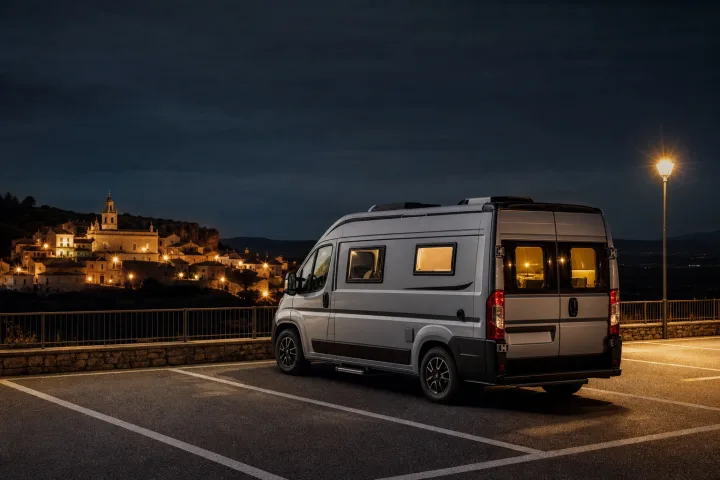
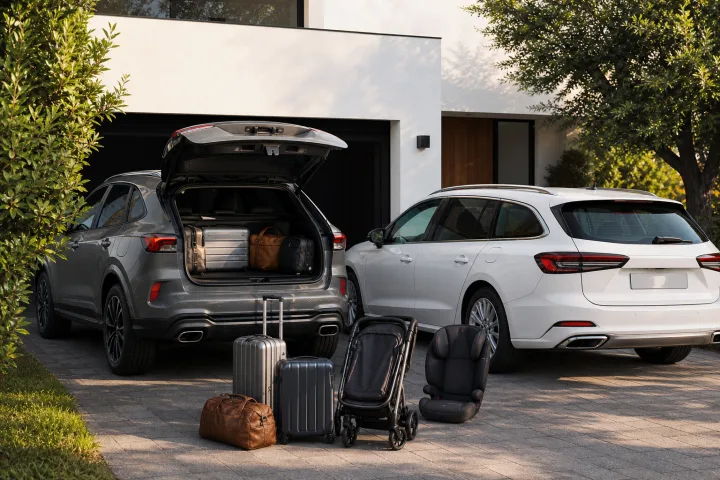
Campervan, low-profile, overcab or A-class: which motorhome suits how you travel
A guide to choosing the format and layout of a campervan or motorhome based on occupants, beds, luggage, dimensions and payload.
Key points
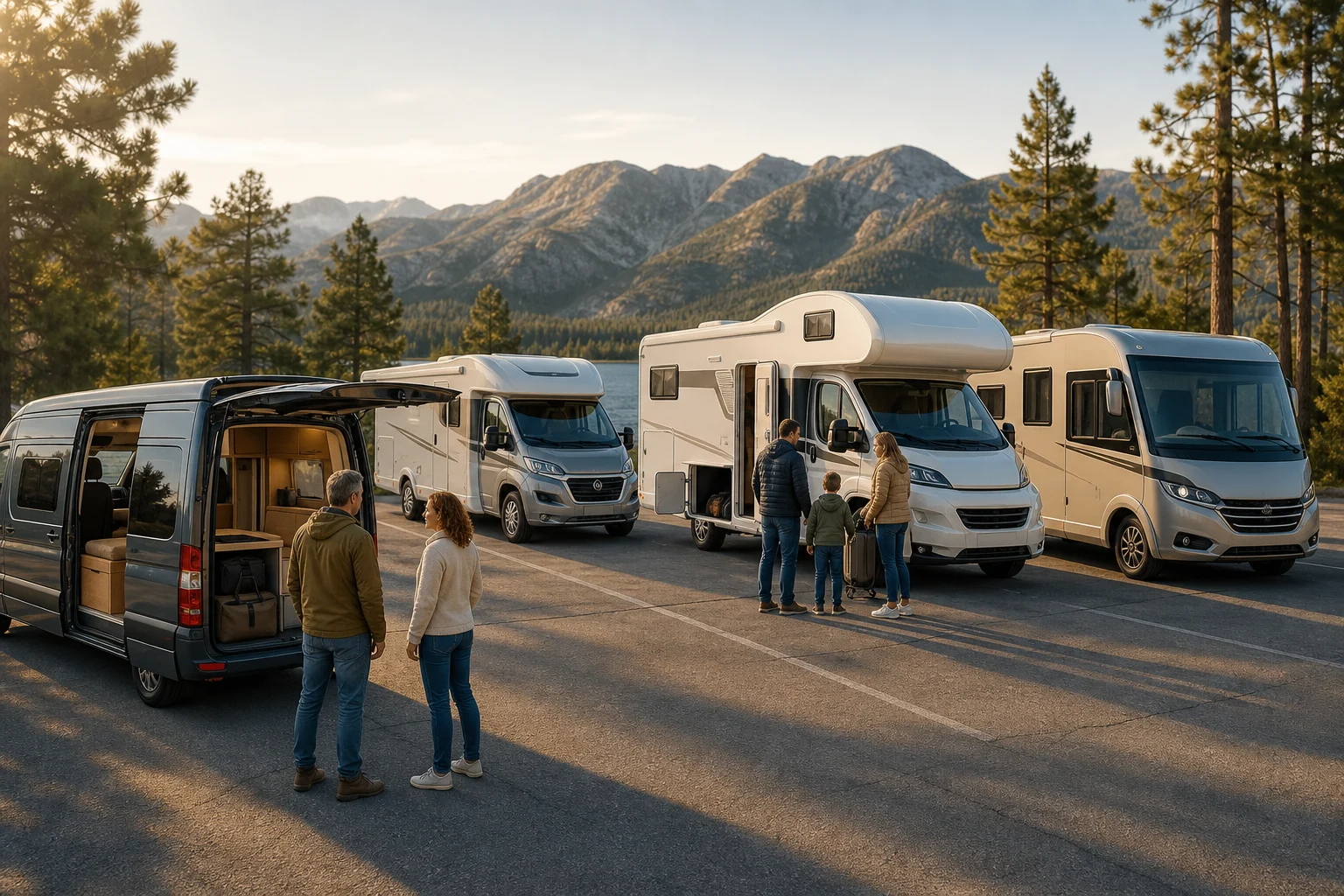
The choice is not settled by the advertised number of berths: you need to consider who is travelling, how many nights you will spend inside, which beds must remain available and the real mass left for people and luggage. Before comparing models, separate travelling, dining and sleeping places, and check the paperwork for the specific vehicle.
Quick answer: the format should suit your trip, not just your number of berths
If you are looking for your first campervan or motorhome, start with five questions: how many people will travel in authorised travelling places, how many will usually sleep in it, whether you want a bed available without converting the lounge, how much luggage you will carry and how many consecutive days you will spend on board. Two vehicles advertised with the same number of berths can meet these needs very differently.
Spain’s DGT distinguishes a motorhome, designed for living inside, from a campervan, which is a van fitted out for that purpose. The regulatory definition of a motorhome requires living accommodation and includes, at a minimum, seats and a table, beds or bunks that can be easily converted into seats, cooking facilities and cupboards or similar fittings. This shared basis does not in itself determine layout comfort or the payload available.
As an initial guideline, a couple should prioritise the bed they want to use every night and how the lounge, bathroom, kitchen and luggage space work together. A family should first check the authorised travelling places, where each occupant sleeps and whether making up the beds disrupts the evening meal, washing or rest routine. For alternating short breaks and longer stays, the decision also depends on how much daily conversion you accept and on the mass remaining after loading water, people, clothing and accessories.
Section references: Definición legal de autocaravana ↗ · DGT: viaje en autocaravana o camper ↗
- Couple wanting to avoid daily conversions: first identify the bed that will remain made up.
- Family: compare actual occupants with authorised travelling places, not with a generic marketing figure.
- Trips with bicycles, chairs, sports equipment or lots of luggage: measure the item and garage access before deciding.
- Routes with tight access: compare the exact unit’s length, width and height, not just its category.
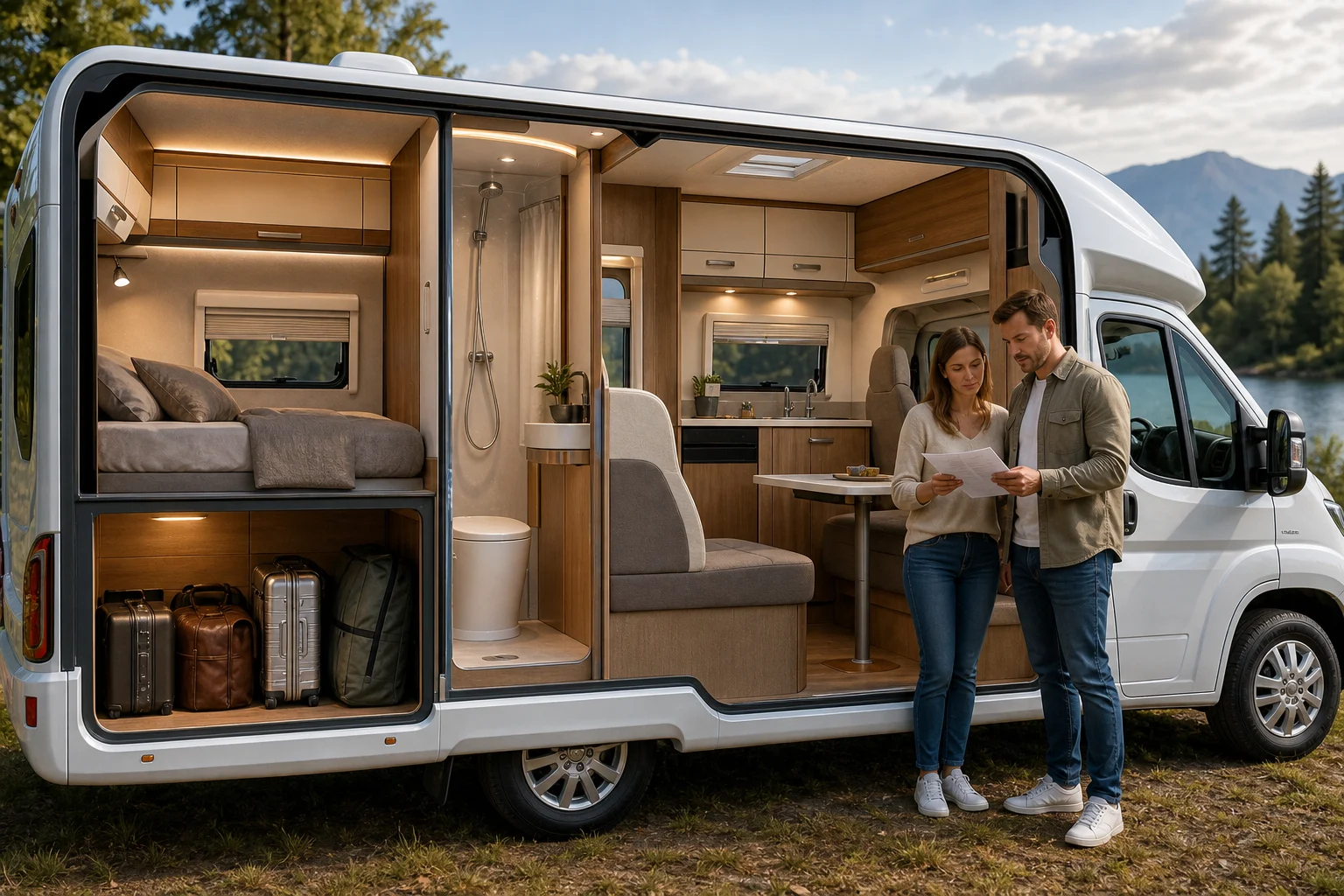
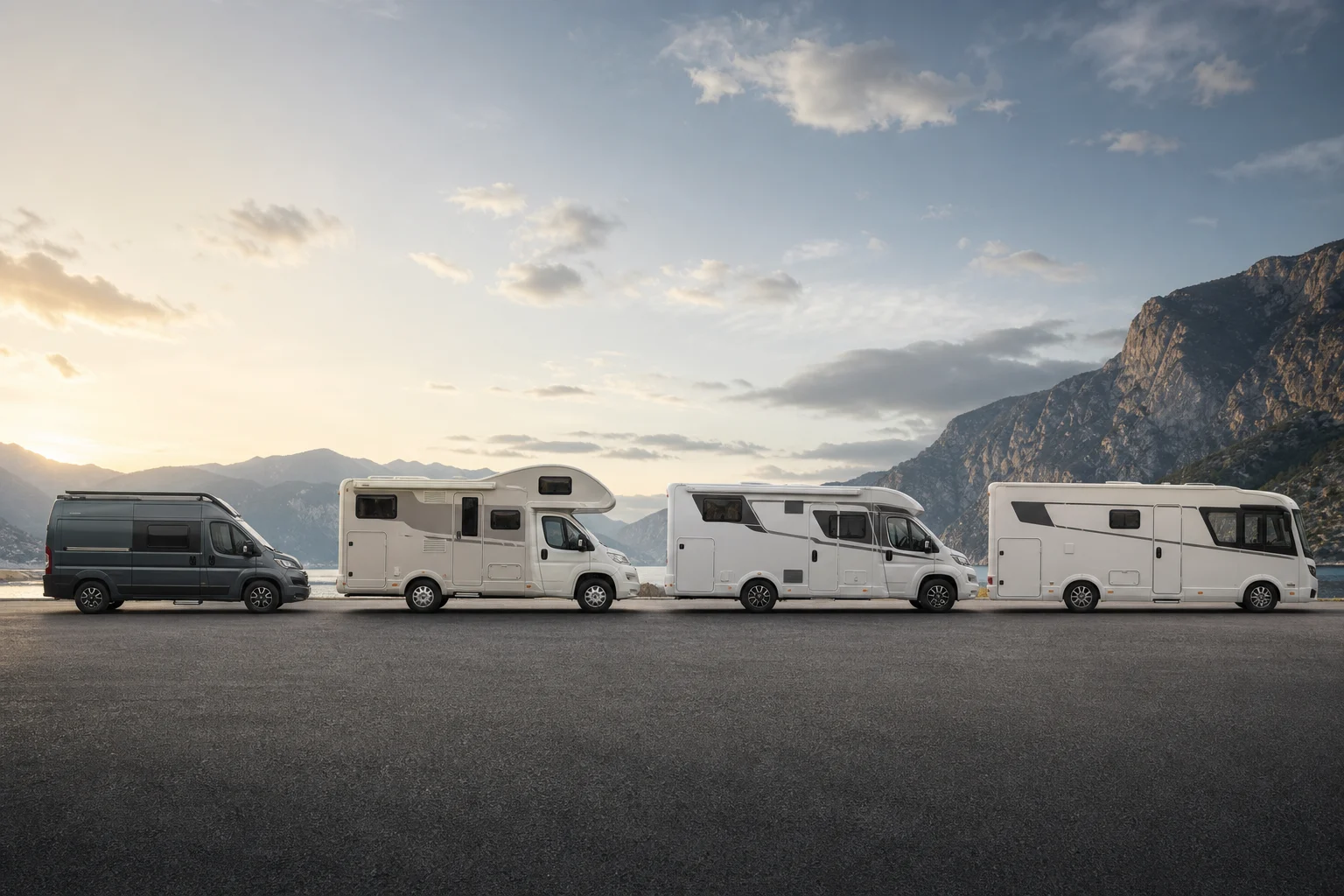
Campervan, overcab, low-profile and A-class: compare the unit, not just the format
A campervan starts with a van fitted out for travel and overnight stays. The DGT distinguishes it from a motorhome because of this concept, but the category alone does not reveal seats, beds, payload or dimensions. To decide whether it suits your trip, you must check the specific unit’s layout, authorised travelling places, available beds, masses and dimensions in its documentation.
In Benimar’s documented examples, the Sport S344 UP is presented as an overcab model, the Tessoro models as low-profile motorhomes, and the Amphitryon A981 as an A-class. The available documentation shows that dimensions and bed solutions vary substantially between specific units; the Sport S344 UP, Tessoro T440 UP and Amphitryon A981 each declare a maximum authorised mass of 3,500 kg. Therefore, none of these categories replaces an in-person check of bed access, dining-area use, cupboard opening and luggage loading.
The documented overcab model includes a bed above the cab: the Benimar Sport S344 UP states an overcab bed measuring 155 × 203 cm, a rear bed of 133 × 198 cm and a dinette bed of 150/121 × 206 cm. The low-profile T440 UP states a rear bed, a ceiling-suspended bed and a dinette bed; the T483 includes an electric ceiling bed for two people. The A-class Amphitryon A981 states a cab ceiling bed of 140 × 190 cm and a dinette bed of 150/121 × 206 cm. These are declared solutions for those examples, not features that should be assumed for every vehicle in each format.
As practical guidance, a campervan requires especially close attention to its real converted-van layout; in an overcab model, the bed above the cab, its access and the exterior height; in a low-profile motorhome, whether the ceiling bed or dinette bed will be used regularly; and in an A-class, the cab ceiling bed, the dining area and the dimensions of the specific unit. In all four cases, the specification sheet and the visit are what confirm seats, beds, masses and measurements.
| Format and example | Dimensions L × W × H | Declared maximum authorised mass | Declared beds |
|---|---|---|---|
| Overcab Sport S344 UP | 748 × 232 × 310 cm | 3,500 kg | Overcab, rear and dinette |
| Low-profile Tessoro T440 UP | 634 × 232 × 289 cm | 3,500 kg | Rear, ceiling and dinette |
| Low-profile Tessoro T483 | 659 × 232 × 289 cm | Not stated in the evidence provided | Electric ceiling bed for two people |
| A-class Amphitryon A981 | 598 × 234 × 295 cm | 3,500 kg | Cab ceiling and dinette |
Section references: DGT: viaje en autocaravana o camper ↗ · Benimar Sport S344 UP: capuchina ↗ · Benimar Tessoro T440 UP: perfilada ↗ · Benimar Tessoro T483: perfilada compacta con cama de techo ↗ · Benimar Amphitryon A981: integral ↗
- Campervan: check the actual converted-van layout, its seats, beds, masses and dimensions.
- Overcab: verify exterior height, the bed above the cab and access to it.
- Low-profile motorhome: establish whether the ceiling bed or dinette bed will be used regularly.
- A-class: check the declared beds, how they work alongside the dining area and the specific unit’s dimensions.
Travelling, dining and sleeping places: three numbers that are not interchangeable
A specification sheet may list travelling, dining and sleeping places separately. Benimar’s 2026 Spanish catalogue uses precisely these three fields and includes 4/4/4 and 5/5/5 configurations. Matching figures in those examples do not allow you to assume the same in another model, trim level or option: you must read the table and the documentation for the unit that will be registered or bought used.
When travelling, you cannot carry more people than the authorised seats. The DGT refers to the registration certificate to check the number permitted in a motorhome and points to the ITV card to check, among other information, authorised seats and masses. To drive with a category B licence, the vehicle must have a maximum authorised mass no greater than 3,500 kg and be designed and built for no more than eight passengers in addition to the driver.
Do not confuse a sleeping place with a place authorised for travelling. During the visit, place every occupant in the travelling places they will use and ask the seller about the exact configuration, including options. If a sleeping place only appears when converting the dining area, check who will have to stop using that space and at what time.
Section references: DGT: viaje en autocaravana o camper ↗ · DGT: transporte de personas y cargas ↗ · DGT: clases de permisos de conducir ↗ · Catálogo Benimar 2026 para España ↗
- Ask for a photo or copy of the ITV card and registration certificate for the available unit.
- Record separately: authorised travelling places, diners and sleepers.
- Physically check every travelling place that will be used.
- Do not assume an accessory, an additional bed or an optional version retains the same authorised passenger capacity.
Layout for a couple: choose the bed before the maximum number of places
For two people, the purchase usually works out better when you define night-time use before considering an occasional extra place. If you do not want to dismantle the lounge, look for a layout where your chosen bed is accessible and suits your height. Then sit in the dining area, simulate preparing a meal and open the bathroom and cupboards with the bed available: the aim is to identify conflicts, not simply to check that every element exists.
Published dimensions can provide an initial filter, but they do not replace a visit. The T440 UP states a rear bed of 138/125 × 198 cm, a ceiling-suspended bed of 74 × 190 cm and a dinette bed of 87/75 × 210 cm. These are very different surfaces and shapes despite being in the same unit. The S344 UP overcab, in turn, states three beds with different measurements. Comparing the bed dimensions you will actually use avoids paying for places that do not suit your routine.
For luggage, take representative items or a template showing their measurements to the visit. The T483, for example, states garage doors of 44 × 159 cm and 72 × 121 cm, plus a maximum internal garage height of 131 cm. It is not enough for an item to fit inside: it must pass through the door and leave room to secure it according to the vehicle instructions.
Section references: Benimar Sport S344 UP: capuchina ↗ · Benimar Tessoro T440 UP: perfilada ↗ · Benimar Tessoro T483: perfilada compacta con cama de techo ↗
- Choose which bed will be used regularly and measure length, width and narrow sections.
- Try the bathroom, kitchen and cupboards with the bed made up for use.
- Check the opening of doors, hatches and internal walkways with everyone on board.
- Measure bicycles, chairs, hard-shell luggage and any item that will go in the garage.
Family layout: assign a bed, travelling place and storage space to each person
With children, map out a full night before choosing. Assign every family member an authorised travelling place for the journey, a specific bed and a place for clothing and belongings. Then imagine the critical moment: one child is asleep, another person uses the bathroom and everyone else needs to sit down or prepare dinner. If a bed depends on the dining area, this situation helps establish whether the compromise is acceptable.
An overcab model with a bed above the cab or a low-profile motorhome with a ceiling bed can increase sleeping possibilities, but each solution must be validated in person for access, dimensions and how it works with the lounge. The Sport S344 UP is an example with an overcab bed, rear bed and dinette bed; the T483 documents an electric ceiling bed for two people. These are specific configurations, not rules for all vehicles in those formats.
The second family filter is mass. Benimar explains that its mass in running order includes a 75 kg driver, 90% fuel and 100% gas, and states a European tolerance of ±5%. It also warns that optional equipment and accessories reduce payload and may reduce the actual number of passengers while travelling. In the catalogue, the declared fresh-water capacity approved for travel is 1 litre in order to meet the permissible payload: do not calculate payload as though the tank were ready for an off-grid stay.
Section references: DGT: transporte de personas y cargas ↗ · Catálogo Benimar 2026 para España ↗ · Benimar Sport S344 UP: capuchina ↗ · Benimar Tessoro T483: perfilada compacta con cama de techo ↗
- Assign each traveller a bed, an authorised travelling place and a luggage space.
- Ask how mass, payload and travelling seats change with each optional package.
- Calculate the load using people, the water you expect to carry, luggage and accessories.
- Request the mass and approved configuration of the delivered unit in writing.
Route, destination and documentation: the final check before signing
Length, width and height affect access and manoeuvring planning; check them on the specific vehicle’s specification sheet. On the standardised Spanish ITV card, F.2 identifies the maximum authorised mass in circulation, G the mass in running order, and F.4, F.5 and F.6 the total height, width and length. Use those three dimensions to plan garages, parking, ferries or routes instead of applying the measurements of another trim level.
The difference between examples is significant: the stated S344 UP overcab measures 748 cm long and 310 cm high, while the low-profile T440 UP states 634 cm and 289 cm. This is not a universal classification, but it does confirm that the example name does not replace the technical specification.
Before buying, it may be worth renting a campervan or motorhome before buying: what to ask and check if you want to test your real routine. On a visit or rental, use the same checklist: load, travelling places, beds, luggage and dimensions. Only then compare price, engine, trim and extras between units that have passed this filter.
Section references: DGT: clases de permisos de conducir ↗ · Modelo oficial de tarjeta ITV: campos de masas y dimensiones ↗ · Benimar Sport S344 UP: capuchina ↗ · Benimar Tessoro T440 UP: perfilada ↗
- Check on the ITV card: F.2 (maximum authorised mass in circulation), G (mass in running order), F.4 (height), F.5 (width) and F.6 (length).
- Check the permitted passenger seats on the registration certificate.
- Request details of standard equipment, options and the declared mass of the specific unit.
- Carry out a practical test: get in, sit down, sleep, cook, use the bathroom, load and unload.
- When comparing used vehicles, require paperwork that corresponds to that unit rather than a generic catalogue.
Does a motorhome with four sleeping places necessarily have four travelling seats?
It should not be assumed. The catalogue may list travelling, dining and sleeping places separately. Check the number of permitted passengers on the registration certificate and the data on the ITV card for the specific unit.
Can I drive any campervan or motorhome with a category B licence?
A category B licence allows you to drive vehicles with a maximum authorised mass of up to 3,500 kg and designed for no more than eight passengers in addition to the driver. You must confirm that the specific vehicle meets these conditions.
Why can payload be crucial for a family?
Because people, water, luggage, accessories and options use up the mass allowance. Benimar warns that options reduce payload and may reduce the actual number of passengers while travelling.
Which measurements should I check before booking or buying?
Check the total height, width and length on the ITV card in fields F.4, F.5 and F.6, as well as the maximum authorised mass in circulation in F.2 and mass in running order in G. Compare them with your access points and intended use.