ETCS in railways: what it is, how it works and the differences between Levels 1 and 2
ETCS is the part of ERTMS that brings signalling and automatic train protection into the cab. This guide explains its components, how movement authorities are transmitted and what distinguishes Levels 1 and 2.
ERTMS and ETCS: related, but not identical, concepts
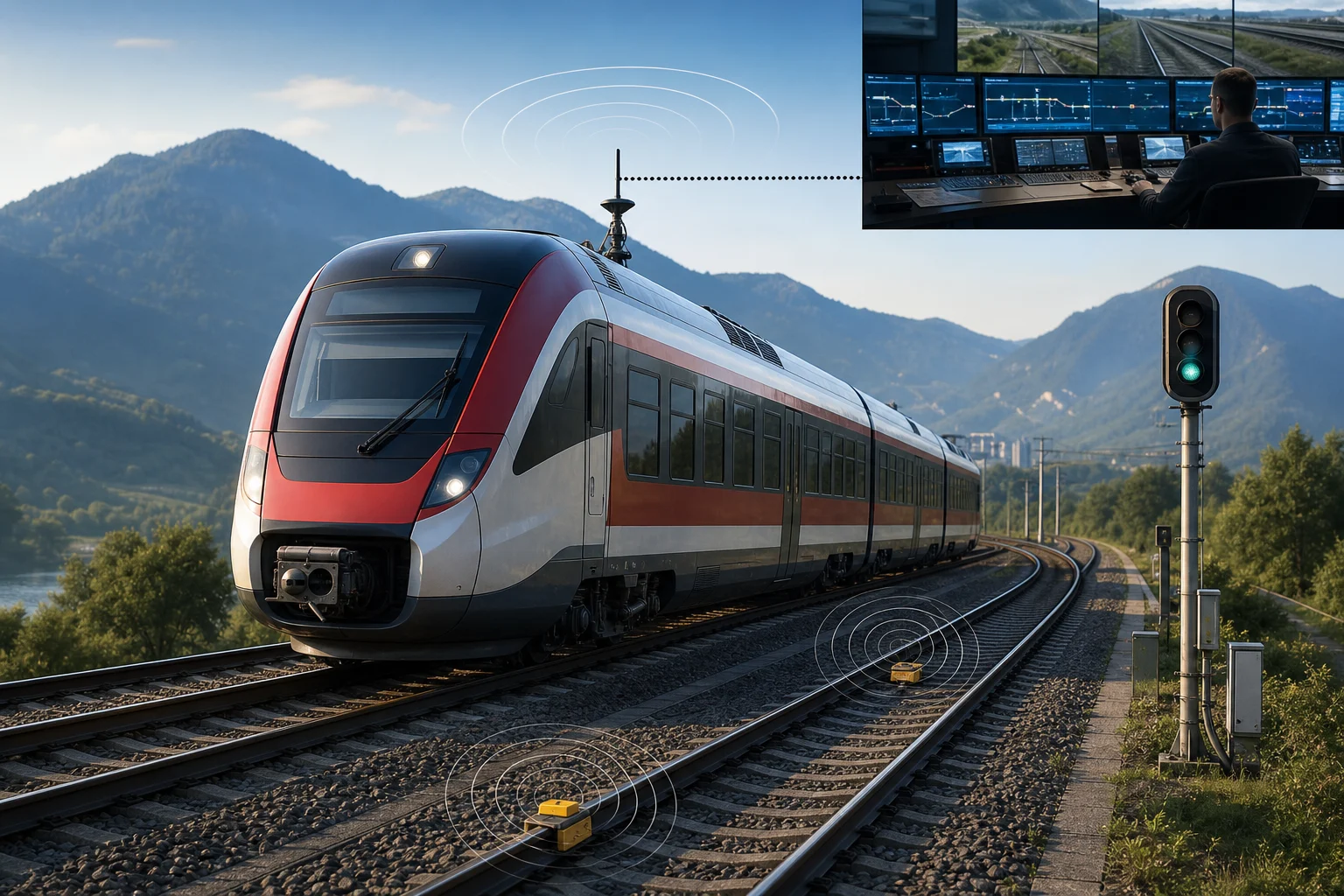
The short answer to what railway ETCS is: it is a cab signalling system incorporating automatic train protection. It is not the same as automatic train operation: it belongs to the field of command, control and movement protection. This is the definition given by the European Union Agency for Railways (ERA).
ETCS is part of ERTMS, the European Rail Traffic Management System. ERA includes ETCS itself, the GSM-R communications system and operating rules within ERTMS. Therefore, using both acronyms as though they were synonyms is inaccurate: ERTMS is the broader framework, while ETCS is one of its components.
According to ERA, ERTMS is intended to ensure the interoperability of national railway systems. This purpose does not mean that ERTMS alone replaces every element of railway operations.
- ETCS: a cab signalling system with automatic train protection.
- ERTMS: according to ERA, comprises ETCS, GSM-R and operating rules.
- GSM-R: provides voice communications between the driver and signaller, as well as data for ETCS.
- Do not confuse ETCS with automatic train operation or ATO.
The elements involved in transmission using Eurobalises
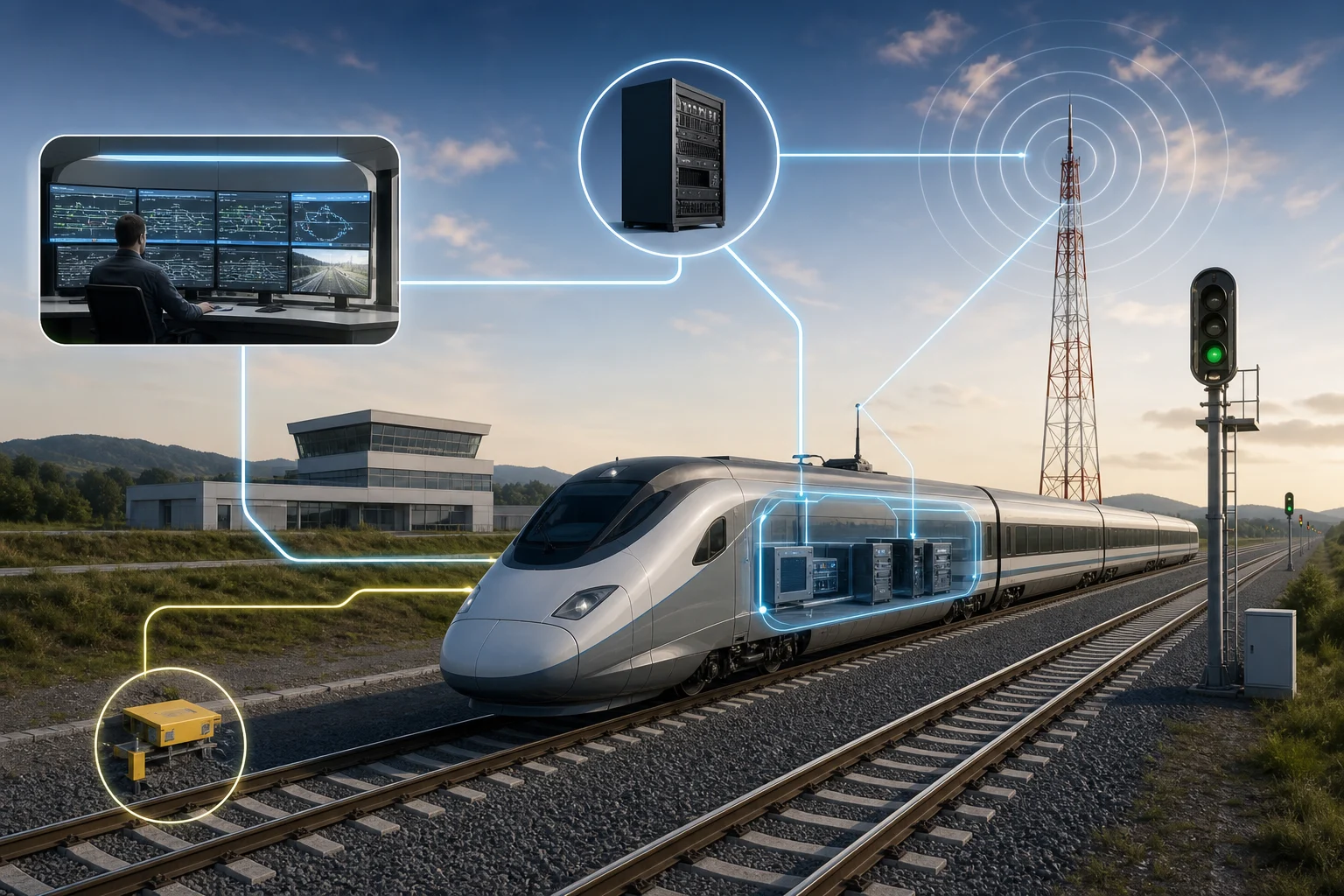
Eurobalises are a point transmission medium. The ERA and UNISIG Eurobalise specification states that information is exchanged when the onboard antenna unit passes over a balise or remains positioned above it.
The physical exchange area is limited to approximately one metre per balise. Therefore, it is not correct to describe Eurobalises as a continuous communications system along the entire line.
The documented Eurobalise architecture includes the balise installed on the track and the onboard transmission equipment, consisting of the antenna and the BTM function. On the infrastructure side, an LEU connected to the signalling system or interlocking may be involved.
- Eurobalise: a transmission point between track and train.
- Antenna and BTM function: onboard elements associated with balise transmission.
- LEU: trackside equipment that may be connected to signalling or an interlocking.
- Transmission using Eurobalises is point-based, not continuous.

What happens when a movement authority arrives
In ETCS Level 2, movement authorities are transmitted by radio. The UNISIG technical definition also states that train position determination relies on conventional means.
Cab signalling and radio transmission do not by themselves imply automatic train operation. Nor do they allow conclusions to be drawn, without installation-specific documentation, about which trackside or operational elements are used on each line.
On Adif's network, ERTMS Level 2 documentation provides for authentication keys between ETCS entities identified as RBC and OBU, as well as a session key to verify the integrity of exchanged messages. These references describe elements of that technical architecture.
- Level 2: movement authorities are transmitted by radio.
- According to the Level 2 technical definition, train position is determined by conventional means.
- Adif's Level 2 documentation identifies ETCS entities such as RBC and OBU.
- Cab signalling is not the same as automatic train operation.
ETCS Level 1: point information and lineside signalling
UNISIG technical documentation defines ETCS Level 1 as an overlay on conventional lineside signalling. Combined with ERA's general definition of ETCS, this description makes it possible to understand that Level 1 incorporates cab signalling and automatic train protection in a configuration overlaid on conventional lineside signalling.
Track-to-train communication in Level 1 may be provided by Eurobalise and, depending on the installation, by radio infill or Euroloop. Eurobalises provide information at specific points.
Euroloop is defined in the technical specification as a semi-continuous and intermittent transmission system using a radiating cable alongside the track. It is not equivalent to a conventional mobile radio network.
- Level 1: an overlay on conventional lineside signalling, according to UNISIG.
- Eurobalise: point transmission when the train passes over the balise.
- Radio infill and Euroloop: documented options for track-to-train communication in Level 1.
- Euroloop: a radiating cable with semi-continuous and intermittent transmission.
ETCS Level 2: radio and the differences that matter
In ETCS Level 2, movement authorities are transmitted by radio and train position is determined by conventional means. This is the description given in UNISIG's ETCS technical glossary.
ERA identifies GSM-R as the technology providing ETCS data and voice communications between the driver and signaller within ERTMS. This general function does not by itself determine the communications solution of a specific installation.
The documented difference between Levels 1 and 2 lies in the communication described by the specifications: Level 1 may use Eurobalise, radio infill or Euroloop for track-to-train communication; Level 2 transmits movement authorities by radio. Specific capabilities must not be inferred solely from the level designation.
- Level 1: may use Eurobalise, radio infill or Euroloop for track-to-train communication.
- Level 2: movement authorities are sent by radio.
- Level 2: train position is determined by conventional means.
- GSM-R provides ETCS data and voice communications between the driver and signaller.
- The ETCS level alone is not enough to describe a specific installation.
ETCS, ASFA and how to read deployment announcements in Spain
In Spain, ETCS should not be presented as a simple universal replacement for ASFA. Adif defines ASFA as a system for point transmission of signal aspects into the cab, which can order emergency automatic braking if the driver does not act in accordance with the received information. ETCS and ASFA correspond to different definitions and architectures.
Spanish rolling-stock regulations require demonstration of compliance with the interface between ERTMS/ETCS equipment and digital ASFA, as well as dynamic transitions where mandatory. Therefore, coexistence between the two systems should not be described as merely a driver's choice during a journey.
When reading an announcement about a deployment, it is advisable to identify the ETCS level and the section to which it refers. It is also necessary to distinguish between an announced technology and an installation whose authorisation for placing into service is documented. ERA frames trackside ERTMS approval within the authorisation for placing into service dossier for the trackside control-command and signalling subsystem.
- Check the level: Levels 1 and 2 do not describe the same communication arrangements.
- Identify the specific section to which the announcement refers.
- Look for references to radio, Eurobalises, Euroloop or radio infill, as applicable.
- Check how transitions with ASFA or other national systems are documented.
- Distinguish between an announcement, works, testing and authorisation for placing into service.
- Authorisation for placing trackside ERTMS into service forms part of the applicable dossier for the control-command and signalling subsystem.
What is ETCS in railways?
ETCS is a cab signalling system that incorporates automatic train protection. According to ERA, it forms part of ERTMS alongside GSM-R and operating rules.
Are ERTMS and ETCS the same thing?
Not exactly. ERA describes ERTMS as a framework comprising ETCS, GSM-R and operating rules. ETCS is one of its components.
What is the main difference between ETCS Level 1 and Level 2?
Level 1 is defined as an overlay on conventional lineside signalling and may use Eurobalise, radio infill or Euroloop for track-to-train communication. Level 2 transmits movement authorities by radio and uses conventional means to determine train position.
Does ETCS always replace ASFA in Spain?
It should not be understood that way. Adif defines ASFA and ETCS differently, and Spanish regulations require the interfaces between ERTMS/ETCS and digital ASFA to be demonstrated, as well as dynamic transitions where mandatory.
Does an announcement of trackside ETCS mean that authorisation for placing it into service has been granted?
Not necessarily. ERA states that trackside ERTMS approval is incorporated into the authorisation for placing into service dossier for the trackside control-command and signalling subsystem.