Catenary-free trains: when to choose battery, hydrogen or modern diesel
Non-electrified regional lines do not have a single technological answer: battery, hydrogen, hybrids and modern diesel depend on the route, the energy and the available infrastructure.
Key points
Non-electrified regional lines do not have a single technological answer: battery, hydrogen, hybrids and modern diesel depend on the route, the energy and the available infrastructure.
| Topic | Key point |
|---|---|
| Concept map: what powers each train | A conventional diesel train carries its fuel on board and produces traction energy with combustion engines. |
| Battery: ideal for partially electrified networks, not for everything | Battery is the most intuitive option when a line already has electrified sections. |
| Hydrogen: longer range, more energy infrastructure | Rail hydrogen changes the problem. |
| Modern diesel and hybrids: transition, not a blank cheque | Although climate pressure is pushing towards solutions with no direct emissions, diesel does not disappear overnight. |
Why catenary-free trains exist
Some of Europe’s regional lines are still not electrified. This is not always due to a lack of climate ambition: installing continuous overhead catenary requires fixed railway infrastructure, planning and investment that can be hard to justify on low-frequency branches or complex alignments. The problem is clear: electric trains with overhead catenary remain the reference where the line supports them, but the real network has gaps where diesel still provides passenger services and shunting operations today.
The European Union does not present catenary-free trains as universal substitutes for electrification. Regulation (EU) 2023/1804 on alternative fuels infrastructure refers to assessing solutions such as hydrogen or battery trains for railway sections that cannot be fully electrified for technical or cost-efficiency reasons. For TEN-T network sections that cannot be electrified, Member States must consider the situation, prospects, measures, milestones, financing and recharging or refuelling needs.
The European Union Agency for Railways, in its 2024 railway environmental report, also identifies battery trains and hydrogen fuel-cell trains as options with the potential to replace diesel on part of the network. The key lies in that phrase, “on part”: each technology works well in some operating patterns and poorly in others.
- Basic idea: catenary remains the benchmark where traffic and construction works justify it.
- A catenary-free train makes sense where electrifying the whole route is not feasible or does not pay off.
- Public decision-making must look at the line, service, available energy, maintenance and infrastructure, not just the train.
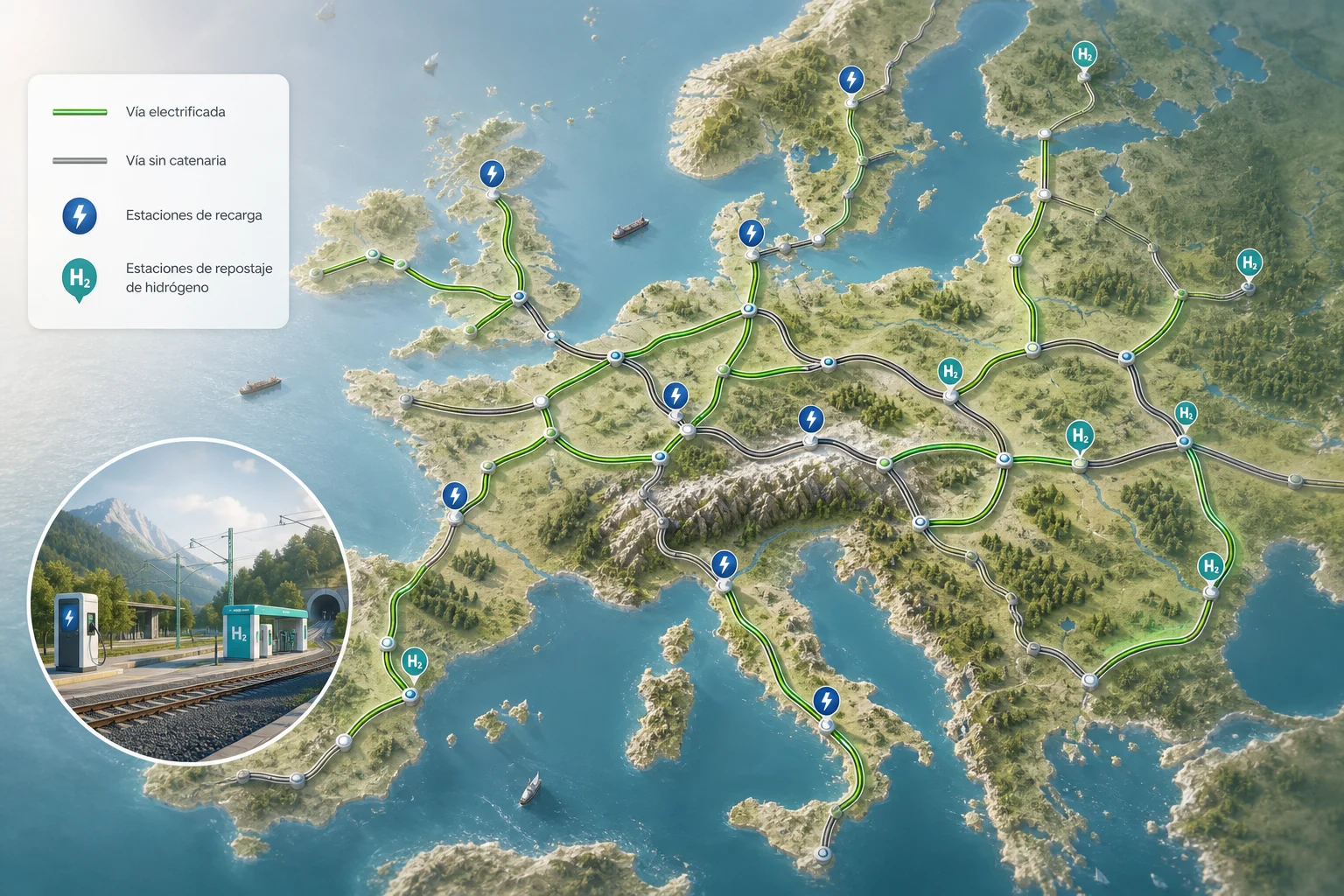
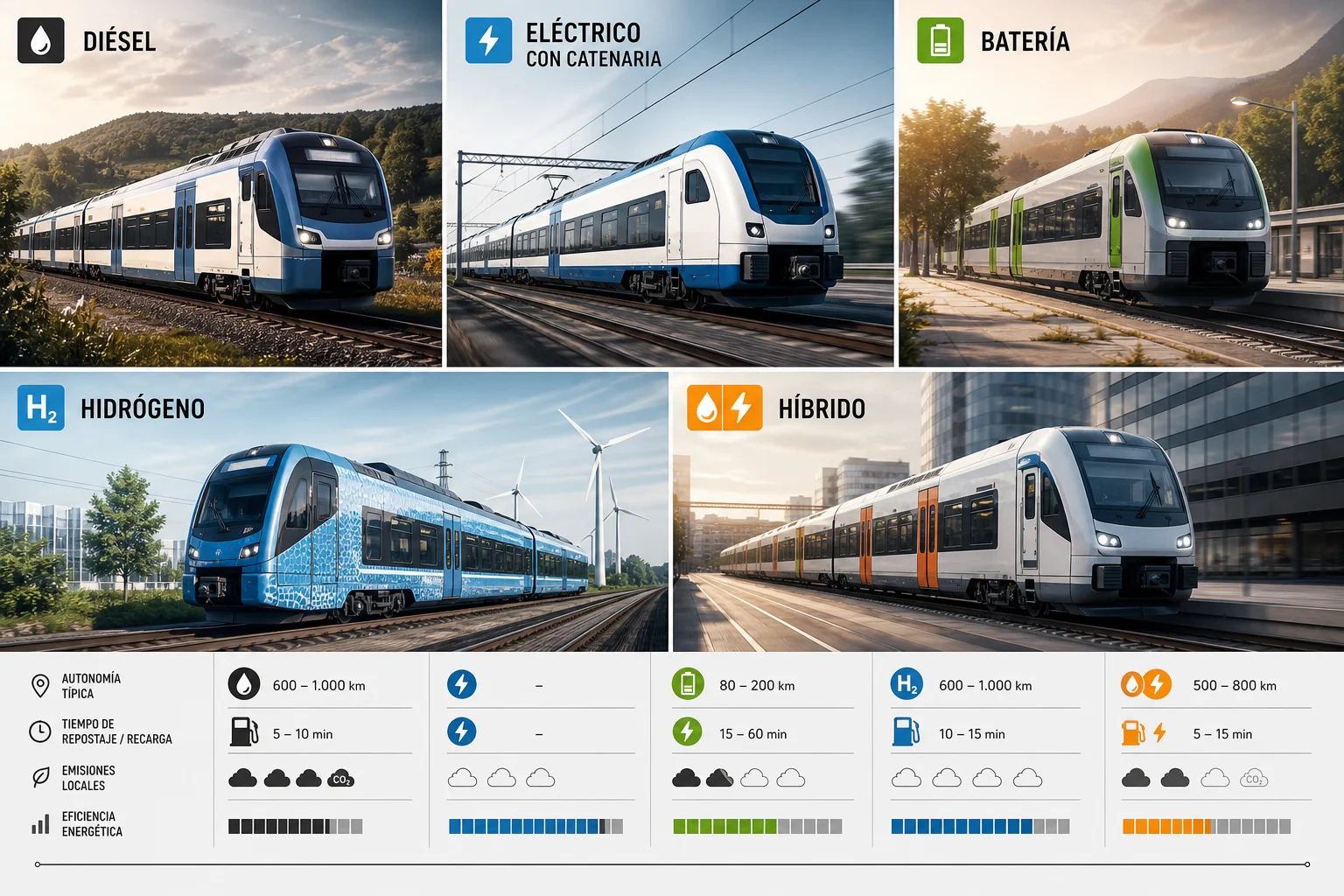
Concept map: what powers each train
A conventional diesel train carries its fuel on board and produces traction energy with combustion engines. Its operational advantage is that it does not depend on catenary or continuous railway electrical infrastructure, but it maintains direct emissions and fossil fuel consumption if it uses conventional diesel fuel.
An electric train with catenary takes energy from the overhead line. It is the classic solution for corridors and lines where fixed infrastructure is justified. Its limit is not only technological, but also economic and construction-related: electrifying every kilometre may not be reasonable on every branch line.
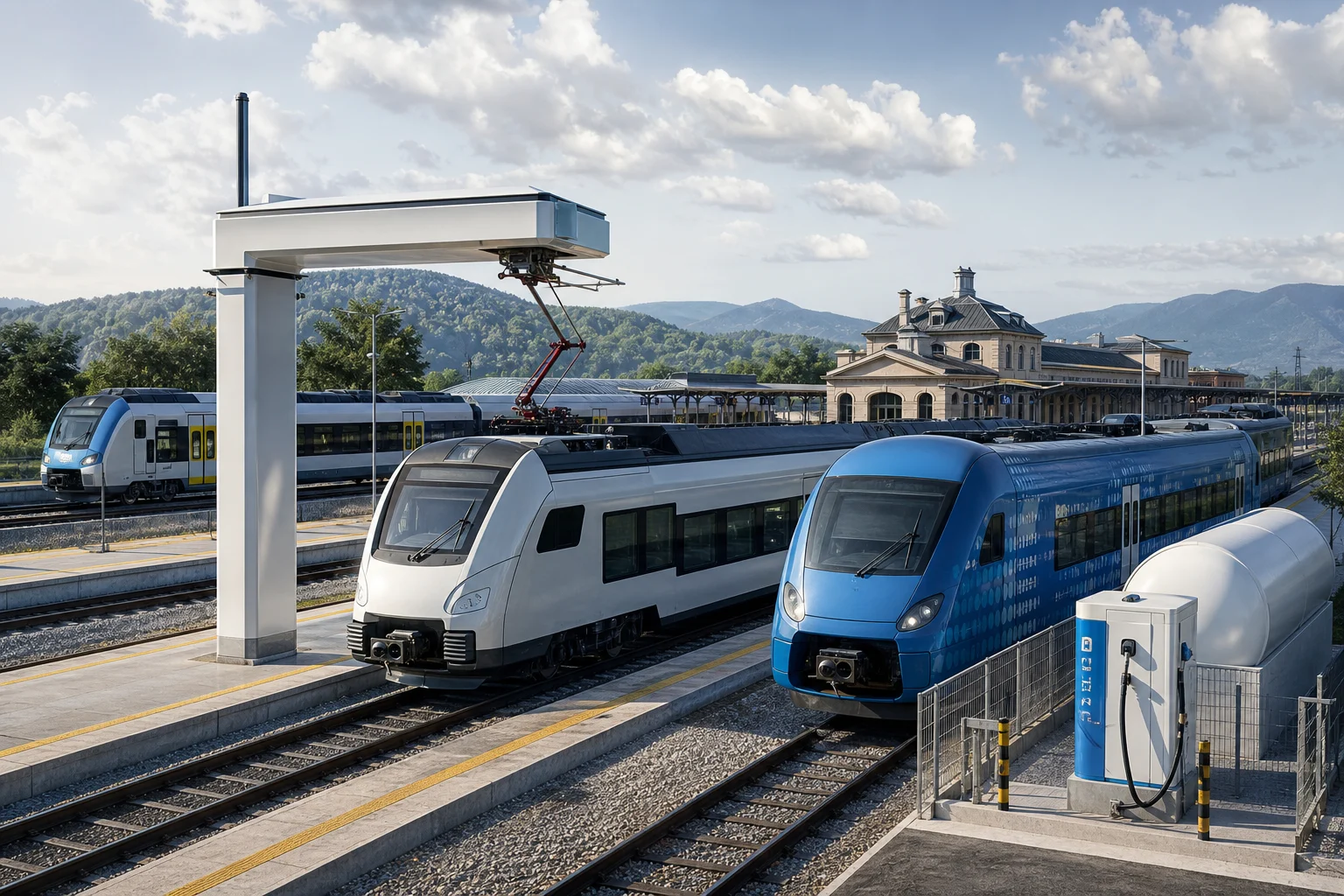
A battery train, or BEMU, combines electric traction with onboard batteries. It can run under catenary like an electric train and cover non-electrified sections using stored energy. In documented projects, charging is carried out under existing catenary, via catenary islands at stations or through regenerative braking energy recovery.
A hydrogen train uses a fuel cell that generates electricity on board from hydrogen. Alstom describes the Coradia iLint as a regional fuel-cell train that emits no direct CO2 in operation and whose exhaust is water. In return, it needs hydrogen production, transport or local generation, storage and refuelling.
A hybrid train combines solutions. It can be battery plus catenary, hydrogen plus battery and catenary, or dual diesel-electric for certain uses. The ERA notes that, for European shunting locomotives, one technical priority is to develop dual diesel-electric locomotives that can move through both electrified and non-electrified sections.
- Battery: strongest fit when there is partial catenary or well-placed charging points.
- Hydrogen: interesting for routes without catenary, provided refuelling is guaranteed.
- Modern or dual diesel: can cover transition, shunting or lines where alternatives do not yet fit.
Battery: ideal for partially electrified networks, not for everything
Battery is the most intuitive option when a line already has electrified sections. Siemens explains that the Mireo Plus B is charged via catenary and regenerative braking energy recovery. In the Baden-Württemberg order for the Ortenau regional network, the manufacturer stated a range of around 80 km in battery mode under real conditions. That contract included 20 trains, delivery announced at the time for June 2023 and maintenance for almost 30 years.
Alstom states a range of up to 120 km for the Coradia Continental BEMU, with operation both under catenary and on non-electrified sections, roof-mounted batteries and a speed of up to 160 km/h in battery mode. Stadler, for its part, supplies FLIRT Akku units; in Schleswig-Holstein, NAH.SH ordered 55 two-car units in July 2019.
The Schleswig-Holstein case illustrates the battery logic well: the point is not to electrify the whole network with continuous catenary, but to use existing catenary intelligently and add targeted infrastructure. NAH.SH refers to making around 480 km of network operational without installing continuous catenary, with catenary islands on non-electrified platforms such as Tönning, Heide and Husum.
The limit can appear when catenary-free sections are long, stop times are short, gradients or weather increase consumption, or demand requires heavy and very frequent formations. There is also the risk of designing a line “on the edge” of range: any diversion, delay, low temperature or battery degradation reduces the margin.
- Battery checklist: kilometres without catenary between charges, dwell time, available power, regenerative braking, operating reserve and maintenance plan.
- Typical planning failure: buying trains with sufficient catalogue range, but without reinforcing charging points or timetable margins.
- Good scenario: regional branches that connect with electrified corridors and have terminal stations suitable for charging.
Hydrogen: longer range, more energy infrastructure
Rail hydrogen changes the problem. Instead of installing catenary or frequent electric charging, it concentrates the infrastructure at refuelling points. Alstom positions the Coradia iLint for non-electrified or partially electrified lines and states ranges of up to 1,000 km. On 15 September 2022, the company reported a 1,175 km run without refuelling; it should be read as a demonstration milestone, not as a guarantee of daily operation on any line.
The operational advantage is clearer on routes without catenary where battery charging would need more careful planning. But the system requires a complete chain: hydrogen produced, stored, compressed or managed under railway conditions, delivered to the train and reliably available every day.
Bremervörde, in Lower Saxony, is a documented European rail hydrogen example. Linde inaugurated on 24 August 2022 a refuelling facility designed for 14 hydrogen passenger trains, with a total capacity of approximately 1,600 kg of hydrogen per day and the possibility of integrating on-site green generation in the future.
The debate does not end at the train’s exhaust. The fact that there is no direct CO2 in operation does not in itself resolve the origin of the hydrogen or the energy losses involved in producing it, storing it and converting it back into electricity. That is why hydrogen usually makes more sense when full electrification is difficult, battery does not provide enough margin and there is a solid local energy strategy.
- Hydrogen checklist: number of trains to refuel, daily consumption, location of the hydrogen refuelling station, origin of the hydrogen, redundancy and supply contracts.
- Typical planning failure: having approved trains but insufficient refuelling infrastructure or infrastructure dependent on fragile logistics.
- Good scenario: a regional network, largely non-electrified, with a maintenance base where refuelling can be centralised.
Modern diesel and hybrids: transition, not a blank cheque
Although climate pressure is pushing towards solutions with no direct emissions, diesel does not disappear overnight. On low-density networks, with still-useful rolling stock or no alternative infrastructure available, it may continue to appear as a temporary solution. The point is to prevent the “temporary” from becoming an excuse not to plan replacement.
Hybrids help cover gaps. Siemens defines the Mireo Plus B as a battery hybrid train capable of operating on routes with or without catenary thanks to its battery hybrid drive. In other approaches, the combination can rely on catenary where external power exists and reserve onboard energy for catenary-free sections.
In light freight, shunting or auxiliary services, needs may differ from those of a regional passenger train. This is where the ERA’s observation on dual diesel-electric shunting locomotives fits: vehicles capable of using electric traction where power supply exists and maintaining capability outside it. It is not a zero-emission solution at all times, but it can reduce dependence on pure diesel and improve flexibility.
The useful criterion is to ask what is being purchased: a real reduction in emissions and consumption within a dated plan, or simply more years of diesel dependence. Without an infrastructure timetable, financing and fleet renewal, modern diesel can block better alternatives.
- Useful as a transition: when there is a date to electrify, install charging or deploy hydrogen.
- Risk: sizing the network around diesel for operational convenience and delaying necessary investment.
- Key question: does the hybrid train use clean external energy when it can, or does it only add complexity to the existing system?
Infrastructure and costs: the decision is not only in the train
Comparing catenary-free trains requires looking at the whole system. Electrifying a line involves high fixed investment, but offers a continuous and proven power supply. Installing chargers or catenary islands can be more selective, although it requires timetables, electrical power and range to fit together. Building a hydrogen refuelling station can concentrate investment in one or several points, but it adds the hydrogen supply chain, storage and specific safety requirements.
European regulation insists precisely on planning recharging or refuelling infrastructure for battery or hydrogen trains on sections that cannot be electrified. Buying new units is not enough: it is necessary to ensure that they will be able to fulfil service diagrams for years, with maintenance, spare parts, trained staff and available energy.
A practical way to frame the decision is this: where continuous electrification is technically and economically justified, it remains the reference; where non-electrified gaps are compatible with charging, battery becomes attractive; where electrification is difficult and battery margins are insufficient, hydrogen may have arguments, provided supply is resolved. Diesel or dual traction remains for transition, special uses or cases where there is still no mature alternative for the specific service.
- Decisive variables: frequency, catenary-free length, gradients, climate, train mass, dwell times, available energy, maintenance base and contractual service life.
- Warning sign: choosing a technology because it is fashionable without a line-by-line operating study.
- Good practice: separate trials, firm orders, entry into service and real performance before generalising conclusions.
European cases and safety: what is proven and what remains under evaluation
There are already commercial projects and pilots in Europe, but they do not all mean the same thing. Baden-Württemberg ordered 20 Siemens Mireo Plus B trains for Ortenau with a stated battery range of around 80 km. Schleswig-Holstein ordered 55 Stadler FLIRT Akku units and supports the fleet with specific charging infrastructure. Alstom offers BEMU trains with a stated range of up to 120 km and the hydrogen Coradia iLint with up to 1,000 km in its product application.
The Bremervörde case shows documented rail hydrogen infrastructure: on 24 August 2022, Linde inaugurated a facility designed to refuel 14 hydrogen passenger trains, with a total capacity of approximately 1,600 kg per day. By contrast, milestones such as the iLint’s 1,175 km without refuelling must be cited as range tests or demonstrations, not as widespread normal operation.
Railway safety cannot be improvised. Batteries, hydrogen tanks, fuel cells, charging systems and refuelling systems require approval, specific maintenance and staff training. For users, what matters is not knowing technical procedures, but knowing that these trains must be integrated into the railway interoperability and safety framework before entering service.
The conclusion is not spectacular, but it is useful: there is no single “catenary-free train” that wins everywhere. There are lines where a catenary island and batteries solve the problem elegantly; others where hydrogen avoids electrifying many kilometres; and cases where dual or hybrid diesel covers a transition. The best technology is the one that fits the network, not the one that promises the most on a technical sheet.
- Available: orders, references and documented infrastructure such as FLIRT Akku, Mireo Plus B, Coradia Continental BEMU or Coradia iLint on specific networks.
- Under evaluation: range demonstrations that do not, by themselves, amount to mass deployment.
- Final criterion: verify whether infrastructure, energy, approval, maintenance and financing exist for the whole service life.
Can a battery train always replace a regional diesel train?
No. It works best when there is partial catenary, well-placed charging points and sufficient range margins. On long, demanding lines or lines without adequate charging times, it may not be the most robust option.
Does a hydrogen train emit no CO2?
In operation, trains such as the Coradia iLint emit no direct CO2 and release water, according to Alstom. But the balance also depends on how the hydrogen is produced, transported and stored.
Why not electrify all lines with overhead catenary?
Catenary is effective on corridors where fixed infrastructure is justified, but on certain sections it may not be feasible for technical or cost-efficiency reasons. European legislation considers battery and hydrogen for those cases.
What is the difference between a range test and a commercial service?
A test demonstrates capability under specific conditions, such as long runs without recharging or refuelling. A commercial service requires meeting daily timetables, maintenance, safety, infrastructure and availability for years.