Long car journeys: breaks and signs of fatigue
Plan your breaks, recognise the signs of drowsiness in time and act safely on a long road journey.
Key points
Fatigue is prevented through sufficient sleep, a realistic route and planned breaks, but if drowsiness appears there is only one effective response: stop somewhere safe and rest. Spain’s DGT recommends planning breaks roughly every two hours or 200 kilometres, without waiting for warning signs.
Quick answer: do not wait until you feel sleepy to plan a stop
To avoid fatigue on a long journey, it is not enough to react when it is already hard to keep your eyes open. The decisive measure is taken before setting off: do not start driving after an intense working day or with accumulated sleep deprivation, choose a departure time that does not coincide with periods of greatest drowsiness, and split the journey into stages with proper breaks.
While driving, the rule should be clear. If signs of tiredness or sleepiness appear, you must stop somewhere safe and rest. Spain’s DGT warns that opening the window or turning up the music are ineffective tricks: they do not eliminate fatigue. Nor should coffee or tea be seen as a solution, as it recommends caution because of their possible rebound effect.
As a guide for long journeys, the DGT advises stopping every two hours or 200 kilometres and taking breaks of at least 20 to 30 minutes. This is a guideline, not permission to drive to the limit: if the driver is tired or conditions become more difficult, the stop should be brought forward.
Section references: DGT — Conducir con sueño o cansancio ↗ · DGT — Cansancio: estas son las señales de alarma ↗
- Plan breaks before setting off and treat them as part of the journey time.
- Stop immediately at any sign of sleepiness or fatigue, even if the planned stop is not yet due.
- Do not extend the drive to reach your destination, a meal or a booking if the driver is no longer fit to drive.
Why fatigue changes your driving before you realise it
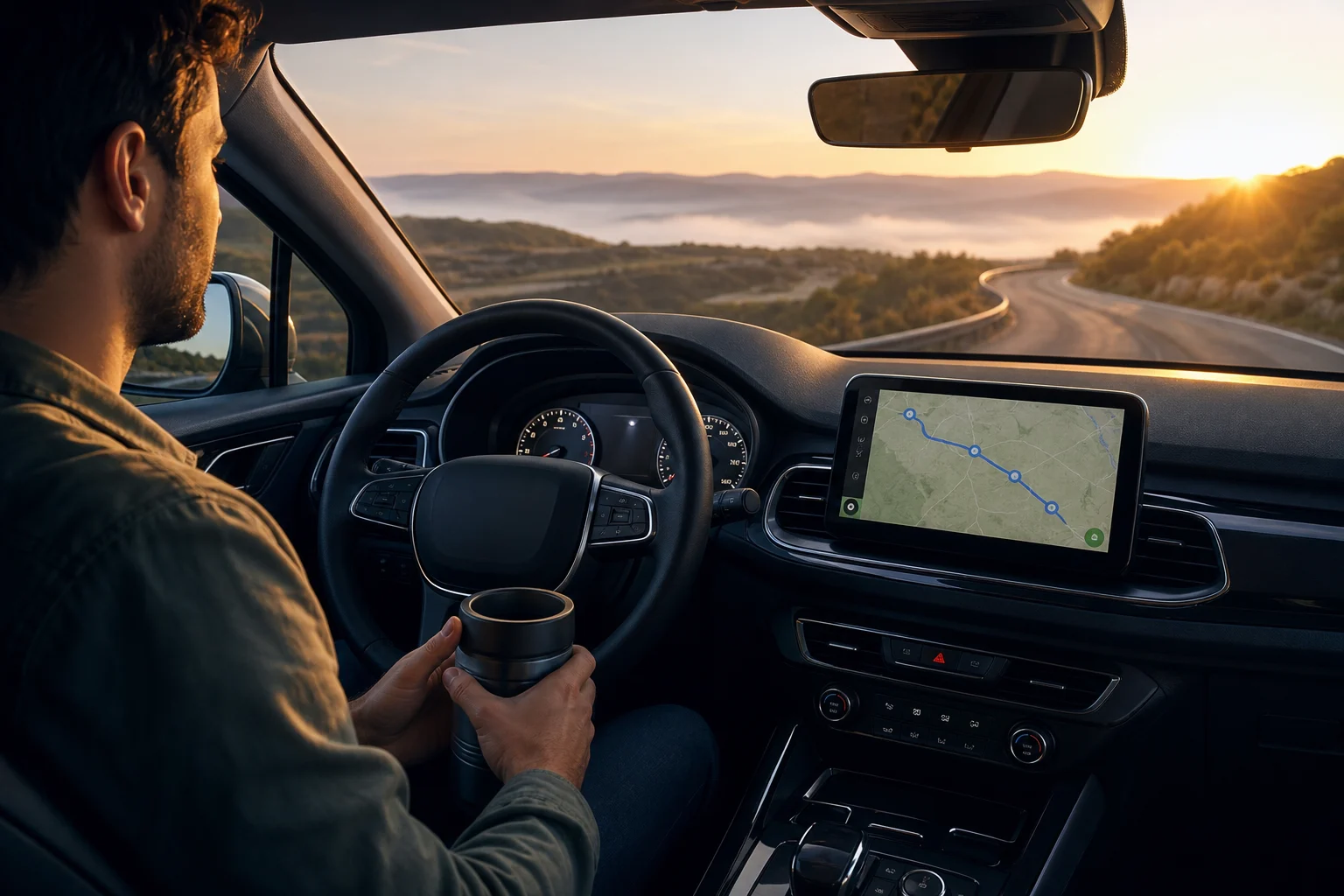
Fatigue is not just a feeling of discomfort. Drowsiness makes it harder to stay focused, slows down information processing and makes wrong decisions more likely. It also noticeably increases the time needed to react to a traffic-related stimulus.
This impairment matters on every type of road and in every traffic situation: reduced concentration, slower information processing, wrong decisions and longer reaction times reduce the ability to drive safely.
The most extreme risk is microsleep: episodes lasting just a few seconds in which the driver is unaware of what is happening in traffic. At any sign of tiredness, stop somewhere safe and rest.
Section references: DGT — Conducir con sueño o cansancio ↗ · DGT — Conducir con fatiga ↗
- Do not assume that talking to passengers means you are alert.
- Do not wait to make a serious mistake before recognising that tiredness is affecting your driving.
- Assess your own condition before each new stage, not only at the start of the day.
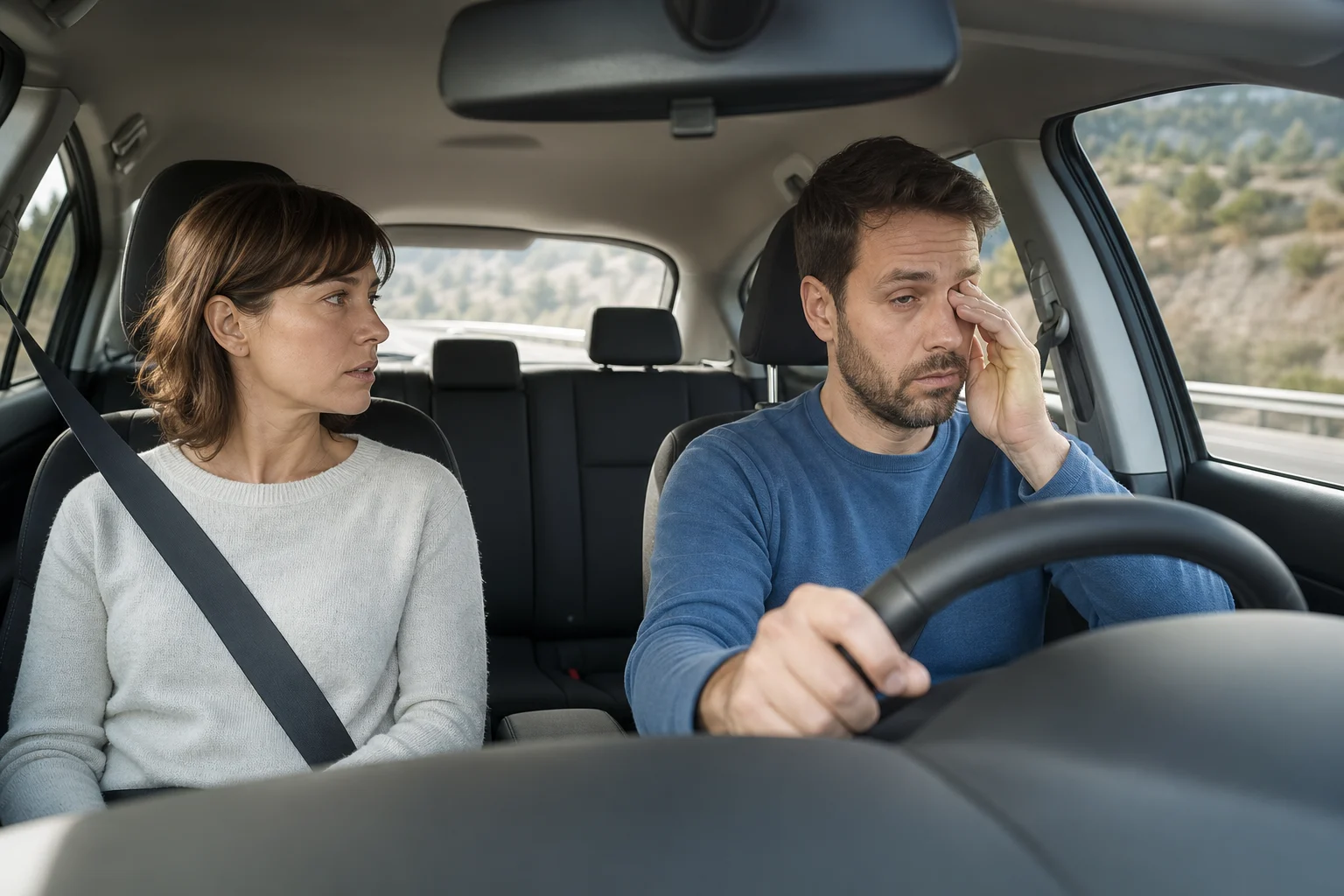
Before setting off: turn the journey into a plan you can follow
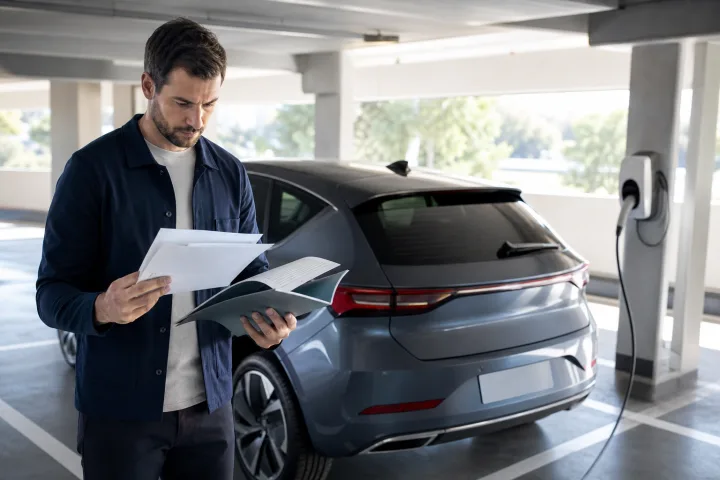
The first safety decision is not to start a long journey after an intense working day or with accumulated sleep deprivation. Leaving later, splitting the route or postponing departure may be more prudent than trying to compensate for tiredness while driving.
When estimating the duration, add stops to the driving time. A route lasting many hours should not be organised as though the kilometres were covered without interruption. Allow time for traffic, breaks and the needs of those travelling with you; this makes you less likely to feel pressure to make up time at the wheel.
When planning, the DGT advises avoiding times of greatest drowsiness: the early hours of the morning and the period after eating. It is also worth checking whether the route includes factors that will require more attention, such as heavy traffic, an unfamiliar road or adverse weather.
If there are two people licensed to drive, decide before setting off how you will share the driving. Taking turns helps distribute the effort.
Section references: DGT — Cansancio: estas son las señales de alarma ↗ · DGT — Conducir con fatiga ↗
- Check how well rested you are before confirming the departure time.
- Include 20- to 30-minute breaks in the planned schedule.
- Avoid planning to arrive in the early hours or just after eating if you have a choice.
- Agree on driver changes and stopping areas before beginning the journey.
Schedule breaks and bring them forward when conditions change
The DGT guideline—stopping every two hours or 200 kilometres for at least 20 to 30 minutes—is a good starting point for structuring a long journey.
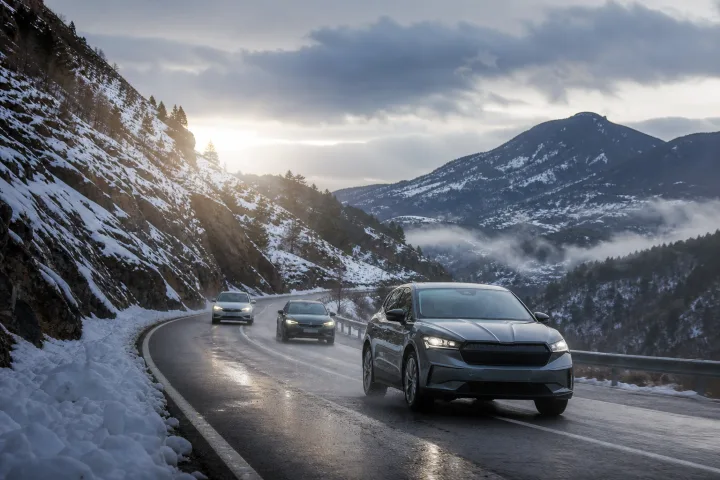
Circumstances may require more frequent breaks. Night driving, fog, rain, snow, heavy traffic and an unfamiliar road increase the attention required and can intensify fatigue. Heat and poor ventilation can also make driving more uncomfortable and encourage drowsiness.
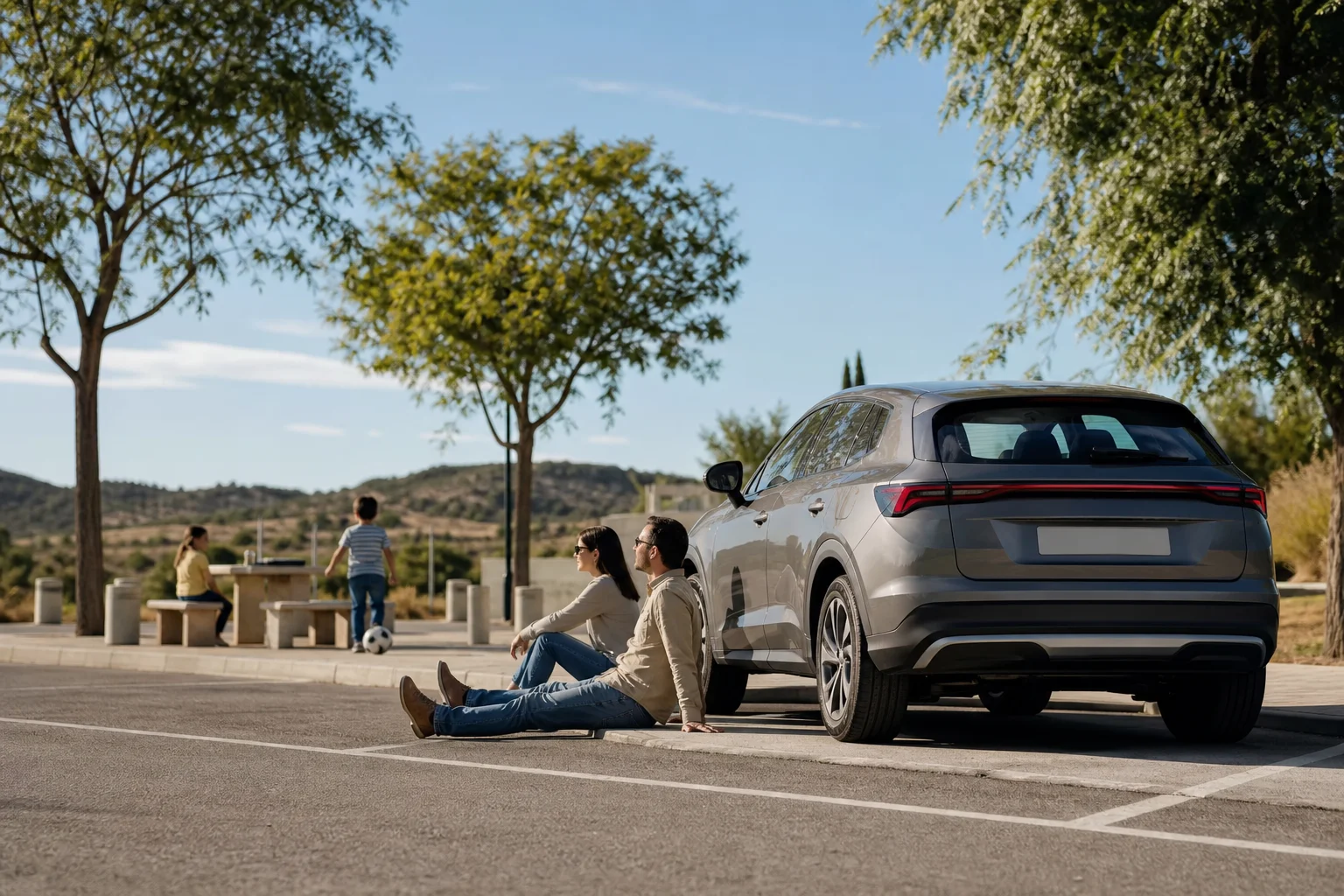
On hot days, a stop has several purposes: hydrating, airing out the vehicle and relaxing. If parked in the sun, children, older people and animals must not be left inside the car, even while carrying out a brief errand.
| Situation | Practical decision |
|---|---|
| Long journey in normal conditions | Schedule a break every two hours or 200 kilometres, lasting at least 20 to 30 minutes. |
| Any sign of tiredness appears | Stop somewhere safe without waiting for the scheduled break. |
| Night, adverse weather, heavy traffic or an unfamiliar road | Increase the frequency of stops. |
| Heat or poor ventilation | Take breaks to hydrate, air out the vehicle and relax. |
Section references: DGT — Conducir con sueño o cansancio ↗ · DGT — Conducir con fatiga ↗ · DGT — Conducir con altas temperaturas ↗
- First rule: stop every two hours or 200 kilometres.
- Bring the next stop forward if you are driving at night, in bad weather, in heat or in heavy traffic.
- Choose a safe place to stop; do not wait for an emergency.
- In summer, use the break to drink water and air out the cabin.
Warning signs: when you need to stop driving
Fatigue can show itself in several ways, and just one of them is enough to interrupt the journey. Among the signs described by the DGT are yawning, excessive blinking, heavy eyes, difficulty staying focused and lack of coordination.
Slower or less precise movements, blurred vision and altered visual perception must also be taken seriously. If you notice blurred vision or changes in visual perception, do not try to correct it with temporary stimuli: find somewhere safe to stop.
Once stopped, the break must be effective. The DGT suggests drinking water, stretching your legs and sleeping a little if necessary. A 20- or 30-minute break can save lives. The aim is not to fill the stop with activities, but to regain suitable conditions before driving again.
Section references: DGT — Cansancio: estas son las señales de alarma ↗ · DGT — Conducir con fatiga ↗
- Repeated yawning, heavy eyes or excessive blinking: stop.
- Lack of coordination, imprecise movements or difficulty concentrating: stop.
- Blurred vision or altered visual perception: stop.
- After stopping, hydrate, move around and sleep a little if you need to before deciding whether to continue.
With passengers, children or pets: breaks that protect everyone
Travelling with others makes it possible to share the driving if another person is licensed to drive, a measure the DGT recommends to distribute the effort.
With children, older people or pets, it is reasonable to include their needs in the stopping schedule. The key is not to use those stops as an argument for stretching the previous or following stage too far. The two-hour or 200-kilometre guideline remains the reference and must be brought forward if the driver shows signs of tiredness.
It is also best to sort out luggage before setting off. A rest stop should not turn into a rushed period of constant reorganisation or arguments that reduce recovery. Prioritise a simple sequence: park safely, attend to people and animals, hydrate, move around, rest and honestly check whether the person who will drive is fit to do so.
Section references: DGT — Cansancio: estas son las señales de alarma ↗ · DGT — Conducir con altas temperaturas ↗
- Share driving turns, but change drivers earlier if the current driver shows fatigue.
- Keep family stops compatible with the driver’s rest.
- Never leave children, older people or animals inside a car parked in the sun.
How often should you stop on a long car journey?
As a guideline, the DGT recommends stopping every two hours or 200 kilometres and taking breaks of at least 20 to 30 minutes. At night, in bad weather, in heat, in heavy traffic or when fatigue appears, it is advisable to stop more often.
Does coffee prevent you from falling asleep at the wheel?
It should not be seen as a solution to tiredness. The DGT advises caution with coffee or tea because of the possible rebound effect and stresses that rest is the only effective way to eliminate fatigue.
What fatigue symptoms mean you must stop?
Repeated yawning, heavy eyes, excessive blinking, difficulty concentrating, lack of coordination, imprecise movements, blurred vision or altered perception are signs that you should stop somewhere safe.
Does opening the window or turning up loud music help you keep driving?
No. The DGT identifies these measures as ineffective tricks that do not eliminate fatigue. If you show signs of sleepiness or tiredness, the response is to stop somewhere safe and rest.
How should you organise driver changes when two drivers are travelling?
Agree on driving turns and stops before setting off to distribute the effort. The driver change should happen earlier if the current driver shows signs of tiredness.