Loaded car and consumption: weight, luggage and trip aerodynamics
Weight, roof racks, roof boxes, bike carriers and trailers do not affect consumption in the same way. We explain what to check to travel safely when fully loaded, without drawing hasty conclusions from a single route.
Key points
Roof loads can increase consumption, while external accessories can alter aerodynamic drag on the road. The efficient and safe approach is to place loads in the boot where possible, observe vehicle limits and check every accessory.
The short answer: not all luggage affects consumption equally
When preparing a loaded car, it is worth distinguishing between cargo carried inside the vehicle and accessories fitted outside it. On a sustained road journey, one important factor is air resistance. This is why a load on the roof can have a different effect from one placed inside the boot.
Spain's DGT warns that carrying loads on a roof rack can compromise stability and increase consumption. That warning should not be turned into a fixed percentage: the result depends on the car, the shape and positioning of the accessory, the load, speed and journey conditions. The useful figure is the one obtained for the actual combination of vehicle, accessory and trip.
The initial guideline is simple: carry the load in the boot first, use an external solution only when necessary, and do not sacrifice stability, visibility or compliance with mass limits in an attempt to reduce fuel or energy use.
Section references: DGT: transporte de cargas y animales en turismos ↗ · Ecuación de la resistencia aerodinámica ↗
- More mass: include passengers, luggage and accessories when assessing the total load.
- More aerodynamic drag: this becomes more important at sustained speeds and can increase with external accessories.
- Safety and manufacturer limits take priority over any potential saving.
Permitted masses and load distribution
It is important to separate the actual load from the concepts shown in the vehicle documentation. The maximum authorised mass, or MMA, is the maximum mass at which a loaded vehicle may be used on public roads. The maximum technically permissible mass is based on the vehicle's construction and specified by its manufacturer. They are not interchangeable labels and do not allow loading the vehicle without checking the car's specific information.
Added mass is not just luggage. Passengers and fitted accessories also count. Before completing a bulky load, check the vehicle data and the manufacturer's instructions. If you are close to the limit, thinking only about the total is not enough: approval requirements also include maximum axle masses. At the maximum technically permissible mass, the load on each axle must not exceed its maximum.
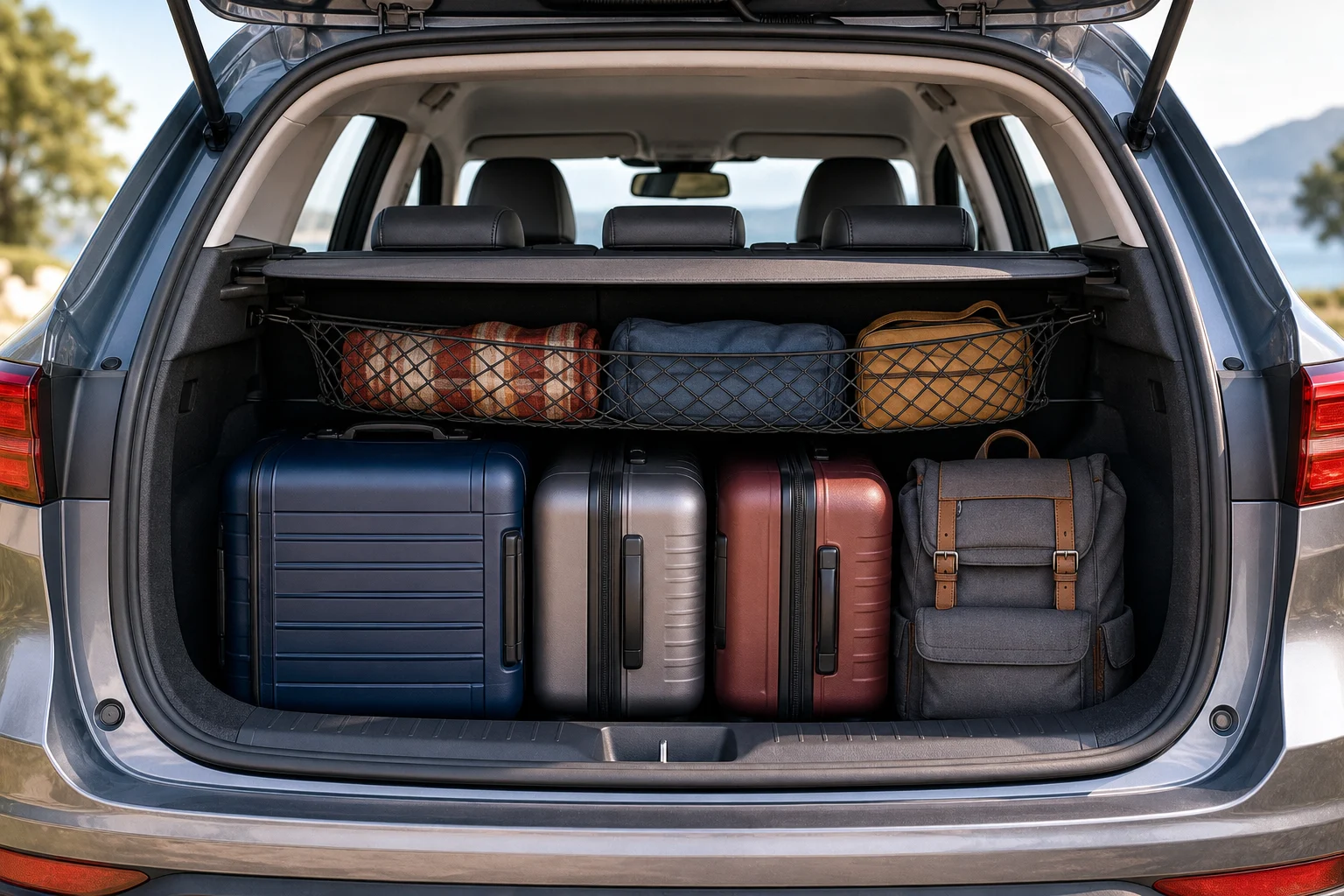
Place cargo in the boot where possible and ensure it cannot move. The DGT states that the passenger compartment should be reserved for exceptional cases; in that situation, the load must not reduce the field of vision and must be secured to prevent it from being thrown against occupants during heavy braking.
Section references: DGT: transporte de cargas y animales en turismos ↗ · Reglamento General de Vehículos: definiciones de masas y remolque ↗ · Reglamento de Ejecución (UE) 2021/535: masas máximas y cargas por eje ↗
- Add up passengers, luggage and accessories; do not assess only the weight of the suitcases.
- Check the permitted masses and maximum axle loads applicable to your vehicle.
- Avoid concentrating loads without checking how they are distributed.
- Do not leave loose objects in the passenger compartment.
Why aerodynamics become more important on the road
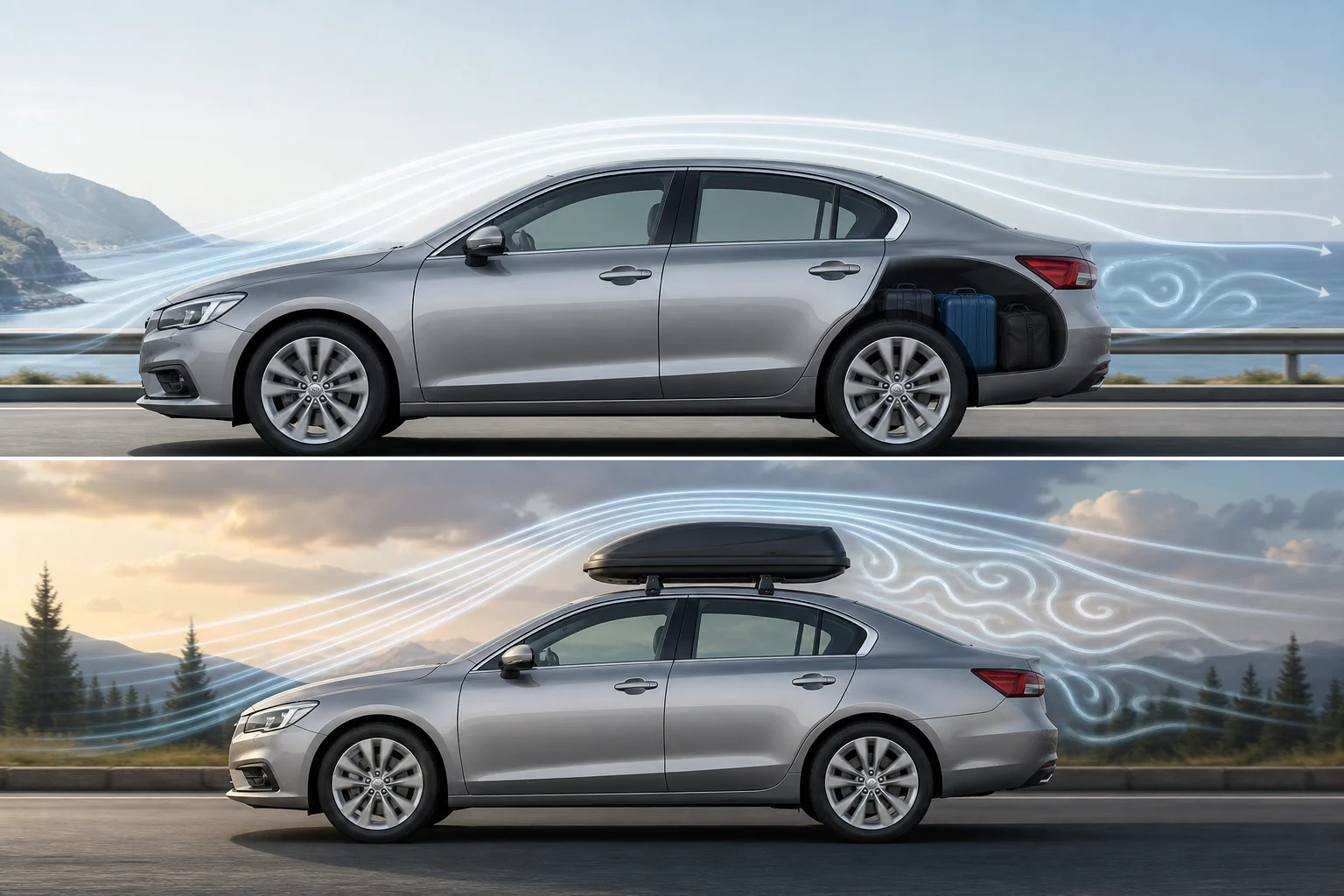
Aerodynamic drag depends on air density, the square of speed, reference area and drag coefficient. The latter accounts, among other aspects, for the effects of the shape and inclination of the body exposed to the air. An external accessory can change precisely the area and shape with which the vehicle moves through the airflow.
The practical consequence is clear: with all other conditions equal, doubling speed quadruples aerodynamic drag force. This does not mean consumption follows an identical rule for every car, but it does explain why a roof rack or roof box should not be assessed only by its weight. Its elevated position and shape can matter over many miles at sustained speed.
Compared with an external load, luggage that fits properly in the boot avoids adding an accessory outside the bodywork. If the journey allows a choice, this difference supports the recommendation to prioritise the boot.
Section references: Ecuación de la resistencia aerodinámica ↗ · Efecto de la velocidad en las fuerzas aerodinámicas ↗
- Do not extrapolate a consumption figure from another car, another speed or an accessory with a different shape.
- An external accessory can alter the vehicle's aerodynamic drag.
- Compare options according to the route: an urban journey and a motorway trip do not impose the same penalty.
Boot, roof, rear bike carrier or trailer: choose according to need and documentation
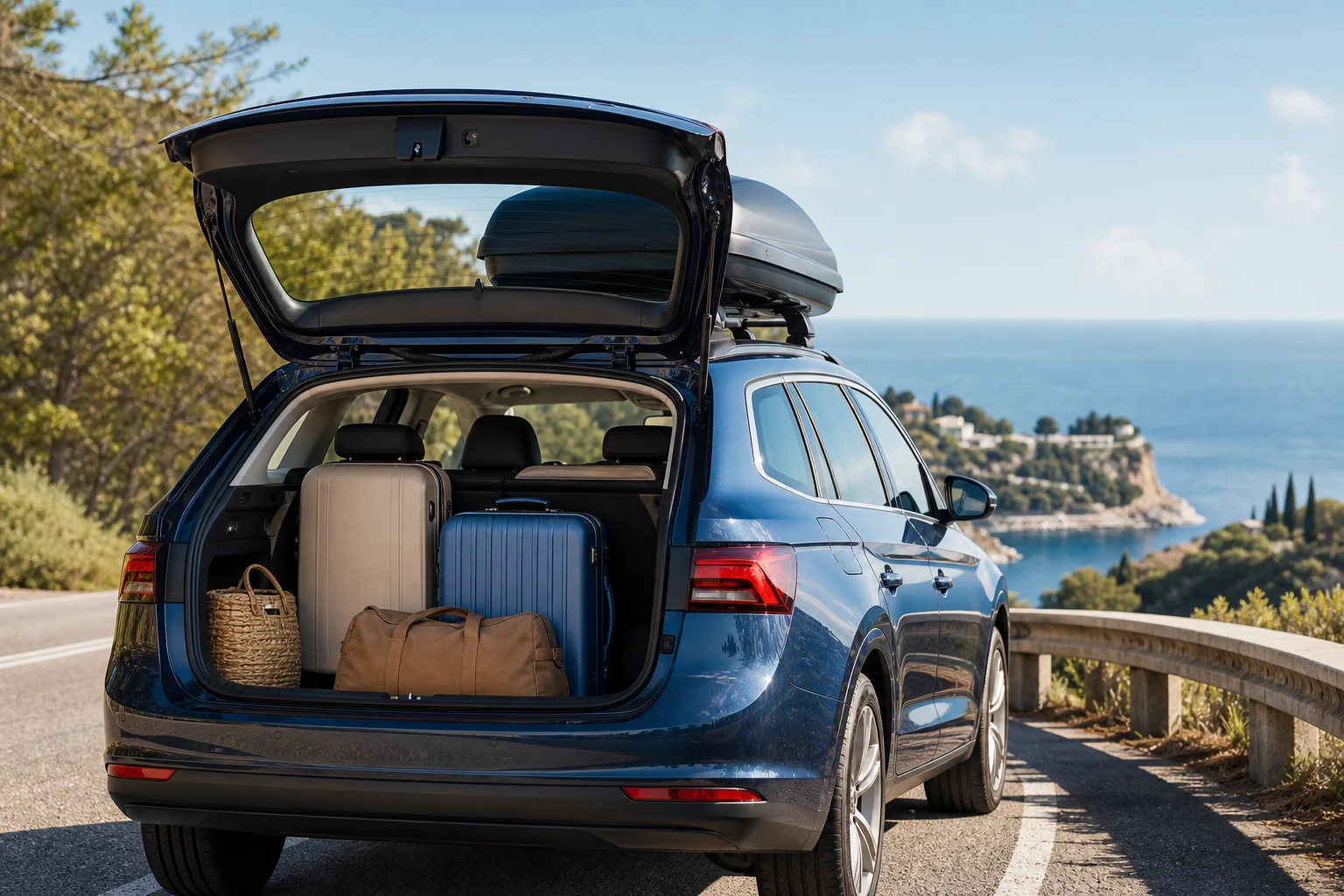
The boot is the starting point recommended by the DGT. If it is not enough, a roof rack or roof box provides capacity, but places the load and accessory in an area exposed to the air. The United States Department of Energy states that carrying items on the roof makes a car less aerodynamic. It also indicates that rear cargo boxes or trays have a much smaller effect on fuel use; this is comparative guidance, not a guarantee of the result for a particular vehicle.
A rear bike carrier should be selected and fitted with particular attention to the visibility of lights, registration plates, identification markings and mandatory signals. Spain's General Traffic Regulations prohibit cargo from obscuring them. Also check the specific requirements applicable to the vehicle and system before setting off. You can find more buying criteria in Car bike racks: towbar, boot or roof, what to check before buying.
A trailer should not be treated as a generic extension of the boot. The maximum technically permissible towable mass depends on the car's construction and is specified by the manufacturer. For the coupling, the manufacturer must state in the manual the maximum technically permissible mass at the coupling point and the mounting points. Also consult the documentation applicable to the towbar and trailer.
| Solution | What mainly changes | Checks before setting off |
|---|---|---|
| Boot | Increases the carried mass without adding an external load. | Securing, visibility, total mass and axle distribution. |
| Roof rack or roof box | Adds mass and may worsen aerodynamics. | Securing, dimensions and vehicle limits. |
| Rear box or tray | Its external position may have less effect on fuel consumption than the roof, according to Department of Energy guidance. | Visible lights, registration plates, identification markings and mandatory signals. |
| Trailer | Adds a towed mass whose permitted use depends on the vehicle. | Towable mass, load at the coupling and mounting points specified by the manufacturer. |
Section references: DGT: transporte de cargas y animales en turismos ↗ · Reglamento General de Circulación: disposición y dimensiones de la carga ↗ · Reglamento General de Vehículos: definiciones de masas y remolque ↗ · Reglamento (UE) n.º 1230/2012: masas, remolques y datos que debe indicar el fabricante ↗ · Consejos oficiales sobre carga exterior y consumo ↗
- Boot: the first option when the load fits and can be properly secured.
- Roof: useful when additional volume is needed, with a potentially significant aerodynamic effect on the road.
- Rear: check that it does not obscure mandatory items.
- Trailer: verify the towable mass and permitted load at the coupling point.
Safe preparation: load, tyres and limits that should not be improvised
Regulations require the load and, where applicable, accessories to be arranged and secured so that they do not drag, fall or move dangerously; they must also not compromise vehicle stability or obscure lighting, registration plates, identification markings or mandatory signals. Their dimensions must not exceed those provided for by the rules applicable to the vehicle or road.
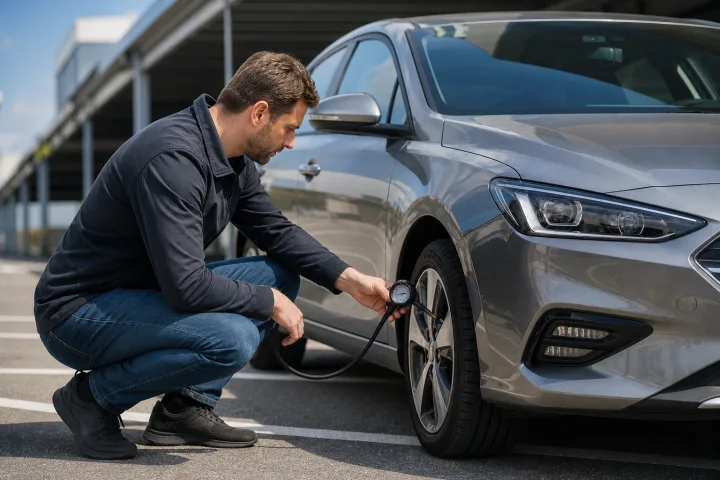
If you have redistributed a substantial load, reassess the distribution. Check tyre pressures in accordance with the manufacturer's instructions for the specific vehicle.
Section references: Reglamento General de Circulación: disposición y dimensiones de la carga ↗ · Reglamento General de Vehículos: definiciones de masas y remolque ↗ · Reglamento de Ejecución (UE) 2021/535: masas máximas y cargas por eje ↗
- Do not exceed permitted masses, dimensions or axle loads.
- Secure the load and accessories so they cannot fall or move dangerously.
- Do not obscure lights, the registration plate, identification markings or mandatory signage.
Method for estimating the impact on your own trip and final checklist
As an indicative, non-regulatory method, you can record several comparable routes if you want to estimate the impact of a roof rack or roof box. Use a regular journey without the external accessory as a reference, note distance and consumption, then repeat the record with the load configuration you will actually use.
Try to keep the route and driving pace comparable where possible. Do not present the result as a universal figure or a promise for other cars. Use it to decide whether to carry some of the load inside or use an external accessory occasionally. To turn your records into an approximate cost, you can use the energy tool.
The conclusion is not to travel less safely or remove necessary equipment. It is to avoid unnecessary external volume, load in an orderly way and follow the documentation for the car and every accessory.
Section references: DGT: transporte de cargas y animales en turismos ↗ · Reglamento General de Circulación: disposición y dimensiones de la carga ↗ · Ecuación de la resistencia aerodinámica ↗ · Consejos oficiales sobre carga exterior y consumo ↗
- Before setting off, confirm that you know the mass of passengers, load and accessories.
- Check MMA, axle limits and, where applicable, towable mass and load at the coupling.
- Prioritise the boot; if using an external load, check dimensions and securing.
- Make sure visibility, stability and the visibility of lights and registration plates are not reduced.
- Record more than one comparable journey before attributing a consumption change to a single factor.
Does carrying luggage in the boot increase consumption?
A change in consumption cannot be attributed to boot luggage without assessing the whole journey. The DGT recommends placing cargo in the boot where possible and warns that loads on a roof rack can increase fuel consumption.
Can an empty roof rack affect consumption?
Drag depends, among other factors, on shape, exposed area and speed. As a roof rack is an external item, it can alter those conditions, although its effect is not identical on every car.
Is a rear cargo box better than a roof box for using less fuel?
The Department of Energy states that roof loads make a car less aerodynamic and that rear cargo boxes or trays have a much smaller effect on fuel use. Even so, you must check that lights, registration plates and identification markings are not obscured.
What should I check if I am travelling with a trailer?
Check the vehicle's maximum technically permissible towable mass, as well as the maximum permitted load at the coupling point and the mounting points specified by the manufacturer. Also review the documentation and instructions for the towbar and trailer.