Car bike racks: towbar, boot or roof, what to check before buying
Towbar, boot and roof racks can all carry bikes, but they are not interchangeable. This guide covers the compatibility, weight, visibility and signalling checks needed before deciding.
Key points
The right car bike rack is not chosen by bike count alone: you must match it to the specific car, each bike’s weight and dimensions, the rack’s limits, and the visibility of lights and number plate. In Spain, a rear overhang also requires V-20 marking and, in certain cases, a red light.
Quick answer: start with the car, not the rack
To decide which car bike rack to choose, the correct order is to check the vehicle and the bikes to be carried first. You must then compare those details against the specifications and instructions for the specific rack. A towbar, boot or roof system does not by itself guarantee that it will fit a particular body shape, carry the bikes’ weight or allow you to drive while meeting visibility and signalling requirements.
Spain’s General Traffic Regulations require loads and accessories to be arranged and secured so that they cannot drag, fall off wholly or partly, or move dangerously. They must not compromise the vehicle’s stability or obscure mandatory lighting devices, light signals or number plates. This is the rule that should guide the entire purchase: an apparently quick fitting does not make up for an incompatibility, an exceeded weight limit or obscured rear lights.
As an initial filter, rule out the product if you cannot confirm its attachment points on the car, if one bike exceeds any of its stated limits, or if the load is wider than the vehicle. Spain’s Directorate-General for Traffic (DGT) expressly warns that a bicycle cannot be carried if it exceeds the vehicle’s overall width. This must be checked with the actual bikes, including mudguards, tyres and any item that will remain fitted during the journey.
Section references: Reglamento General de Circulación, artículos 14 y 15 ↗ · Cómo transportar las bicis de forma segura ↗
- Identify the exact car model and consult its manual before choosing a system.
- Note each bike’s weight and relevant dimensions: wheels, tyres, wheelbase and frame section.
- Check whether the vehicle has a towbar or compatible roof bars where the system requires them.
- Before buying, verify that the number plate, lights and signalling will remain visible, or that the assembly includes the necessary solution.
- Do not treat the capacity of one specific model as the capacity of every bike rack of the same type.
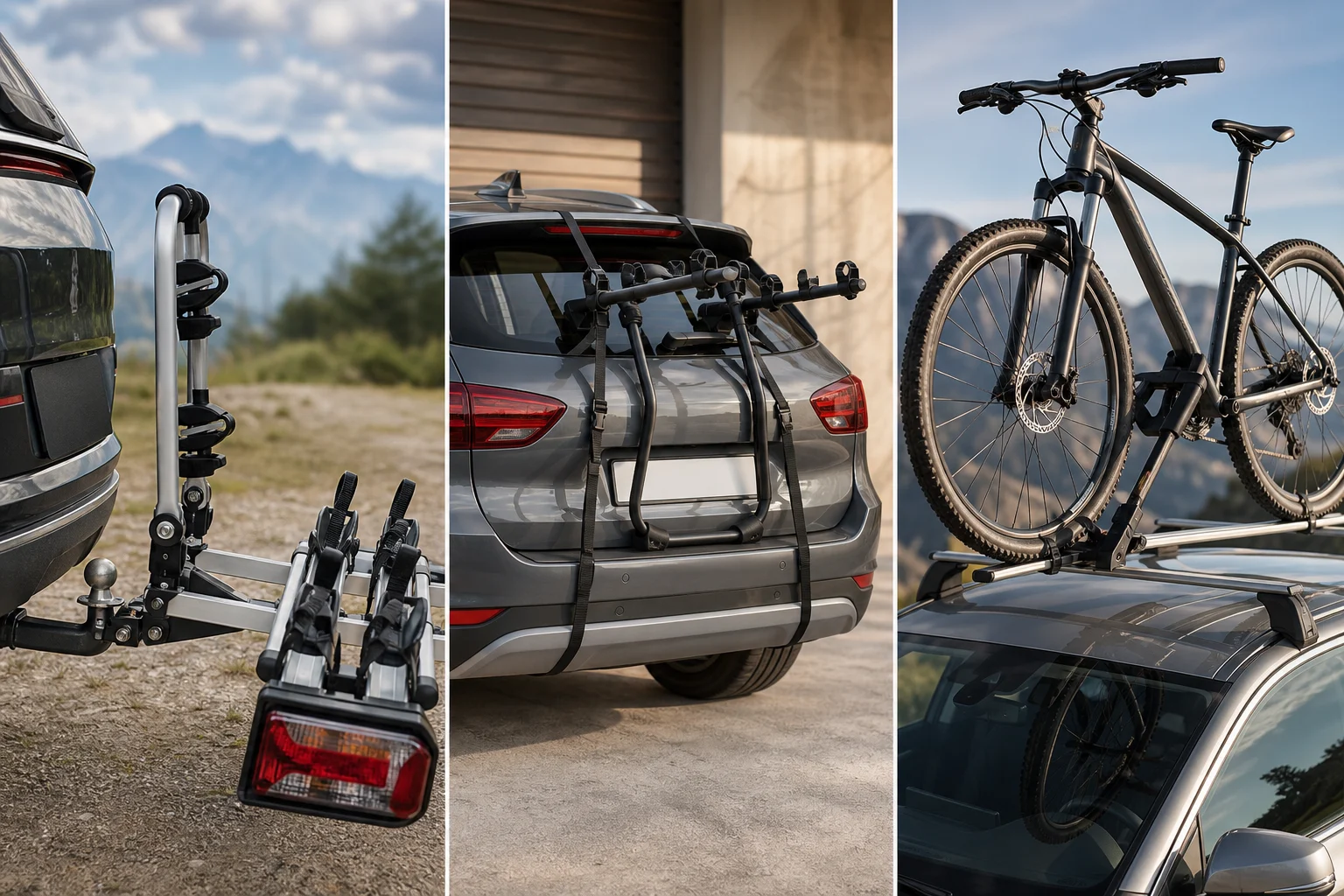
Towbar, boot and roof: what each system attaches to
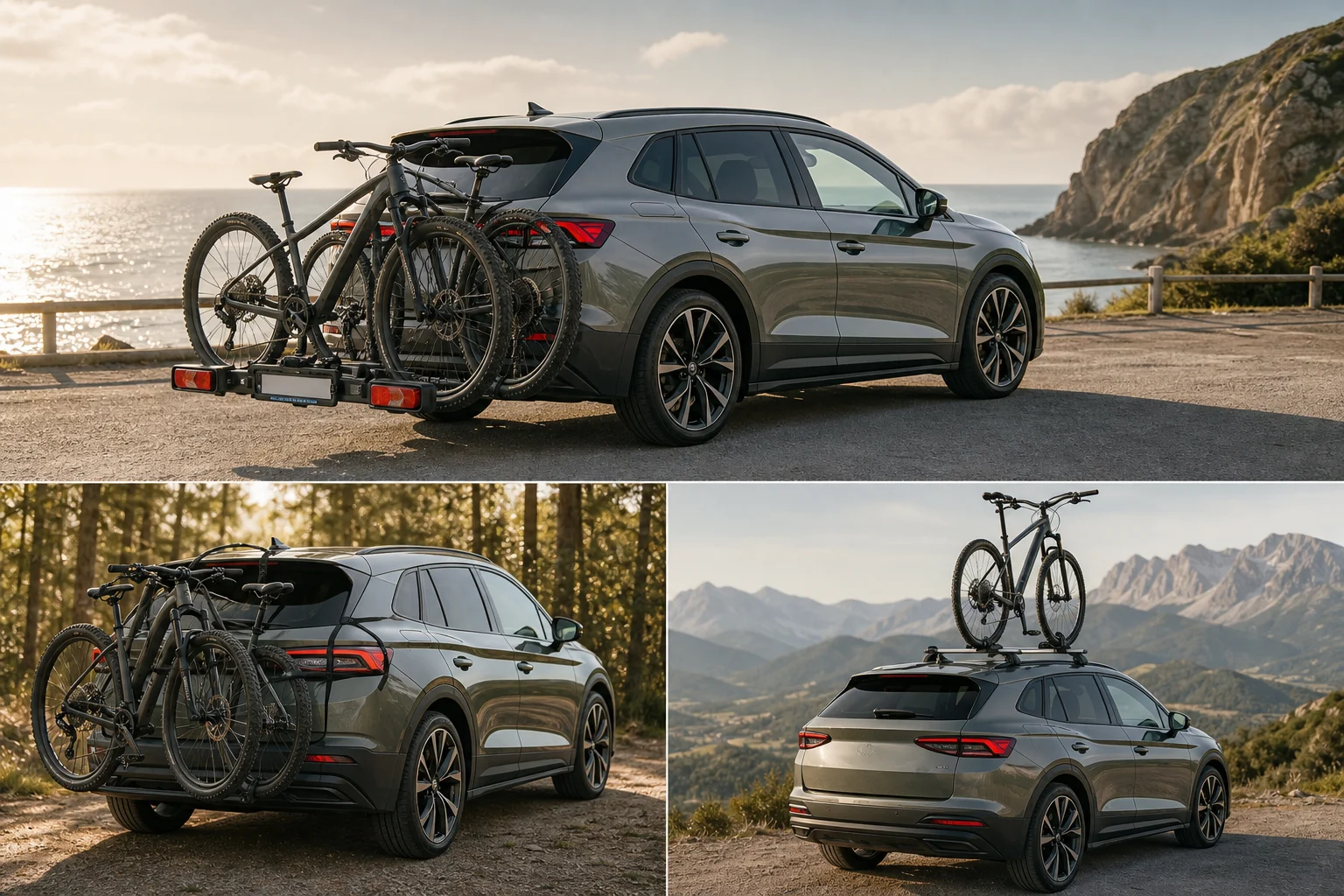
A towbar bike rack mounts directly onto the towing coupling. Therefore, it is not enough for the car simply to have a towbar: you must know the permitted vertical load at the coupling point and also comply with the limits of the rack and the bikes. European coupling rules state that the permissible static vertical load at that point must be observed and that it is a value specified by the manufacturer.
A boot-mounted system rests on and is secured to the rear of the vehicle. It is an alternative that requires particularly thorough fitment checks: compatibility is not universal merely because the car has a rear boot. For example, the Thule OutWay Hanging 3 product page refers users to a buying guide for checking specific car models. Treat any general compatibility claim as insufficient until you have verified the exact application.
Roof bike racks attach to roof bars. Here too, two compatibilities apply: that of the rack with the bars, and that of the rack with the bike. The product page should state its fastening system and the accepted wheel sizes and tyre widths. Therefore, choose based on the full combination—car, bars, rack and bike—not just on where the bike is carried.
| System | Attachment point | Decisive check | Weight and dimensions | Visibility and signalling |
|---|---|---|---|---|
| Towbar | Towing coupling | Permitted vertical load of the coupling and rack compatibility | Limits of the bike rack and of each bike | Check number plate and lights; if obscured, a visible auxiliary solution is needed |
| Boot | Rear of the vehicle | Specific application for the car model | Limits stated by the rack and the bikes | Check number plate and lights; assess whether the load projects rearward |
| Roof | Roof bars | Compatibility between bars, rack and bike | Weight, wheel, tyre and fastening-system limits | Check that the load does not exceed the vehicle’s overall width |
Section references: Thule OutWay Hanging 3, modelo 995001 ↗ · Portabicicletas de techo ↗ · UN Regulation No. 55, requisitos de acoplamientos mecánicos ↗
- Towbar: confirm the coupling, its permitted vertical load and rack compatibility.
- Boot: check the exact application for the car body and do not assume a universal fit.
- Roof: confirm the required bars and the rack’s limits for the wheel, tyre and bike.
- In all three cases, review the installation and use instructions provided by the manufacturer.
Details to gather before you pay
Prepare a check sheet using three sources: the vehicle manual, the towbar documentation where applicable, and the bike rack’s technical specification or instructions. The manual helps identify approved fixing points or conditions that apply to the vehicle. With a towbar system, the coupling documentation and vehicle manufacturer’s information are needed to identify the permitted vertical load. The accessory specification states its own maximums and accepted bike formats.
Weight must be checked as a chain of limits. Add the weight of all bikes to be carried and compare it with the rack’s overall capacity; also compare each bike’s weight with the individual maximum, where stated. For a towbar installation, that load must also comply with the permitted vertical load of the coupling point. A valid outcome is one that does not exceed any applicable figure: the lowest limit is the one that applies.
Dimensions can rule out a product even where the weight is correct. As an example of why reading the specification matters, the single-bike Thule VeloLite states a 25 kg capacity, a maximum of one bike, frames from 20 to 90 mm, tyres up to 3 inches, wheels from 16 to 29 inches, and a maximum wheelbase of 1,250 mm. These are figures for that model, not a general rule for all towbar racks.
Section references: Thule VeloLite 1-bike, modelo 9051100 ↗ · UN Regulation No. 55, requisitos de acoplamientos mecánicos ↗
- From the car: exact model, manual, designated roof-bar points and towbar details if fitted.
- From the bike rack: maximum number of bikes, total and per-bike capacity, and compatible frame, wheel and tyre formats.
- From the bikes: individual weight, wheel diameter, tyre width, wheelbase, and frame section or shape.
- From the complete assembly: physically check the position of the bikes before the first journey.
Electric bikes, special frames and wide tyres
Electric bikes require an individual weight check. Do not assume that a towbar rack accepts every electric bike: in the Spanish Thule catalogue consulted on 20 September 2026, models had maximum per-bike weights of 15, 25 and 30 kg depending on the product. If a bike exceeds the stated individual maximum, the rack must be ruled out even if the combined weight of the bikes appears acceptable.
Frame shape matters too. If a rack states a range for frame size, a section or design that falls outside that range should not be forced in with an improvised fastening. The VeloLite example, with stated compatibility for frames from 20 to 90 mm, illustrates why you must measure or confirm the manufacturer’s intended contact point before buying.
With a roof rack, the limit can be just as decisive. The Thule UpRide states bikes up to 20 kg, wheels from 20 to 29 inches and tyres up to 3 inches; with its specific fatbike adapter, the width limit reaches 5 inches. These figures do not replace checking the specification of the chosen product, but they show that wheel size and tyre width are buying criteria, not minor details.
Section references: Portabicicletas de bola ↗ · Thule VeloLite 1-bike, modelo 9051100 ↗ · Thule UpRide, modelo 599001 ↗
- Weigh each bike as it will travel, without assuming that the electric category alone determines compatibility.
- Compare individual weight against the individual limit and the total against the overall limit.
- Measure tyres and check wheel diameter against the rack specification.
- Do not force clamps, straps or holders if the frame shape or wheel does not match the stated compatibility.
- If a specific adapter is needed, confirm that it matches the same rack model.
Number plate, lights and V-20: when fitting the rack is not enough
Before driving, place the bikes on the rack and inspect the rear of the car from a sufficient distance. If the bikes obscure the number plate or rear lights, the DGT states that a visible lighting and signalling device must be fitted, along with an additional number plate. This check is especially important with rear-carrying solutions, but it must be carried out on the actual assembly rather than based on commercial photographs.
A second, separate issue is the rearward projection of the load. On passenger cars, a load may project behind the vehicle by up to 10% of the vehicle’s length, or up to 15% if it is indivisible. When a load projects rearward, it must be marked with a V-20 panel at its rearmost end and perpendicular to the vehicle’s longitudinal axis. If it occupies the full rear width, two panels are used at the ends to form an inverted V.
Between sunset and sunrise, or if visibility is significantly reduced by weather or environmental conditions, a load projecting rearward also requires a red light. Do not confuse the V-20 with the additional number plate or auxiliary lights: each item meets a different requirement. The plate and lights address the obscuring of mandatory items; the V-20 identifies a load projecting rearward.
Section references: Reglamento General de Circulación, artículos 14 y 15 ↗ · Reglamento General de Vehículos, señal V-20 ↗ · Cómo transportar las bicis de forma segura ↗
- Check with the bikes fitted that the number plate and rear lights are visible.
- If they are obscured, use a visible lighting and signalling device and an additional number plate.
- Measure the rearward projection against the vehicle length before setting off.
- Place the V-20 at the rear end of the load and perpendicular to the vehicle’s longitudinal axis when there is a projection.
- Use two V-20 panels forming an inverted V if the load occupies the full rear width.
- At night or in reduced visibility, add the required red light for the projecting load.
Final installation and use checklist
The purchase ends with an installation that follows the manufacturer’s instructions, not with the first apparently successful fit. The most avoidable mistakes are choosing a rack without confirmed application for the car, adding weights without checking the individual maximum, ignoring the towbar’s permitted vertical load, forcing an incompatible fastening, or setting off with obscured lights and number plate. All of them can be prevented by gathering information and checking the fully loaded assembly.
Do not replace specific instructions with an improvised installation. The bike rack manufacturer determines its attachment points, fastening methods, limits and compatible accessories; the vehicle manufacturer determines the conditions of its anchoring points and, where applicable, the coupling. If information is missing or documents contradict each other, do not treat the setup as valid until it has been clarified.
A careful check before every journey also confirms that the load cannot move dangerously, fall off or compromise stability, which are the general conditions required by the Regulations. The inspection must include signalling items where there is a projecting rear load and auxiliary equipment where the number plate or lights are obscured.
Section references: Reglamento General de Circulación, artículos 14 y 15 ↗ · Thule OutWay Hanging 3, modelo 995001 ↗ · UN Regulation No. 55, requisitos de acoplamientos mecánicos ↗
- Confirm that the rack matches the car, roof bars or coupling actually fitted.
- Confirm the number of bikes, individual weight, total weight and all accepted dimensions.
- For towbar racks, check the permitted vertical load of the coupling point.
- Follow the fitting, fastening and securing sequence specified by the manufacturer.
- Check that no bike exceeds the vehicle’s overall width.
- Check the visibility of the number plate, lights and rear signalling with the assembly fitted.
- Fit the V-20 and, where applicable, the red light for a projecting load.
- Do not set off if any item is insecure, moves, or its compatibility cannot be confirmed.
Which bike rack is suitable for an electric bike?
One that accepts its individual weight and dimensions, is compatible with the car, and does not exceed any limit of the complete assembly. Do not assume that every towbar rack is suitable: the Thule catalogue consulted included limits of 15, 25 and 30 kg per bike depending on the model, while the roof-mounted UpRide states up to 20 kg.
Is a V-20 required with a rear bike rack?
It is required when the load projects behind the vehicle. The panel must be placed at the rear end of the load and perpendicular to the vehicle’s longitudinal axis. If the load occupies the full rear width, two panels are used to form an inverted V.
Can I carry bikes if they cover the number plate or lights?
Not without resolving that obstruction. The DGT states that if the number plate or rear lights are obscured, a visible lighting and signalling device and an additional number plate are required.
Will a boot-mounted bike rack fit any car?
No. Compatibility depends on the car body and the specific rack model. The Thule OutWay Hanging 3 product page, for example, states that it does not have a universal fit and requires checking the guide for specific models.