Tyre pressure warning light: what TPMS means and how to respond safely
A TPMS warning does not identify the cause on its own. Learn how to stop safely, check the correct pressure, reset the system where appropriate and recognise when to call for assistance.

Key points
The TPMS warning light means you should check the tyres as soon as possible or, if it flashes and then stays on in some vehicles, that the system itself may have a fault. It does not diagnose a puncture on its own: reduce risk, check the pressure specified for your car and follow that vehicle’s manual.
What the TPMS warning light means and the first decision to make
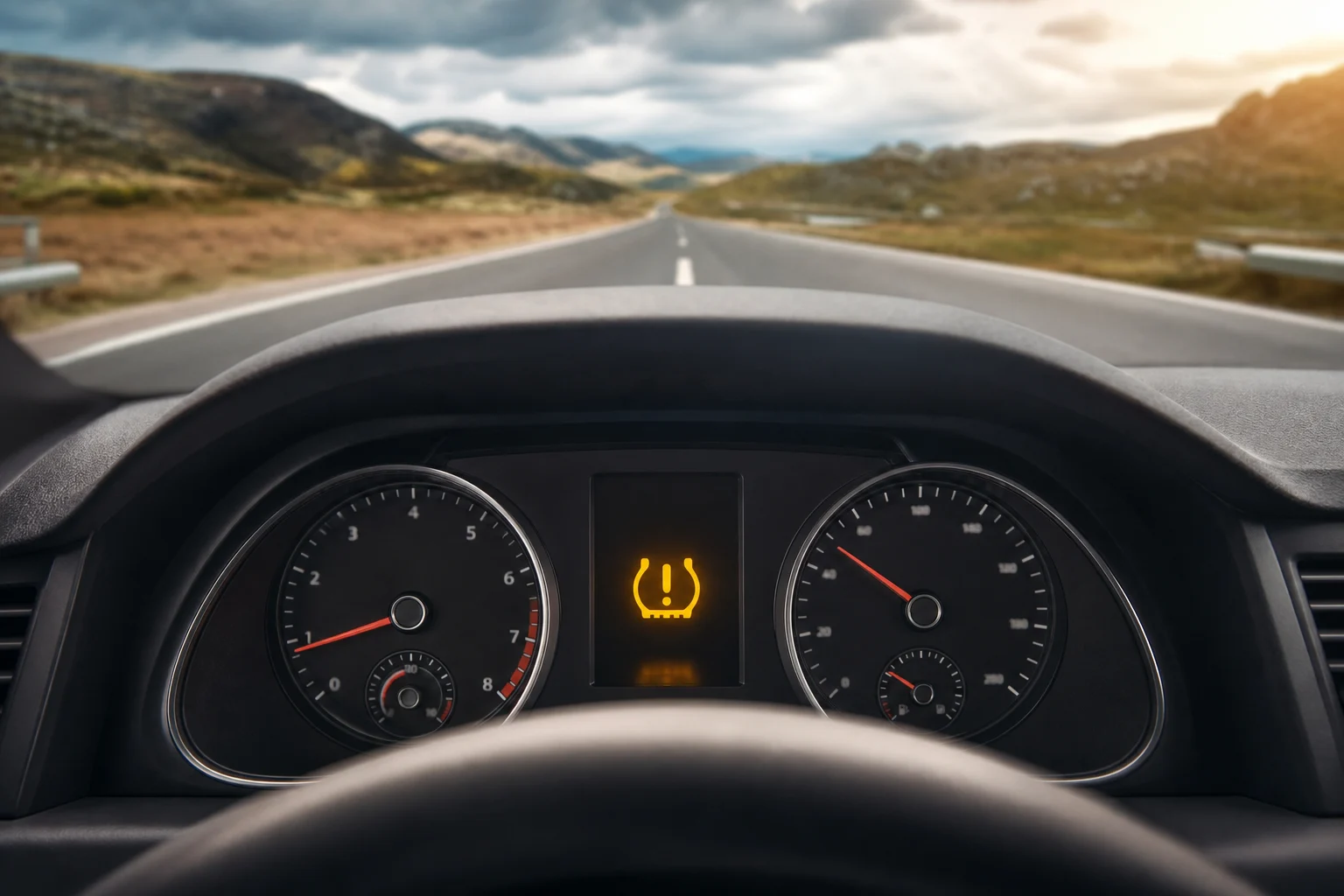
TPMS is the tyre pressure monitoring system. If the low-pressure warning comes on, the prudent response is not to guess the cause or carry on as if nothing had happened: adapt your driving and stop to check the tyres as soon as possible in a safe place. This is what the consulted Spanish manual instructs.
The warning may be due to pressure loss, but it does not confirm a puncture on its own. It would also be premature to automatically attribute it to a temperature change or an electronic fault. TPMS is a monitoring aid, not a replacement for checking with a pressure gauge or for regular maintenance; responsibility for maintaining the correct pressure remains with the driver.
First, look at how the warning is displayed and what message accompanies the symbol on your instrument cluster. Not all cars show the same information. One particularly relevant case is certain models in which the warning light flashes for approximately one minute and then remains on: the manual associates this with a TPMS malfunction, rather than the same warning as a steady low-pressure light. Your vehicle’s manual should have the final word on its specific meaning.
Section references: Sistema de control de la presión de los neumáticos (manual de propietario, mercado España) ↗
- Low-pressure light: reduce risk and arrange a check as soon as possible.
- Flashing followed by a steady light: consult the manual, as it may indicate a system issue.
- Do not use the warning light as proof that a tyre is fine or as a definitive diagnosis of a puncture.
Direct and indirect TPMS: what they monitor and what you should not assume
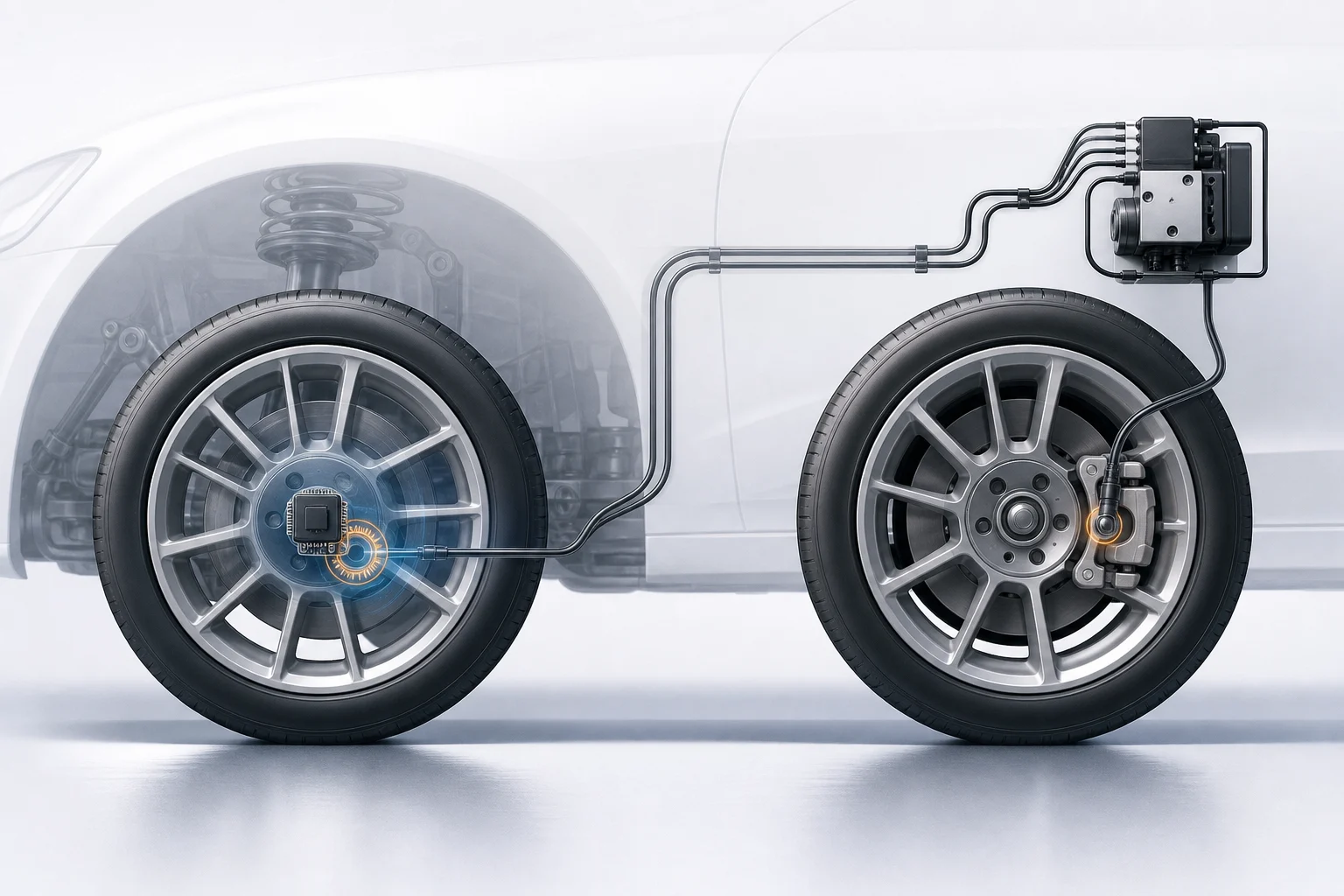
There are two main technical approaches. Direct TPMS uses pressure sensors in the wheels and transmits that information. This explains why certain cars can provide pressure data, but it does not mean that every vehicle with TPMS displays the individual pressure of each tyre: that function depends on the system fitted.
Indirect TPMS does not use tyre-pressure sensors. It detects possible deflation by monitoring and comparing tyre characteristics while driving. According to NHTSA’s technical description, these systems commonly rely on ABS wheel-speed sensors and differences in rotational speed linked to pressure differences.
The practical consequence is straightforward: do not interpret information available in another car as if it applied to yours. Whether your vehicle shows only a warning, identifies a tyre or requires a calibration procedure are questions that must be answered by the original documentation for that specific vehicle.
| System type | How it detects possible deflation | What to check in the manual |
|---|---|---|
| Direct | Using pressure sensors fitted in the wheels. | Whether it shows data for each wheel and what procedure is required after work on tyres or wheels. |
| Indirect | By comparing tyre characteristics while driving; it commonly uses wheel-speed signals. | How it is calibrated or reset, and what conditions the vehicle must meet for the reference to be valid. |
Section references: Understanding Indirect TPMS ↗ · TPMS final rule summary ↗
- Direct: pressure sensors in the wheels.
- Indirect: comparison of tyre characteristics while driving, normally using wheel-speed signals.
- In both cases, TPMS does not remove the need to measure and maintain the correct pressure.
What to do when the warning appears: a safe sequence
When the low-pressure warning appears, the consulted Spanish manual says to stop the vehicle and check the tyres as soon as possible. Do so in a safe place and follow the instructions in the manual applicable to your vehicle.
Then check the pressure with a gauge under the condition specified by the manufacturer. In the example manual, a “cold” measurement means that the vehicle has been stopped for three hours or has travelled only a few kilometres at low speed. Do not turn this definition into a rule for all cars: always check the one in your documentation.
If a tyre has visible damage, or you notice vibrations, an abnormal change in the way the car drives or unusual noises, the example manual advises reducing speed, pulling over safely and requesting roadside assistance. If the warning disappears temporarily after inflating the tyre, do not consider the problem solved without consulting your vehicle’s manual.
Section references: Sistema de control de la presión de los neumáticos (manual de propietario, mercado España) ↗ · Manual del propietario Explorer, edición 2024, España ↗
- When there is a low-pressure warning, the consulted Spanish manual says to stop and check the tyres as soon as possible.
- Measure pressure under the checking condition specified by the manufacturer.
- According to the example manual, if there is visible damage, vibration, changed driving behaviour or unusual noises, reduce speed, pull over safely and request assistance.
- Do not consider the warning resolved simply because it temporarily disappears after inflating the tyre.
The correct pressure is the one on the vehicle label
To correct low pressure, find the reference specific to your car on the pressure placard or label specified by the manufacturer and in the manual. In the example manual, the tyre information label is located on the driver’s-side B-pillar, but its exact position must be confirmed for each vehicle.
Do not use a generic figure as a reference. The figure that should guide inflation is the pressure recommended by the manufacturer for that vehicle.
Before inflating, read the label and manual carefully. Measure, adjust to the stated reference and check again. If a value drops again, do not consider the problem resolved just because the warning has gone out.
Section references: Sistema de control de la presión de los neumáticos (manual de propietario, mercado España) ↗ · Manual del propietario Explorer, edición 2024, España ↗
- Locate the pressure label or placard and the vehicle manual.
- Use a pressure gauge and follow the specified measurement condition.
- Do not use a generic figure as the target pressure.
After inflating: when to reset and what problems this precaution avoids
Correcting the pressure does not always complete the process. Some systems require a reset or calibration in order to adopt the current pressure as a reference. The example manual says to do this after replacing or rotating tyres, and also after inflating them correctly. Other vehicles may have a different procedure; this is why you should not blindly apply steps from a video, another model or another model year.
First carry out the physical check and adjust the pressure in accordance with the label. Then follow the sequence and procedure set out in that vehicle’s manual to reset the system, if it requires one.
Also check compatibility when wheels or tyres are changed. The manufacturer warns that alternatives may prevent TPMS from working properly in certain vehicles, and recommends checking the system after replacing one or more wheels or tyres. If the warning persists after the checks and specified procedure, or follows the possible-malfunction pattern described in the manual, consult your vehicle documentation.
Section references: Sistema de control de la presión de los neumáticos (manual de propietario, mercado España) ↗ · Manual del propietario Explorer, edición 2024, España ↗
- Set the correct pressure first; reset only afterwards if the manual specifies it.
- Check the specific procedure after inflating, rotating or replacing tyres.
- Verify TPMS operation after changing wheels or tyres.
- A persistent warning should not be hidden by repeatedly resetting the system.
TPMS in a used car: checks before buying
With a used car, it is not enough to check that the instrument cluster is not showing a warning at that moment. Ask for the original manual that corresponds to the vehicle and check there which system it has, what the low-pressure warning looks like, whether the vehicle can show more information and what the reset process is. The manufacturer itself identifies the owner’s manual originally supplied with the vehicle as the primary source of information.
Also review the vehicle documentation and ask about tyre or wheel changes. This is a relevant check because alternative wheels or tyres can affect correct TPMS operation in certain vehicles. If the car has the system, include in your pre-purchase inspection a check that there are no persistent warnings and that the seller can explain its operation in line with the applicable manual.
The aim is not to demand that every car has the same display or procedure, but to avoid drawing a wrong conclusion from an isolated symbol. The correct manual, traceable reference pressures and a system without abnormal warnings make it easier to use this feature for what it is: support for detecting a possible issue, not an alternative to tyre care.
Section references: Sistema de control de la presión de los neumáticos (manual de propietario, mercado España) ↗
- Request the original manual applicable to that vehicle’s model, year and version.
- Check the TPMS warning on the instrument cluster and compare it with the manual.
- Ask whether tyres or wheels have been changed and confirm system compatibility.
- Include the reference pressure and reset procedure in your pre-purchase inspection.
Can I keep driving if the tyre pressure warning light comes on?
Reduce risk and stop to check the tyres as soon as possible in a safe place. According to the example manual, if there is visible damage, vibration, unusual noises or an abnormal change in driving behaviour, reduce speed, pull over safely and request assistance.
Does TPMS confirm that I have a puncture?
No. The system warns of possible pressure loss or, depending on the warning pattern and vehicle, an issue with TPMS itself. The cause must be checked through visual inspection, measurement and, where appropriate, a professional inspection.
What pressure should I use if the TPMS warning comes on?
The pressure stated on the vehicle’s pressure label or placard and in its manual. Do not use a generic figure as the target.
Do I have to reset TPMS after inflating the tyres?
It depends on the car. Some manuals require the system to be reset after correctly inflating, rotating or replacing tyres. Correct the pressure first, then follow the procedure specific to your vehicle’s manual.
Do all cars with TPMS show the pressure of every tyre?
Not necessarily. Direct systems use pressure sensors in the wheels, but whether the vehicle displays individual readings depends on the specific implementation. Consult the car’s original manual.