How to Choose a Motorcycle for Your Height: What Matters Beyond Seat Height
The seat-height figure alone is not enough to know whether a motorcycle will be manageable. This guide explains how to assess footing, manoeuvring, riding position and possible lowering options before buying.
Key points
Seat height is a starting point, not a verdict: the real fit depends on how you reach the ground with the suspension loaded, the motorcycle’s bulk and your position at the controls. Before buying or lowering a motorcycle, check it while stationary and review the documentation required for any modification in Spain.
Seat height is a guide, but it does not decide on its own
To choose a motorcycle for your height, start with the seat height stated in the technical specifications, but do not use it as a definitive filter. The National Highway Traffic Safety Administration (NHTSA) recommends choosing a motorcycle that fits the rider and checking two things at once: being able to touch the ground with both feet while straddling it, and being able to reach, operate and use the controls easily and comfortably.
The value of this check is that it moves the decision away from an isolated figure and towards the interaction between person and vehicle. A motorcycle may seem suitable on paper yet force you to stretch towards the handlebars, spread your legs too wide or feel insecure when stabilising it. The alternative is not to choose only the lowest one either: a position that lets you operate the controls comfortably must be part of the decision.
Therefore, treat seat height as information to prepare your dealership visit, not as a guarantee that you will reach the ground in the same way or that your riding position will be correct. The decision should be made while sitting on the specific unit and, where available, during an authorised test ride.
Section references: Buying the Right Motorcycle ↗
- First shortlist: note the official seat height of the motorcycles that interest you.
- Decisive check: sit on each unit wearing your usual riding gear.
- Reject a motorcycle if you cannot reach or operate its controls easily and comfortably.
- Do not mistake a brief showroom impression for a position suitable for how you will use the motorcycle.
Why the same seat height can feel different
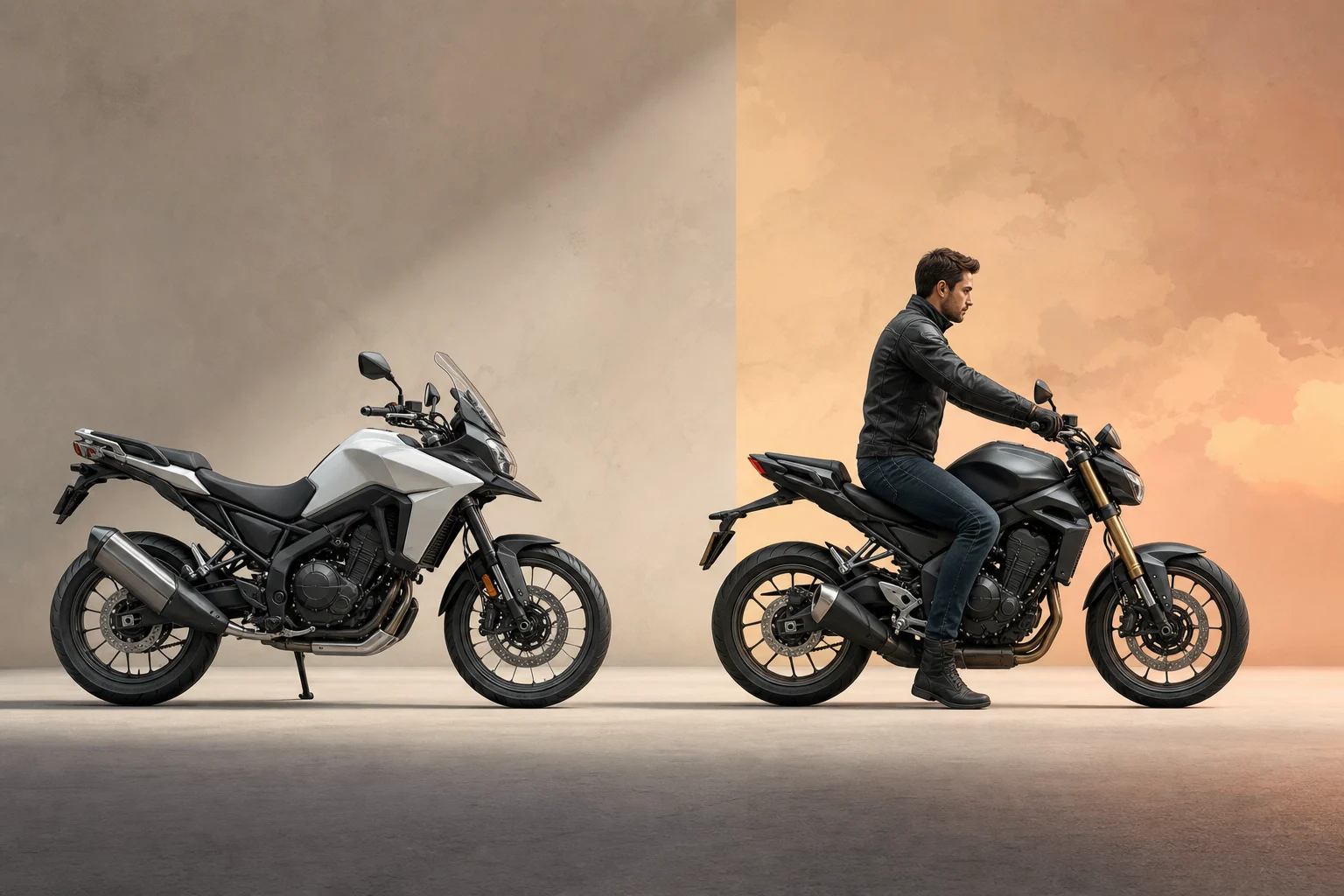
Shape matters as much as the vertical measurement. In one specific design example, Honda states that it combined an 800 mm seat height with a slimmer area between the seat and its support to promote firm footing. This does not allow that solution from one model to become a rule for all motorcycles, but it illustrates why you should look at the seat profile and its junction with the fuel tank as well as reading the published figure.
You should also check the motorcycle with your weight on it. Motorcycle manuals expressly account for applying the rider’s weight when measuring the changed distance under load. This means the relevant position for assessing ground reach is the position it takes when you are seated with your weight applied.
When comparing candidates, bring a simple record: your height, your inseam measurement taken in the same way each time, the stated seat height, the shape you feel between your legs and the footing you achieve when seated. Do not try to infer a mathematical equivalence between inseam and seat height; use it to organise consistent in-person comparisons.
Section references: Honda WN7 – A Standout Model Blending Honda’s Uniqueness with the Appeal of Electric Motorcycles ↗ · Rider’s Manual (BMW Motorrad) ↗
- Check whether the seat widens where your legs come down.
- Check the junction between the seat and fuel tank; it can change how far your legs have to spread.
- Assess footing with the suspension loaded by your weight, not just by looking at the empty motorcycle.
- Write down impressions and data for each unit on the same day so you can compare them consistently.
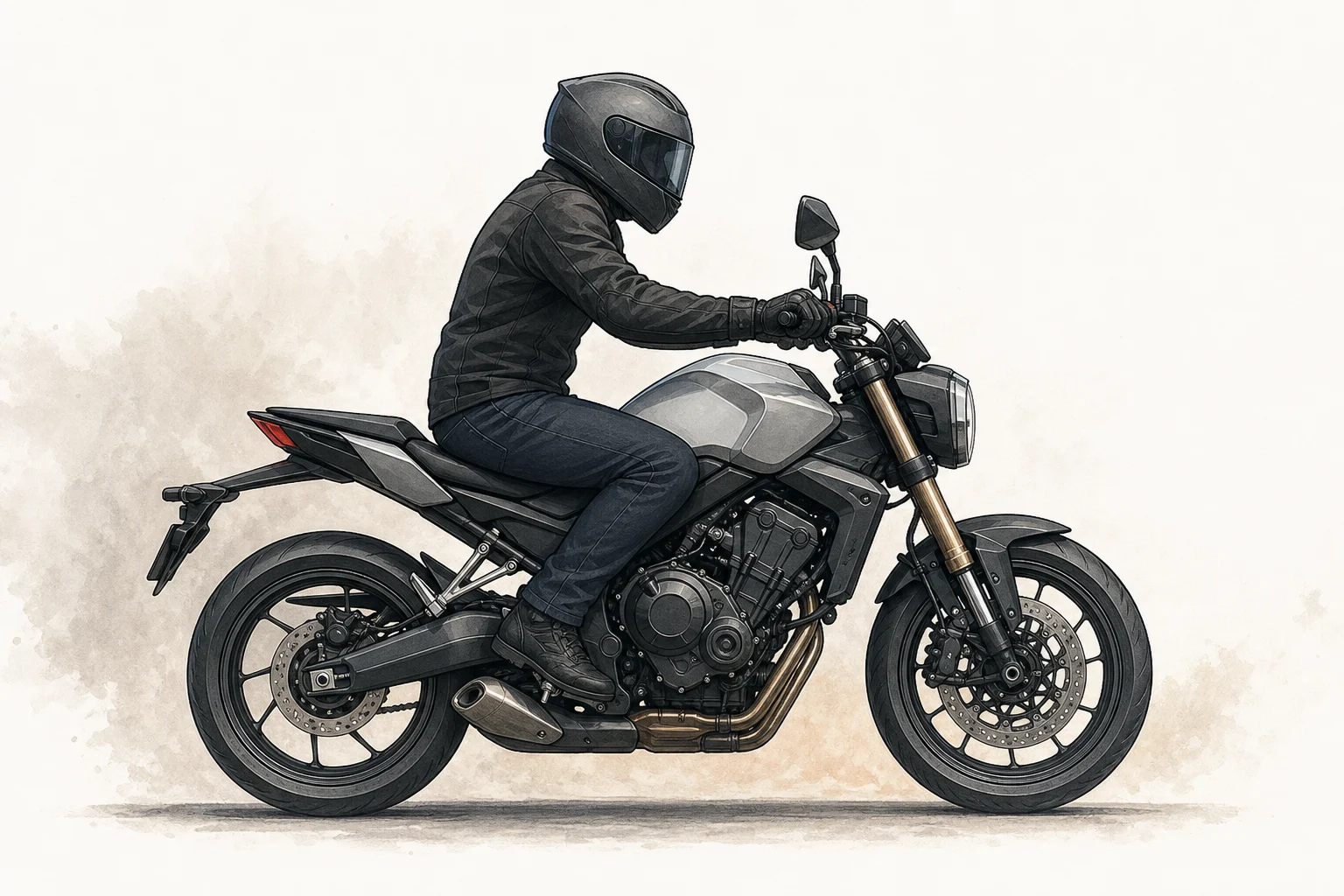
Footing and manoeuvring: look for control, not a universal position
Reaching the ground provides an important reference when you stop, but there is no single position that works for all people, motorcycles and situations. The NHTSA states that the rider should be able to touch the ground with both feet; treat this as the starting standard.
Even so, low-speed manageability does not end when you put your feet on the ground. Spain’s Directorate-General for Traffic (DGT) includes removing the stand and moving the motorcycle while walking beside it, without engine assistance and while maintaining balance, among the A1 and A2 licence manoeuvres. As a practical consideration when choosing a motorcycle, it is worth considering whether you can handle it in this way with control.
Ask to perform this operation only if the dealership authorises it and in a clear area. With the motorcycle switched off, check that you can remove it from the stand, keep it balanced at your side and move it with control. Do not do this on a slope, near other motorcycles or if nobody has explained the safe procedure for that unit.
Section references: Maniobras A1 y A2 ↗ · Buying the Right Motorcycle ↗
- With the motorcycle stationary and upright, confirm your footing on both sides.
- Try removing the stand only with dealership authorisation.
- Walk beside the switched-off motorcycle on a smooth, level and clear surface.
- If this manoeuvre requires excessive force or makes you lose balance, do not ignore it because the seat-height figure looks good.
Weight, centre of gravity and handlebar steering lock: what to check while stationary
Include the stated weight among the data for each candidate, but do not draw conclusions from that figure alone. Check how the actual unit behaves when holding it upright and moving it by hand with authorisation. This test gives you a personal, practical check that the specifications cannot replace.
The centre of gravity, wheelbase and handlebar steering angle are among the design choices a manufacturer can combine to seek ease of handling. Honda describes precisely that combination in one of its models. There is no universal formula for ranking all motorcycles by ease of use from these three parameters, but there are reasons to ask about them and to test the available steering lock.
While seated and with the motorcycle firmly held as instructed by staff, turn the handlebars from lock to lock. Check that your arms do not become locked, your knees do not hit the fuel tank and you can reach the levers. Repeat the observation with the handlebars centred, which will be the most common stopping position.
Section references: Maniobras A1 y A2 ↗ · Honda WN7 – A Standout Model Blending Honda’s Uniqueness with the Appeal of Electric Motorcycles ↗
- Note the stated weight, but give priority to the authorised practical check.
- Ask about the handlebar steering angle and test both locks without forcing anything.
- Observe whether your knees, hands or arms interfere with the fuel tank or handlebars.
- Assess these checks alongside foot contact; no single variable resolves the fit.
Ergonomics while riding: handlebars, footrests, fuel tank and load
A motorcycle that is accessible when stopped may not be comfortable while riding. For riding position, a motorcyclist training guide recommends sitting close enough to the handlebars to reach them with relaxed, slightly bent arms. This is a useful guideline for spotting excessive reach to the handlebars or a position that forces you to support yourself with tension.
The same guide places the knees firmly against the fuel tank and the feet securely on the footrests, close to the controls. When seated, check these three contact points: if your knees cannot find a natural position beside the fuel tank, if your feet are not firmly supported or if the controls are uncomfortable to reach, the motorcycle is not well suited to you even if its seat height is appealing.
Before interpreting any adjustment, consult the model manual. The BMW manual used as a reference states that front and rear preload should be matched to the rider’s weight and the load carried where the model has that adjustment. Do not treat it as a generic way to lower the motorcycle: follow only the manufacturer’s instructions and limits.
| Item | What to check | Practical decision |
|---|---|---|
| Footing | Both feet making contact with the ground while seated on the motorcycle | Do not decide solely by the seat-height figure. |
| Handlebars | Relaxed, slightly bent arms when reaching them | Reject a position that requires you to stretch or lock your arms. |
| Footrests and fuel tank | Feet secure near the controls and knees supported beside the fuel tank | Check all three contact points before considering accessories. |
| Suspension | Position with the rider’s weight applied | Assess it while seated, not with the motorcycle unloaded. |
Section references: Position your body on a motorcycle for maximum control ↗ · Rider’s Manual (BMW Motorrad) ↗
- Reach the handlebars with relaxed shoulders and slightly bent elbows.
- Check that you can keep your feet firmly on the footrests near the controls.
- Check knee contact with the fuel tank without forcing your legs apart.
- If the model allows preload adjustment, consult the manual and set it for rider and load, not for a desired height.
Stationary dealership test: useful order and questions
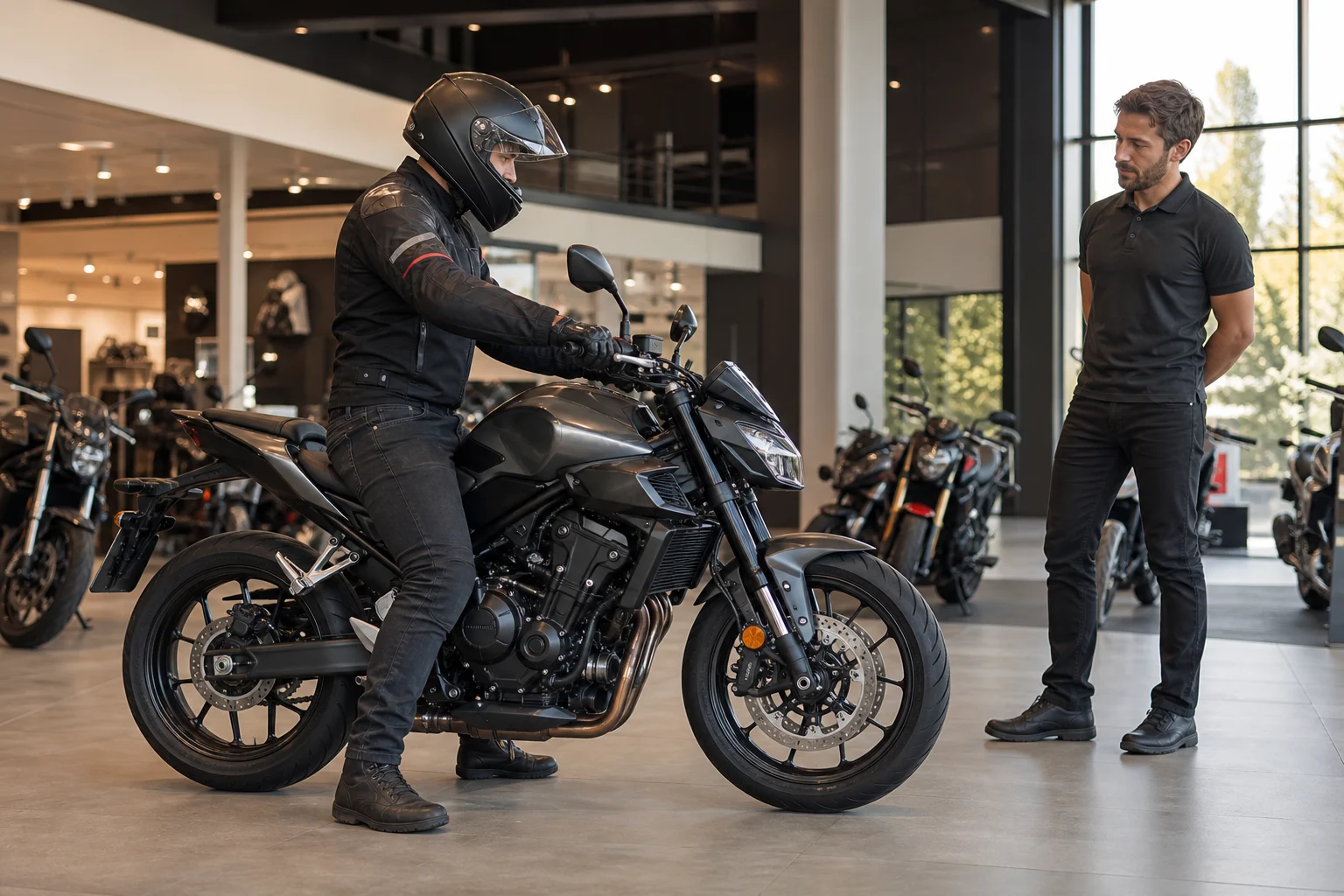
Allow time for an unhurried check and ask whether there is a test unit. The sequence must be safe: motorcycle on level ground, dealership staff available, and no attempt to move it or get on it without their authorisation. Wear the boots or footwear you would normally ride in, because the footing you feel in other footwear may not represent real use.
First, sit on the stationary motorcycle and assess footing, the perceived width of the seat, reach to the handlebars, knee position and foot stability on the footrests. Then ask for permission to remove the stand and walk beside it while it is switched off. Finally, ask whether you can take a dynamic test ride and under what conditions. The test ride does not replace the stationary assessment: each answers different questions.
Ask whether the display unit has the standard or optional seat, whether the specifications for the exact version state a different height, and what the manual says about preload. If you are considering a version with a factory low seat, confirm that this configuration corresponds to the unit that will be registered and request its documentation before signing.
Section references: Maniobras A1 y A2 ↗ · Buying the Right Motorcycle ↗ · Rider’s Manual (BMW Motorrad) ↗
- Wear the motorcycle footwear you will normally use.
- Ask staff to identify the version, seat and configuration of the display unit.
- Ask for a test unit and the conditions for using it.
- Request the model manual or official access to it to review permitted adjustments.
- Do not sign based on a unit whose configuration you cannot identify.
Low seats, lowering kits and adjustments: check legality before buying
Do not assume that every low seat or lowering kit is compatible with your motorcycle, its manual or the ITV vehicle inspection. In Spain, Royal Decree 866/2010 defines as a vehicle modification any alteration, replacement, work, addition or removal carried out after registration that changes vehicle characteristics or may affect regulatory requirements. Before proceeding, check the applicable Vehicle Modifications Manual and the documentation required for the specific installation.
The same royal decree establishes that, depending on the type of modification, a technical project, conformity report and workshop certificate may be required; the applicable details are set out in the Vehicle Modifications Manual. After a modification, the owner must submit the vehicle for technical inspection within a maximum of fifteen days, providing the documentation indicated by that manual.
If the modification is made before final registration, the framework is different: it must be included in the type approval or processed through individual approval. Therefore, for a new motorcycle with a low seat or lowering arrangement offered by the seller, ask whether it is a configuration included in the unit’s approval and keep the answer and supplied documentation in writing. Do not replace these checks with generic internet advice.
Section references: Real Decreto 866/2010, de 2 de julio ↗
- Identify the exact part or kit and the motorcycle version for which it is intended.
- Consult the manufacturer’s manual before changing suspension settings.
- Ask the seller or workshop for the documentation applicable to the specific installation.
- Confirm the applicable procedure under the Vehicle Modifications Manual.
- If the motorcycle has not yet been registered, verify that the configuration appears in its approval or applicable procedure.
What seat height do I need for my height?
There is no reliable universal equivalence between a person’s height and seat height. Use the official figure to shortlist candidates, but decide after checking footing with your weight on the motorcycle, reach to the handlebars, position on the footrests and your ability to move it while switched off with authorisation.
Is it essential to put both feet flat on the ground?
The NHTSA recommends being able to touch the ground with both feet while straddling the motorcycle. Beyond that, this guide does not set a universal position: you should assess your control when stopping and how easily you can maintain balance while moving the switched-off motorcycle beside you.
Can I lower a motorcycle by adjusting preload?
It should not be considered a generic method of lowering it. Where the model provides for it, the manual states that preload should be adjusted for the rider’s weight and the load. Always consult your motorcycle’s specific manual.
Does a low seat or lowering kit require an ITV inspection in Spain?
Whether a low seat or lowering kit is treated as a vehicle modification depends on the specific intervention. If it is treated as a vehicle modification, the applicable documentation and procedure follow the Vehicle Modifications Manual, and the Royal Decree provides for technical inspection within a maximum of fifteen days after a modification.