Conventional vs cornering ABS on motorcycles: differences, limits and what to check before buying
Having ABS does not mean that two motorcycles brake with the same functions. We explain what lean-sensitive management adds, its limits and how to verify the actual equipment on a new or used bike.
Key points
Conventional ABS reduces the risk of wheel lock under braking; in Bosch’s documented solution, cornering braking adds lean-angle information to manage that situation. Before buying, confirm the functions fitted to the specific bike in its manual and check the ABS warning light, without mistaking the system for a guarantee against loss of grip.
The essential difference: preventing wheel lock is not the same as managing braking while leaned over
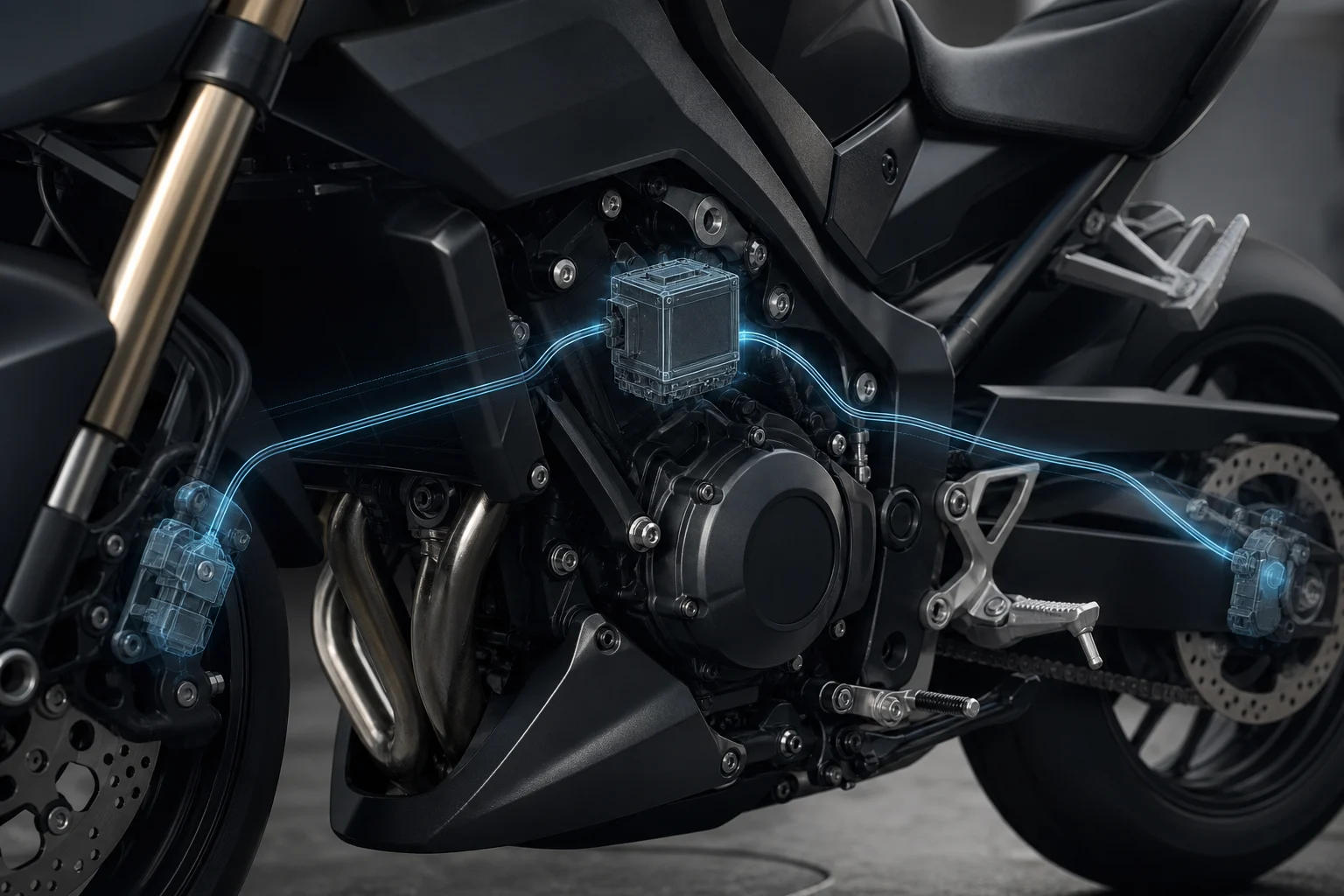
The short answer is that conventional ABS and cornering ABS both aim to provide braking stability, but they do not work with the same information. ABS automatically regulates the slip of one or more wheels during braking. When it detects a risk of locking—because of heavy braking or low grip—it can reduce braking pressure. In Bosch’s description, it monitors wheel speeds and motorcycle deceleration for this purpose.
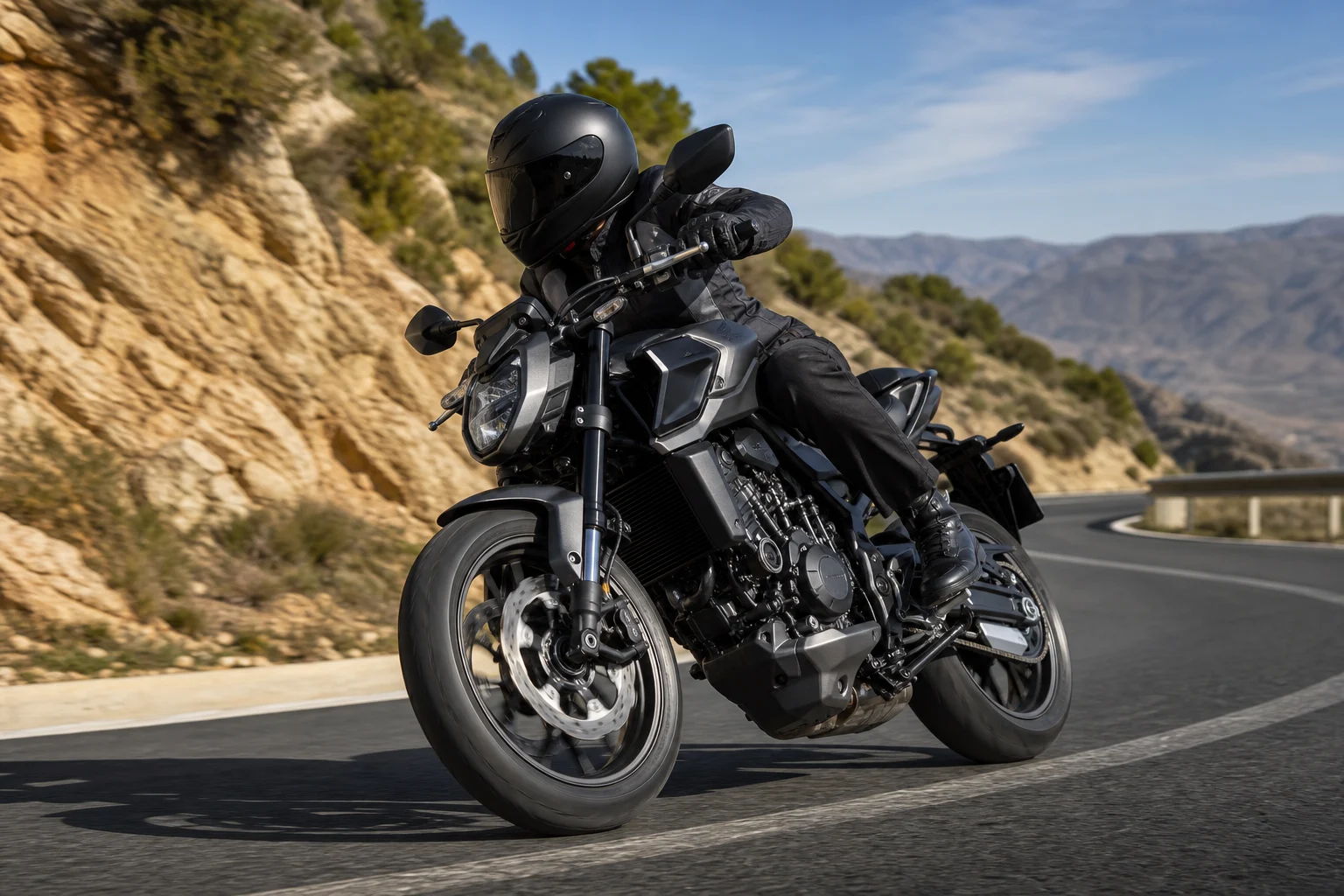
Depending on the brand, a cornering braking system may be called cornering ABS, ABS Pro, or be integrated into a stability control system. In Bosch’s described solution, cornering braking management depends on lean and pitch angles. It is a relevant aid when braking is needed while leaned over, but it should not be understood as permission to enter a corner faster or as a way to recover from any mistake.
The practical conclusion for a buyer is straightforward: “it has ABS” only confirms a basic function. To know what additional protection a particular unit has, you need to identify its version, year, market and specific configuration, then check them against official documentation.
Section references: Manual de procedimiento de inspección de las estaciones ITV, versión 7.8 ↗ · Motorcycle ABS ↗ · Motorcycle stability control (MSC) ↗
- Conventional ABS: focuses on limiting wheel lock during braking.
- In Bosch’s documented solution, cornering braking adds management that considers, among other data, motorcycle lean angle.
- Neither replaces the available grip or anticipation when riding.
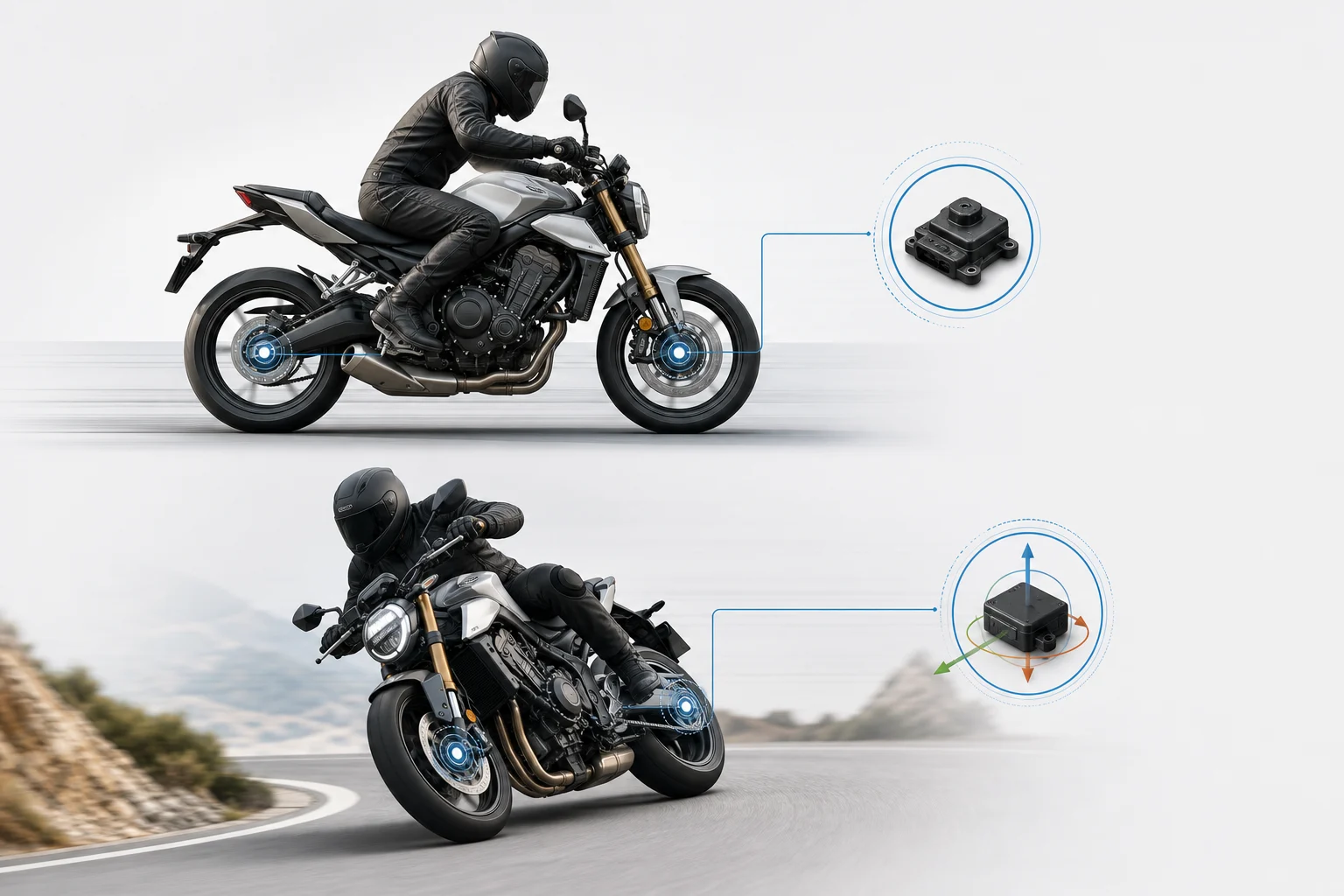
What the inertial measurement unit adds
The technical difference lies in the information received by the system. In addition to the speed sensors on both wheels, the motorcycle stability control described by Bosch uses an inertial measurement unit. This unit measures acceleration and angular velocity 100 times per second. With this data, the system can take lean and pitch into account when regulating braking.
That explanation should not be turned into a promise of braking distance or invulnerability. The BMW Motorrad manual for ABS Pro expressly warns that the system does not redefine the physical limits of riding a motorcycle and was not developed to increase individual braking performance when the motorcycle is leaned over. In other words, the function helps manage a braking situation; it does not create grip where there is none.
This matters especially on the road: a bend may conceal a change in road surface, dirt or dampness. The system operates within physical limits and the conditions set by the manufacturer.
Section references: Motorcycle stability control (MSC) ↗ · Manual BMW Motorrad: ABS Pro ↗
- The IMU provides acceleration and angular-velocity data.
- In Bosch’s documented solution, cornering braking is based, among other variables, on lean and pitch.
- Electronic assistance does not cancel physical limits or the conditions set by the manufacturer.
Conventional ABS versus cornering ABS: what you should actually compare
A commercial name is not enough to complete this table: each manufacturer may group functions differently. Use it as a way to read the manual, not as a universal specification sheet for every model. In particular, confirm whether the lean-sensitive function is standard, linked to a riding mode or tied to an optional package.
Braking equipment must also be separated from other rider aids. A model may offer ABS modes, riding modes and technical accessories without all of them being fitted to every unit. The 2025 KTM 990 Duke R press kit, for example, distinguishes four standard ABS modes from Track Mode and two Custom modes offered as technical accessories. This clearly shows why a motorcycle advertisement, even when it mentions advanced equipment, needs to be verified.
| Aspect | Conventional ABS in Bosch’s documented description | Cornering ABS in Bosch’s documented solution | What the buyer should check |
|---|---|---|---|
| Main purpose | Limit wheel lock during braking. | Manage braking while taking the lean situation into account. | The exact system description in the manual. |
| Information cited | Wheel speed and vehicle deceleration. | Wheel-speed sensors and an inertial measurement unit; lean and pitch. | Whether the unit states that it has an IMU and cornering braking function. |
| Relevant use | Heavy braking or braking on a slippery surface. | Braking when the motorcycle is leaned over, within physical limits. | Which modes, conditions or settings the manufacturer specifies. |
| Specification check | Consult the manual specific to the unit. | Consult the manual specific to the unit. | Review the manufacturer’s specifications for that unit; the 2025 KTM 390 Adventure R manual is an identified example. |
Section references: Motorcycle ABS ↗ · Motorcycle stability control (MSC) ↗ · Manual BMW Motorrad: ABS Pro ↗ · Manual KTM 390 Adventure R 2025 ↗ · 2025 KTM 990 DUKE R Press Kit ↗
- Ask for the factory equipment list for that specific unit, not just the model’s generic specification sheet.
- Check which modes are active and which are optional in the relevant manual.
- Do not assume a motorcycle has cornering ABS because it has ABS, traction control or riding modes.
Why two motorcycles with ABS may not offer the same features
In Spain, Regulation (EU) No 168/2013 requires ABS on new L3e-A2 and L3e-A3 motorcycles that are marketed, registered and put into service. For L3e-A1, it allows the manufacturer to fit ABS, combined braking or both. In addition, two-wheel enduro and trial motorcycles in subcategories L3e-AxE and L3e-AxT are exempt from this requirement. Therefore, the regulation helps explain the presence of basic ABS on many new motorcycles, but it does not certify a cornering braking function.
More variables apply in the used market: model year, commercial version, the market where it was first sold and the packages selected. Even within the same range, functions may depend on a particular mode or technical accessories. The most frequent mistake is accepting wording in an advertisement—“ABS”, “full electronics” or “Sport mode”—as if it detailed the safety architecture of that specific unit.
The useful rule is to require evidence linking the functions to that motorcycle: owner documentation, factory equipment information by vehicle identification number that the seller can provide, and consistency between those documents and the controls or menus actually present.
Section references: Reglamento (UE) n.º 168/2013 — Anexo VIII ↗ · 2025 KTM 990 DUKE R Press Kit ↗ · Manuales del propietario ↗
- Do not extrapolate the equipment in a press review to a used unit.
- Do not treat a version from another market as equivalent to one originally sold in Spain.
- Always distinguish between a standard function, an option and an activatable accessory.
Checks before signing: documents, instrument panel and motorcycle condition
Start with the exact owner’s manual. Official manual portals are useful sources because they bring together specifications, features and maintenance schedules; then check that the manual matches the motorcycle’s year and version. Look for sections on ABS, riding modes, stability control and warning lights. If cornering ABS is advertised, the function should be described unambiguously, even if the brand uses a different name.
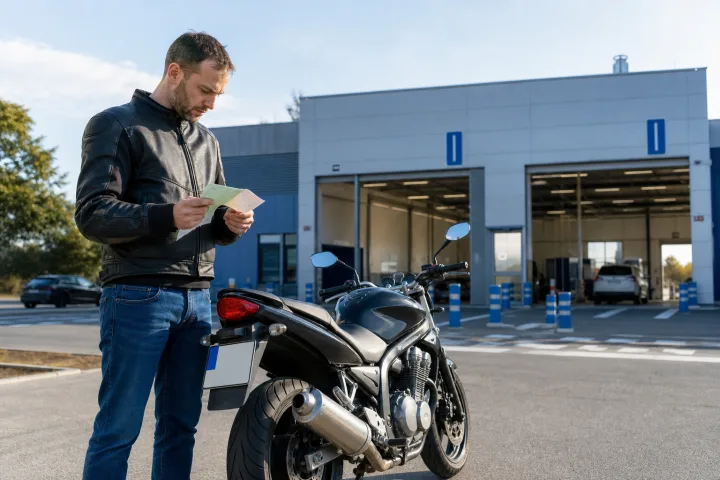
Then, with the motorcycle stationary and following the manual’s instructions, switch on the ignition and observe the ABS warning light. Spain’s ITV inspection procedure specifically checks that the light comes on with the ignition and goes out after the check; if it remains on, this indicates a fault. This is a basic fault check, not certification that all the advertised advanced functions are present.
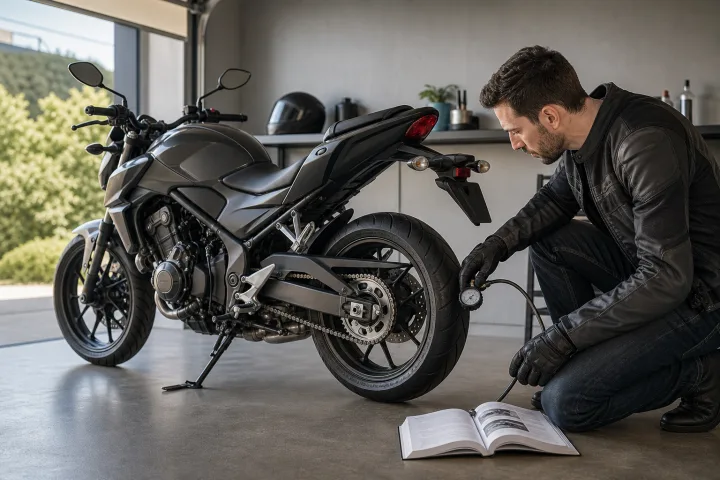
Finally, check whatever the manual specific to the unit indicates for proper system operation. KTM states for its 2025 390 Adventure R that suspension travel must not be modified, approved tyres and wheels must be used, specified pressure must be maintained, and servicing and repairs must be carried out correctly. For a used motorcycle, consult the relevant manual and ask for maintenance invoices.
Section references: Manual de procedimiento de inspección de las estaciones ITV, versión 7.8 ↗ · Manual KTM 390 Adventure R 2025 ↗ · Manuales del propietario ↗
- Note the vehicle identification number, version, date of first registration and country of origin before comparing documents.
- Ask for the manual for that version and locate the description of the ABS and its modes.
- Switch on the ignition and check the ABS warning-light cycle; if it stays on, do not ignore it.
- Consult the specific manual regarding tyres, wheels, suspension and maintenance, and ask for the available records.
- Do not try to trigger ABS intervention during a public-road purchase test ride.
How to decide whether it is worthwhile and preserve its value
For daily use and road riding, the confirmed availability of a cornering braking function may, as a personal preference, be a valuable buying criterion if the budget allows a choice between comparable units. However, it should not displace essential checks: suitable ergonomics, documented condition, tyres in good condition and consistent maintenance. A motorcycle advertised with cornering ABS but without clear documentation or with its fault warning light on does not deserve to be credited with that advantage.
The choice should start with intended use. Someone prioritising urban journeys may value handling and overall condition first; someone who regularly travels on winding roads may decide to place greater weight on confirmation of lean-sensitive management. In both cases, keep the manual, invoices and details of the tyres fitted to make the unit easier to document for a future buyer.
The system is a safety net, not a riding strategy. Maintaining a margin in speed and lean angle, watching the road surface, and keeping wheel, tyre and suspension specifications unchanged remain decisive choices. To complete your pre-purchase review, see this guide on motorcycle tyre pressure and the used vehicle checklist.
Section references: Manual BMW Motorrad: ABS Pro ↗ · Manual KTM 390 Adventure R 2025 ↗
- Choose based on confirmed functions, not abbreviations in an advertisement.
- Prioritise a unit with verifiable history and condition.
- Consider practical training as a complement to technology, never as a reason to take more risk.
Does a motorcycle with ABS always have cornering ABS?
No. Basic ABS regulates slip to reduce the risk of wheel lock during braking. In Bosch’s described system, cornering management uses additional functions and sensors; you need to review the documentation for the specific unit.
Can the ABS warning light confirm that the motorcycle has cornering ABS?
Not on its own. The warning light lets you check the basic ABS self-test cycle and identify a fault if it remains on, but it does not prove every advanced function is fitted. You need to review the manual and the unit’s equipment.
Does cornering ABS allow risk-free braking at a high lean angle?
No. The manuals consulted state that these functions operate within physical limits and were not developed to increase individual braking performance by themselves when the motorcycle is leaned over.
What should I ask a used motorcycle seller for?
The vehicle identification number, the manual for the relevant version, factory equipment details where possible, maintenance invoices, and tyre and wheel information. Also check the ABS warning-light cycle when switching on the ignition.