ECE 22.06 motorcycle helmet: how to identify approval and what to check before buying
The ECE label is the first filter, not the only one. This guide explains how to read it, what the 22.06 series adds, how to check fit and which risks to assess in a new or used helmet.
Key points
ECE 22.06 includes, among other documented changes, an oblique-impact test and rules for accessories. Before paying, read the label and try the helmet on according to the model’s instructions.
Quick answer: approval is necessary, but it does not decide the purchase on its own
If you are considering a motorcycle helmet advertised as ECE 22.06, start by locating its approval mark and that of its visor. The United Nations states that both the helmet and visor approved under UN Regulation No. 22 must bear a type-approval mark. This check helps distinguish an identified, documented product from an offer that merely uses marketing messages about safety.
The documentation for series 06 of UN Regulation No. 22 includes an oblique-impact method that measures rotational acceleration, as well as specific provisions on accessories and their compatibility. You should not conclude from that reference alone, without further information, that a particular helmet will fit better or be suitable for every use.
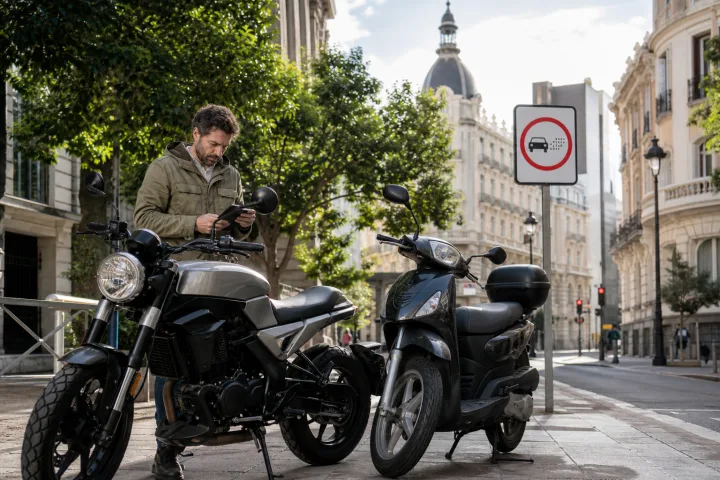
For riding in Spain, the current text of the General Traffic Regulations consulted on 10 September 2026 requires riders and passengers to properly use an approved or certified protective helmet in accordance with current legislation, on urban and interurban roads. The DGT places the entry into force of the articles relating to approved helmets for motorcycle users on 1 October 2027; any change should be checked against its application date.
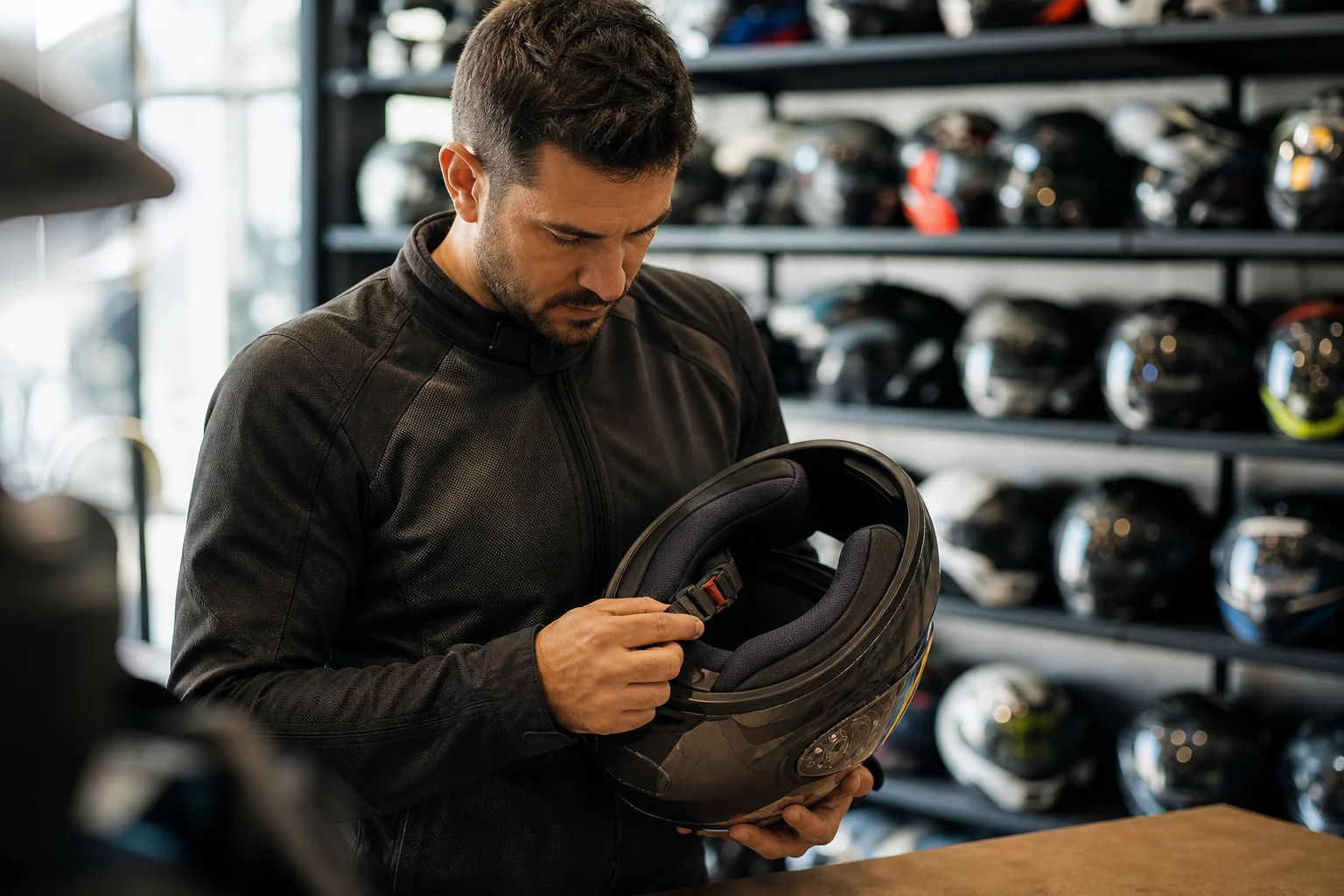
In practice, do not buy based on the “22.06” claim without carrying out four checks: a legible label, trying the helmet on in line with the model instructions, checking the visor and confirming accessory compatibility. Approval certifies a type; it does not replace trying on the helmet or consulting its instructions.
Section references: Reglamento General de Circulación, artículo 118 (texto consolidado) ↗ · Actualización del Reglamento General de Circulación: entrada en vigor ↗ · Folleto explicativo de la Reglamentación UN nº 22 ↗ · Reglamento UN nº 22, serie 06: texto de aprobación ↗
- Look for the approval mark on both the helmet and the visor.
- Check the model documentation and instructions before assessing price, design or promotions.
- Try the helmet on and follow the model instructions to assess fit.
- For a used unit, treat a lack of history as a significant risk, not a minor detail.
Where to find the ECE label and how to read its codes
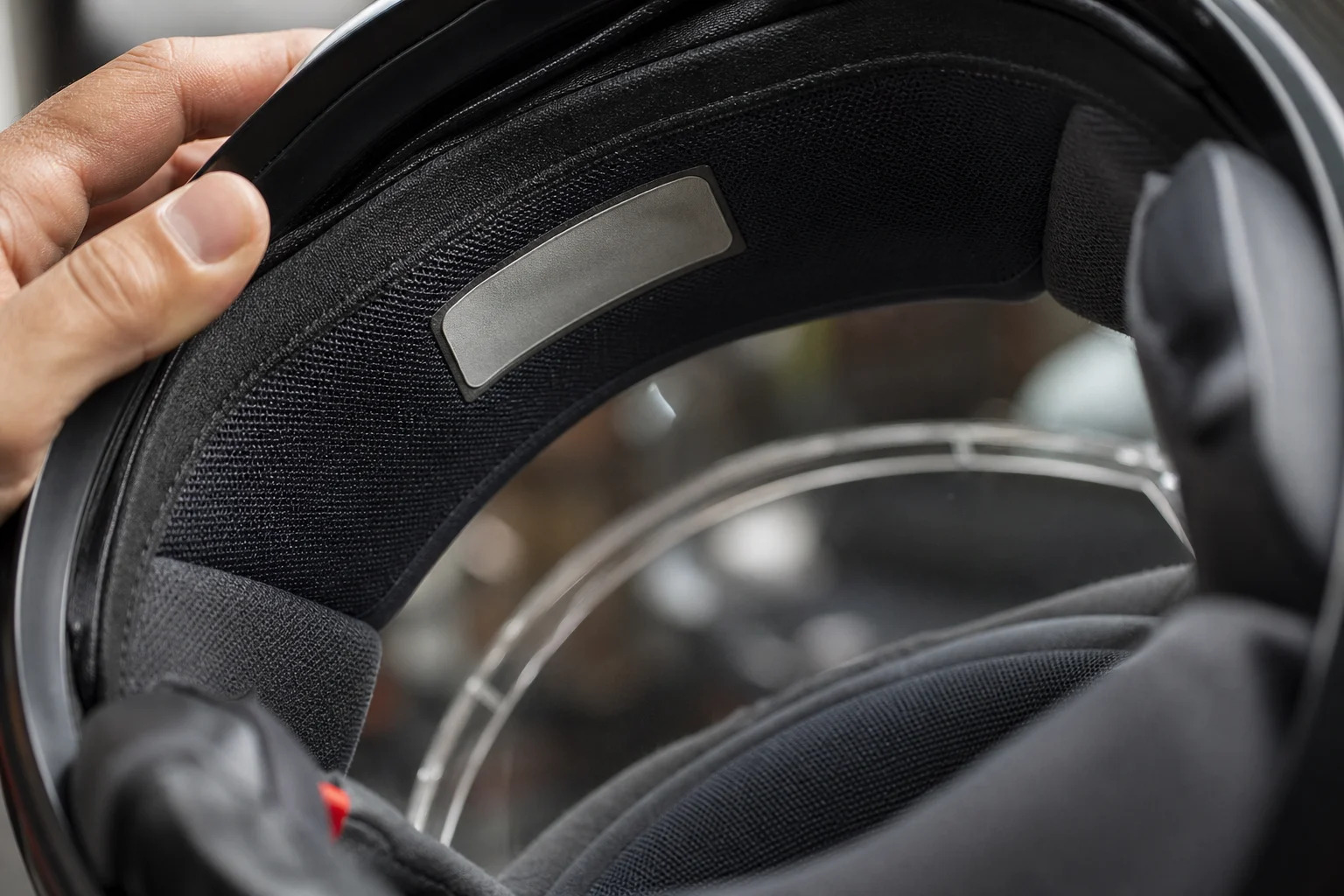
The approval mark is the starting point for checking that the helmet and visor display a type-approval mark. UNECE’s explanation describes a capital E inside a circle followed by a number: that number identifies the country whose authority granted the approval. It does not identify the country of manufacture, the brand, the level of comfort or a protection ranking between helmets.
Next, check that the label belongs to the helmet being offered and that it is not cut, peeling off or illegible. Ask to see the inside, not only side photographs. Carry out the same check on the fitted visor: helmets and visors approved under UN Regulation No. 22 must bear their type-approval mark. A dark visor without identification, or one whose origin you cannot verify, deserves particular caution.
Some codes provide information about the approved configuration and should not be confused with a commercial name. In UNECE’s guide, P means “Protective”: it identifies a chin guard tested and approved as protective on a full-face helmet. J identifies a jet or open-face type approval. If you are comparing a helmet with a chin guard, check the exact code on its label and the model instructions rather than deducing its status from its appearance alone.
Section references: Folleto explicativo de la Reglamentación UN nº 22 ↗
- Do not confuse the number beside the circled E with a size, manufacturing date or country of production.
- Compare the helmet label with the listing, invoice or advertisement when buying remotely.
- Check that the fitted visor is marked, and do not assume a replacement visor is valid simply because it physically fits.
- Keep the instructions: they are the manufacturer’s reference for approved components and configurations.
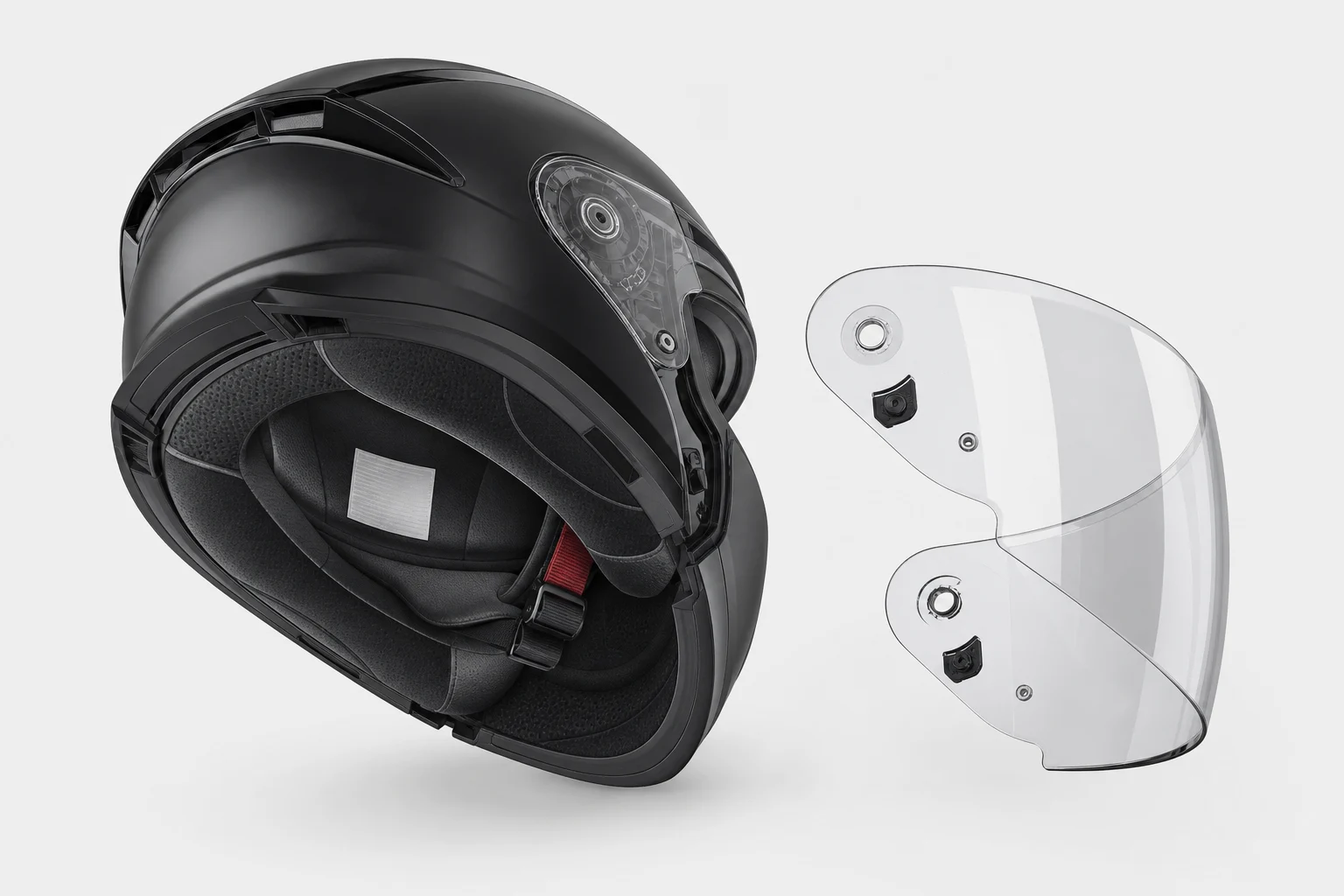
What ECE 22.06 documents and what it means when buying
The clearest documented technical difference in ECE 22.06 is that series 06 includes an oblique-impact method for measuring rotational acceleration. It also develops the treatment of accessories: it distinguishes between universal accessories, intended for helmets prepared for them, and specific accessories designed for a particular model. These are useful changes for interpreting documentation and the manual, but they do not replace physically checking the helmet you will wear.
When assessing an ECE 22.06 helmet, avoid two common mistakes. The first is presenting approval as a guarantee of fit: the manufacturer states that the size chart is only a guide and that you must try the helmet on and follow the manual. The second is claiming that every 22.06 helmet allows an intercom, camera or any visor to be fitted. The regulation requires a warning that an accessory must not be fitted if the symbols on the helmet label do not include all the accessory’s symbols.
The practical consequence is straightforward: if the accessory is part of your purchase, take it to the shop or request precise documentation before paying. Check which helmet model is in front of you, which accessory it is and what its label and instructions state.
| Documented aspect | ECE 22.06 | Implication for the buyer |
|---|---|---|
| Documentation | Series 06 documented in UN Regulation No. 22. | The reference does not replace trying the helmet on or consulting the manual. |
| Oblique impact | Includes an oblique-impact method that measures rotational acceleration. | It is a documented technical difference of series 06; it does not allow the protection of a specific helmet in use to be quantified. |
| Accessories | Distinguishes universal and specific accessories and requires compatibility symbols to be checked. | Do not fit an accessory if the symbols on the helmet label do not include all of the accessory’s symbols. |
| Configuration | Label codes remain essential; P identifies a protective chin guard and J a jet or open-face type. | Do not use the outer shape as the only proof of the approved configuration. |
Section references: Reglamento UN nº 22, serie 06: texto de aprobación ↗ · Enmienda sobre accesorios para la serie 06 del Reglamento UN nº 22 ↗ · Guía de talla ↗
- ECE 22.06: the series documents an oblique-impact test and accessory compatibility rules.
- The ECE 22.06 reference does not replace trying the helmet on or consulting the manual.
- For accessories, check the label and instructions for the specific model.
- Ask the seller for the manual applicable to the model and keep the purchase documentation.
Size and configuration come first: full-face, jet and helmets with a chin guard
A size conversion chart in centimetres is only useful for starting the search. HJC expressly warns that its chart is for guidance only and that you must try the helmet on and follow the manual to achieve the correct fit. Try several sizes or models if the retailer offers them.
The helmet should be tried on according to the model instructions. If you have doubts about fit during the fitting, consult the manual and consider another model or size before buying.
Always check the approved configuration. On a full-face helmet, the P mark confirms that the chin guard was tested as protective; on an open-face helmet, J identifies jet type approval. On a helmet with a movable chin guard, do not assume permitted uses from its mechanism: consult the label and model instructions.
Section references: Folleto explicativo de la Reglamentación UN nº 22 ↗ · Guía de talla ↗
- Try the helmet on according to the model instructions.
- Consult the manual if you have doubts about fit or the approved configuration.
- On a full-face helmet, verify P; on an open-face helmet, identify J; on a movable chin guard, follow the model manual.
- Try several sizes or models if the retailer offers them.
Visor, fastening and accessories: checks that prevent incompatibilities
Before paying, check that the fitted visor has an approval mark and has not been replaced with an unidentified screen. Consult the model instructions for approved components and configuration.
If you choose a tinted ECE 22.06 visor, check its own marking and its compatibility with the specific helmet. Shoei explains that minimum light transmission of 80% allows unrestricted use, while visors between 35% and 80% must carry a daytime-use indication. That reference does not authorise extrapolating the figure to unmarked screens or visors from another source.
Accessories are a frequent source of mistakes: an apparently neat installation may not be intended for that helmet. Examine the label and manual before buying the combination. If you cannot verify the match, the prudent decision is not to fit the accessory or to seek documentary confirmation from the manufacturer.
Section references: Folleto explicativo de la Reglamentación UN nº 22 ↗ · Enmienda sobre accesorios para la serie 06 del Reglamento UN nº 22 ↗ · Preguntas frecuentes: mantenimiento, sustitución, visores y etiqueta ↗
- Check that the fitted visor is marked and consult the model instructions.
- For a tinted visor, identify its marking and any daytime-use indication.
- Check the label and manual before buying an accessory.
- Do not assume an accessory is compatible because another rider has fitted it to a similar helmet.
Second-hand helmets and replacement: when the label is no longer enough
A used helmet can be attractive because of its price, but it has one limitation that good photographs cannot solve: its history. HJC warns that protective foam adapts over time to the shape of its wearer’s head. For this reason, a borrowed or second-hand helmet requires particular caution regarding fit and history, even if its nominal size matches yours.
Its external appearance does not resolve every doubt either. Shoei states that fine cracks in the shell or EPS deformation cannot be made visible without destroying the helmet. Do not base the decision on the fact that it “has no visible knocks”. If the seller cannot explain its origin, drops, storage, visor changes, fastening or parts, the discount should be weighed against insufficient traceability; it is often more sensible to reject the unit.
As a manufacturer recommendation, Shoei advises replacing the helmet after approximately five years of normal use, care and storage, and always after a drop or accident. Also consult the manual for the specific brand: this is the source that should guide maintenance and replaceable components.
Final checklist before paying: check the approval mark on the helmet and visor; consult the documentation and codes; try the helmet on according to the manual; consult the instructions for approved configuration and components; verify accessories through the label and manual; and, if it is used, require a credible history or walk away from the purchase.
Section references: Guía de talla ↗ · Preguntas frecuentes: mantenimiento, sustitución, visores y etiqueta ↗
- Reject a helmet that has been dropped or involved in an accident, in line with the cited manufacturer recommendation.
- Do not interpret an apparently perfect shell as proof that the inside has not been damaged.
- When buying second-hand, request clear photos of the label, fastening, interior, visor and mounts, as well as its usage history.
- Do not confuse the manufacturer’s replacement recommendation with a single legal time limit applicable to all helmets.
- Keep the invoice, manual and references for compatible replacement parts for future checks.
What do Spain’s General Traffic Regulations require regarding helmets?
The current text of the General Traffic Regulations consulted requires the proper use of an approved or certified helmet in accordance with current legislation, on both urban and interurban roads. Check any regulatory change according to its application date.
What does a helmet’s ECE label indicate?
For a helmet and visor approved under UN Regulation No. 22, UNECE documentation states that both must carry a type-approval mark. The label is an essential check before buying, although it cannot by itself reveal internal damage or choose the right size.
What does P mean on a helmet label?
P means Protective and identifies a chin guard tested and approved as protective on a full-face helmet. J, by contrast, identifies a jet or open-face type approval. Always check the actual code on the label and the model instructions.
Is buying a second-hand helmet a good idea?
Require complete traceability and check the label, fastening, visor, interior and mounts. Even then, some internal damage cannot be seen without destroying the helmet, and the protective foam adapts to the previous wearer’s head. If there are doubts about drops, origin or storage, it is best to reject it.