Renting a campervan or motorhome before buying: what to ask and check
A rental trip can become a buying test if you define your needs, review the contract and document how each space is actually used.
Key points
A well-planned rental lets you find out whether the size, layout and routines of a campervan or motorhome suit your intended use before buying. The key is to separate what the rental company provides from what the vehicle itself offers, and to record comparable information throughout the trip.
The test starts before you book, not when you collect the keys
Renting before buying is useful for answering one specific question: whether that type of vehicle works for its occupants, their luggage and their way of travelling. It is not enough for it to look appealing during a brief visit. The trip should reproduce, on a reasonable scale, the use you expect to make of the future purchase: couples’ breaks, family holidays, frequent journeys or stays of several days.
Before comparing prices, write a test scenario. State how many people will travel and sleep, how many nights the trip will involve, the season in which it will take place, the type of roads expected and where you intend to park or stay overnight. Then turn that scenario into requirements: travelling seats with restraints, beds that can be used without rearranging the entire living area, space for clothes and equipment, a kitchen and bathroom if they are essential, and a realistic tolerance for the exterior size.
The DGT distinguishes between a motorhome, designed to be lived in inside, and a camper van, a vehicle adapted for that purpose. That difference alone does not determine which one is right to buy. The rental should test the practical consequences of each format: access to the driving position, manoeuvring, living space, storage and the time needed to get the vehicle ready for driving or resting.
Section references: DGT: caravana, remolque o autocaravana ↗
- Define a route that includes the type of road you will use most often.
- Travel with all the intended occupants and a volume of luggage close to the real one.
- Note which items are essential, which only add comfort and which you would not use.
- If you are undecided between a campervan and a motorhome, try to rent comparable configurations in terms of occupants and duration, rather than simply choosing the cheapest option.
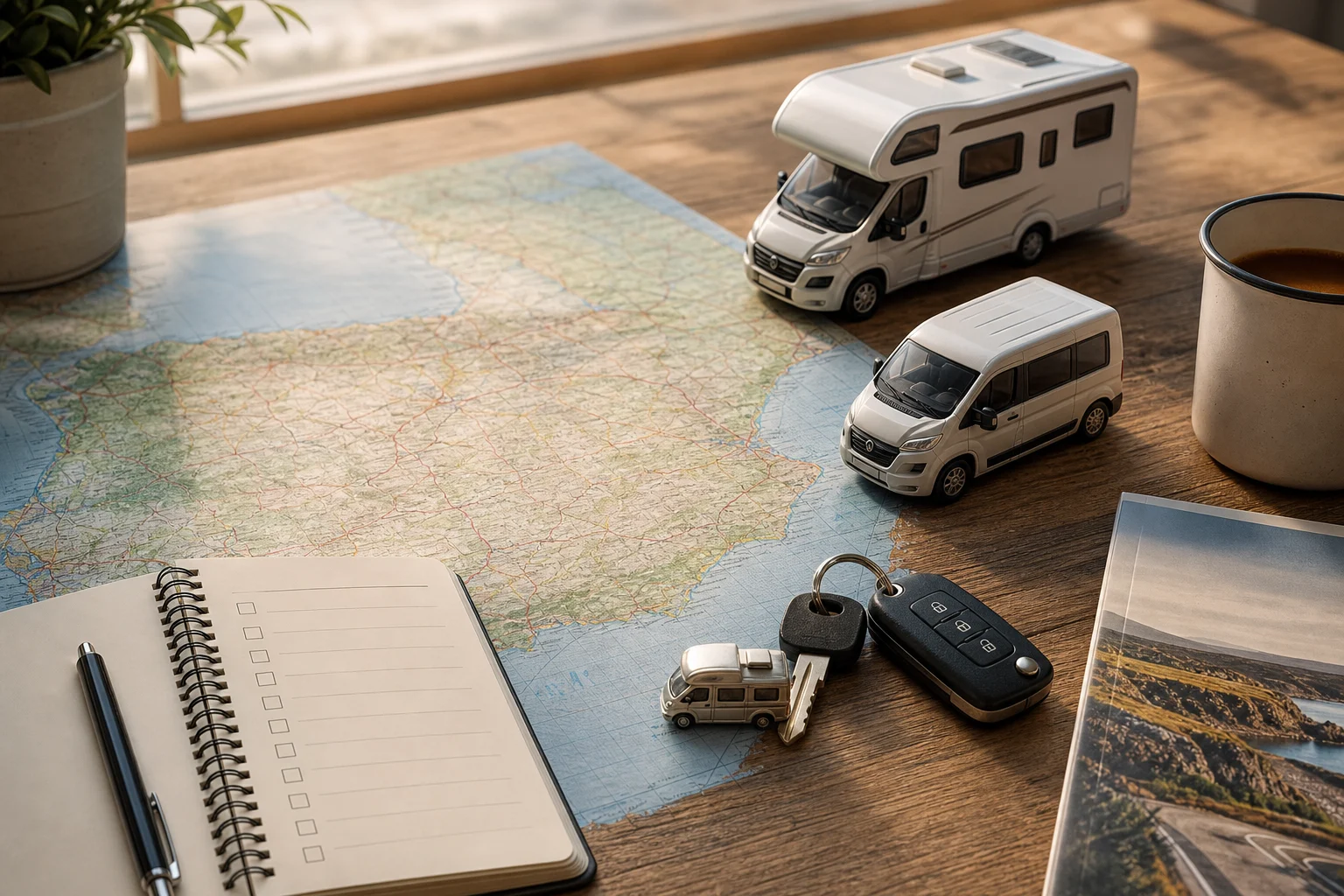
Campervan or motorhome: turn the differences into practical questions
Avoid assigning a universal advantage to either option. A campervan may be the best fit if your test reveals that exterior size is a decisive constraint on the route. A motorhome may be preferable if using the living area with all occupants on board is what matters most. The decision should not be based on the commercial name of the category, but on how it solves the tasks you will repeat.
When booking, ask for the dimensions of the vehicle or, if a specific registration number has not yet been assigned, the range applicable to the booked category. Plan at least one parking manoeuvre, one narrow access point that forms part of your usual route and one short stop. The aim is not to create artificial difficulties, but to identify whether the size adds time, stress or restrictions to the itineraries you intend to make.
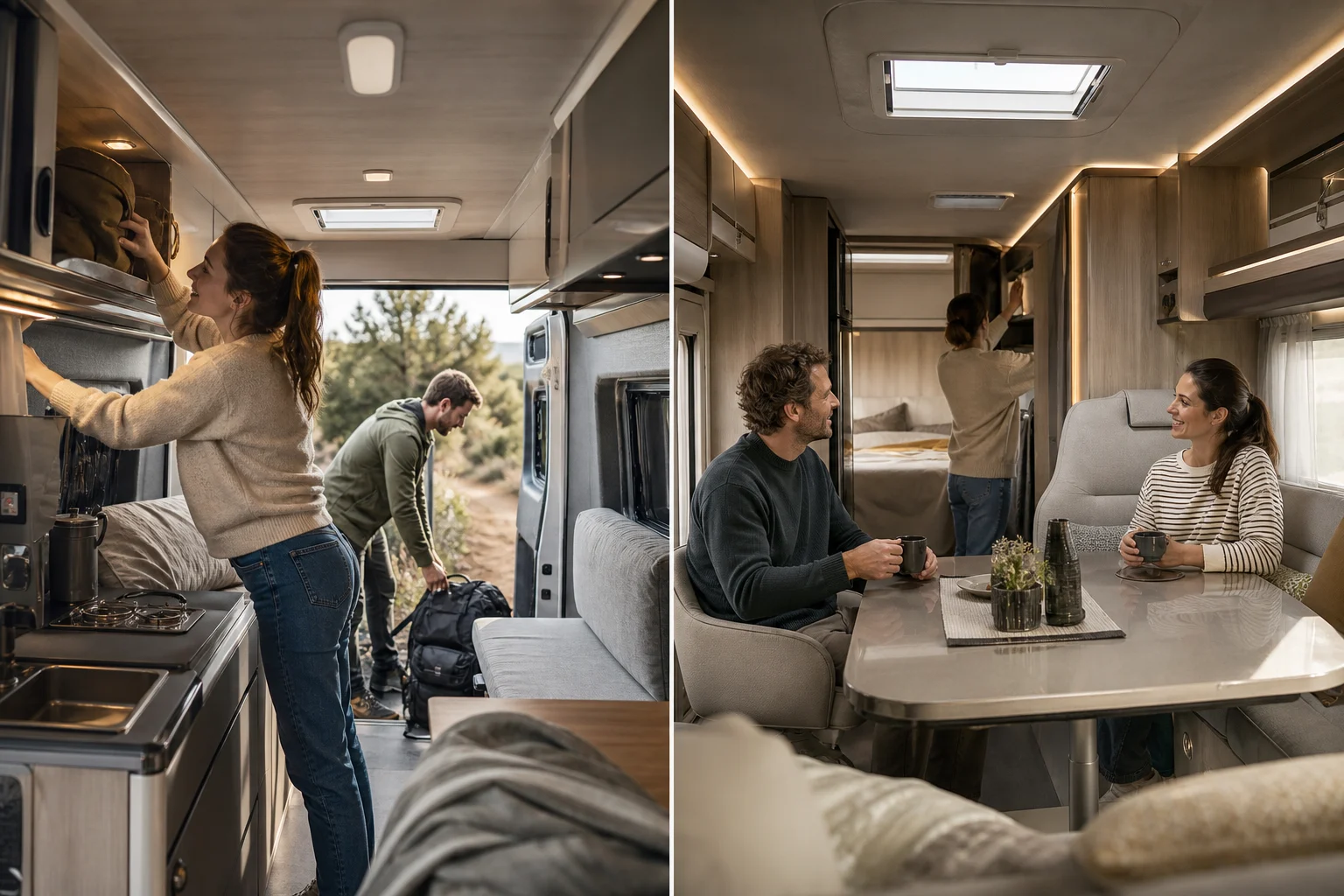
It is also important to test the layout with the vehicle occupied. Check whether everyone can sit down and fasten their seat belts without obstructing access, where belongings are stored after a night’s stay and what happens when one person cooks, another looks for clothes and another needs to get in or out. Repeated inconvenience in these tasks is more useful buying information than a long list of accessories.
Section references: DGT: caravana, remolque o autocaravana ↗
- Measure whether you can store luggage without taking up the bed, aisle or dining area.
- If useful, time how long you spend clearing the space before setting off and preparing it when you stop.
- Record driving ease, night-time comfort and day-to-day life inside separately.
- Do not conclude that a category lacks a feature because the rented vehicle does not have it: check that vehicle’s specification and inventory.
Before booking: contract, licence and cover questions
Rental conditions vary between companies, categories and contracts, so ask for answers in writing or make sure they appear clearly in the terms that apply to your booking. The driving licence must also be checked vehicle by vehicle. The DGT states that a campervan or motorhome with a maximum authorised mass (MAM) of up to 3,500 kg can be driven with a category B licence, while some rental vehicles may exceed that threshold and require the relevant licence.
Confirm which drivers will be declared. Under a Yescapa contract, only declared people may drive, and the contracted mileage and excess-mileage rate must appear in the contract. As an example that requirements are not uniform, McRent’s terms in Spain require every driver to be at least 25 years old and to have held a category B licence for more than two years; they also warn that some vehicles exceed 3.5 tonnes.
Review the deposit, insurance, excess, assistance and exclusions before paying. The European Consumer Centre warns that certain damage, such as damage to windows, tyres or windscreen wipers, may not be covered. Also ask about fuel, tolls, cleaning, mileage, travel abroad, pets and any return charges. The practical question is not only how much the initial rate costs, but in which situations the final amount changes.
Section references: DGT: caravana, remolque o autocaravana ↗ · Alquiler de vehículos ↗ · Contrato de alquiler entre particulares ↗ · Condiciones generales de alquiler para autocaravanas en España ↗
- What licence does the reserved vehicle specifically require, and what is its MAM?
- Who can drive, and what are the minimum age and licence-holding requirements?
- How much is the deposit, how is it blocked or charged, and when is it released?
- What excess and exclusions apply to the cover taken out?
- What mileage is included and what is the contractual price for excess mileage?
- Are pets, international travel, return to a different office or out-of-hours return permitted?
What should be recorded to assess the vehicle you are given
Request or photograph the documents and inventory for the vehicle finally assigned to you. In Spain’s General Vehicle Regulations, field F.2 identifies the maximum laden mass permitted for use on Spanish roads, and S.1 identifies the number of seats, including the driver. These details help check the licence requirement and occupancy, but they do not replace an inspection of the layout or safety equipment.
For a motorhome, the DGT reminds users that the number of places permitted on the registration certificate must not be exceeded and that an approved seat belt or restraint system is compulsory both in the cab and living area. For a family, counting beds is not enough: the documented travelling seats, available seat belts and the occupants who will actually travel must match.
Always separate the vehicle from the service. For example, roadsurfer states that it includes basic camping equipment, an outdoor table and chairs, and allows extras to be booked. That describes that company’s commercial policy, not a feature inherent to all campervans or a reason to buy a specific model. In your test sheet, note what belongs to the vehicle, what is provided as equipment and what you have added yourself.
| Aspect | Where to confirm it | Why it changes a future purchase |
|---|---|---|
| MAM and required licence | Vehicle documentation; field F.2 | Determines whether the licence you hold is valid for that specific vehicle. |
| Travelling seats | Documentation; field S.1 and seating positions with restraints | Beds do not guarantee that everyone can legally travel seated and restrained. |
| Deposit, excess and exclusions | Contract and cover terms | Makes it possible to compare the actual financial risk, not only the rate. |
| Included mileage and excess mileage | Contract | Changes the cost of a test trip and equivalent future journeys. |
| Inventory and extras | Handover inventory and booking | Avoids confusing items lent by the company with the vehicle’s own equipment. |
| Initial condition and return | Handover and return report | Reduces disputes and provides a record of incidents. |
Section references: DGT: caravana, remolque o autocaravana ↗ · Reglamento General de Vehículos consolidado ↗ · Alquiler de vehículos ↗ · Preguntas frecuentes de alquiler de camper ↗
- Vehicle document or specification: MAM/F.2, seating capacity/S.1 and declared dimensions.
- Signed inventory: kitchenware, outdoor furniture, cables, levelling ramps or other supplied items.
- Condition at handover: overall and damage photos, together with the report and a copy.
- Declared restrictions on driving, use, cleaning, fuel, mileage and return.
During the trip: observe routines, not only the enjoyable moments
The usefulness of the test depends on recording what happens when the vehicle is full, being driven, parked and set off again. Keep shared notes and score each area at the end of every day using a simple scale, for example from 1 to 5. Add a short comment: “luggage accessible”, “bed requires bags to be moved” or “difficult parking”. This prevents a general impression from obscuring specific problems.
Check autonomy as a user experience, without extrapolating it to every model. Note how often you had to reorganise, find a service point or limit an activity because of a lack of space or available resources. If the trip includes a night outside a campsite, plan it only where this is permitted. Municipal by-laws may limit parking time or prohibit camping except in authorised areas.
State regulations must also be distinguished from local rules. Article 92.4 of the General Traffic Regulations provides, with effect from 1 October 2026, that when motorhomes and living vehicles are parked, no elements may extend beyond their perimeter, they must rest only on their tyres except for safety chocks or wedges, and no fluids from the living area may be discharged. Also check the rules of the municipality or chosen area before stopping.
Section references: DGT: actualización de la instrucción sobre autocaravanas ↗ · Reglamento General de Circulación consolidado ↗
- Driving: perceived visibility, manoeuvring, access to parking and fatigue after each stage.
- Rest: ease of making up beds, privacy, noise and night-time access.
- Day-to-day life: blocked passageways and simultaneous use of the kitchen, bathroom and cupboards.
- Loading: items that have no fixed place and daily time spent reorganising.
- Practical operation: tasks to do before leaving and on arrival; what is frequently forgotten or delayed.
- Rules: parking location, verified local rules and any restriction that altered the plan.
Return and interpretation: turn the rental into a buying decision
When returning the vehicle, repeat the inspection with the same care as at handover. The European Consumer Centre recommends inspecting the vehicle before signing, reporting damage and obtaining written confirmation together with a copy of the report. Whenever possible, return the vehicle while the office is open: the organisation warns that, if it is returned out of hours, the customer may be liable for damage until the company carries out its inspection.
While the trip is still fresh in your mind, turn your notes into three lists. The first contains non-negotiable requirements: for example, a specific number of travelling seats, a bed solution that does not block access or dimensions that fit your routes. The second contains preferences you would pay for if the budget allows. The third lists features you did not use; these are the first things not to oversize in a purchase.
Finally, compare vehicles for sale against that document, not against the rental inventory or an isolated impression. If a decisive doubt remains—for example, between two layouts or between travelling as two or as four—a second rental specifically aimed at that question will usually provide a cleaner comparison than indiscriminately expanding the list of extras.
Section references: Alquiler de vehículos ↗ · Contrato de alquiler entre particulares ↗
- Inspect the vehicle with company staff and keep a copy of the final report.
- Document in writing any incident, disagreement or charge still requiring clarification.
- Classify every observation as essential, preferable or unnecessary.
- Then compare the mass, seating capacity, dimensions and layout of candidate vehicles with your requirements list.
- Use the experience to narrow down options: a sound purchase usually depends more on ruling out incompatibilities than on adding accessories.
Can any rental campervan or motorhome be driven with a category B licence?
Not necessarily. The DGT states that a category B licence may be sufficient when the MAM does not exceed 3,500 kg. You must check the MAM of the reserved vehicle, as some rental vehicles exceed that limit and require the relevant licence.
Do sleeping places correspond to travelling seats?
No. You must verify the documented number of seats for the vehicle and ensure occupants have an approved seat belt or restraint system. In motorhomes, the DGT requires users to respect the authorised seating capacity and use restraints in the living area as well.
Will the table, chairs or kitchenware included in a rental be part of the vehicle I buy?
That cannot be assumed. These items may depend on each company’s inventory or extras. Record separately what belongs to the rented vehicle and what is lent to you as a service to avoid making an inaccurate comparison.
What is most important when returning a rented campervan?
Inspect it and record any damage or incident in writing, keeping a copy of the report. The European Consumer Centre advises returning it while the office is open whenever possible, so the inspection can be carried out at that time.