Sleeping in a Campervan or Motorhome in Spain: Key Rules
A guide to telling parking apart from camping, checking the conditions of a stop and preparing an alternative before sleeping in a campervan or motorhome.
Key points
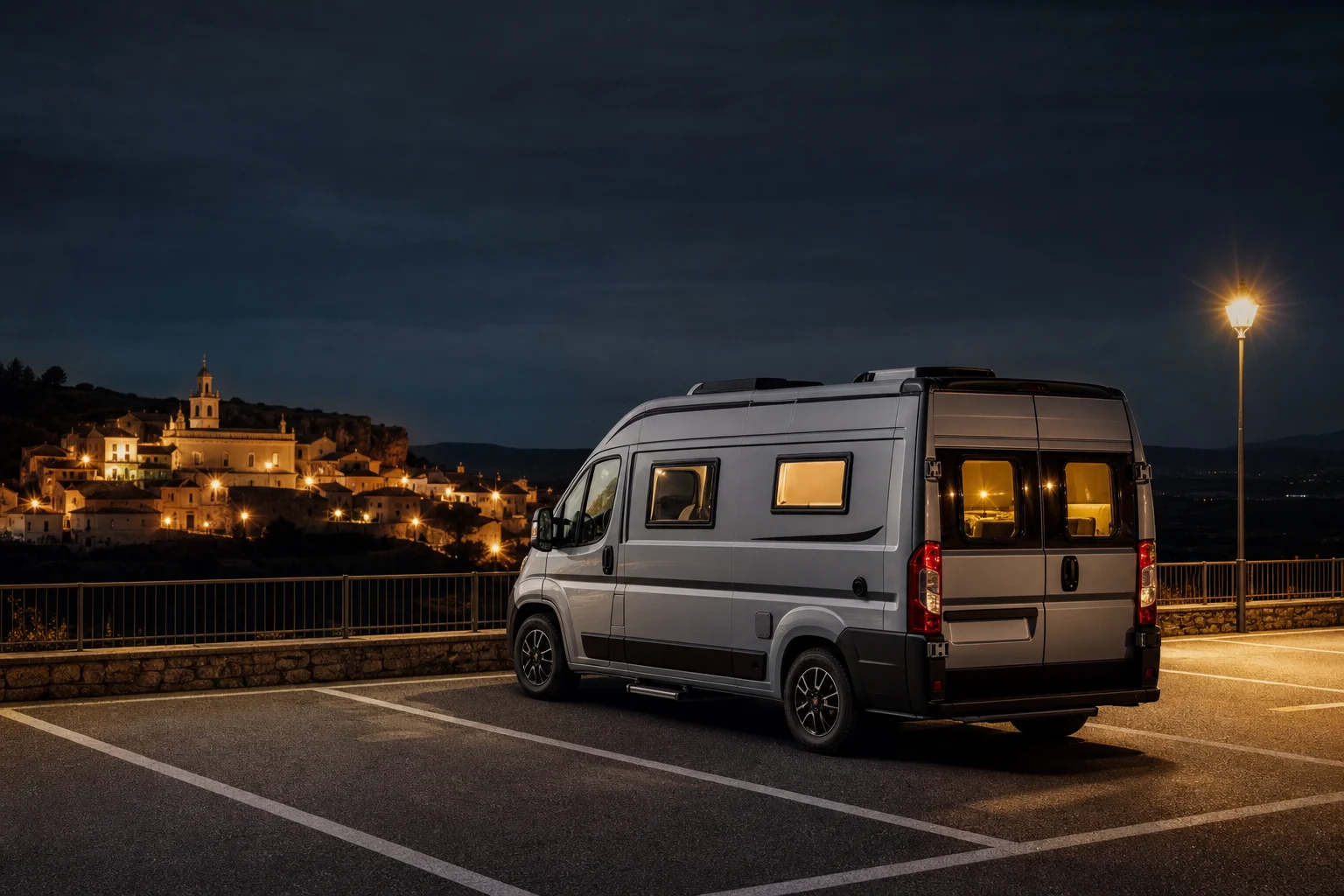
Sleeping inside a campervan or motorhome does not automatically amount to camping under the DGT’s parking criterion, but it does not make every location valid either. You must comply with traffic rules and check signs, the site manager and any destination-specific rules.
The short answer: sleeping inside is not enough to define the situation
To sleep overnight in a motorhome in Spain, it helps to separate two questions. The first is whether the vehicle is correctly parked under traffic rules. The second is whether the location imposes additional conditions that prevent overnight stays, restrict access or require the use of a specific area. Meeting the first requirement does not turn the stop into unlimited permission to stay anywhere.
DGT Instruction PROT 2026/04 distinguishes parking, a manoeuvre governed by traffic rules, from camping, which falls under tourism regulations. Its criterion also states that the presence of occupants inside is not decisive on its own: what matters is that the vehicle is properly parked and that the activity does not extend outside, beyond its ground footprint.
Therefore, the useful approach is neither to assume that “if I sleep inside, I can do it” nor that every night spent inside a vehicle is camping. The decision requires checking the parking conditions, signage and rules for the specific location. If a prohibition, access regime or applicable condition exists, the safest approach is not to treat the general traffic criterion as an exception to that condition.
| Situation | What the DGT criterion indicates | Practical decision |
|---|---|---|
| Occupants inside, vehicle correctly parked | The presence of people inside is not relevant on its own | Also check the location’s specific conditions |
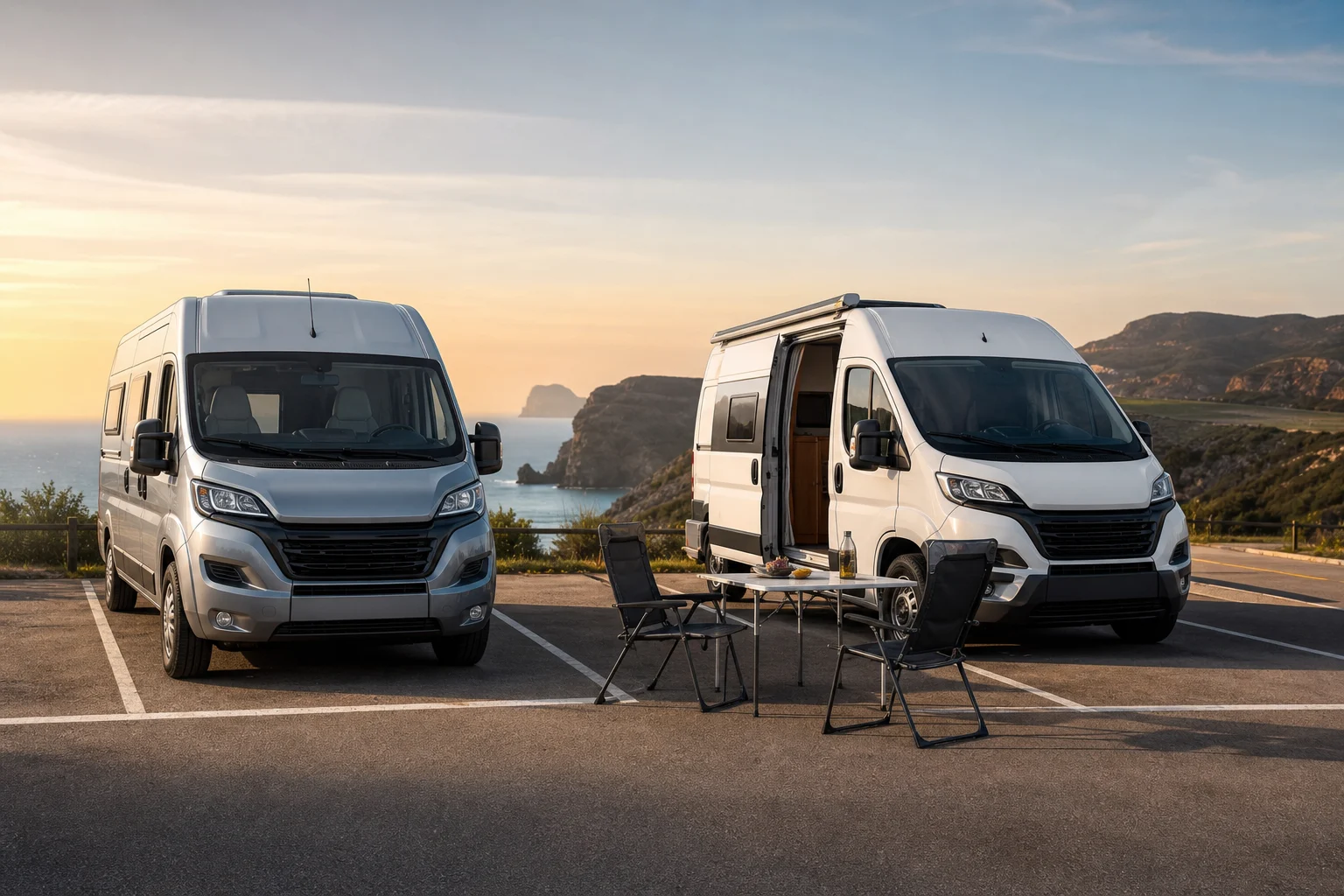
| Chairs or tables outside | The activity takes up more space than the vehicle’s ground footprint | Put them away; do not treat the bay as an outdoor living area |
| Stabilising legs or other devices | They are incompatible with the described parking criterion | Do not deploy them in a standard car park |
| Discharge of fluids or noise outdoors | The instruction includes these among incompatible situations | Avoid discharging fluids and plan ahead for disposal |
Section references: Instrucción PROT 2026/04 sobre autocaravanas ↗
- Parking correctly is essential, but it may not be sufficient at the chosen destination.
- Remaining inside the living area does not automatically make the stop camping.
- Keeping activity from extending outdoors reduces the risk of failing to meet the DGT’s parking criterion.
- Where official information about the location leaves a question unresolved, choose a campsite or an expressly designated site.
What the DGT regulates and what changes on 1 October 2026
The DGT instruction is used to interpret motorhome parking from a traffic perspective. Its references include not using stabilising legs, not setting out chairs or tables that increase the occupied surface area, and not releasing fluids or noise outdoors. It is essential guidance for avoiding confusion between a parking bay and a camping area.
There is an important date in the regulations provided: as of 15 September 2026, the new paragraph 4 of Article 92 of the General Traffic Regulations is not yet in force. It will take effect on 1 October 2026. From then on, the text expressly sets three conditions for motorhomes and other vehicles fitted out as living accommodation: they must not extend items beyond their perimeter, they must rest only on their tyres—with wheel chocks or safety wedges permitted—and they must not discharge fluids from the living area.
This clarification avoids two common mistakes. The first is using legs, trestles or other supports to level the vehicle in an ordinary car park. The second is interpreting any vehicle-related item as permitted if it is not visually intrusive. The legal reference is the perimeter, and the instruction links this to the vehicle’s ground footprint.
General road rules also remain in force. On interurban roads, stopping or parking must take place off the carriageway, on the right, and without occupying the usable part of the hard shoulder. On motorways and dual carriageways, stopping or parking is prohibited except in designated areas.
Section references: Instrucción PROT 2026/04 sobre autocaravanas ↗ · Reglamento General de Circulación — Real Decreto 1428/2003 ↗
- Check the effective date of the rule you consult: Article 92.4 takes effect on 1 October 2026.
- Do not use stabilising legs in a standard parking area.
- Wheel chocks or safety wedges are allowed under the new Article 92.4; in addition, vehicles over 3,500 kg must be chocked on a significant slope and the chocks must be removed before setting off again.
- Do not stop to sleep on a motorway or dual carriageway outside a designated area.
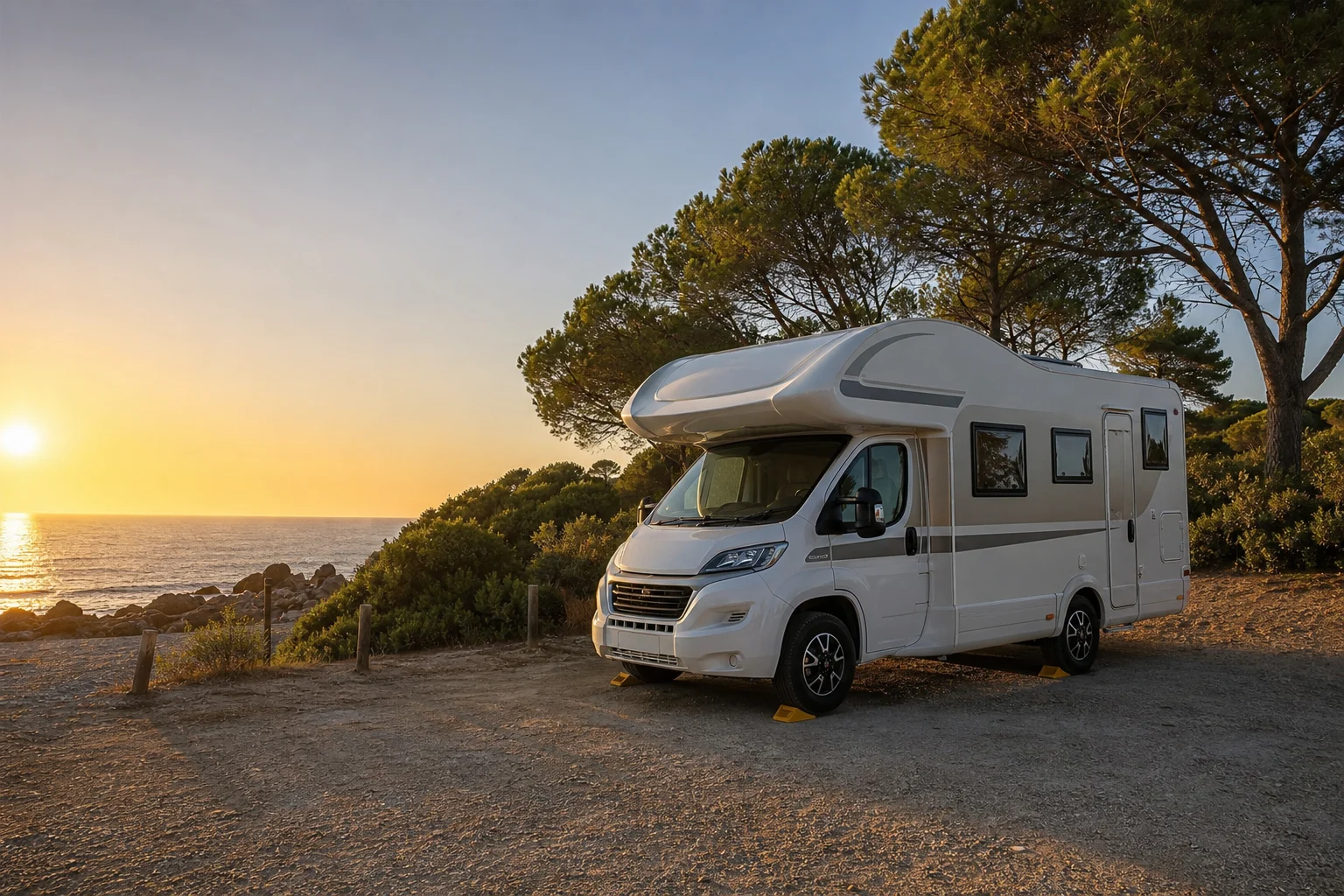
Signage and the destination can change the outcome
The check should not end when you find a free space. In woodland areas, public access is subject to regulation by the competent authorities, and Spain’s autonomous communities define the conditions for motor vehicle traffic on forest tracks outside the road network. Reaching a clearing, track or mountain car park does not in itself prove that access and staying there are permitted.
Protected natural areas require a specific review. The national map of Protected Natural Areas includes designations declared by the autonomous communities and by the Ministry, while regional regulations extend protected-area designations to more than 40 types. In other words, there is no single practical rule that can be transferred from one park, reserve or natural monument to another.
Sierra Nevada illustrates why you must consult the specific destination: its official information does not allow overnight stays in caravans or motorhomes outside campsites and designated places. This restriction should not be extrapolated to all of Spain, but it is a warning that the traffic parking criterion does not replace site-management rules.
Before using a location found on a map or app, check the signs on arrival and look for official information from the municipality, the site manager and, where applicable, the protected-area authority. If these channels do not clarify the situation, do not turn community-sourced information into permission.
Section references: Ley de Montes — Ley 43/2003 ↗ · Espacios Naturales Protegidos (ENP) ↗ · Normas generales del Espacio Natural Sierra Nevada ↗
- Read all signage before switching off the engine; a sign or site condition may be decisive.
- On forest tracks, first verify that motor vehicle traffic is permitted.
- Identify whether the location lies within a protected natural area and consult its regulations or visitor information.
- Have a second legal location ready so that you do not depend on a doubtful interpretation at the end of the day.
How to choose between a motorhome area, campsite or car park
Do not choose based on proximity alone. A motorhome area, a campsite and a standard car park may have different conditions for access, opening hours, length of stay and use of services. Before setting off, confirm the rules of the chosen site directly and do not assume that services are available unless the manager states so.
A standard car park requires particular discipline: respect bay markings, parking direction, signage and circulation space. Keep every item packed away and do not empty wastewater from the living area. A motorhome area or campsite may be a more predictable option when you need waste and water facilities, provided you confirm their availability with the site manager, or when the destination restricts overnight stays outside designated places.
Vehicle choice also affects logistics. A compact campervan and a large motorhome do not occupy the same space or manoeuvre in the same way; before booking or entering a site, check that it accepts your vehicle’s dimensions and mass. If you are still deciding which format suits your trip, see this guide to campervans, low-profile, overcab and A-class motorhomes.
Section references: Instrucción PROT 2026/04 sobre autocaravanas ↗ · Normas generales del Espacio Natural Sierra Nevada ↗
- Confirm the address, access, signage, opening hours and stay rules for the chosen site.
- Check that your vehicle’s dimensions and mass are compatible with the access and parking bays.
- Plan wastewater and waste disposal in advance, and confirm the available facilities with the site manager.
- Keep a campsite or designated motorhome area as an alternative if you expect to arrive late or travel through a protected area.
Checklist before spending the night
Doing this review before the final driving hour avoids having to improvise on a hard shoulder, forest access road or car park with conditions you had not noticed. It is not a universal guarantee that an overnight stay is permitted, but it is an organised way to identify the main reasons why a stop may be inappropriate.
The golden rule is simple: if you cannot confirm that the site accepts your vehicle and your intended use, continue to a known alternative. This decision is especially advisable in protected areas, where rules may be specific and the Sierra Nevada example shows that overnight stays may be limited to campsites or designated places.
Section references: Instrucción PROT 2026/04 sobre autocaravanas ↗ · Reglamento General de Circulación — Real Decreto 1428/2003 ↗ · Normas generales del Espacio Natural Sierra Nevada ↗
- Parking: does the bay or area allow parking, and does the vehicle fit without encroaching on the carriageway, usable hard shoulder or circulation area?
- Signs: have you read the information at the access point and beside the bay?
- Setting: is it woodland, a forest track or a protected natural area with its own rules?
- Perimeter: are the table, chairs, awning, steps and any other items extending beyond the vehicle packed away?
- Supports: is the vehicle resting on its tyres and, if you use safety chocks, will you be able to remove them before leaving?
- Water and waste: do you have enough capacity until you can deal with them without discharging anything?
- Consideration: can you avoid outdoor noise and leave the site free of rubbish?
- Alternative: do you have a motorhome area or campsite you can reach if the first option is not valid?
Can I open a campervan pop-top roof to stay overnight?
The DGT instruction does not specifically address pop-top roofs. Its criterion refers to not exceeding the vehicle’s ground footprint or perimeter. Therefore, it should not be treated as general permission: check the signage and the specific rules of the location before using it.
Can I use wheel chocks with a motorhome?
Article 92.4 of the General Traffic Regulations, effective from 1 October 2026, allows wheel chocks or safety wedges, although the vehicle must rest on its tyres. For vehicles over 3,500 kg on a significant slope, the Regulations require them to be chocked and the chocks to be removed before setting off.
Can I empty grey water into a drain or onto the ground?
No. From 1 October 2026, Article 92.4 prohibits discharging fluids from the living area. The DGT instruction also places the release of fluids outdoors outside its parking criterion. Plan ahead for disposal and confirm the available facilities with the site manager.
Does a route app confirm that overnight stays are allowed?
It does not replace official verification or the signage at the location. Use it only to help locate options, then check the rules of the site manager, municipality and, where relevant, the protected natural area.
Can I park to sleep on a motorway or dual carriageway?
No, except in areas designated for that purpose. The General Traffic Regulations prohibit stopping or parking on motorways and dual carriageways outside those areas.