Campervan and motorhome payload: how to calculate it without exceeding the MAM
Beds, garage space and seating capacity are not enough to choose a campervan or motorhome. Learn how to check the masses for the specific vehicle and plan water, luggage, travellers and accessories without exceeding the MAM or axle limits.

Key points
Payload is the margin between the maximum permitted mass in use and the vehicle's documented mass, but it is only useful if you know what each figure includes. Before buying or setting off, budget for occupants, luggage, water, gas and accessories, without overlooking axle limits.
The quick answer: calculate the margin before choosing the beds
To calculate motorhome payload, start by separating two ideas: the maximum authorised mass (MAM) does not describe what the vehicle weighs empty, but the mass limit for using it loaded on public roads. Laden mass expressly includes passengers and operating personnel, as well as the load. Therefore, a layout with many beds, a large garage or several seats does not by itself show that everything can travel at once with full tanks and substantial luggage.
The documentary starting point is the margin between the maximum laden mass permitted in circulation in Spain and the vehicle mass in service shown in the documentation: F.2 minus G. This is an initial margin, not permission to add weights without checking anything else. Before allocating it to people, suitcases or bicycles, confirm which items are already included in the declared mass of the specific vehicle. If the manufacturer provides a stated payload, compare it with F.2 and G, and ask for the content of each figure to be clarified in writing.
The planning calculation can be expressed as follows: available margin = F.2 − G − planned masses not included in G. These planned masses include occupants, luggage, water to be carried, gas, and accessories or carriers that are not already part of the documented mass. If the result is negative, the planned trip exceeds the documentary margin; if it is positive, you still need to check the load on each axle.
Section references: Reglamento General de Vehículos: definiciones de masas y límites por eje ↗ · Reglamento General de Vehículos: campos F.1, F.2, G y S.1 del permiso de circulación ↗
- Do not use sleeping berths as a substitute for travelling seats.
- Do not assume that two vehicles of the same model have identical mass: options and conversions mean each vehicle must be checked.
- Do not subtract an accessory, a tank or any item twice if it is already included in the mass figure used.
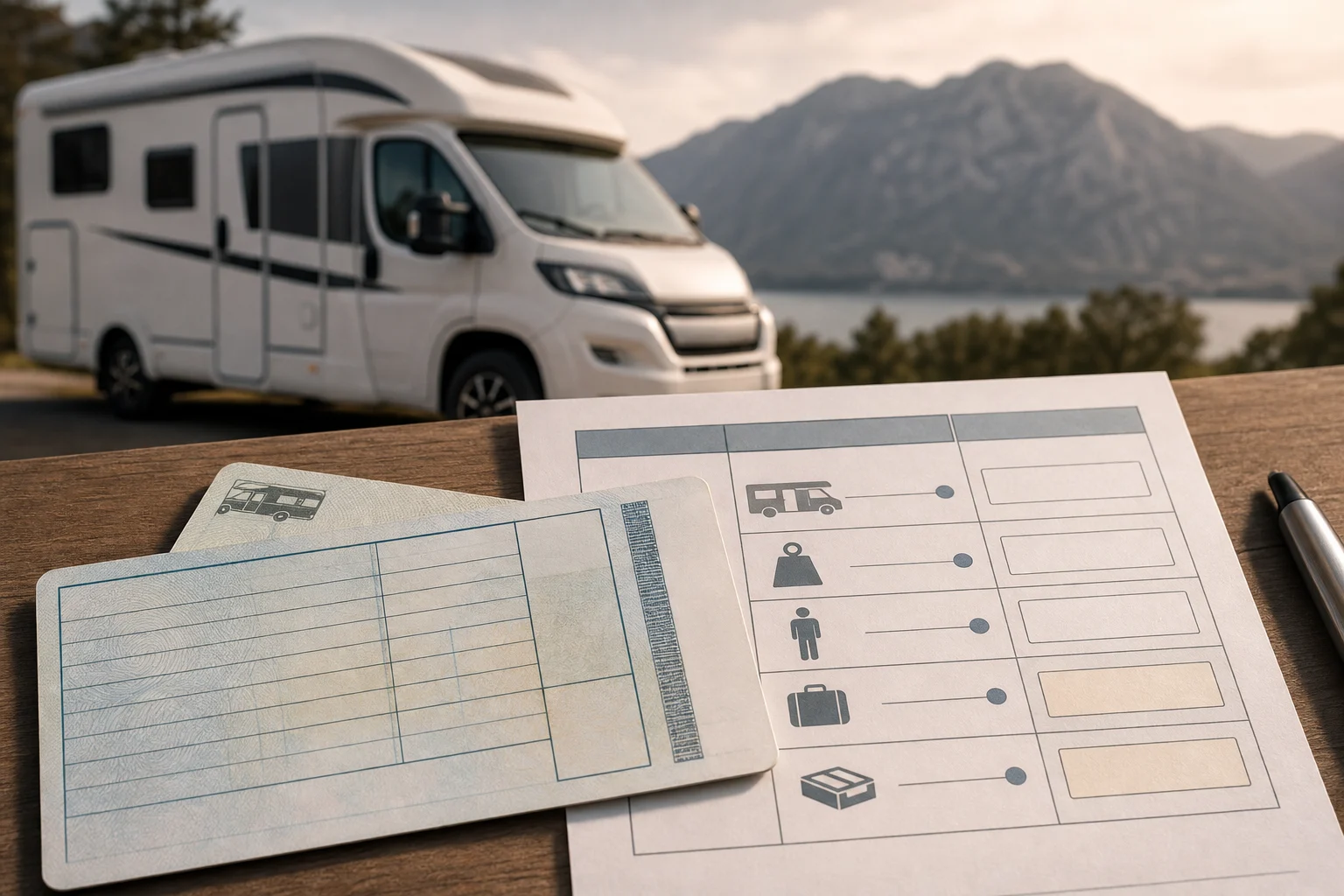
Documents and fields: what to check before doing the calculation
Gather the vehicle registration certificate, the ITV card or technical data sheet, and the manufacturer's technical documentation. If available, also include the certificate of conformity (CoC). For vehicles covered by Regulation (EU) 2018/858, the manufacturer must provide the electronic certificate of conformity from 5 July 2026. When buying, these documents must relate to the vehicle being offered, not merely to a catalogue or generic configuration.
On the registration certificate, F.1 identifies the maximum technically permissible mass; F.2, the maximum authorised laden mass permitted in circulation in Spain; G, the vehicle mass in service; and S.1, the number of seats, including the driver. For planning use in Spain, F.2 is the figure that sets the maximum permitted mass in circulation. F.1 may differ, so one should not be substituted for the other.
Ask the manufacturer or seller for the applicable technical documentation showing the authorised mass limits for each axle or axle group. The rules define these as their own limits for travelling loaded. This means checking two things: total mass and how that mass is distributed. A campervan may remain below F.2 yet still concentrate too much weight on one axle if the garage is full, a rear carrier is fitted or one particular area is overloaded.
| Item | Figure to record | Source to check |
|---|---|---|
| Total limit in circulation | F.2 | Vehicle registration certificate |
| Technically permissible mass | F.1 | Vehicle registration certificate |
| Vehicle mass in service | G | Vehicle registration certificate and the vehicle's technical documentation |
| Number of seats | S.1, including the driver | Vehicle registration certificate |
| Axle limits | Value for each axle or axle group | Applicable technical documentation provided by the manufacturer or seller |
| Configuration and options | Items included and not included in the mass used | Manufacturer, CoC and vehicle documentation |
Section references: Reglamento General de Vehículos: definiciones de masas y límites por eje ↗ · Reglamento General de Vehículos: campos F.1, F.2, G y S.1 del permiso de circulación ↗ · Reglamento (UE) 2018/858: certificado de conformidad y plazas de asiento ↗
- Write down F.2, G and S.1 exactly as shown, including their units.
- Keep the manufacturer's sheet or record describing that vehicle's configuration and equipment.
- Ask the manufacturer or seller for the applicable technical documentation showing axle limits; do not settle for knowing only the MAM.
- If buying used, compare the documents with the vehicle and the accessories actually fitted.

A repeatable method: turn the planned trip into a list of masses
Make a spreadsheet or paper list for the most demanding configuration you plan to use. First enter F.2 and G, and calculate the initial documentary margin. Then create one line for each person travelling, another for each group of luggage, and others for water, gas, bicycles, carriers and accessories. Always note the source of the figure: your own measurement, a label, the manufacturer's specification or a vehicle document.
The operating rule is simple: include every mass only once. If an item is included in the reference mass, mark it as included and do not subtract it again. If it is not included, subtract it from the margin. Do not fill in fields with estimates presented as official figures: where a weight matters to your margin, use that item's specification or a verifiable measurement.
After adding the planned masses, compare the total with F.2. Also carry out a second check by axle, assigning each item to the area where it will be transported. Axle calculations should not be limited to garage luggage: the distribution of occupants, tanks, lockers, bicycles and interior load can change where the mass rests. If the vehicle manual includes loading instructions, take them into account. As a voluntary practical measure to check the calculation before a loaded trip, you can use a weighing service that allows both the total and each axle to be checked.
Section references: Reglamento General de Vehículos: definiciones de masas y límites por eje ↗ · Reglamento General de Vehículos: campos F.1, F.2, G y S.1 del permiso de circulación ↗
- Prepare two scenarios: a short trip with a light load and a holiday with all planned travellers and equipment.
- Keep a margin for shopping, waste or other items that may be added during the trip.
- Review the list whenever the number of travellers, destination or equipment changes.
- If you cannot determine what a mass figure includes, treat it as pending information and request clarification before deciding.
Water, gas and accessories: add vehicle-specific figures, not universal weights
Water requires defining how many litres will actually be carried, not merely the tank capacity. Record the litres planned for each trip and use the applicable mass figure according to the relevant documentation or measurement. Proceed in the same way with gas: identify the type and number of cylinders travelling on board, and record the mass stated by the manufacturer or on the label. This avoids both underestimating a trip and using generic figures that do not correspond to your installation.
With bicycles, bicycle carriers, awnings, solar panels, auxiliary batteries, antennas or other accessories, the order matters little: all consume margin if they are not included in the reference mass. Record the weight of the accessory, its carrier and the transported load separately. For example, a bicycle carrier and the bicycles are distinct items and must be checked separately.
Their documentary status must also be checked. The Ministry defines a vehicle modification as a modification, replacement, intervention, addition or removal after registration that changes vehicle characteristics or may alter regulatory requirements. The Vehicle Modifications Manual expressly mentions solar panels, awnings and satellite antennas, and covers load carriers exclusively used for bicycle carriers, motorcycle carriers, personal mobility vehicles and pet carriers. If a used campervan has received items of this type, check its modification documentation where applicable, and update the calculation with what is fitted today, rather than its original configuration.
Section references: Manual de Reformas de Vehículos, revisión 7.ª, corrección 2.ª ↗ · Preguntas frecuentes sobre reformas de vehículos ↗
- Water: planned litres, applicable mass and whether it is included in the starting figure.
- Gas: cylinder type, number of units and stated mass for that configuration.
- Accessories: manufacturer specification, carrier, transported load and modification documentation where applicable.
- Added batteries and equipment: confirm their individual mass and whether they were listed in the documented configuration.
Approved seats: do not confuse a travelling seat, a bed and load capacity
S.1 states the number of seats, including the driver. It is the figure to check to know how many seats are listed in the documentation, but it does not by itself resolve the question of available mass. Every traveller forms part of the laden mass, so adding occupants reduces the margin left for luggage, water, gas and accessories not included in the declared mass.
European rules distinguish seats designed to be used while the vehicle is moving from those identified for use when it is stationary. This distinction is especially relevant in motor caravans: a seat that can be used in a living area while parked must not become a travelling seat because of its appearance or comfort. When driving, use the seats shown in S.1 and designed for travel.
The useful question when comparing two layouts is not only “how many people sleep?”, but “how many can travel in accordance with S.1, while keeping the vehicle below F.2 and within its axle limits?”. A family intending to travel with every seat occupied, a full tank, bicycles and luggage should calculate that complete scenario before committing to a model. To compare body styles and interior layouts, see the guide to Campervan, low-profile, overcab or A-class: which motorhome suits how you travel.
Section references: Reglamento General de Vehículos: definiciones de masas y límites por eje ↗ · Reglamento General de Vehículos: campos F.1, F.2, G y S.1 del permiso de circulación ↗ · Reglamento (UE) 2018/858: certificado de conformidad y plazas de asiento ↗
- Check S.1, not just the advertised number of beds.
- Include the mass of each occupant in the load budget for every travelling seat.
- Do not assume a seat for stationary use can be used while driving.
- Always compare the same travel scenario between candidate vehicles.
Final checklist before signing and before setting off
At a dealership or when dealing with a private seller, request the figures for the specific vehicle and do not complete the purchase based on a single payload figure. Check F.2, G and S.1; ask the manufacturer or seller for the applicable technical documentation showing axle limits; identify factory options and added accessories; and request documentation for any modification. The aim is to be able to repeat the calculation for the vehicle as delivered.
Before setting off, repeat the list with the actual travellers, water you will carry, gas, luggage and accessories actually fitted. Load items according to the manual if the vehicle includes loading instructions, and avoid concentrating all the weight in one area. If you change the rear carrier, add bicycles, fit an auxiliary battery or increase the travel equipment, update the budget: the valid calculation is the one for the current configuration.
Finally, as a voluntary practical measure to verify the calculation, if you have access to weighing that allows it, you can compare total mass with F.2 and the result for each axle with the documented limits. If there is an excess, the solution is not to rely on the vehicle having a garage or the trip being short: reduce or redistribute the load and check again. This routine helps you choose more carefully and travel with planning that is consistent with the vehicle documentation.
Section references: Reglamento General de Vehículos: definiciones de masas y límites por eje ↗ · Reglamento General de Vehículos: campos F.1, F.2, G y S.1 del permiso de circulación ↗ · Preguntas frecuentes sobre reformas de vehículos ↗
- Before buying: check the vehicle documents, options, accessories and modifications.
- Before loading: update the list of occupants, luggage, water, gas and equipment.
- Before driving off: voluntarily verify total mass and axle distribution by weighing, if carried out.
- After any significant change: carry out a new document review and calculation.
How is motorhome payload calculated?
As a starting point, subtract the vehicle mass in service, G, from the mass permitted in circulation in Spain, F.2. Then subtract occupants, luggage, water, gas and accessories not already included in the mass used. Also check the limit for each axle.
Do travelling seats guarantee that I can fill the tank and garage?
No. S.1 states the number of seats including the driver, but occupants form part of the laden mass. You need to calculate the complete scenario with travellers, luggage, water, gas and accessories against F.2 and the axle limits.
What is the difference between F.1 and F.2?
F.1 is the maximum technically permissible mass, while F.2 is the maximum mass permitted in circulation in Spain. To plan use of the vehicle in Spain, F.2 is the reference limit for circulation.
Must I include a bicycle carrier in the payload?
You must determine whether its mass and that of the bicycles are already included in the reference mass. If they are not, both must be subtracted from the available margin. Also check the carrier documentation and, where applicable, the vehicle modification documentation.
Does an additional bed count as a travelling seat?
Not necessarily. Travelling seats must be checked in S.1 and correspond to seats intended for use while the vehicle is moving. Seats identified for use when the vehicle is stationary are distinct from those designed for travel.