Conventional, sport, adaptive or air suspension: which suits your use?
A guide to comparing conventional, sport, adaptive and air suspension according to your routes, load, desired comfort and vehicle documentation.
Key points
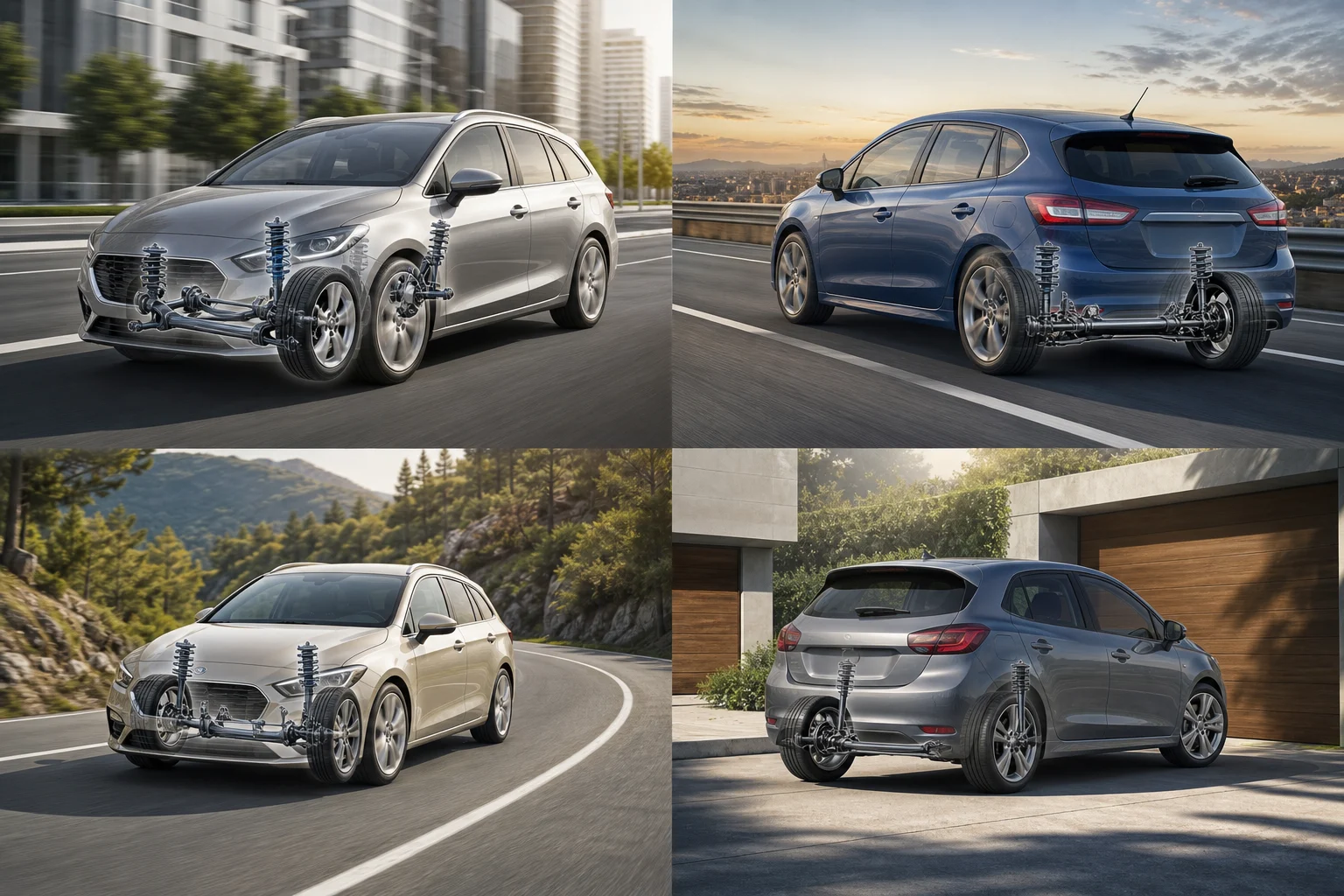
There is no single best suspension for everyone: choose the exact setup that matches the roads, load and comfort you actually use. Before paying for a trim or buying used, confirm which components it includes and how wheels, tyres and pressure affect it.
The quick answer: choose the setup, not the label
To decide which car suspension to choose, start with four questions: how smooth your usual routes are, how many people and how much luggage you carry, whether you need to clear ramps or low entrances, and how much you value adjustable settings over a simpler solution. The best answer is not necessarily sport, adaptive or air suspension: it depends on the exact vehicle and version.
Commercial names do not always describe the same set of components or functions. Volkswagen, for example, defines DCC as a system that allows damping and steering to be varied through Normal, Sport and Comfort modes. In the Golf 8, it is also described as electronically controlled dampers that adapt continuously to the driving situation. That does not mean that any system called “adaptive” by another brand does exactly the same thing.
Nor does “sport” automatically mean “adaptive”. In a documented Golf R configuration, the sport chassis included changes to the springs, dampers and rear anti-roll bars, lowered the body by 25 mm, and could optionally be complemented by DCC. It is a useful example of why you should read the specification for the version rather than decide from the package name alone.
Section references: Regulación adaptativa DCC ↗ · Catálogo Golf 8: suspensión adaptativa DCC ↗ · Dossier Golf R: chasis deportivo y DCC ↗
- Prioritise daily comfort if city driving, uneven surfaces and long journeys with passengers predominate.
- Give more weight to levelling or height functions if you regularly travel fully loaded, tow, or face difficult access routes, provided that function is confirmed for that vehicle.
- Do not pay for a driving mode without checking what it actually adjusts: it may affect damping, steering or both.
- For a used car, verify the equipment through manufacturer or dealer documentation for the specific vehicle, where available, as well as the catalogue for its model year and the purchase invoice, not just photos or the advert.
What determines the result: it is not just the dampers
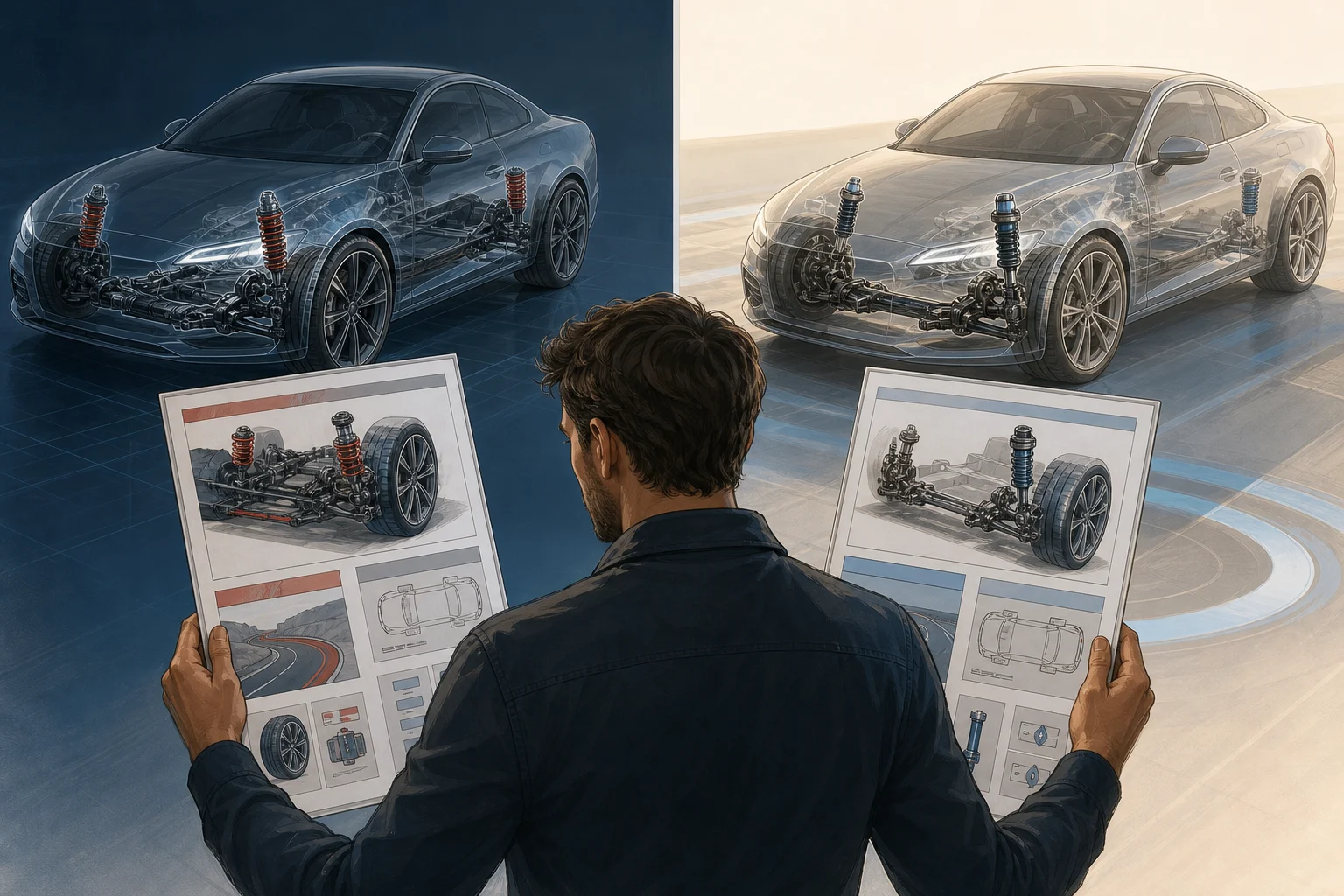
When discussing comfort or body control, everything is often attributed to the suspension, but the setup brings together several components. In the documented Golf R example, the sport chassis changed springs, dampers and rear anti-roll bars, and lowered the body. This is why the specification for each version should be checked rather than relying on the model name alone.
Wheels are a decisive part of the result. Continental warns that changing the tyre or wheel size can affect handling, braking, speedometer accuracy and ride height. If two cars with different wheels are compared, it is not reasonable to attribute every difference in response or comfort to the dampers.
Load and pressure also matter. Michelin states that pressure is specified by the manufacturer for the particular vehicle and tyre combination, and provides for a load pressure when the car is especially heavily laden. Before concluding that a car is uncomfortable or unstable with the family and luggage, check the pressure specified for that situation.
Section references: Dossier Golf R: chasis deportivo y DCC ↗ · Presión de neumáticos y carga ↗ · Dimensión de neumáticos, llantas y comportamiento ↗
- Compare the wheel and tyre size for each trim as well as the advertised suspension.
- Check the pressure label or the vehicle documentation, and use the specified pressure when travelling especially heavily loaded.
- Do not extrapolate the feel of a car with non-original wheels to every example of that version.
- Assess ride height separately: it can change with a sport setup or a wheel change.
Conventional and sport suspension: compare the actual tune
In this guide, “conventional” is used only as a buying shorthand for a setup whose documented specification should be checked. Opel, for example, describes frequency-selective damping with a second hydraulic circuit that mechanically adapts damping force according to frequency. In other words, a variable response does not necessarily imply electronic control.
This technology, described by Opel for the Grandland, aims to provide a comfortable response to short, high-frequency impacts and more direct road contact at low frequencies. That is a description of that specific system, not a rule that applies to every standard suspension. The practical conclusion is clear: ask for the technical name and the manufacturer’s description if a seller promises “comfort” or “intelligent” suspension.
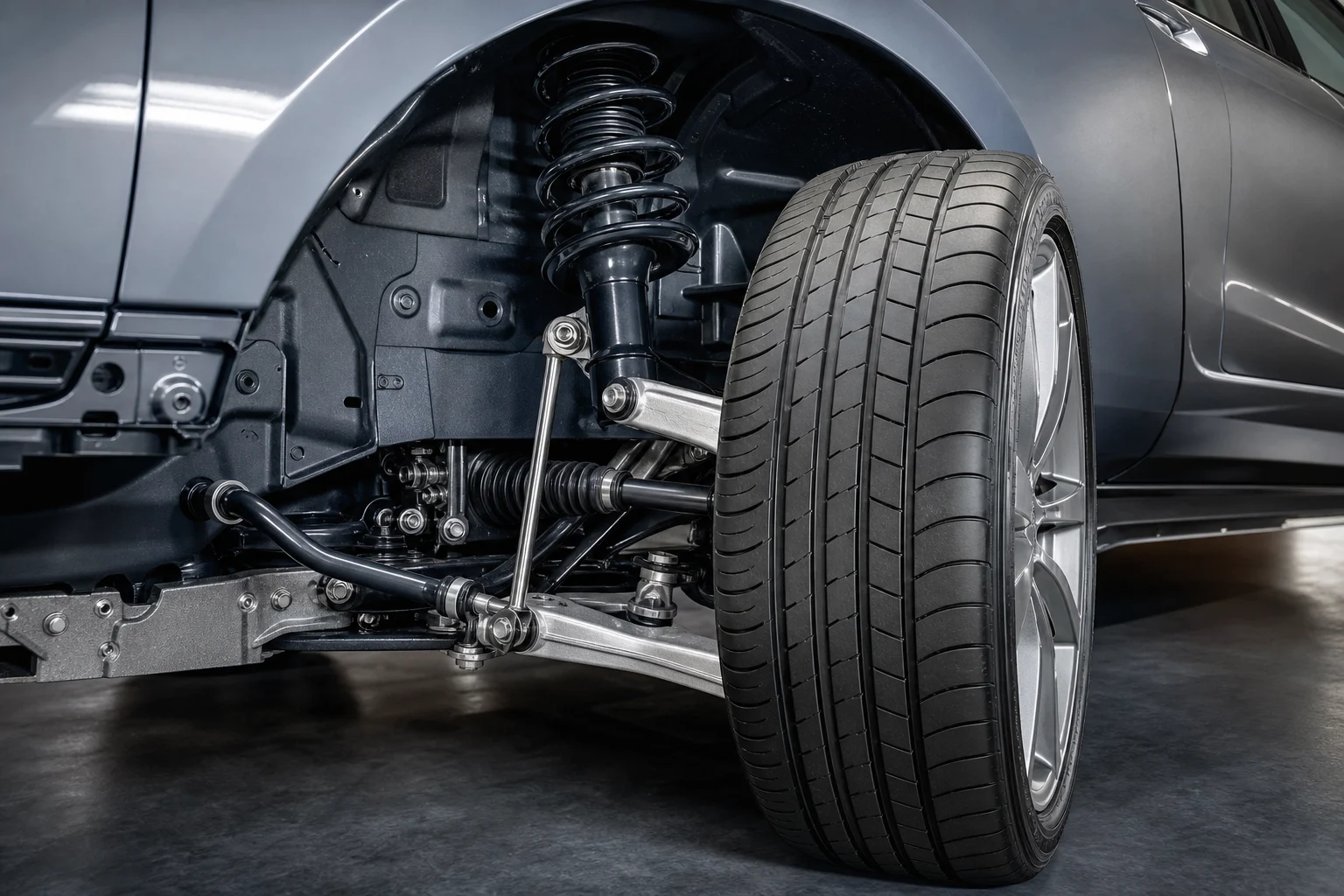
If you are considering sport suspension, check whether the exact version has specific spring, damper and anti-roll bar changes, and whether its body is lower. The 25 mm reduction documented for the Golf R shows why clearance should be checked when entering a garage, driving over speed bumps or loading the car. Do not assume that figure for any other model.
| Setup | What it may offer according to the documentation | Limit of the label | Check before choosing |
|---|---|---|---|
| Conventional or standard | It may include specific mechanical solutions, such as frequency-selective damping. | It does not by itself define a comfort level or rule out particular technologies. | Technical specification, catalogue and wheel size. |
| Sport | It may change springs, dampers and anti-roll bars; in some cases it lowers the body. | It does not necessarily mean adaptive damping. | Package contents, height, and whether DCC or another system is optional. |
| Adaptive | It may electronically adjust damping and, depending on the model, steering and driving modes. | The scope of the adjustments is not identical across brands and models. | Manual, available modes and equipment list. |
| Air | It may maintain behaviour under load and provide levelling or compensation for uneven surfaces, depending on the vehicle. | Not all applications have the same height or levelling functions. | Manual, axle configuration and maintenance documentation for used cars. |
Section references: Dossier Golf R: chasis deportivo y DCC ↗ · Tecnología de amortiguación selectiva de frecuencia ↗
- Check whether the sport trim also changes wheels and tyres as well as the suspension.
- Confirm the height of the exact version if you use garages, ramps or access roads.
- Distinguish frequency-selective mechanical damping from electronically controlled damping.
- Request the catalogue for the relevant model year: package contents can change between years and markets.
Adaptive and air suspension: when they provide tangible value
Adaptive suspension makes sense if you will use its settings. In Volkswagen’s definition of DCC, Normal, Sport and Comfort modes modify damping and steering; in the Golf 8, the dampers are electronically controlled. Before choosing it, open the manual for that version and verify the available modes, which parameters each one changes, and whether it is standard equipment, an option or linked to another package.
You should not expect adaptive suspension to solve issues it cannot fix on its own. A different wheel or tyre can alter handling, braking and ride height; check the pressure specified for travelling under load alongside any selected mode. For someone who always keeps the same route, load and preference, the practical benefit of having several settings may be smaller than for someone who alternates between city driving, motorways, country roads and family trips.
Air suspension should be assessed by its specific function. Mercedes-Benz presents rear air suspension in the E-Class Estate as a solution for maintaining consistent driving dynamics, safety and comfort when empty and when carrying a substantial load. It also links it to correct headlamp levelling at full load and trailer stability. In the Marco Polo, the brand mentions automatic compensation for small unevenness in the ground. These are benefits that are especially relevant if load, towing or levelling are a regular part of your use, rather than a merely occasional possibility.
When buying used, give importance to maintenance documentation and the operation described in the manual. Do not accept “it goes up and down” as the only proof: confirm which system is fitted, on which axle it operates, which functions it offers and which work is documented.
Section references: Regulación adaptativa DCC ↗ · Catálogo Golf 8: suspensión adaptativa DCC ↗ · AIRMATIC y nivelación de carga en Clase E Estate ↗ · AIRMATIC con control de nivel para Marco Polo ↗ · Dimensión de neumáticos, llantas y comportamiento ↗
- Adaptive: check the modes, adjusted parameters and operating conditions stated by the manufacturer.
- Air: verify whether levelling is rear-only or another type, and whether the vehicle states an intended benefit when loaded or towing.
- When buying used, ask for invoices and system documentation, and compare the equipment with the specific vehicle.
- If the condition or configuration is unclear, a professional inspection before buying a used car can help document the decision.
Final checklist for a new, used or modified car
For a new car, request the equipment specification for the offered vehicle in writing and compare it with the current catalogue for its market. For a used car, add the maintenance history and do not assume that large wheels, a trim badge or a mode button prove a particular suspension system. It is especially important to distinguish original equipment from later modifications.
If the suspension has been changed after registration, there is an additional issue in Spain. Royal Decree 866/2010 considers any modification, replacement or intervention that changes vehicle characteristics or may alter regulatory requirements to be a vehicle reform, and it expressly includes the suspension function. The applicable documentation is determined by the Vehicle Reforms Manual, and the vehicle must undergo technical inspection within a maximum of 15 days after the modification.
The soundest decision combines actual use, the exact version and documentation. For everyday travel, the starting point can be the standard setup with the correct wheels and pressure. For a specific chassis response, verify the contents of the sport package. To alternate driving preferences, confirm the adaptive settings. And for frequent loads, towing or levelling needs, assess whether the air suspension in the specific vehicle provides those functions and whether its history is documented.
Section references: Dossier Golf R: chasis deportivo y DCC ↗ · Presión de neumáticos y carga ↗ · Real Decreto 866/2010: reformas de vehículos ↗
- Equipment specification or catalogue for the exact year.
- Owner’s manual to identify modes and functions.
- Fitted wheel and tyre sizes, as well as the pressure for load.
- Invoices and maintenance history for used vehicles.
- If there are modifications, reform documentation and technical inspection in accordance with the applicable regulations.
- Test-drive the car on a route that includes the surface type and load you actually use.
Is sport suspension always firmer than conventional suspension?
It is not advisable to state that without reviewing the setup. Sport suspension can change springs, dampers and anti-roll bars and lower the ride height, as the Golf R example shows, but the result and components depend on each version. The fitted wheels and tyres can also have an influence.
Does adaptive suspension replace the need to maintain the tyres properly?
No. Adaptive control can modify the parameters stated by the manufacturer, but wheel size can affect handling, braking and ride height. You must also use the pressure specified by the manufacturer, including the stated load pressure where applicable.
What should I check in a used car with air suspension?
Confirm the exact system, the axle on which it operates and its functions through the manual or equipment specification. Request the maintenance history and available invoices. If the vehicle is advertised for its levelling ability with a load or trailer, verify that this function actually belongs to that version.
Can I change the suspension after buying the car?
In Spain, a subsequent modification that changes vehicle characteristics or may alter regulatory requirements can be considered a vehicle reform; suspension is expressly listed among the regulated functions. The applicable documentation depends on the Vehicle Reforms Manual, and the vehicle must undergo technical inspection within the period set by the regulation.