Work Van Ergonomics: What to Check If You Drive for Long Hours
A practical guide to assessing the driving position in a professional van: access, adjustments, visibility, controls, static testing and incident management in small fleets.
Key points
In a work van, ergonomics should be checked before deciding: repeated cab access, actual seat and steering-wheel adjustment, visibility, control reach and the organisation of breaks. Specifications help, but each regular driver should validate the final position in a static test.
The short answer: what to look at before choosing
Payload and volume remain decisive, but they do not by themselves show whether a van suits a delivery route, technical assistance work or continuous visits. When a vehicle is used as work equipment, the choice should take account of the characteristics of the task and existing health and safety risks. Occupational safety rules also require ergonomic principles to be considered in workstation design and in the position of the person using the equipment.
Before comparing prices or powertrains, prioritise five checks: how the cab is entered and exited in real operations; how much adjustment range the seat and steering wheel provide; what visibility is obtained from the final position; whether controls, screens and objects are within reach without interference; and how breaks and driver changes will be integrated. They are not substitutes for a risk assessment, but they are a useful way to rule out an unsuitable configuration before buying or renting.
The specification sheet, configurator and manual help identify available equipment and adjustments. However, they do not replace a test in the final posture: an adjustment that appears sufficient on paper may not allow a particular person to see the instrument cluster, operate the pedals or use the mirrors without changing position.
Section references: Ley 31/1995 de Prevención de Riesgos Laborales ↗ · Real Decreto 1215/1997 sobre utilización de equipos de trabajo ↗
- Define the use: number of entries and exits, continuous time at the wheel, type of road, load carried and people who will share the vehicle.
- Request the exact configuration that will be bought or rented; do not assume that an adjustment seen on a demonstration vehicle is included.
- Carry out the check with regular drivers, not only with the person making the purchase decision.
- Record the limitations observed before signing or assigning the vehicle.

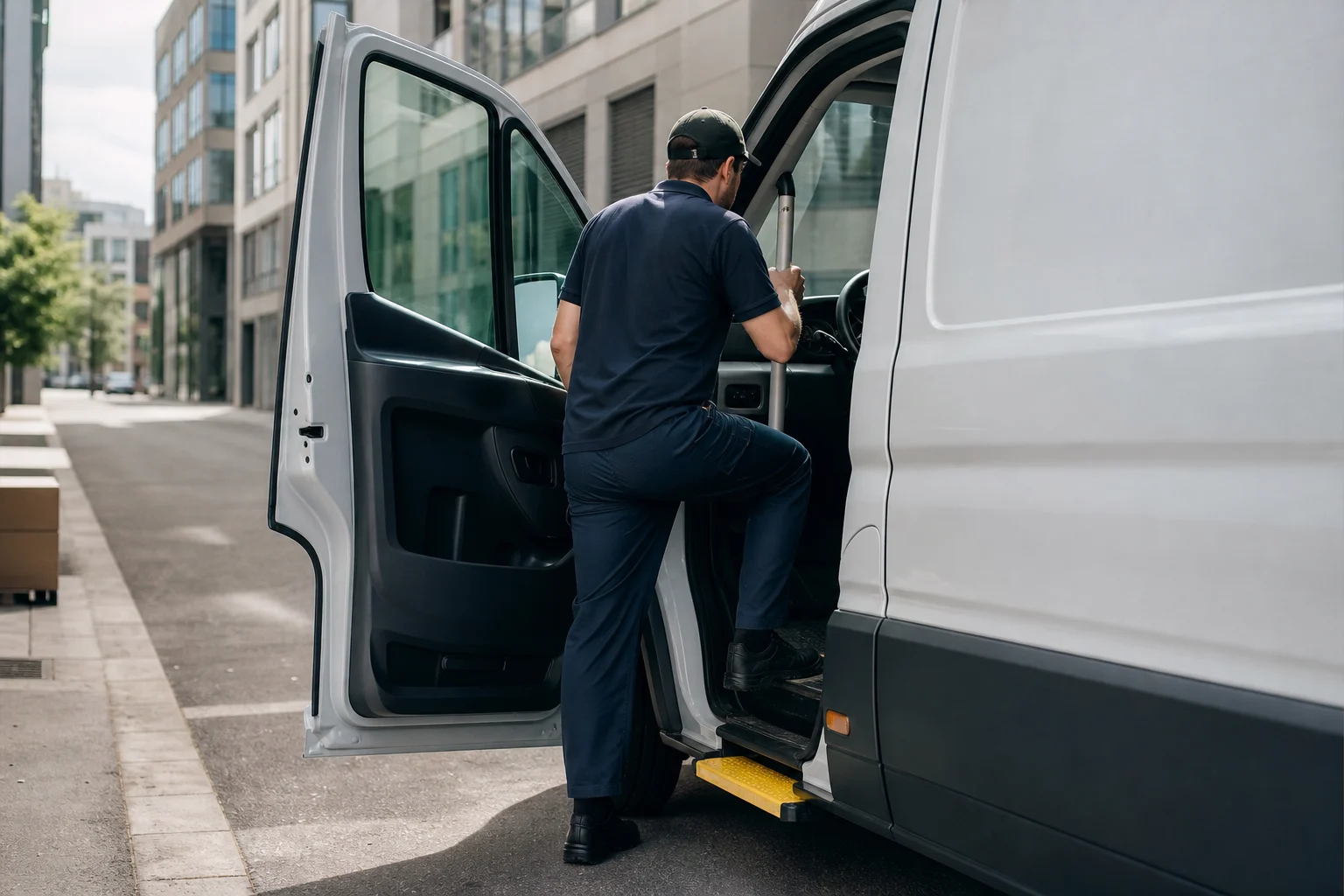
Cab access: observe it in the work sequence, not only from outside
If the activity requires getting in and out many times, that sequence must be part of the assessment. Check how far the door opens where the work will take place, the space available next to the vehicle, the location of grab handles and steps, and how entry and exit fit the intended height, clothing, footwear and frequency of use. There is no need to assign a universal score to each solution: what matters is checking it in relation to the intended task.
Make the observation with the vehicle stopped and in a safe area. Simulate a normal entry and exit and consider how the door movement and space next to the vehicle affect access in usual parking conditions. Then check whether, once seated, there is enough freedom to fasten the seat belt, reach the door latch and adopt the driving position without clothing, documents or objects encroaching on the pedal area.
For road freight transport, Spain's National Institute for Safety and Health at Work (INSST) identifies static posture at the workstation, possible compression of thighs and legs, visual fatigue, noise, vibration and inadequate ventilation among ergonomic factors. It is a sector-specific list, not a diagnosis for every van, but it helps you look beyond the upholstery or appearance of the seat.
Section references: Transporte terrestre de mercancías por carretera: orientaciones para el seguimiento de la actividad ↗ · Reglamento General de Circulación ↗
- Check how door opening and the side space normally available on the route affect access.
- Identify the steps and grab handles as part of a vehicle- and task-specific access check.
- When seated, check that you can fasten the seat belt and move your legs without obstruction.
- Do not leave documents, parcels or tools where they could interfere with the driver.
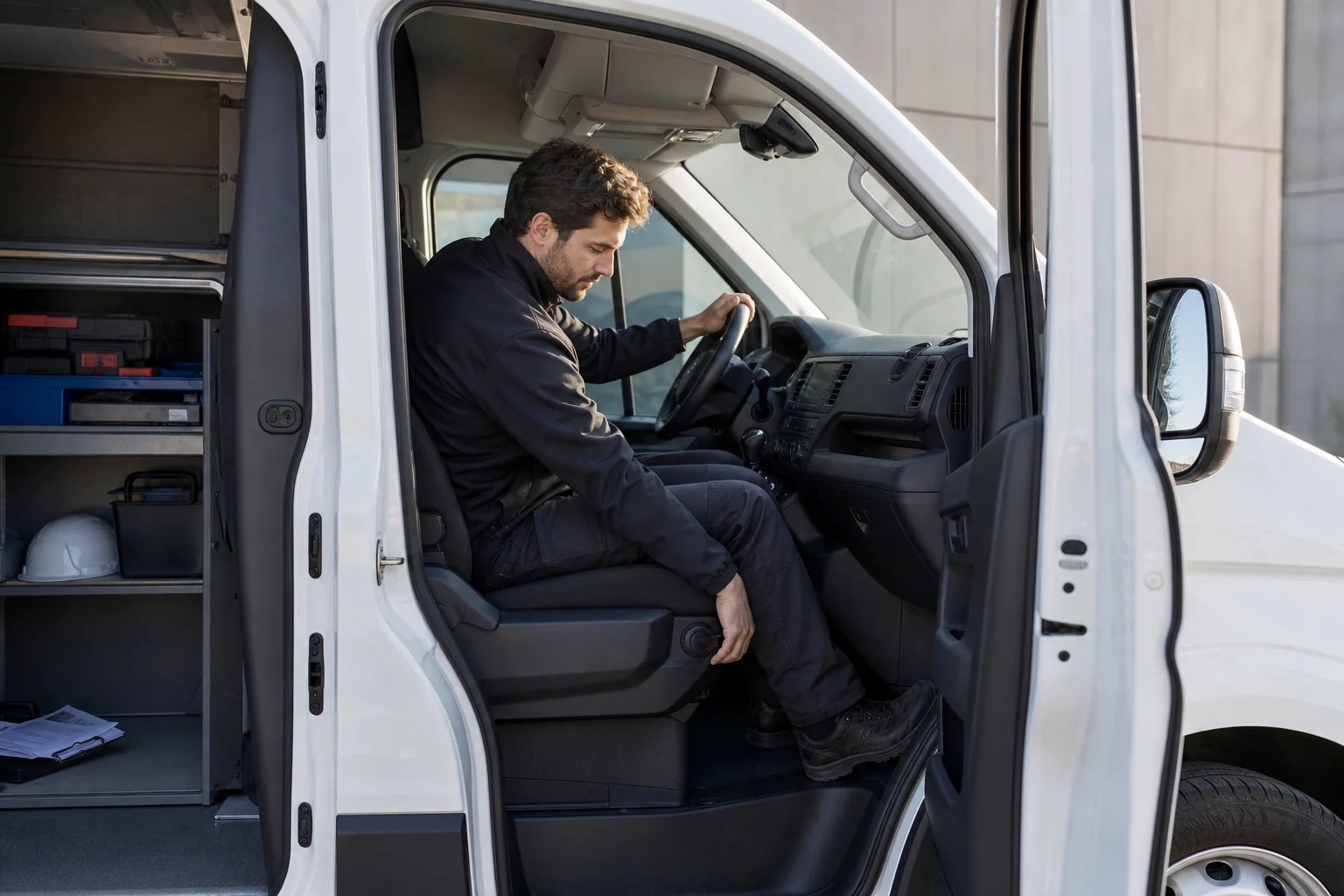
Driving position: adjust in this order and confirm the available range
Adjustment should start with the seat, continue with the steering wheel and finish with the rear-view mirrors. In a manual-transmission van, Spain's Directorate-General for Traffic (DGT) advises setting the fore-and-aft distance so that, when the clutch is fully depressed, the left leg remains slightly bent rather than fully extended. This is a quick way to check whether the seat slide offers enough travel for that driver.
Next, adjust the height to obtain a full forward view: the DGT's reference point is for the eyes to be approximately halfway up the windscreen. With your back supported by the backrest, check that your wrists reach the top of the steering wheel. The DGT also states that the elbows should remain slightly bent, the knees should not touch the steering wheel, and the wheel should not obscure either the road or the instrument cluster.
For the specific version, identify whether steering-wheel height, reach and tilt adjustments, backrest adjustment, lumbar support or armrests are available. Do not assume that every item available in the catalogue will be fitted or adjustable in every configuration. If an adjustment does not exist or its range is insufficient, record it as a limitation for that driver and use, rather than as a generic fault in the model.
| Item | Practical question it answers |
|---|---|
| Seat fore-and-aft and height adjustment | Does it allow the driver to operate the pedals and maintain forward visibility without sitting too close or too far away? |
| Backrest | With the back supported, can the wrists reach the top of the steering wheel? |
| Steering-wheel adjustment | Are the elbows slightly bent, the knees clear, and both the instrument cluster and road visible? |
| Rear-view mirrors | Is rearward visibility obtained without moving the head after setting the seat and steering wheel? |
| Lumbar support and armrests, if offered | Do they provide an acceptable position for the intended driver and workday? |
| Controls and screens | Can they be reached without objects or devices interfering with the driver? |
Section references: Posición del conductor y ajustes previos ↗
- Seat: distance, height and backrest; check pedal reach and forward visibility.
- Steering wheel: height and reach where available; confirm slightly bent elbows and clear knees.
- Instrument cluster: check that the rim does not hide important warning lights or instruments.
- Mirrors: adjust them only once the seat and steering wheel are set; they should be visible without moving your head.
Visibility, screens and objects: technology does not replace a direct check
Regulations require the field of vision ahead, to the right and to the left to provide an unobstructed view of the road, and rear-view mirrors to make it possible to see traffic behind. Therefore, after completing the adjustments, observe the surroundings from the seat: pillars, mirrors, the area immediately in front and side visibility. A camera or assistance system may be useful for a specific function, but it does not remove the need to check what can actually be seen from the final posture.
Also review what remains within the visual field or within hand reach. Films, stickers and badges must not obstruct the driver's proper vision. The placement of mobile phones, delivery notes, tools and other objects must not interfere with the person driving either. It is advisable to bring the items that usually accompany the working day to the test, so you can decide where they can be stored without encroaching on pedals, steering wheel, controls or visibility.
While driving, screens with internet access, television monitors and video players are incompatible with the permanent attention required for driving. The rules provide exceptions, including monitors needed for a rear-view manoeuvring camera and GPS. Consequently, calling a mount “approved” is not enough without specific documentation: check its position, function and whether it requires attention to be diverted from driving.
Section references: Reglamento General de Circulación ↗ · Reglamento General de Vehículos ↗
- From the final position, check forward, side and rearward visibility using the mirrors.
- Check that the steering wheel does not obscure the instrument cluster and that stickers or documents do not reduce the field of vision.
- Store work items before setting off; do not leave them loose or between the driver and the controls.
- Set up navigation and communications with the vehicle stationary.
Static test before buying or renting: a short protocol
An organised static test makes it possible to compare several vans using the same criteria. Carry it out with the vehicle stationary, the seat in its initial position and the items that will normally be used. Record the result by driver, because the same cab may suit one person and be limiting for another. If users will alternate, also check how easy it is to return to a safe position after each change.
Request or consult the user manual and commercial documentation for the exact version. Use them to confirm which adjustments exist and how they operate, but do not conclude that a feature is standard if it is not listed for the specific vehicle. A demonstration unit with optional packages may not match the van ultimately delivered.
This review does not guarantee the absence of fatigue or eliminate other driving risks. The DGT notes that poor ergonomic design of the seat or other interior elements can make driving more uncomfortable and difficult. In addition, the INSST explains that static posture produces prolonged muscle contraction and can cause muscular fatigue; therefore, the vehicle, workday organisation and breaks should be considered together.
Section references: Fatiga en la conducción ↗ · Análisis de las condiciones de trabajo de los conductores profesionales ↗
- Get in and out of the cab in conditions similar to those at work.
- Adjust the seat, backrest and steering wheel; operate the pedals and check the instrument cluster and road.
- Adjust the mirrors last and verify that you do not need to move your head to use them.
- Locate frequently used controls without forcing a body movement.
- Check where the phone, documents and tools can be placed without interference.
- Record which adjustment is missing, who identifies it and in which task it appears.
Assignment in a small fleet: record, adapt and escalate where appropriate
Ergonomics does not end with the purchase. Spain's Occupational Risk Prevention Act establishes that the assessment must be carried out when choosing work equipment and updated when working conditions change. As a practical application, it is advisable to review the assignment if the route, type of load, regular driver or service organisation changes. A van that worked for interurban journeys may need reviewing if it begins to be used for deliveries with numerous stops.
Create a simple incident record: date, vehicle, driver, task, adjustment used and situation observed. It is better to describe facts — for example, that the steering wheel obscures part of the instrument cluster in a position that allows the pedals to be operated correctly — than to try to diagnose a medical cause. Workers have the right to make improvement proposals to the employer, so this record can turn an isolated observation into a verifiable operational improvement.
If discomfort, adjustment limitations or task-related issues recur, report them to the company or fleet manager to assess intervention by the occupational health and safety service. When there are indications that preventive measures are insufficient, the Act provides for the employer to investigate the causes. Consulting the occupational health and safety service or a healthcare professional does not amount to an automatic diagnosis, but it avoids addressing a persistent problem solely by changing an accessory or seat position.
For long journeys, the DGT recommends interrupting driving every two hours or every 200 kilometres, with breaks of at least 20 to 30 minutes, and increasing the frequency in unfavourable conditions. This is a road-safety recommendation for long trips, not a universal work rule for urban deliveries; in all cases, breaks should be planned according to the activity and applicable prevention measures.
Section references: Ley 31/1995 de Prevención de Riesgos Laborales ↗ · Conducir con sueño o cansancio ↗
- Review the assignment when the route, load, driver or stop frequency changes.
- Record incidents in a specific and repeatable way.
- Do not attribute discomfort to a single cause without an appropriate assessment.
- Escalate recurring problems to the occupational health and safety service or fleet management.
- Plan breaks on prolonged journeys; do not wait until tiredness appears.
Which adjustment should be made first in a van?
Adjust the seat first, then the steering wheel and, once that position is set, the rear-view mirrors. The DGT states that the mirrors should be adjusted after the seat and steering wheel, aiming to see properly without moving your head. [Source: DGT](https://www.dgt.es/muevete-con-seguridad/viaja-seguro/en-coche/)
Does a rear-view camera mean you do not need to check mirrors and visibility?
No. Regulations require an unobstructed view ahead, to the right and to the left, as well as rear-view mirrors that allow traffic behind to be observed. A camera may be useful for a manoeuvre, but it does not replace that check from the driving position. [Source: General Vehicle Regulations](https://boe.es/buscar/act.php?id=BOE-A-1999-1826&p=20221221&tn=0)
Can any mobile phone mount be installed in the cab?
The device and other objects must not interfere with the driver. In addition, while driving, screens with internet access are incompatible with the permanent attention required for driving; the rules provide specific exceptions, such as GPS and monitors needed for a rear-view camera. [Source: General Traffic Regulations](https://www.boe.es/eli/es/rd/2003/11/21/1428)
When should the ergonomics of a van already in the fleet be reviewed?
When working conditions change, for example the route, load, regular driver or service organisation. The Occupational Risk Prevention Act establishes that the assessment must be updated when those conditions change and recognises workers' right to propose improvements. [Source: Act 31/1995](https://www.boe.es/eli/es/l/1995/11/08/31/dof)