Van off the road: how to prepare a replacement vehicle without improvising
A guide for self-employed professionals and microfleets that need to plan for what happens when their van is immobilised: cover, category, payload, drivers, costs and alternatives.
Key points
A replacement vehicle keeps operations running only when cover is in place and the available vehicle can handle the payload, drivers and real-world work involved. Anticipating the terms and documenting a Plan B reduces urgent decisions and downtime costs.
The short answer: having a van available is not enough
A replacement vehicle for a work van is only a genuine solution when two conditions are met: the contract activates the service for that incident, and the vehicle supplied can carry out the planned work. Having compulsory insurance in force does not resolve this issue: its legal purpose is to cover third-party liability, not material damage to the insured van or to the goods being carried.
You should therefore not assume that the insurer, renting provider, garage or roadside assistance will always provide an equivalent van. In one professional renting service consulted, the replacement vehicle is expressly listed as an optional service. Even when it is included, the alternative may belong to a different category, have a minimum immobilisation period or be subject to availability.
The useful decision is not simply asking, “Is a replacement available?” You need to be able to answer in writing: what cause activates it, from when, for how many days, what category is supplied, who may drive it, what insurance it has and whether it can accommodate the payload, routes and essential equipment. This check must be made before a breakdown, accident or scheduled service.
Section references: Ley sobre responsabilidad civil y seguro en la circulación de vehículos a motor ↗ · Servicio de vehículo de sustitución ↗
- Do not equate compulsory insurance with a replacement vehicle.
- Do not interpret “van” as meaning equivalent capacity.
- Do not accept a commercial category as proof of sufficient volume, payload or equipment.
- Keep the policy, renting or maintenance contract, and activation telephone numbers in one file.

Separate the reason for the stoppage and read the contracted benefit
Scheduled maintenance, mechanical breakdown, accident, theft and total loss should not be treated as a single situation. One specific renting benefit covers accidents, mechanical breakdowns, total losses and theft; the driver’s manual from the same provider also mentions maintenance as a replacement trigger. This difference illustrates why the covered cause must be checked in the terms that apply to each contract, rather than inferred from previous experience.
The Insurance Contract Act requires general and specific terms to appear in the policy or a supplementary document. It also establishes that clauses limiting the insured party’s rights must be highlighted and specifically accepted in writing. Therefore, locate the current document and do not rely on a commercial reference or verbal answer.
Also review the activation threshold. One specific offer links a category B vehicle to immobilisations lasting more than 24 hours. If a service is completed within that period, or the garage cannot yet confirm its duration, the service may not solve the first working day. Record the exact period and who confirms the immobilisation.
Section references: Ley de Contrato de Seguro, artículo 3 ↗ · Servicio de vehículo de sustitución ↗ · Manual del Conductor Arval ↗
- Classify every possible stoppage: maintenance, breakdown, accident, theft or total loss.
- Check whether there is a waiting period, activation threshold or maximum duration.
- Identify the activation channel and the documentation that must be provided.
- Request written confirmation of the authorised category and the return date or condition.
Check the category, insurance and driver before accepting delivery
The category stated in the plan matters more than a generic promise of a replacement. The provider consulted classifies its commercial vehicles in categories 1, 3 and 6 and provides, when the requested category is unavailable, a higher category, a lower category or an open-market rental that may subsequently be reimbursed under its terms. The operational risk is that a lower category may force you to split routes, leave tools behind or cancel a service.
Nor should the cover under the renting agreement be automatically transferred to the temporary vehicle. The manual consulted warns that the conditions of use and rental insurance cover may differ from those of the renting agreement and are determined by the rental office. In the cited commercial-vehicle offer, these vehicles are subject to an excess and fuel is not included. Before leaving, request the applicable excess, fuel terms, mileage limits and return conditions.
Finally, validate the driver. In general, a Category B licence covers automobiles, including vans, up to 3,500 kg MAM; C1 covers vehicles over 3,500 kg and up to 7,500 kg, under the applicable regulations. If the replacement vehicle exceeds the licence scope of the person assigned to the route, having it available will not prevent the interruption.
Section references: Servicio de vehículo de sustitución ↗ · Manual del Conductor Arval ↗ · Reglamento General de Conductores ↗
- Compare the category granted with the minimum requirement, not with the commercial name of your usual van.
- Record the excess, fuel, mileage and return rules for the temporary vehicle.
- Confirm which drivers are authorised under the rental or replacement contract.
- Check the replacement vehicle’s MAM and the licence held by every possible driver.
Prepare an operational sheet: equivalence is measured at work
The operational sheet translates the usual van into requirements that a provider, partner business or responsible person can quickly check. It must separate essentials from desirable features. Writing that you need a “large” van is not enough: describe what is transported, how it is loaded and which limit would prevent the route from being completed.
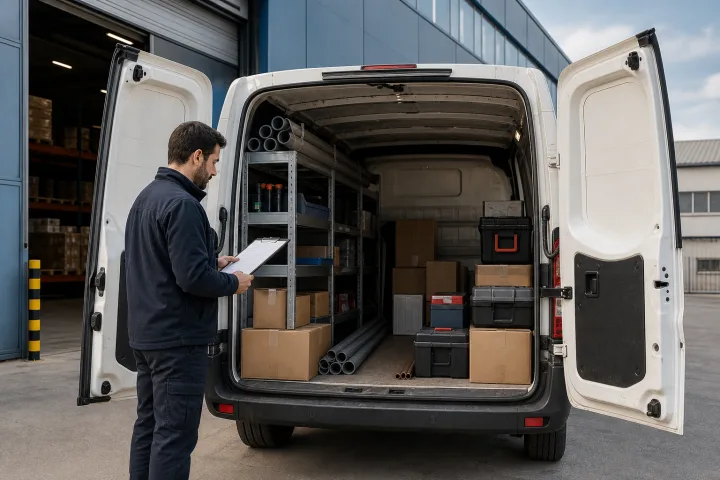
Record the weight of the usual load and peak loads, the number and dimensions of packages, the useful length, width and height genuinely required, the number of seats needed and the maximum access height for garages, loading bays or customer premises. Add the tools that must always travel and any specific operational need, such as refrigeration or installed equipment. If the replacement does not include that item, do not assume it can be transferred: first confirm that the alternative allows the work to be carried out validly and safely.
Weight cannot remain a vague estimate. The General Traffic Regulations govern the maximum permitted masses and require the load to be arranged and, where necessary, secured so that it does not compromise safety. A van that looks larger may not solve the problem if its available payload, load compartment or tie-down points do not suit the operation. To choose the right working baseline, the guide on payload or volume may be useful.
| Area | Information that must be recorded | Failure it prevents |
|---|---|---|
| Activation | Covered cause, waiting period and duration | Requesting a replacement for an excluded or excessively short event. |
| Vehicle | Granted category and availability | Accepting a lower-grade alternative with insufficient capacity. |
| Payload | Weight, packages, geometry and securing | Exceeding limits or carrying cargo improperly. |
| Drivers | Applicable licence and contractual authorisation | Assigning the route to a person who is not qualified. |
| Cost | Excess, fuel, mileage and open-market rental | Discovering charges or conditions after delivery. |
Section references: Reglamento General de Circulación, artículo 14 ↗
- Payload: usual weight, foreseeable maximum weight, number of packages and dimensions of the bulkiest items.
- Space: required usable dimensions and maximum permitted height at usual access points.
- Service: number of seats, route, expected mileage and essential tools.
- Specific requirements: refrigeration, interior organisation or equipment that cannot be improvised.
- Safety: the load arrangement and securing method that must be maintained.
Design a documented Plan B and monitor the incident
The contracted replacement should be the first alternative, but not the only one. Set out a decision sequence in writing: activate the service, check whether the assigned vehicle meets the operational sheet and, if it does not, consider rental, temporary collaboration or route rescheduling. An open-market rental should only be selected after confirming how it must be requested and whether the contract provides reimbursement; the existence of that option in one specific offer does not make it universal.
Define which jobs can continue with reduced capacity and which must be postponed. Group services by payload, urgency, access and available driver. Notify the customer with a prudent estimate as soon as you know about the immobilisation, without promising a delivery time that depends on a category not yet confirmed. This protocol prevents an insufficient van from generating a second incident: failing to complete a route or using an unsuitable vehicle.
To maintain traceability, keep the garage’s deposit receipt or signed estimate. Garage regulations require it to identify, among other details, the vehicle, whether it is delivered for an estimate or repair, and the expected delivery date. Also retain authorisations, roadside-assistance communications, the replacement contract, photographs of the condition at handover and return, fuel receipts and the invoice. The garage invoice must be written and itemised, showing charges, operations, parts or components and labour hours: it helps reconstruct the scope and cost of the stoppage.
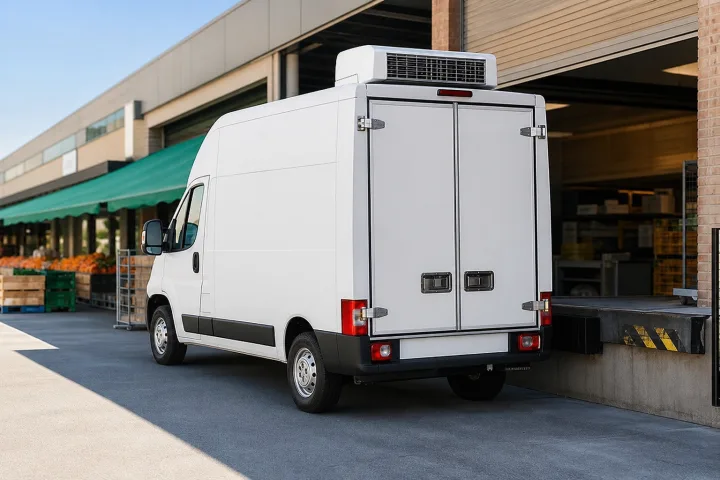
After each case, compare what was planned with what happened: hours immobilised, vehicle actually received, postponed work, direct cost and the reason for any deviation. Update the sheet and contract renewal using that information. If the activity depends on refrigeration, also remember that the alternative must meet that specific need; the reference on refrigerated vans and ATP certificates helps focus that check.
Section references: Servicio de vehículo de sustitución ↗ · Regulación de los talleres de reparación ↗
- File the garage receipt or estimate with the expected delivery date.
- Keep the replacement authorisation and the terms of the rental actually signed.
- Record the stoppage time, delivery time, affected routes and costs incurred.
- Review the plan after every incident and correct the requirement that failed.
Does compulsory insurance include a replacement van?
Not by itself. Compulsory insurance covers third-party liability in road traffic, not material damage to the insured van or to the goods carried. The replacement must be stated in the specific cover or contract.
Will a replacement van in the same category always work?
Not necessarily. It must be checked against the operational sheet: payload weight and dimensions, number of packages, access height, seats, tools and any service-specific requirement.
What licence is needed to drive the temporary van?
Check the MAM of the assigned vehicle. In general, a Category B licence covers automobiles, including vans, up to 3,500 kg MAM; for vehicles over 3,500 kg and up to 7,500 kg, C1 applies under the relevant regulations.
What documents should I keep if the van goes into a garage?
Keep the deposit receipt or signed estimate, replacement authorisation, temporary vehicle contract, communications, fuel receipts and itemised garage invoice. They support the dates, scope and costs of the immobilisation.