Payload or volume: how to choose a work van without falling short
Volume does not guarantee that a van can carry more kilograms. This guide explains which figures to compare, how to account for the real weight of the fit-out and which documents to request before completing a purchase in Spain.
Key points
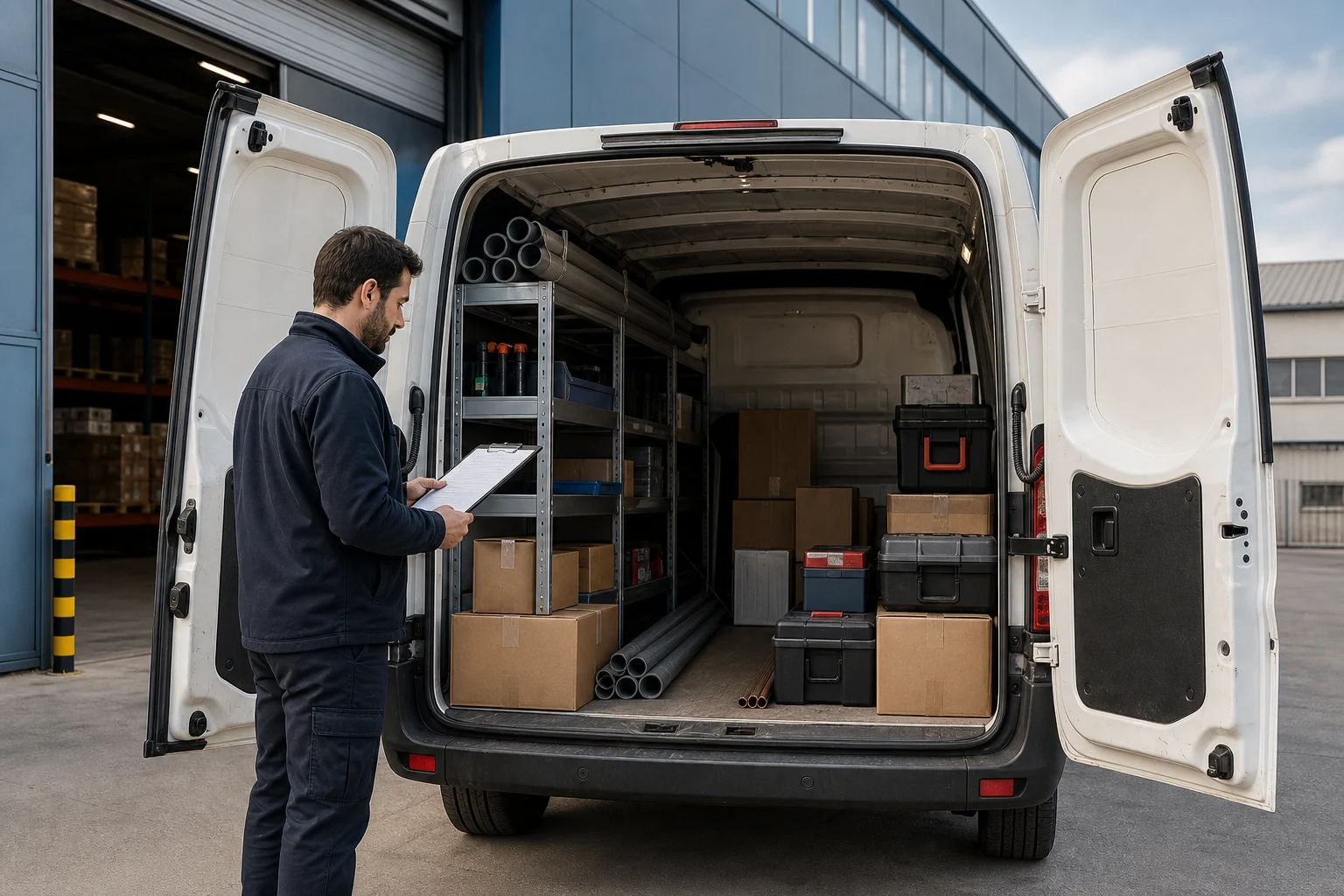
The right van solves the real constraint on each working day: weight, volume, load length or the conversion required. Always compare the exact configuration, its documentation and the mass still available after it has been equipped for work.
The quick answer: buy for your bottleneck
A larger van is not automatically the best choice or the one that lets you carry more kilograms. Before comparing models, identify what genuinely limits your work on a demanding day: the mass of the goods, the space the items occupy, the length of a component, access through the doors or the fixed installation you need inside.
If cubic capacity fills up first with light packages, volume and access are what matter. If you carry heavy tools, bags, metal spare parts or compact materials, the priority becomes the payload of that specific vehicle and its permitted masses. For profiles, pipes or long equipment, a high volume figure may be secondary to usable floor length and the size of the entrance opening.
The comparison must be made between equivalent vehicles in their real configuration: number of seats, length, engine, doors, tail lift, bulkhead, linings and professional equipment. The catalogue figure for a basic version may not be the figure for the van that is delivered.
Section references: Reglamento General de Vehículos: definiciones de masas ↗ · Ford Transit City MY27: folleto técnico de España ↗
- Choose according to the first limit you regularly reach, not the biggest number in the brochure.
- Keep a margin for peak days, not just the average load.
- If two options meet your needs, consider which one retains more margin in the critical factor for your work.
- Also see Commercial Vehicles and compare versions, not just model names.
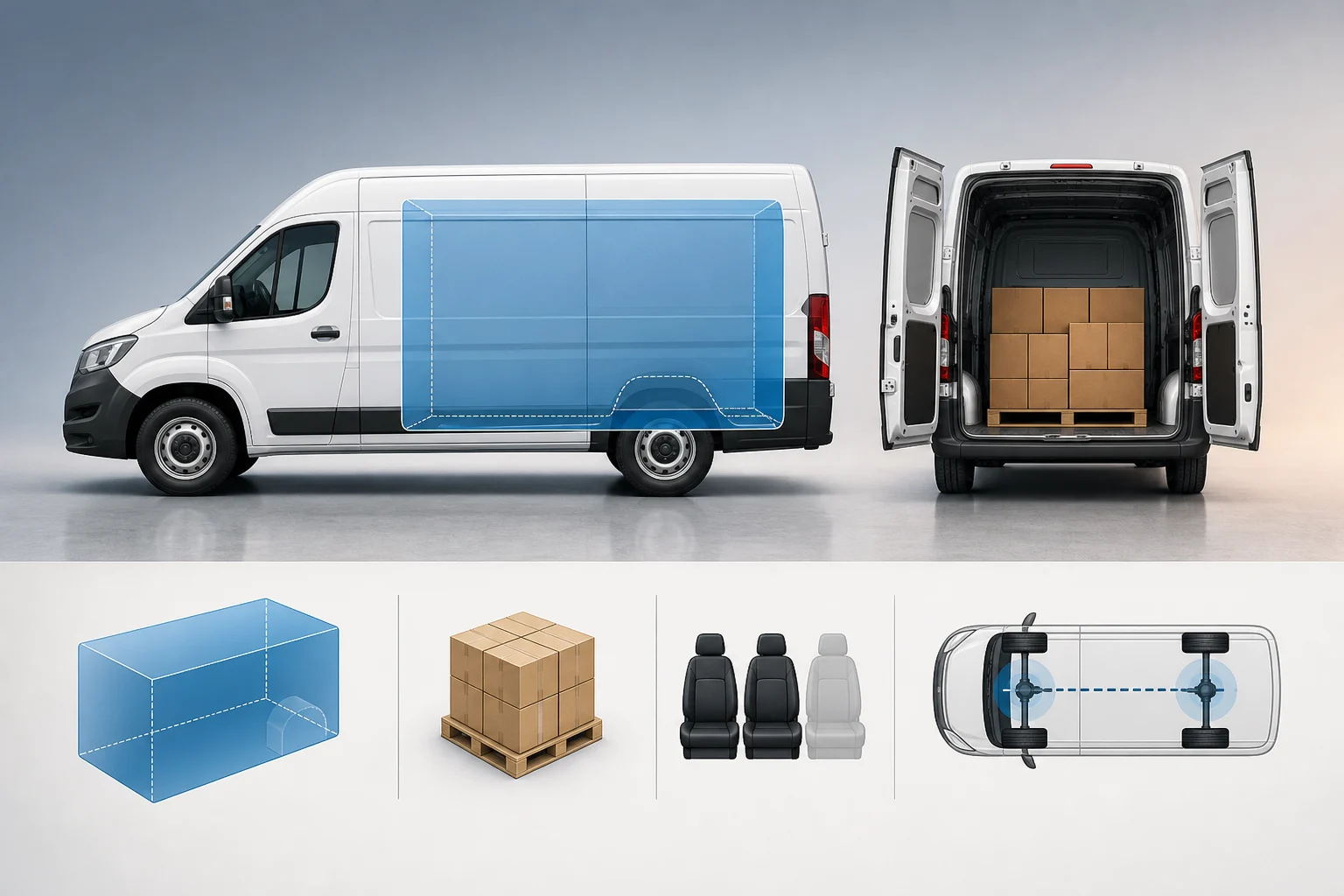
Do not confuse volume, payload, GVW and mass in running order
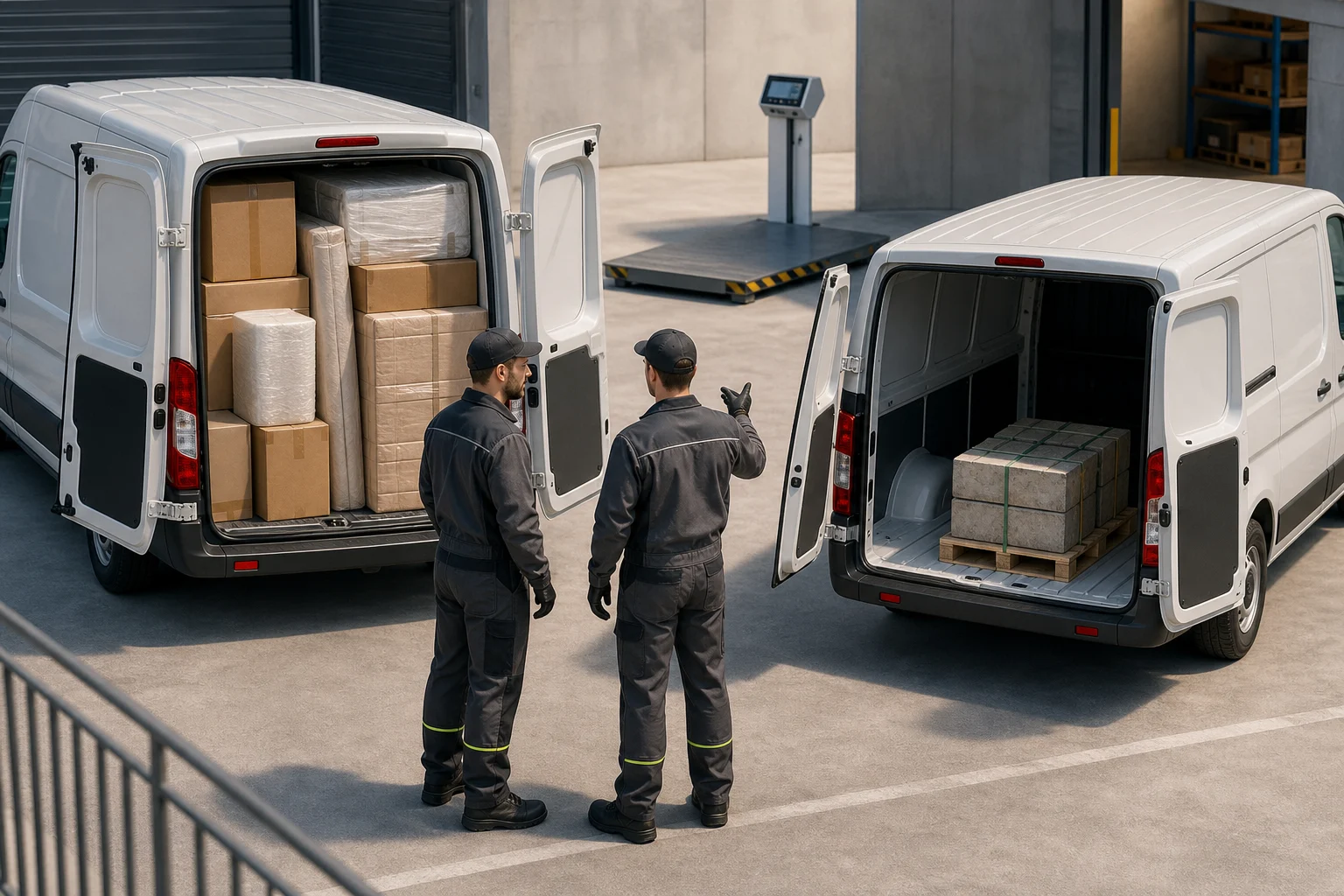
Load volume expresses the space available, usually in cubic metres, but it does not determine how many kilograms can be carried. You must also check how it has been measured: a Spanish Ford brochure lists separate concepts for the same body, including SAE volume, maximum volume and VDA load space. Litres or cubic metres measured by different methods should not be compared as though they were identical.
GVW, or gross vehicle weight, is the legal mass limit for the loaded vehicle when it is on the road. Laden mass includes goods, service personnel and passengers. Therefore, GVW is not an amount entirely available for boxes or materials.
Mass in running order is another essential reference. Spanish regulations define it using kerb weight and a standard driver mass of 75 kg. Manufacturers may explain commercial payload using criteria that require you to review their methodological note; always ask the seller to confirm the calculation that applies to the vehicle offered.
Section references: Reglamento General de Vehículos: definiciones de masas ↗ · Datos de la tarjeta ITV: campos de masa y dimensiones ↗ · Ford Transit City MY27: folleto técnico de España ↗
- Volume: how much space the items occupy.
- Declared payload: the mass stated by the manufacturer for the specific configuration; check what it includes.
- GVW: the mass limit for the loaded vehicle to travel on the road.
- Mass in running order: the starting figure for interpreting the available mass margin.
- Axle limits: these determine where dense loads can be placed.
Calculate your needs using a real working week
Do not base your purchase on an exceptional load or an estimate from memory. Over a representative week, inventory everything that goes on board at the start of the day: packages, tools, consumables, securing equipment and occupants. Also record the most demanding days and the type of journey, because a load that fits may still be impractical to place or unload.
Split the analysis into two columns. In the first, add up known masses for materials and equipment; in the second, note the space and dimensions of every difficult item. Heavy articles also require you to plan their position. The Spanish ITV vehicle inspection card records both mass in running order in field G and road-going GVW in F.2, as well as maximum axle masses in F.2.1.
Start with the declared payload for the vehicle as already configured and subtract any items that will be installed afterwards and are not included in that figure. Also allow mass for people and equipment not included in the commercial definition. If in doubt, ask the dealer or converter in writing exactly what is included in the stated mass in running order and payload. For operations close to the limit, a final check on a weighbridge is a prudent verification; Ford recommends a 5% margin of mass in running order in its E-Transit payload guide.
Section references: Datos de la tarjeta ITV: campos de masa y dimensiones ↗ · Ford E-Transit: guía técnica de carga útil ↗
- Weigh tool cases, portable machinery and consumables; do not estimate them if you can avoid it.
- Measure the length, width and height of the most problematic items, including packaging.
- Record the peak day and add a reasonable operational margin.
- Plan the position of heavy loads without exceeding axle limits.
- Keep the inventory: it helps compare future offers and justify the chosen conversion.
Advertised volume can conceal very different payloads
Two vans with similar cubic capacity can have very different mass margins because of their configuration. This is especially important in high-volume vehicles fitted out for delivery work, where added components and access solutions can reduce the capacity available for goods.
Spanish documentation for the Renault Master High Volume illustrates this difference: two L3 versions are advertised with 20 m³, but with a rear tail lift their stated diesel payload ranges are 711 to 961 kg and 520 to 711 kg. In an L4 version with 23 m³, the stated range with a rear tail lift is 425 to 615 kg. The useful figure is not simply that a body has more space, but what mass the specific version can carry once equipped.
It is also a mistake to treat accessories and conversions as later details. Shelving, interior linings and isothermal or refrigerated equipment are expressly listed in the Vehicle Conversion Manual under body conversion 8.30. Interior panelling that does not exceed 5% of the mass in running order may fall outside the definition of a conversion in that case, but its mass does not thereby become available payload: it still uses up part of the vehicle's real margin.
Section references: Manual de Reformas de Vehículos, revisión 7, corrección 2 ↗ · Renault Master Gran Volumen: medidas y carga útil ↗
- Request the weight and reference of every accessory that will be added after purchase.
- Do not compare a base-vehicle specification sheet with an offer that includes a tail lift, shelving or refrigeration.
- Avoid loading up to GVW without allowing for passengers and mass distribution.
- If your load is dense, give priority to available mass and the limits on each axle.
Check the dimensions that let the load enter and remain usable
Cubic metres do not describe the shape of the compartment. To decide reliably, compare maximum load length, width between wheel arches, interior height and door entrance width. These dimensions are listed separately in van technical documentation and determine whether a machine, pallet, cabinet or long component will fit.
Make a layout test using the real dimensions of your items. Bear the unloading sequence in mind: a load may fit with difficulty and still block tools needed earlier. If you use the side of the van, also check the sliding-door opening; if you load from a dock or with trolleys, the sill and rear access are decisive.
The following table ranks priorities by type of activity. It does not replace the approved values for each vehicle, but it helps avoid a comparison based on a single figure.
| Activity or load | Initial priority | Checks you should not skip | Common purchasing mistake |
|---|---|---|---|
| Light, bulky parcels | Load volume and access | Method used to state volume, interior height, doors and unloading order | Choosing by cubic metres without checking the entrance opening or measurement method |
| Tools and portable machinery | Payload of the configured vehicle | GVW, axle masses, shelving weight and occupants | Using the payload of a base version after fitting heavy equipment |
| Dense materials | Payload and mass distribution | Axle limits, item position and margin for peak days | Looking only at total GVW and concentrating too much weight on one axle |
| Long goods | Usable length and openings | Maximum load length, width between wheel arches and side or rear door | Buying by volume when the item cannot enter or be handled |
| Isothermal or refrigerated equipment | Resulting mass and conversion documentation | Weight of insulation and equipment, final payload and applicable documentation | Treating refrigeration equipment as an accessory with no effect on mass or paperwork |
Section references: Ford Transit City MY27: folleto técnico de España ↗
- Measure the longest rigid item, not the average item you carry.
- Check the width between wheel arches for any load that must sit on the floor.
- Check the effective width and height of the opening, not just the interior size.
- Simulate the loading and unloading order using the doors you will actually use.
Before signing: vehicle documentation and conversion control
Request the technical specification or ITV vehicle inspection card for the specific vehicle, not just a general brochure. It can be used to verify G for mass in running order, F.2 for road-going GVW and F.2.1 for permitted axle masses. Check that they match the seats, body and equipment offered.
If there is a conversion, determine before buying who carries it out, what documentation they provide and what will ultimately appear on the ITV card. Depending on the type of conversion, Royal Decree 866/2010 provides for a technical project and final works certificate, conformity report and workshop certificate. After a conversion, the owner must present the vehicle for ITV inspection within a maximum of fifteen days with the required documentation; if the result is favourable, the ITV card is endorsed or issued.
This documentation check is as important as comparing prices. A well-structured offer identifies the base vehicle, every installed item, its effect on mass and the documentation provided at handover.
Section references: Datos de la tarjeta ITV: campos de masa y dimensiones ↗ · Real Decreto 866/2010: reformas de vehículos y documentación ↗ · Manual de Reformas de Vehículos, revisión 7, corrección 2 ↗
- Request the payload for the exact configuration offered in writing.
- Check G, F.2 and F.2.1 on the ITV vehicle inspection card.
- Request a list of accessories, their weight and whether they are included in the payload figure.
- For shelving, linings, isothermal equipment, refrigeration or a tail lift, confirm whether there is a conversion and which documents are supplied.
- If you buy a converted used van, check that its documentation and ITV card reflect its current condition.
Is GVW the payload of a van?
No. GVW is the maximum permitted mass of the loaded vehicle for use on the road. Laden mass includes goods, service personnel and passengers; payload must be checked for the specific configuration and understood in terms of what it includes.
Why can a van with more volume have less payload?
Because volume measures space, not available mass. The body, seats, a tail lift, shelving, linings or refrigeration equipment can alter the vehicle's mass and reduce the margin available for goods.
Which ITV vehicle inspection card figures should you check before buying?
The main ones are G, for mass in running order; F.2, for road-going GVW; and F.2.1, for maximum permitted axle masses. They must correspond to the vehicle and configuration offered.
Do shelving or insulation require documentation?
They may form part of a body conversion under the Vehicle Conversion Manual. Before buying, confirm the documentation that applies to the specific conversion. Where a conversion applies, the Royal Decree provides for documentation such as a conformity report and workshop certificate, among other requirements depending on the case.