Spare wheel, run-flat or repair kit: what to check
Equipment can vary between versions and individual vehicles. We explain what to check in the manual, boot and included equipment before choosing a new or used car.
Key points
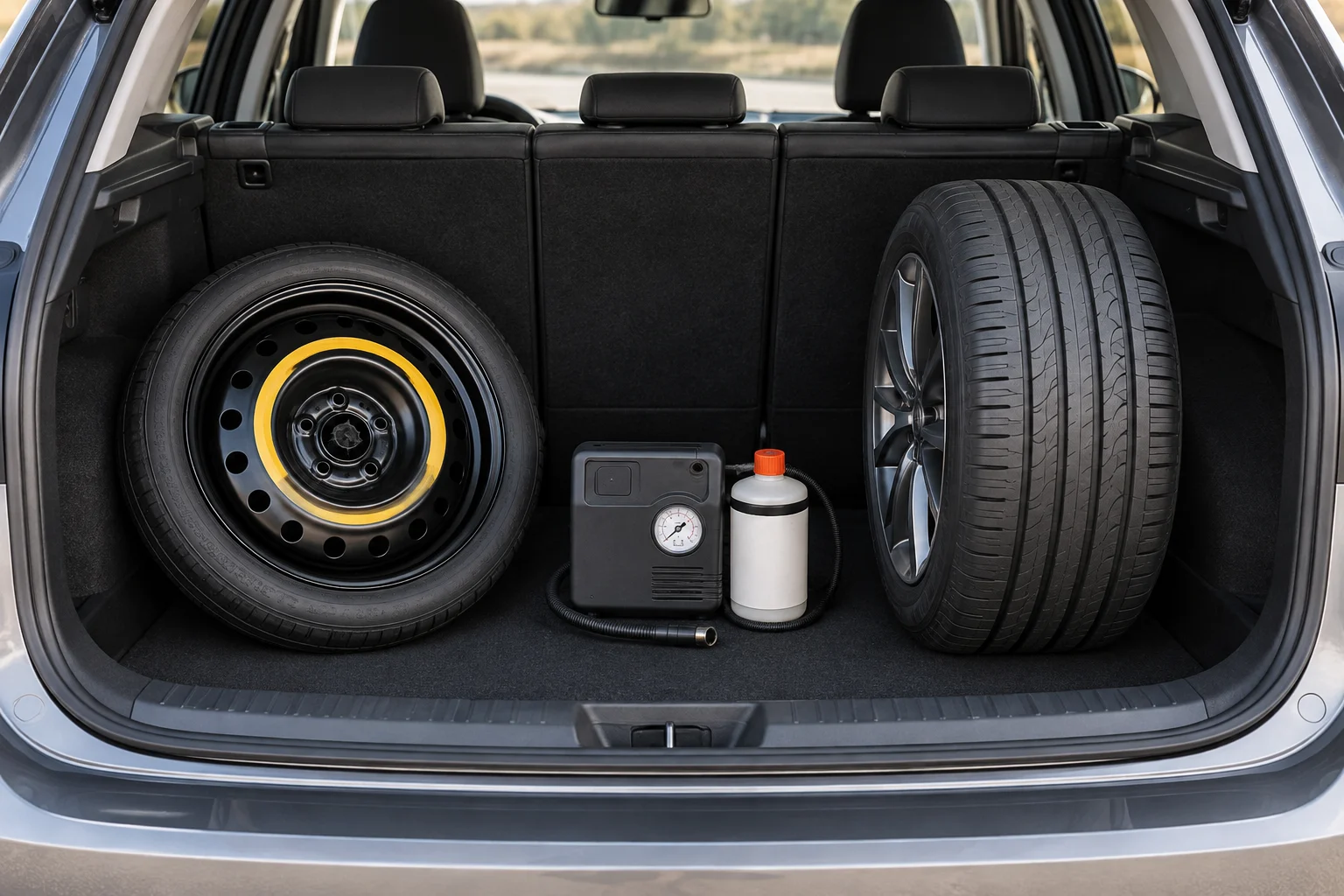
There is no universal solution: spare wheels, repair kits and run-flat tyres each have different conditions and limits. Before buying, check what the specific vehicle comes with, how much space it takes up and what its manufacturer’s instructions say.
The answer depends on the equipment fitted to that specific vehicle
Before deciding between a spare wheel and a puncture repair kit, find out exactly what comes with the car you are considering. The model name alone is not enough: for example, the 2024 Kia MQ4A owner’s manual treats the compact spare as an item available “if equipped”. That is a good reason to check the specific vehicle rather than assume that every version comes with the same equipment.
Your decision also depends on how you intend to use the car and on its instructions. A space-saver wheel may let you continue temporarily, subject to specific limits; a repair kit is only suitable depending on the damage and the kit manufacturer’s instructions; and you can continue on run-flat tyres only if the vehicle manual and tyre instructions allow it. None of these options should be treated as a solution for every puncture.
Section references: Manual del propietario Kia MQ4A, edición española 2024: neumático de repuesto compacto ↗ · Catálogo de accesorios Ford Focus MY2019 para España ↗
- Ask to see the equipment included, not just a generic sales description.
- Check the tyre section of the manual for the specific year and version of the vehicle.
- Find out whether a spare wheel is standard, optional or not included.

The options you may find and what they involve
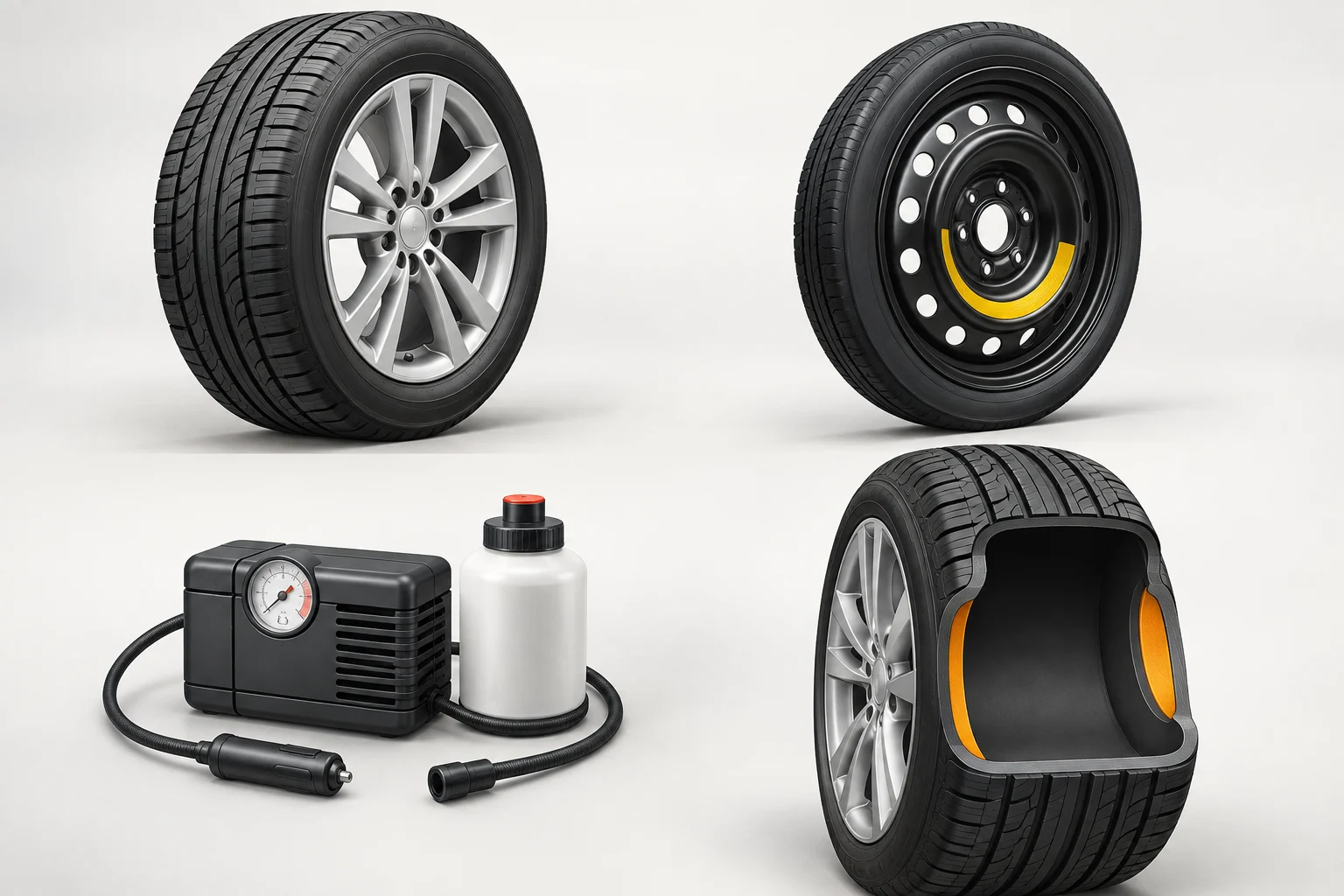
A conventional spare is an additional wheel. A space-saver or emergency spare is also a wheel, but its conditions of use depend on the vehicle and its manual. The 2024 Kia MQ4A manual says the space-saver described takes up less room than a normal wheel, is designed for temporary use only and must not be driven above 80 km/h. It also warns that it is designed for the vehicle it comes with and should not be transferred to another car.
The Ford repair kit described by the manufacturer includes a bottle of sealant and a compressor. It is not the same as carrying a complete wheel: its usefulness depends, among other things, on the nature of the damage and the procedure specified for that kit.
Run-flat tyres are subject to specific instructions. The 2017 MINI F57 owner’s manual allows you to continue under restrictions for that vehicle: no more than 80 km/h and, with an average load and in favourable conditions, up to 80 km. The same manual warns that the possible range varies with use and conditions. These figures apply to that manual, not to every car or run-flat tyre.
| Option | What to check | Documented limitation |
|---|---|---|
| Conventional wheel | Whether it is included and whether it is suitable for the vehicle | The Spanish Ford Focus MY2019 catalogue lists it as an option; this does not confirm the equipment on other versions or individual vehicles. |
| Space-saver wheel | Compatibility and conditions of use in the manual | For the Kia MQ4A 2024 described, temporary use and a maximum of 80 km/h. |
| Repair kit | Contents, condition and sealant expiry date | The cited Ford guide limits use according to puncture size and gives instructions specific to that kit. |
| Run-flat tyre | Whether the car is fitted with this type of tyre and what its manual says | The 2017 MINI F57 sets specific limits; they should not be applied to other vehicles. |
Section references: Manual del propietario Kia MQ4A, edición española 2024: neumático de repuesto compacto ↗ · Cómo utilizar el kit para inflar neumáticos ↗ · Manual del propietario MINI F57, edición MY2017: neumáticos runflat ↗
Space, contents and conditions of use
Available space matters, but you cannot work it out just from the body style or trim name. Check the boot itself to see where the equipment is stored and whether it affects the load space you need. For the space-saver wheel described by Kia, the manual says it takes up less room than a normal wheel; for other models, confirm the specific configuration.
Also identify what comes with the system. If there is a repair kit, check its contents against the relevant manual; the cited Ford guide describes a bottle of sealant and a compressor for that kit. Check the sealant’s expiry date: Ford specifically recommends doing so for its kit. Do not assume that having a compressor means the kit is complete or ready to use.
The limits for a repair kit are not universal either. In the cited Ford guide, a puncture larger than 6 mm is considered too large for that kit to repair, and the manufacturer recommends calling roadside assistance. After sealing, it says not to drive more than 200 km before replacing the tyre. Treat those figures as applying only to the product described; for another make or kit, its own instructions take precedence.
Section references: Manual del propietario Kia MQ4A, edición española 2024: neumático de repuesto compacto ↗ · Cómo utilizar el kit para inflar neumáticos ↗
- Open the boot and locate the equipment physically.
- Check that the items present match the manual.
- For a repair kit, check the sealant expiry date and the specific instructions.
- Do not assume that damage can be repaired: its size and location matter.
The type and location of the damage may leave you without a solution
A car having a repair kit does not mean it will work for every puncture. Michelin Spain says that damage to the tread can usually be repaired in most cases, while damage to the shoulder cannot be repaired under the general conditions described in its guide, and damage to the sidewall generally cannot be repaired either. The specific assessment depends on the manufacturer’s instructions and a tyre inspection.
You should also avoid making dangerous generalisations about run-flat tyres. The 2017 MINI F57 owner’s manual warns you not to continue driving if the car has normal tyres with no pressure, and says to follow the specific instructions for run-flat tyres. So you cannot simply assume that any deflated tyre lets you drive on to a garage.
If the damage exceeds the equipment’s limits, does not match its instructions, or you cannot confirm which tyres the car has, do not improvise a repair or extrapolate distances or speeds from another model. Check the manual and call for assistance when the instructions say to do so.
Section references: Manual del propietario MINI F57, edición MY2017: neumáticos runflat ↗ · Reparación de neumáticos: ¿se puede reparar mi neumático? ↗
What to check on a used car and what to ask the seller
With a used car, start by checking the boot, not the model specification. See whether it has a wheel, a kit or both; confirm that the equipment matches the manual and check the visible condition of its components. If you find a kit, check the sealant date and make sure the compressor is there. If there is a space-saver wheel, look for the instructions and check that it is intended for that vehicle.
Equipment can vary even within the same model family. As an example limited to a particular period and market, the Spanish Ford Focus MY2019 catalogue listed a repair kit, an emergency wheel and a conventional wheel. The document shows that different options were available in that catalogue, but it does not establish what a Focus from another year, trim or individual vehicle comes with.
When buying new, ask whether the solution is standard, optional or dependent on the trim, and whether it affects the load space. Ask the seller to identify the exact equipment and the applicable manual. For a used car, if the advertised equipment is missing or incomplete, ask for clarification before completing the purchase.
Section references: Manual del propietario Kia MQ4A, edición española 2024: neumático de repuesto compacto ↗ · Cómo utilizar el kit para inflar neumáticos ↗ · Catálogo de accesorios Ford Focus MY2019 para España ↗
- Locate the actual equipment in the boot and compare it with the manual.
- Check the contents and sealant expiry date if there is a kit.
- Ask about the equipment on that specific version and vehicle, not the range in general.
- Confirm compatibility and operating limits before relying on the solution.
Quick checklist before you buy
The most reliable way to compare two cars is to check the physical equipment against the manual and your needs. If you take long journeys, carry loads or need to preserve boot space, include those factors in your decision, but do not assume the system can do anything the manufacturer has not documented.
Section references: Manual del propietario Kia MQ4A, edición española 2024: neumático de repuesto compacto ↗ · Cómo utilizar el kit para inflar neumáticos ↗ · Manual del propietario MINI F57, edición MY2017: neumáticos runflat ↗
- What does this specific vehicle have: a conventional wheel, space-saver, repair kit or run-flat tyres?
- Is it included as standard, or does it depend on a trim or optional extra?
- Do the equipment, vehicle and manual instructions match?
- Is everything present, and, if it has sealant, is it still within its usable date?
- What types of damage can it handle, and what speed, distance or conditions does the manufacturer specify?
- Where is the equipment stored, and how does it affect the space you need?
Can you drive in the same way on a temporary spare as on a normal wheel?
You should not assume so. The 2024 Kia MQ4A manual describes its space-saver wheel as temporary and sets a maximum speed of 80 km/h for it. Check the limit and conditions in the manual for the specific car.
Will a repair kit work for every puncture?
No. It depends on the kit’s instructions and the damage. Ford says that a puncture larger than 6 mm exceeds the capacity of the kit described in its guide. Michelin also notes that location matters: damage to the shoulder or sidewall cannot be repaired under the general conditions it describes.
Can you always keep driving after losing pressure on run-flat tyres?
Do not assume the same limits apply to every tyre. The 2017 MINI F57 manual sets specific conditions for that vehicle and warns against continuing to drive on normal tyres with no pressure. Always check the manual and the instructions that apply to the tyres fitted to that vehicle.