Imported used car: documents and version to check before buying
A guide to checking paperwork, history, approval, equipment and costs before buying an imported used passenger car in Spain.
Key points
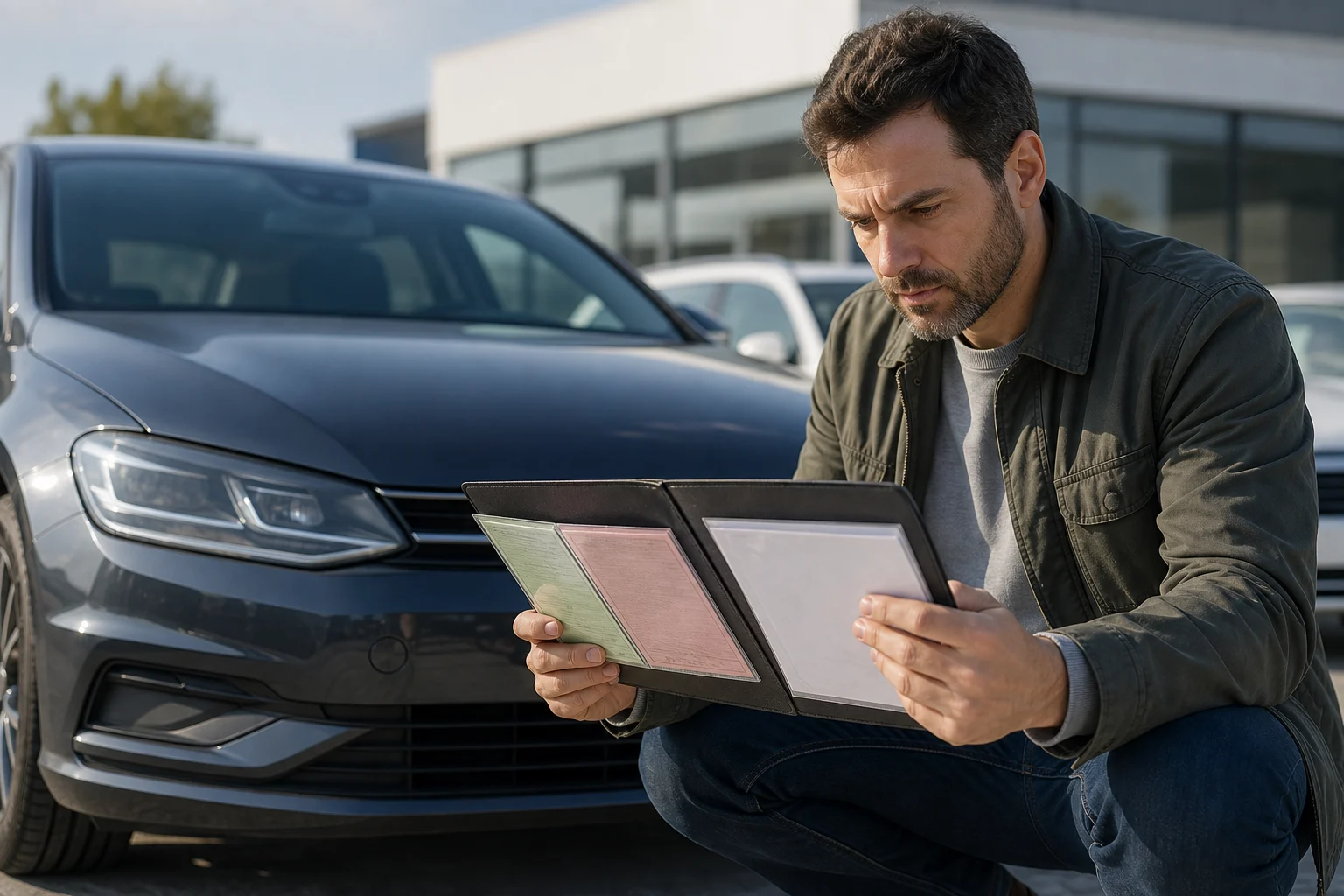
An imported used passenger car can be a sensible purchase, but before paying you need to distinguish between one already registered in Spain and one that still needs to be registered. Then, the key is to match its identity, available history, approval, actual version and tax costs with the original documents.
The quick answer: first identify the car’s administrative status
You should not assess an imported car solely by its price, appearance or advertised mileage. The first question changes the whole purchase: does the vehicle already have Spanish registration plates, or does it retain foreign plates and will the buyer have to register it in Spain?
If it is already registered in Spain, the transaction is similar to buying any domestic used car: you need to check that it can be transferred, review its Spanish paperwork and complete the change of ownership. Spain’s Directorate-General for Traffic (DGT) states that the buyer has 30 days from signing to make that change. This does not remove the need to investigate its earlier period abroad.
If it still needs to be registered, as well as deciding whether the car is suitable, you need to confirm that the required originals are available, that it can pass the inspection needed to obtain a Spanish technical data sheet, and that taxes, fees and travel have been budgeted for. For a vehicle from another EU Member State, the DGT states that it must be registered in Spain in order to drive there.
A reason to stop the transaction is that the seller cannot clearly explain which of these two cases applies, or intends to replace original documents with photographs, screenshots or promises to hand them over later. Ask to see the paperwork before paying a deposit and make any payment conditional in writing on the agreed document checks.
Section references: DGT — Matricular un vehículo proveniente de la UE ↗ · DGT — Comprar un vehículo de segunda mano ↗
- Already registered in Spain: prioritise the registration certificate, ITV card, DGT report and whether transfer is possible.
- Awaiting registration: prioritise the original foreign registration certificate, proof of ownership, CoC or technical alternative, and registration ITV inspection.
- Non-EU origin: do not automatically apply this intra-EU registration guide; it is an import subject to specific customs treatment.
Identity and origin: every detail must tell the same story
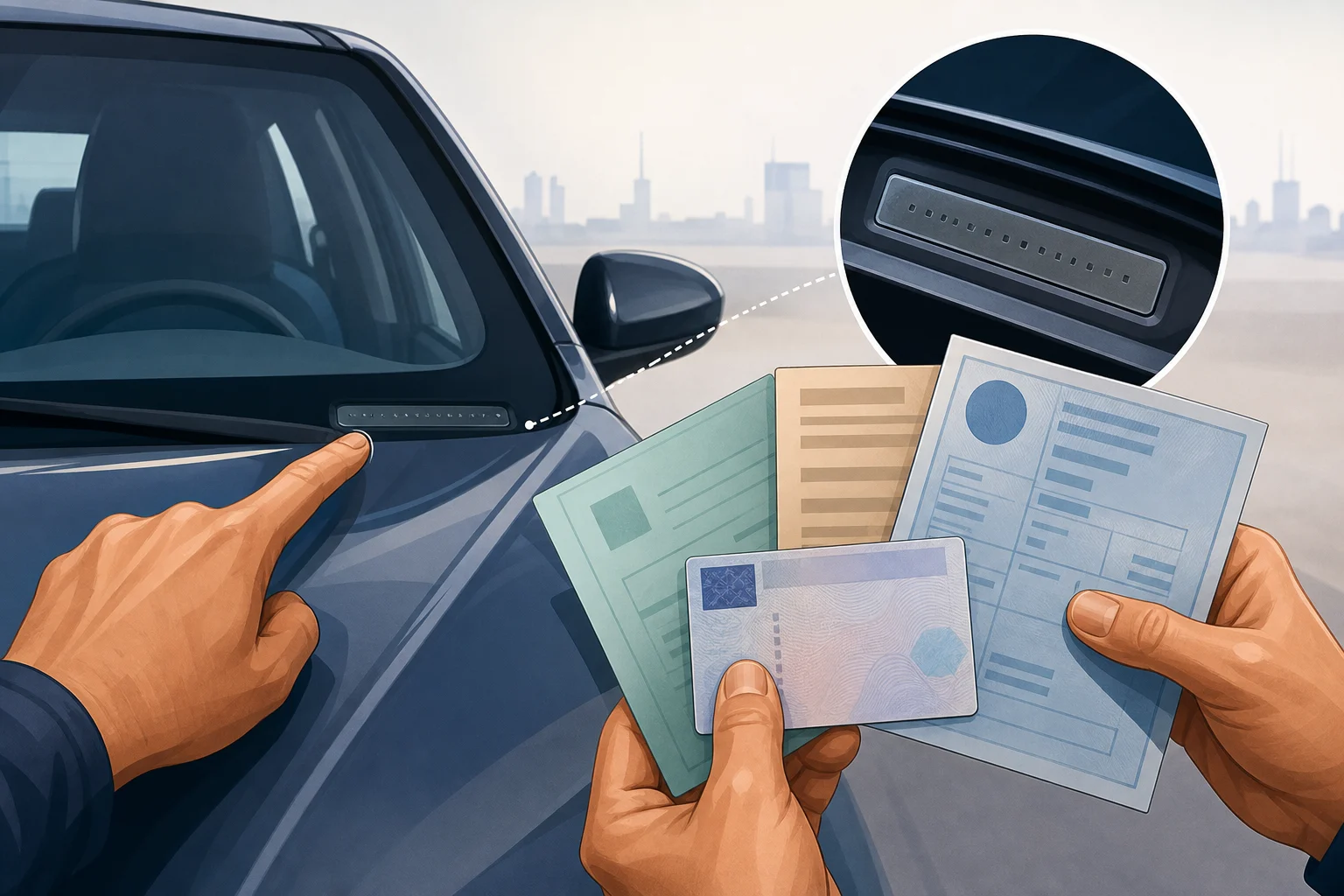
The basic check is to match the vehicle identification number, or VIN, visible on the car against all available documents. Then check that the make, model, date of first registration, fuel, power output, emissions, weights and number of seats match across the advert, the vehicle and the paperwork. A discrepancy does not in itself prove there is a problem, but it does require a documented explanation before you sign.
For a car already registered in Spain, the registration certificate identifies ownership and the ITV card confirms that the vehicle is approved for use on Spanish roads. Check both documents, not just one. The DGT technical data report or full report can help cross-check details when the car is already registered in Spain.
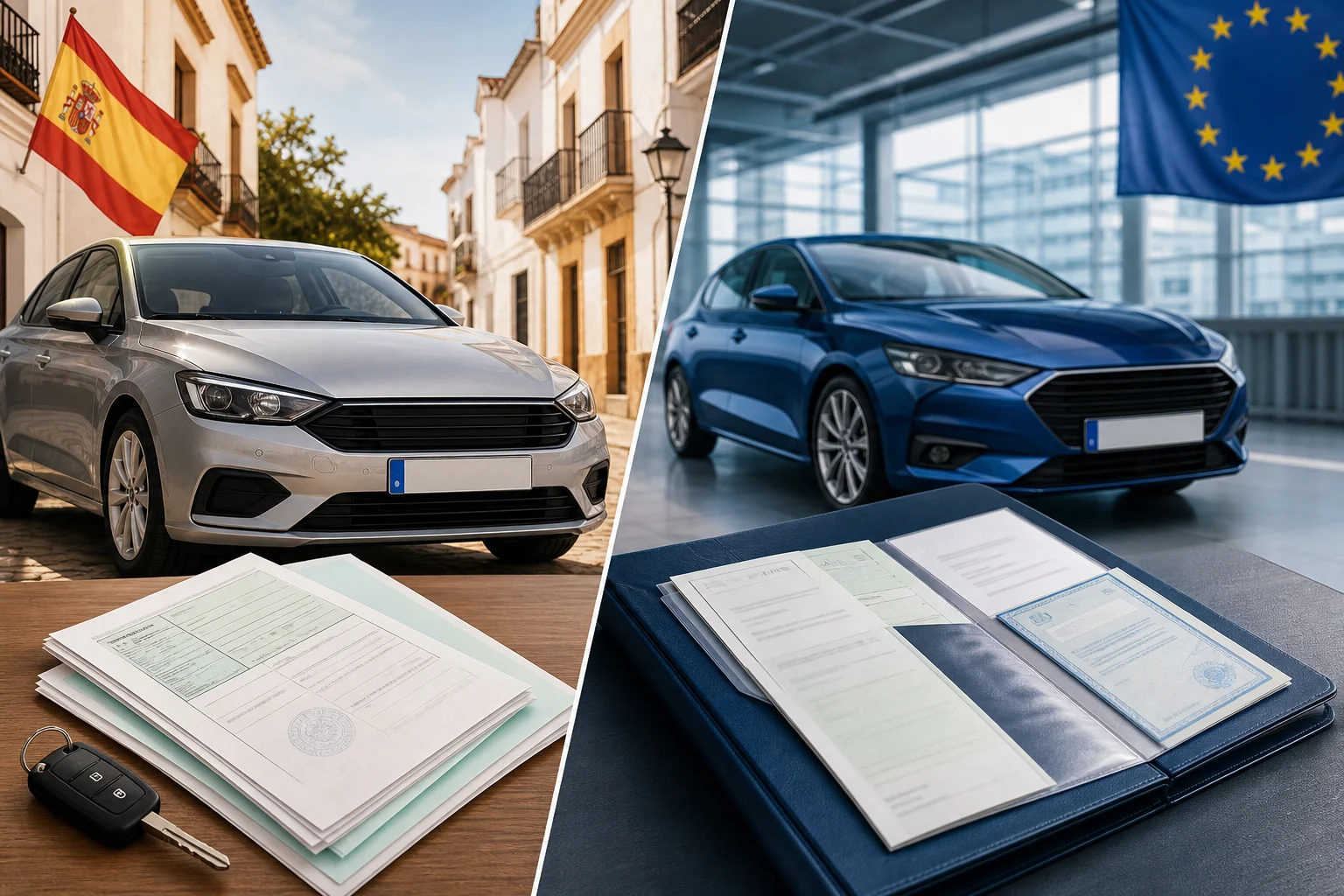
For an EU vehicle awaiting registration, retain the original registration certificate from the country of origin. If that certificate has two parts, the European Commission warns that both must be submitted. The DGT also requires the vehicle’s original paperwork and a document proving ownership. In a private sale, it specifies a translated contract; when buying from a foreign professional seller, the invoice must include its VAT number.
Do not accept the commercial designation in the advert as a substitute for the documents. A trim level may have a different name depending on the market, model year or commercial campaign. Verifiable identity is the combination of VIN and paperwork, not an equipment badge.
Section references: DGT — Matricular un vehículo proveniente de la UE ↗ · DGT — Informe de un vehículo ↗ · DGT — La documentación de un vehículo ↗ · Your Europe — Documentación y trámites para la matriculación de vehículos en la UE ↗
- Ask for readable copies before travelling: registration certificate or permit, Spanish ITV card if one exists, CoC if available, and contract or invoice.
- Check the VIN on the car and on every document; do not rely solely on a registration plate, which may have changed when the car was registered again.
- Ensure the contract states the VIN, price, seller, date and documents handed over.
- If a technical or ownership detail does not match, pause the purchase until the issuing body or seller provides documentary clarification.
History and mileage: useful in Spain, but not complete by definition
When the car has Spanish plates, request a DGT vehicle report before buying. The basic report can reveal issues that may prevent transfer or road use. The full report includes, among other information, ITV history, mileage, number of owners, encumbrances, recall campaigns and available maintenance.
Pay particular attention to encumbrances. The DGT recommends using the full report to check for seizure orders, restrictions, insolvency proceedings or other administrative or judicial encumbrances. Do not mistake a properly registered car for one necessarily free of issues: these are separate checks.
There is a crucial limitation with imports: DGT reports concern vehicles registered in Spain. Therefore, they do not by themselves prove what happened before the first Spanish registration. A Spanish ITV history may begin once the vehicle had already been driven abroad for years; nor does mileage recorded in Spanish registers automatically reconstruct its whole earlier life.
The practical conclusion is straightforward: define the scope of each piece of evidence. Compare the advert’s mileage with available DGT data and with any foreign documents provided by the seller, but do not present Spanish information as a complete European history. If the period before import is decisive to your purchase and is not sufficiently documented, treat the risk as a lack of information, not as favourable certainty.
Section references: DGT — Informe de un vehículo ↗
- Before signing for a Spanish-registered car, consult at least the basic report; use the full report to review history and encumbrances.
- Compare the date of first foreign registration with the date of first Spanish registration.
- Keep the report and mileage documents with the contract.
- Do not assume that the absence of prior damage, use or maintenance is proven just because it does not appear in the Spanish report.
Approval and technical data sheet: the condition that determines whether it can be registered
For an EU car not yet registered in Spain, an authorised ITV station must inspect it to obtain the Spanish technical data sheet. The DGT lists the foreign registration certificate and the European certificate of conformity, known as the CoC, among the required documents; where applicable, a reduced technical data sheet may be used and, for vehicles from before 2002, individual approval.
The CoC deserves a specific check because it is issued by the manufacturer and includes the European type-approval number. If it has been lost, the DGT allows for a duplicate to be requested from the make. Compare it with the car offered for sale: VIN, fuel, power output, emissions, weights and seats are details affecting technical identification and, where relevant, later procedures.
A valid EC certificate of conformity applies across the EU, unless the vehicle has been modified after leaving the factory. Therefore, do not assume that a car with a CoC will automatically resolve the file if it has been altered. Any later modification makes it especially important to compare the CoC, the car’s actual condition and technical paperwork before committing to the purchase.
For a car that already has a Spanish ITV card, the question is no longer how to obtain it, but whether that data sheet, the Spanish registration certificate, the DGT report and the car all match. If the advert refers to a different engine, number of seats or emissions figure, ask for clarification before using those data to compare costs or restrictions.
Section references: DGT — Matricular un vehículo proveniente de la UE ↗ · Your Europe — Documentación y trámites para la matriculación de vehículos en la UE ↗
- Request the original CoC or confirm which documentary alternative will be submitted to the ITV station.
- Check the type-approval number, VIN and key technical details.
- Check whether the vehicle retains its factory configuration; a later modification may require additional checks.
- Do not pay the final amount without knowing which technical paperwork will accompany the car.
The same version name does not guarantee the same car
An imported model may differ in production specification and equipment from a car sold in Spain. Before comparing two adverts by trim level, confirm through the manufacturer’s official technical and commercial documentation for the VIN, model year and market of origin what that specific car came with. This is the defensible way to verify safety equipment, driver-assistance systems, lighting, instrumentation, languages, connectivity and connected services.
Extra caution is needed when using safety ratings as a buying argument. Euro NCAP warns that its ratings apply strictly to specifications offered in Europe and may not apply to models sold under the same name in other regions. Do not extrapolate a score or the list of assistance systems from another version without confirming the exact specification.
Turn this review into a list of the features you genuinely need. Check whether the advertised safety assistants are present and whether the vehicle has the headlights, instrumentation, language and connectivity you expect. For connected services, the issue is not merely whether they appear in a catalogue: you need to confirm compatibility for the market of origin and that individual car.
The common mistake is paying a premium for a Spanish trim level that the car is not. Ask for the official equipment list by VIN or market before finalising the comparison. If the seller does not provide it, assess the car by what can be verified, not by generic extras listed in the advert.
Section references: Euro NCAP — Occupant protection a side issue for some ↗
- Verify by VIN, model year and market of origin, not only by the trim name.
- Prioritise the items that affect your decision: ADAS, lighting, seats, language, navigation and connectivity.
- Do not carry over a Euro NCAP rating from another region or version without checking.
- Record decisive extras in writing and compare them with the manufacturer’s official documentation.
Costs, taxes and the final decision: budget before paying
The advertised price is not the final cost if the vehicle still needs to be registered. Separate the purchase price, transport, registration ITV inspection where applicable, taxes and fees. The DGT requires proof of payment, exemption or non-liability for registration tax using forms 576, 06 or 05, and states that, except for trailers, the amount is linked to the vehicle’s CO₂ emissions.
Do not use an old figure as a final budget. The Spanish Tax Agency (AEAT) centralises information on forms 576, 05 and 06; check there for current rates, tax bases, reductions, exemptions and requirements for your case. Tax evidence also depends on the seller: for a purchase from a private individual in another EU country, the DGT cites a translated contract and ITP transfer tax; if a foreign professional seller is selling the car, it requires an invoice with a VAT number.
Do not plan to drive the foreign vehicle as though it were already registered. The DGT states that it cannot be driven while the process is being completed, except through the temporary routes it details—green plates or valid temporary plates from the country of origin—and always with insurance. Arrange transport, insurance and timing before collecting it.
If the car comes from outside the EU or from a territory excluded from the Union’s customs and tax legislation, the case is different: the AEAT treats it as an import and provides for a DUA customs declaration. Do not extend the requirements for a vehicle from a Member State to that situation.
| Status | Document or check | Purpose | Source that should confirm it |
|---|---|---|---|
| Already registered in Spain | Spanish registration certificate and ITV card | Confirm ownership, approval and consistency of data | Vehicle documents and DGT |
| Already registered in Spain | Basic or full DGT report | Identify issues, available history, mileage and encumbrances | DGT |
| Awaiting registration from the EU | Original foreign registration certificate; both parts if divided | Prove origin and support re-registration | Authority in the country of origin and documents handed over |
| Awaiting registration from the EU | Translated contract or invoice with VAT number | Prove ownership and meet the applicable tax evidence requirement | Seller and DGT |
| Awaiting registration from the EU | CoC, reduced technical data sheet or applicable alternative; ITV inspection | Obtain the Spanish technical data sheet and check technical conformity | Manufacturer, ITV and DGT |
| Any status | Specification by VIN, model year and market | Confirm actual safety equipment, features and connectivity | Manufacturer |
Section references: DGT — Matricular un vehículo proveniente de la UE ↗ · AEAT — Primera matriculación de medios de transporte ↗ · AEAT — Importar un vehículo ↗
- Add up every item before comparing the price with an equivalent already registered in Spain.
- Confirm the tax route according to whether it is a private sale or a purchase from a foreign professional seller.
- Check current amounts and conditions with the DGT and AEAT before signing or transporting the car.
- Ensure it can genuinely be registered and driven legally before arranging collection.
Is an imported car worse than one sold new in Spain?
Not necessarily. The decision depends on whether its identity, available history, approval paperwork and actual specification are sufficiently documented. For an imported car already registered in Spain, the DGT report does not by itself cover the period before its first Spanish registration.
Is a DGT report enough to check the mileage of an imported car?
No. It is very useful for the period in which the vehicle has been registered in Spain, but the DGT limits its reports to vehicles registered in Spain. You must also review available documents from the country of origin and acknowledge any period with no verifiable information.
Which technical document is most important if the car does not yet have Spanish plates?
The CoC is a central document because it includes the European type-approval number and is issued by the manufacturer. Depending on the case, a reduced technical data sheet or, for vehicles from before 2002, individual approval may also be required, in addition to the ITV inspection.
Can I drive the imported car while waiting for Spanish registration plates?
The DGT states that it cannot be driven until it is registered in Spain, except through the temporary routes it specifies, such as green plates or valid temporary plates from the country of origin, and always with insurance.