Scooter drive belt: when to inspect or replace it according to the manual
There is no universal interval for a scooter drive belt. Find out where to check it, how to interpret the service history and what to request before buying a used scooter.
Key points
The date or mileage for inspecting or replacing a scooter’s drive belt is determined by the manual for the specific model. When buying used or dealing with an incomplete history, treat the work as needing confirmation and ask for records showing the date, mileage and details of the service.
The short answer: your scooter manual is the authority
There is no single figure that determines when to replace a scooter drive belt. The valid interval is the one stated in the owner’s and maintenance manual for its specific model, version and market. Piaggio expressly warns that service intervals vary from one vehicle to another and refers owners to the maintenance schedule in the manual.
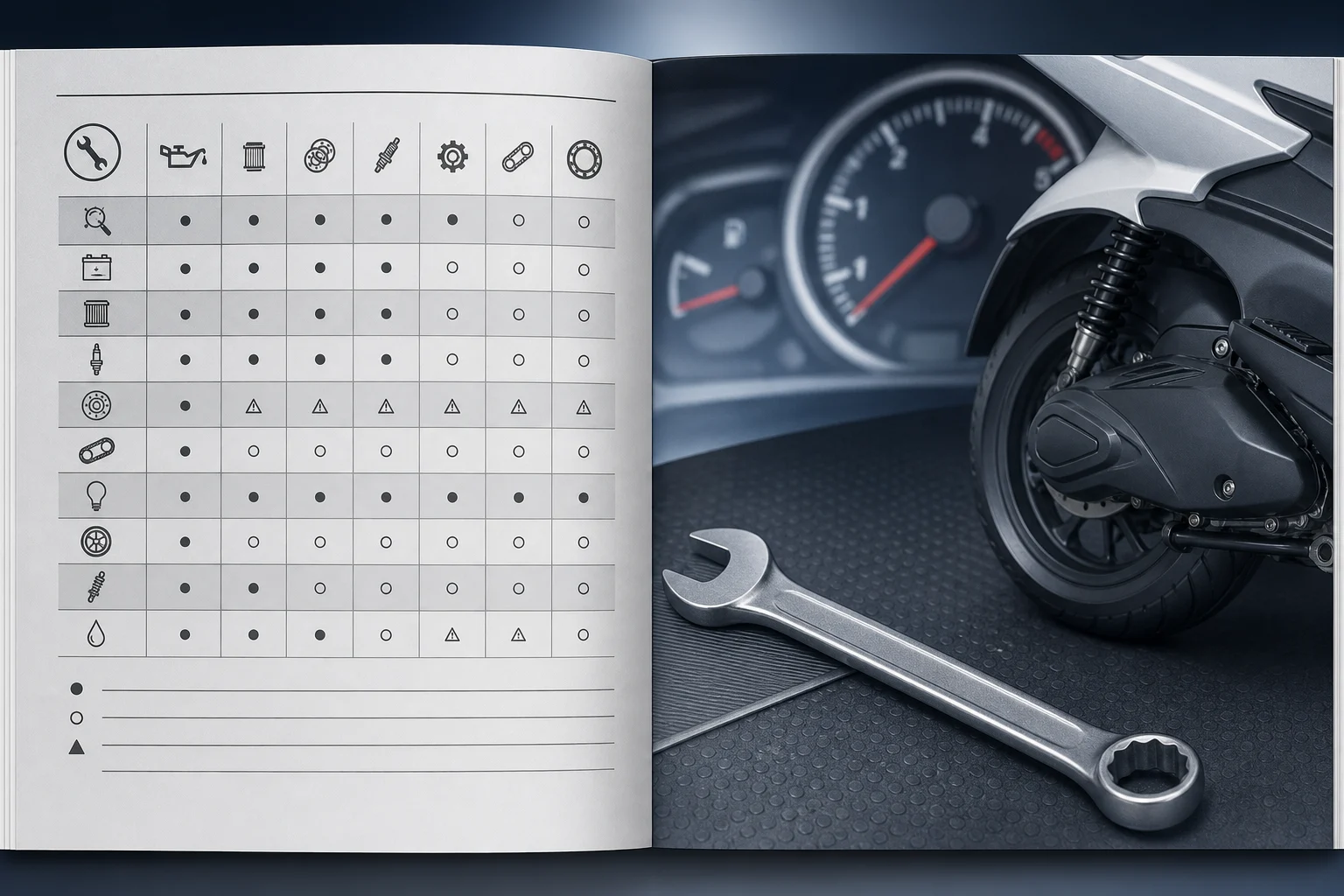
You also need to read exactly what that schedule says. An inspection is not the same as a scheduled replacement: the Honda manuals reviewed use different symbols for “I: inspect” and “R: replace”. Confusing the two operations can lead to replacing a belt early for no reason or, conversely, assuming it has been changed when the documentation only confirms an inspection.
Two official examples show why you should not copy the interval from another scooter. In the Spanish edition of the Honda SH125 manual reviewed, the belt is listed for inspection at 12,000 km, replacement at 24,000 km and inspection at 36,000 km. For the Honda NSC110, the stated schedule is inspection every 8,000 km and replacement every 24,000 km. These are references from specific schedules, not a general recommendation for every motorcycle.
Section references: Manual del propietario Honda SH125 (edición española, PDF) ↗ · Manual del propietario Honda NSC110 (edición española, PDF) ↗ · Mantenimiento programado ↗
- Find the exact manual for your model before using a figure from the internet or another vehicle.
- Check whether the entry states inspection, replacement or both.
- Record both the mileage and the date of the last service: the manufacturer may set time-based conditions as well as distance-based ones.
Which part to look for in the maintenance schedule
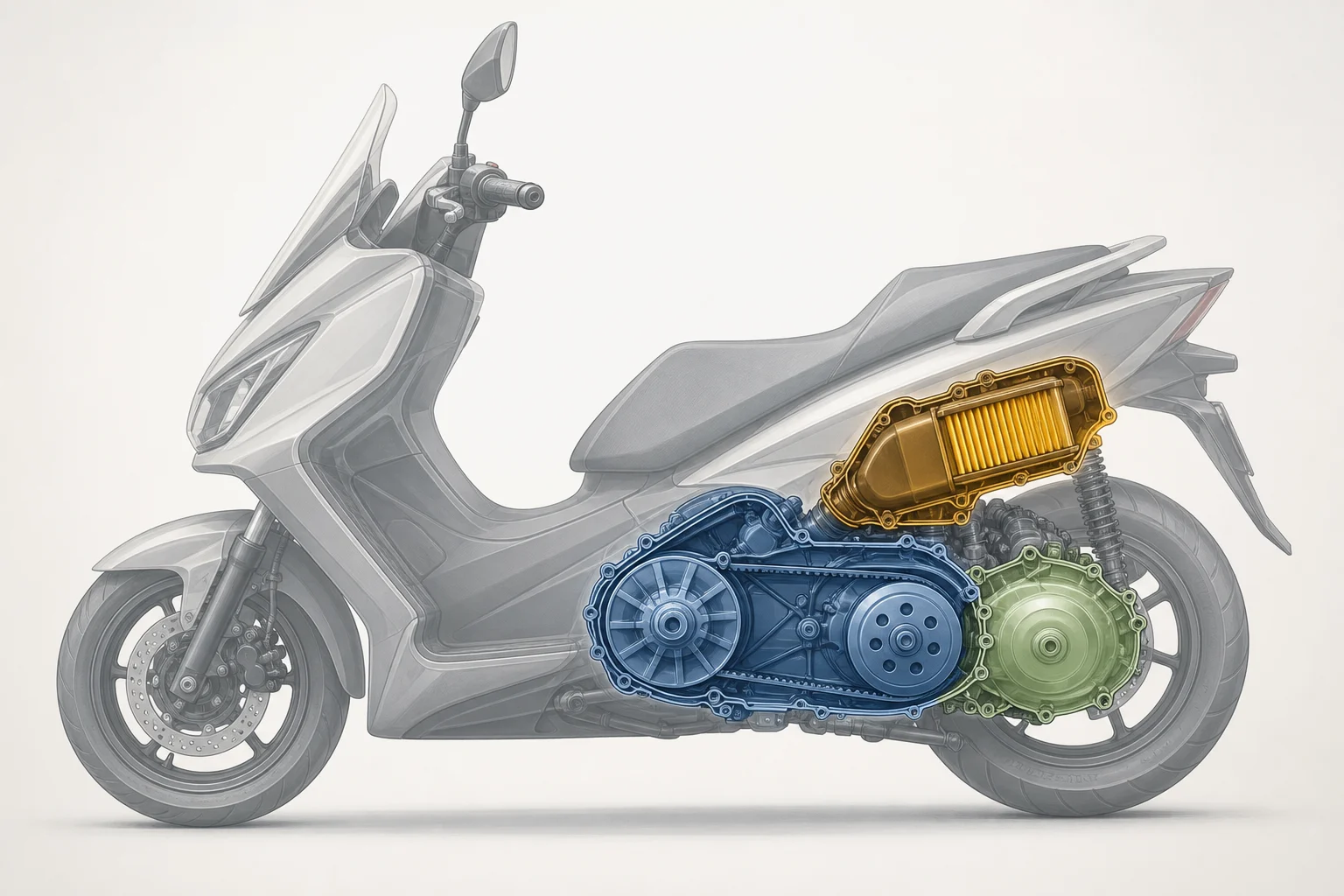
For this query, look for the term “drive belt” or the equivalent wording used by the manufacturer in the scooter’s schedule. Do not confuse it with other items that may appear in the same service plan. In the Honda manuals cited, the drive belt and final drive oil are listed as separate items with independent operations.
It is also important not to mistake a reference to the air filter for the belt housing as referring to the belt itself. A Yamaha manual lists the belt case filter elements separately in its maintenance chart, with their own cleaning and replacement operations. A bill mentioning that filter does not, by itself, prove that the belt was inspected or replaced.
If you compare an automatic scooter with a motorcycle that uses a chain, do not transfer the schedule from one to the other. First identify the system and the exact item named in the manual for the vehicle in front of you. The operation name, date, mileage and model identification are the details that turn a maintenance entry into useful information.
Section references: Manual del propietario Honda SH125 (edición española, PDF) ↗ · Owner’s Manual (scooter Yamaha, PDF) ↗
- Drive belt: check its own line in the manufacturer’s schedule.
- Final drive oil: this is a separate item in the Honda manuals reviewed.
- Belt case air filter: it is not the belt and may have its own interval.
- A chain on another motorcycle: consult that motorcycle’s specific schedule, not that of an automatic scooter.
How to find the applicable interval and record it properly
Start with the owner’s and maintenance manual. Find the scheduled maintenance chart and confirm that it matches the motorcycle exactly: model, version, year or generation where the manufacturer distinguishes them. If the manual provides a mileage-based table, identify the belt line and read the symbol key. If it also specifies a time interval, that interval applies even if the scooter has covered few kilometres; Piaggio states that time intervals must be observed even where the expected mileage has not been reached.
Then gather evidence of the most recent work: a workshop invoice, a physical or digital maintenance book and, where available, the service network record. Piaggio recommends that completed servicing be recorded. A clear entry makes it possible to calculate the next milestone; a general statement such as “service carried out” does not always show whether the belt was inspected or replaced.
Create a simple record for the scooter. It will prevent you from relying on the previous owner’s memory or a conversation with the workshop, and will make it easier to request comparable quotes.
Section references: Manual del propietario Honda NSC110 (edición española, PDF) ↗ · Mantenimiento programado ↗
- Scooter identification: model, version and registration number or VIN, to verify that the document belongs to the vehicle.
- Manual consulted: the applicable edition and maintenance schedule.
- Last documented operation: inspection or replacement, exactly as stated on the invoice or record.
- Date and mileage of the operation.
- Next milestone specified by the manual, including any time-based condition where applicable.
- Documents retained: invoice, stamp or digital record, plus any workshop observations.
Why you should not improvise the interval or the service
The variation between the two available Honda schedules is already enough to rule out a universal inspection pattern. The maintenance schedule for each vehicle sets out what is checked and when. Therefore, daily urban use, typical load or low mileage do not by themselves justify changing an interval: they only help explain why it is especially important to check whether the manufacturer sets additional conditions, including time-based ones.
It is also not advisable to turn this check into an improvised home repair. The Honda manuals reviewed classify the work associated with the belt as intermediate-level maintenance and recommend that it be performed by a dealer, unless you have the necessary tools and technical skills. For the owner, the useful action is to identify the interval, retain records and arrange a professional inspection when it is due.
Consult the manual or a workshop before the next interval if there is a discrepancy in the documentation: the seller claims the belt was changed but provides no invoice; the invoice does not distinguish between inspection and replacement; the recorded mileage does not allow the operation to fit the schedule; or the prescribed date has been reached without reaching the mileage. These are reasons to clarify the maintenance status, not a diagnosis of a fault.
Section references: Manual del propietario Honda NSC110 (edición española, PDF) ↗ · Mantenimiento programado ↗
- Do not bring the schedule forward or delay it based solely on a common figure from another scooter.
- Do not regard a replacement as documented simply because a general service is recorded.
- Do not confuse limited use with the absence of time-based intervals.
- If evidence is missing, ask for a professional assessment and a documented proposal.
Buying used: what to ask for and what decision to make
Before completing the purchase, request the available invoices and check that each includes the date, mileage, workshop identification and a description that distinguishes inspection from replacement. Also ask for the manual, maintenance history and written confirmation from the seller if they say the belt has been changed. That confirmation does not replace an invoice, but it makes the statement being made clear.
In Spain, the full DGT vehicle report can complement this check. Among other details, it includes ITV history, mileage, keepers, outstanding charges, technical data, pending recalls and maintenance available for the vehicle queried. Its limitation is important: the DGT itself specifies that repairs and servicing come from workshops registered with its electronic maintenance book. It should therefore not be treated as a guaranteed complete history of all work carried out.
If there is no documentary proof of replacement, the prudent option is neither to state that the belt is new nor that it is necessarily worn out. Instead, reflect the uncertainty in the purchase decision, confirm the applicable schedule and request an inspection or quote to clarify the maintenance status before making a purchase decision.
| Situation found | What can be concluded | Recommended action |
|---|---|---|
| An invoice identifies a replacement, date and mileage; the information fits the manual | There is specific evidence of the operation, although the next scheduled milestone still needs to be checked | Keep the invoice, note the next mileage and, if applicable, date interval, and follow the manual |
| Only “service” or “maintenance” is recorded, without specifying the belt | It does not establish that the belt was replaced | Ask the workshop or seller for clarification and compare it with the maintenance schedule |
| The seller states that it was replaced, but there is no invoice or verifiable record | There is a statement, not documentary proof of the operation | Request written confirmation, consider a professional inspection and factor that uncertainty into the purchase |
| There is no history, or it does not match the mileage, dates or model | The maintenance status cannot be established with certainty | Consult the correct manual, request a quote and factor the uncertainty into the purchase decision |
Section references: Mantenimiento programado ↗ · Informe de un vehículo ↗
- Invoice showing the date, mileage and exact description of the operation.
- Manual and maintenance schedule for the specific model.
- Available maintenance history and a check that it is consistent with the mileage.
- Full DGT report as a supplementary source, not a replacement for all invoices.
- Written confirmation from the seller when they cannot provide supporting evidence.
Plan the cost with a comparable quote
It is not useful to publish a general figure for this maintenance without tying it to a specific model, date and scope of work. The practical way to control the cost is to request an itemised quote and compare proposals that describe the same operation. Give the workshop the exact model, mileage, date of first registration if it helps identify the version, and the invoices you already have.
Ask for the document to specify whether it covers a scheduled inspection or replacement, which items are included and excluded, part references where appropriate, labour, taxes and the quote’s validity date. If the workshop recommends additional work, ask for it to be listed separately from the operation scheduled in the manual. This will let you distinguish planned maintenance from other work that may require separate assessment.
Keeping that quote with the later invoice completes the scooter’s history. It is especially valuable to the next owner and when comparing one used vehicle with another that has better-documented maintenance.
Section references: Manual del propietario Honda NSC110 (edición española, PDF) ↗ · Mantenimiento programado ↗
- Provide the exact model, mileage and existing documentation when requesting a quote.
- Ask for it to distinguish between inspection and replacement.
- Request included and excluded items, parts, labour, taxes and validity.
- Compare quotes with the same scope, not only the final total.
- Keep the final invoice with the date, mileage and work performed.
How many kilometres before a scooter belt is replaced?
It depends on the model. The official manuals reviewed show different schedules, so do not use one figure as a universal rule. Find the drive belt line in the exact manual for your scooter and distinguish between inspection and replacement.
Does a scooter service prove that the belt was replaced?
Not necessarily. Manuals distinguish between inspection and replacement. Check that the invoice or record specifically states the work carried out, the date and the mileage.
Should I take the date into account even if I ride few kilometres?
Yes, where the manufacturer also specifies a time interval. Piaggio states that prescribed time intervals must be observed even if the expected mileage has not been reached.
Does the DGT report prove all maintenance on a used scooter?
No. The full report may show available maintenance, but the DGT states that repairs and servicing come from workshops registered with its electronic maintenance book. Supplement it with invoices and the seller’s records.
Can I use the interval for a chain-driven motorcycle for my automatic scooter?
That is not a reliable basis. Consult the maintenance item and schedule that apply to the specific vehicle; do not extrapolate a schedule from another system or model.