Which engine oil does your car need? How to check viscosity and approval
The 5W-30 on the container is not enough to choose an oil. Learn how to find the viscosity and, above all, the specification or approval required by your car's manufacturer.

Key points
To find out which oil your car needs, check the exact recommendation in the owner's manual or technical documentation for its version and market. The SAE grade, such as 5W-30, describes viscosity, but it must also match the specification or approval required by the manufacturer.
The quick answer: look for a complete recommendation, not just 5W-30
The reliable way to find out which oil your car needs is to locate a recommendation in its owner's manual, maintenance plan or manufacturer technical documentation that includes two details: the SAE viscosity and the required specification, category or approval. You must then check that both are declared for the product you intend to buy or have fitted.
A grade such as 0W-20, 5W-30 or 5W-40 does not, by itself, identify a suitable oil. The SAE J300 standard classifies engine oils solely in rheological terms, meaning their viscosity behaviour; it does not include the lubricant's other characteristics. The API guide also defines viscosity grade as the ability to flow at specific temperatures and warns that requirements vary by vehicle.
The practical rule is simple: do not replace the manufacturer's recommendation with a visual match between the numbers on the container. If the vehicle documentation requires a particular standard alongside an SAE grade, require both. Ford documentation for a UK-market vehicle, for example, specifies both the WSS-M2C956-A1 standard and SAE 0W-20 viscosity; this illustrates that viscosity and specification must be checked together.
Section references: Clasificación SAE J300 de viscosidad ↗ · Motor Oil Guide 2025 ↗ · Manual oficial Ford, mercado Reino Unido — ejemplo de prescripción conjunta de norma y viscosidad ↗
- First, identify the engine and exact version of the vehicle.
- Then write down the prescribed SAE grade and standard or approval exactly.
- Finally, compare those details with the product declaration or the detailed line on the quote.

Where to check the correct oil and which details to copy
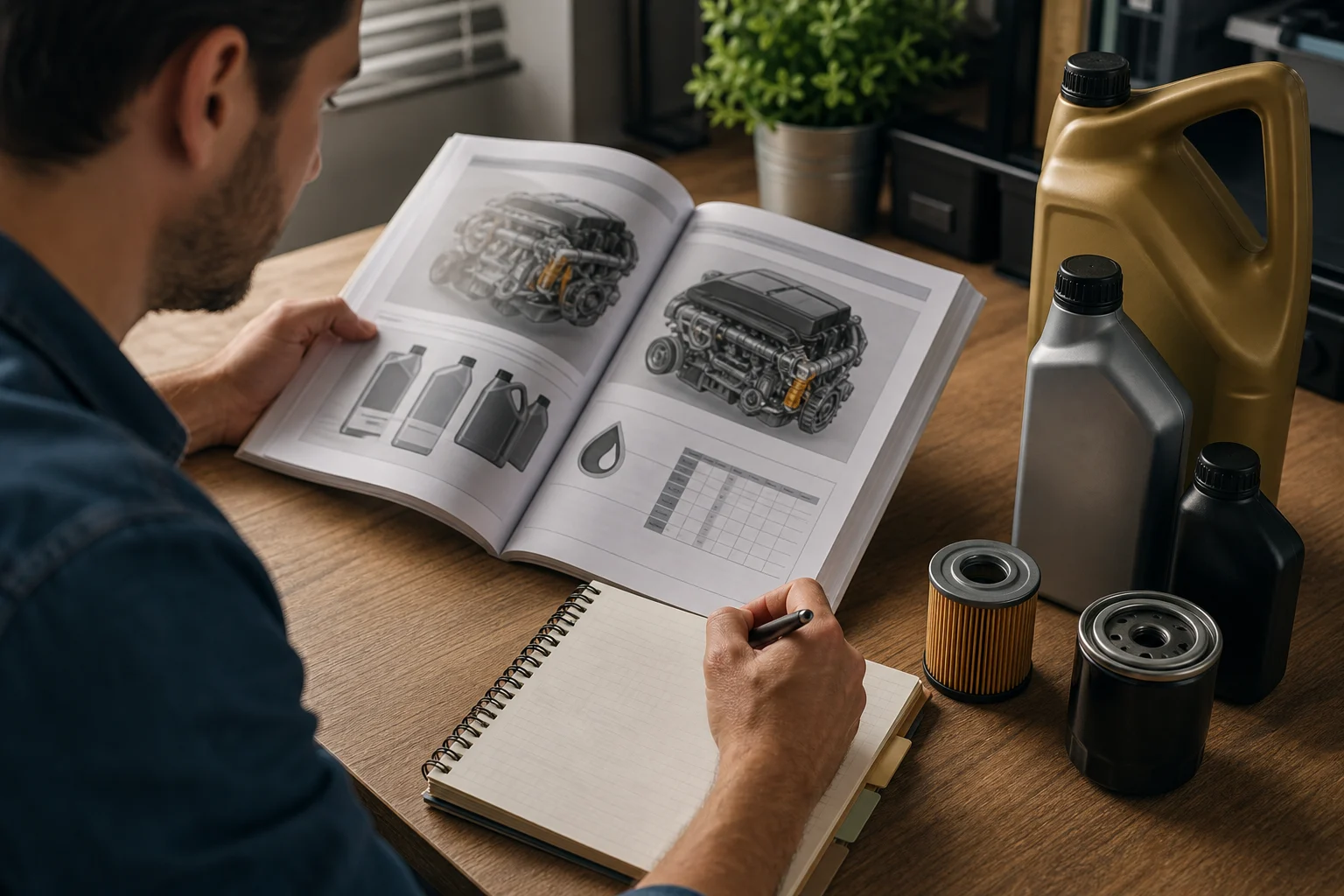
Start with the owner's manual supplied with the car. Look for sections covering maintenance, capacities, fluids or engine oil. If the manual offers several combinations, do not choose one without reading the accompanying conditions: they may depend on the engine, a technical revision or an expressly limited top-up alternative.
The maintenance plan and model-specific technical documentation are useful additional checks, especially for used vehicles whose manual may be generic, incomplete or from another market. The API guide itself recommends following the vehicle manufacturer's guidance on SAE viscosity.
Copy the reference in full, including hyphens, letters and numbers. Also keep the page or a clear photograph of the recommendation. This is a straightforward way to check a purchase in a shop, a workshop proposal or a product you already have in the garage.
Section references: Motor Oil Guide 2025 ↗ · Manual oficial Ford, mercado Reino Unido — ejemplo de prescripción conjunta de norma y viscosidad ↗
- The make, model, version and year of your car.
- Engine type and fuel, as stated in its documentation.
- The prescribed SAE viscosity, for example 0W-20 or 5W-30.
- The exact required standard, category or approval.
- Any notes about alternative uses, quantities or conditions of use.
What SAE viscosity means and its limits
In a multigrade designation such as 5W-30, the SAE grade indicates the oil's flow behaviour at particular temperatures. It is not an overall quality rating or confirmation that the lubricant meets every requirement of a particular engine.
For this reason, it is also incorrect to conclude that all oils with the same grade are interchangeable. Two products may both show 5W-30 and differ in their ACEA category or declared approvals. ACEA sequences, for example, include categories intended for compatibility with after-treatment systems; within class C, C2 and C3 have different minimum HTHS viscosity requirements: 2.9 mPa·s and 3.5 mPa·s respectively.
The common mistake is to stop checking once the large number on the front matches. Use it as an initial filter, never as the final verdict. If the required standard does not match, do not consider the choice valid simply because the SAE grade is identical.
| Detail | What it tells you | What to check against the manual |
|---|---|---|
| SAE 0W-20, 5W-30 or another grade | Viscosity classification or flow behaviour at particular temperatures | That it is exactly the recommended SAE grade. |
| ACEA category | The declared class and category when the product claims to meet ACEA sequences | That it is the required class and category; do not assume categories are equivalent. |
| Manufacturer standard or approval | Technical reference declared for the product | That it matches the complete reference prescribed for the vehicle. |
| Brand name and quantity | Identifies the fitted product and invoiced volume | That they are traceably shown on the quote and invoice. |
Section references: Clasificación SAE J300 de viscosidad ↗ · Motor Oil Guide 2025 ↗ · ACEA Oil Sequences para turismos y vehículos ligeros ↗
- The first number and the letter W form part of the SAE viscosity grade.
- The second number also belongs to that viscosity classification.
- The SAE designation does not itself include the oil's remaining characteristics.
- ACEA C2 and C3 must not be treated as synonyms: the vehicle documentation determines which one applies.
The standard or approval: the detail that makes the final decision
The required specification may be expressed as an ACEA sequence, as a manufacturer-specific standard or by both references. Similar categories should not be interpreted as compatible unless the manual allows it. ACEA specifically warns that an A5/B5 oil may not be suitable for certain engines and refers users to the manufacturer's manual if in doubt.
When checking a container, product data sheet or workshop proposal, look for a specific, complete declaration. If compliance with ACEA sequences is claimed, ACEA documentation requires the class and category to be specified. This allows A5/B5, C2, C3 or other references to be compared with the car's recommendation, but it does not allow one category to be replaced with another based on intuition.
In practice, the acceptance criterion is cumulative: correct SAE grade plus correct specification or approval. It is not enough for the product to be from a well-known brand, advertised as synthetic or apparently intended for the same fuel. The cited Ford documentation also warns of consequences, including damage not covered by warranty, when oils with the designated specifications and viscosities are not used.
Section references: ACEA Oil Sequences para turismos y vehículos ligeros ↗ · Manual oficial Ford, mercado Reino Unido — ejemplo de prescripción conjunta de norma y viscosidad ↗
- Look for the full reference, not a similar family of standards.
- Check that the declaration applies to the specific product, not merely the brand.
- If the SAE grade and approval do not both match, do not buy or authorise the oil until this is clarified.
- Keep the invoice and product reference for future services.
Avoid version errors and check the workshop quote
A single model name can cover different engines, years, markets and revisions. That is why a recommendation found for “the same model” is not sufficient evidence. Always check documentation that applies to your own vehicle, and avoid relying on another owner's experience, a photograph of a previous oil container or a generic search by model.
In Spain, customers are entitled to a written quote. It must include the planned repairs or activities and the itemised total price. In addition, the vehicle identification on the quote includes make, model, registration number and mileage. This information helps you check that the work has been assigned to the correct car before authorising it.
Ask for the oil line to be verifiable: brand, product name, quantity, SAE grade and declared specification or approval. Then check that the invoice retains sufficient detail. The regulations state that it must be written and itemised, including work carried out, parts or items used, and labour hours with the amount for each item.
Section references: Regulación española de talleres: presupuesto y factura ↗
- Check the make, model, registration number and mileage shown on the quote.
- Request the oil's brand name and the planned number of litres.
- Compare the SAE grade and approval with your manual before accepting.
- Do not accept a substitute described only as “equivalent oil” if the technical reference is not declared.
- Check that the invoice details the oil used and the work carried out.
When to stop and ask before topping up or buying
Stop the purchase if the manual and the quote do not match, if the approval is missing, if you can identify only the SAE grade, or if you are not certain the documentation applies to your engine and market. It is preferable to ask the workshop to document the proposed product or to consult the official network or a qualified workshop using the vehicle's exact identification.
Extra caution is also advisable when the manual allows a top-up alternative. Do not turn it into a general rule. In the Ford example for the United Kingdom, a specific alternative is limited to a maximum of 0.5 litres between scheduled service intervals. The existence, type and quantity of an alternative depend on the manufacturer's specific instructions.
The outcome you should seek is not “a similar oil”, but a documented match. This check reduces the likelihood of mixing recommendations from different versions and lets you assess both a one-off purchase and a maintenance quote more confidently.
Section references: ACEA Oil Sequences para turismos y vehículos ligeros ↗ · Manual oficial Ford, mercado Reino Unido — ejemplo de prescripción conjunta de norma y viscosidad ↗
- Manual available and version identified: compare the two required details.
- Manual missing or unclear: request technical confirmation before adding oil.
- Top-up alternative specified: follow its limits and conditions exactly.
- Quote without an identifiable product: request an itemised breakdown before authorising the work.
Is it enough for the oil to be 5W-30 for my car?
No. 5W-30 is an SAE viscosity grade. It must also match the specification, category or approval required by the manufacturer for your vehicle version.
Where can I find the oil approval my car needs?
Look for the recommendation in the owner's manual, maintenance plan or manufacturer technical documentation that applies to your vehicle. Copy the full reference and compare it with the product declaration.
Can I use an ACEA category that is similar to the recommended one?
It should not be assumed. ACEA warns that some categories may not be suitable for certain engines. Follow the category indicated by the manufacturer and seek advice if there is any doubt.
What should an oil change quote include?
In Spain, you can request a written, itemised quote. To check the lubricant, ask for the brand, product, quantity, SAE grade and declared specification or approval, as well as verifying the vehicle identification details.