Road-focused or mixed-use adventure bike: what to check before choosing
A guide to comparing a road-oriented adventure bike with a mixed-use one through specifications, ergonomics, tyres, payload, licence requirements and approval documentation.
Key points
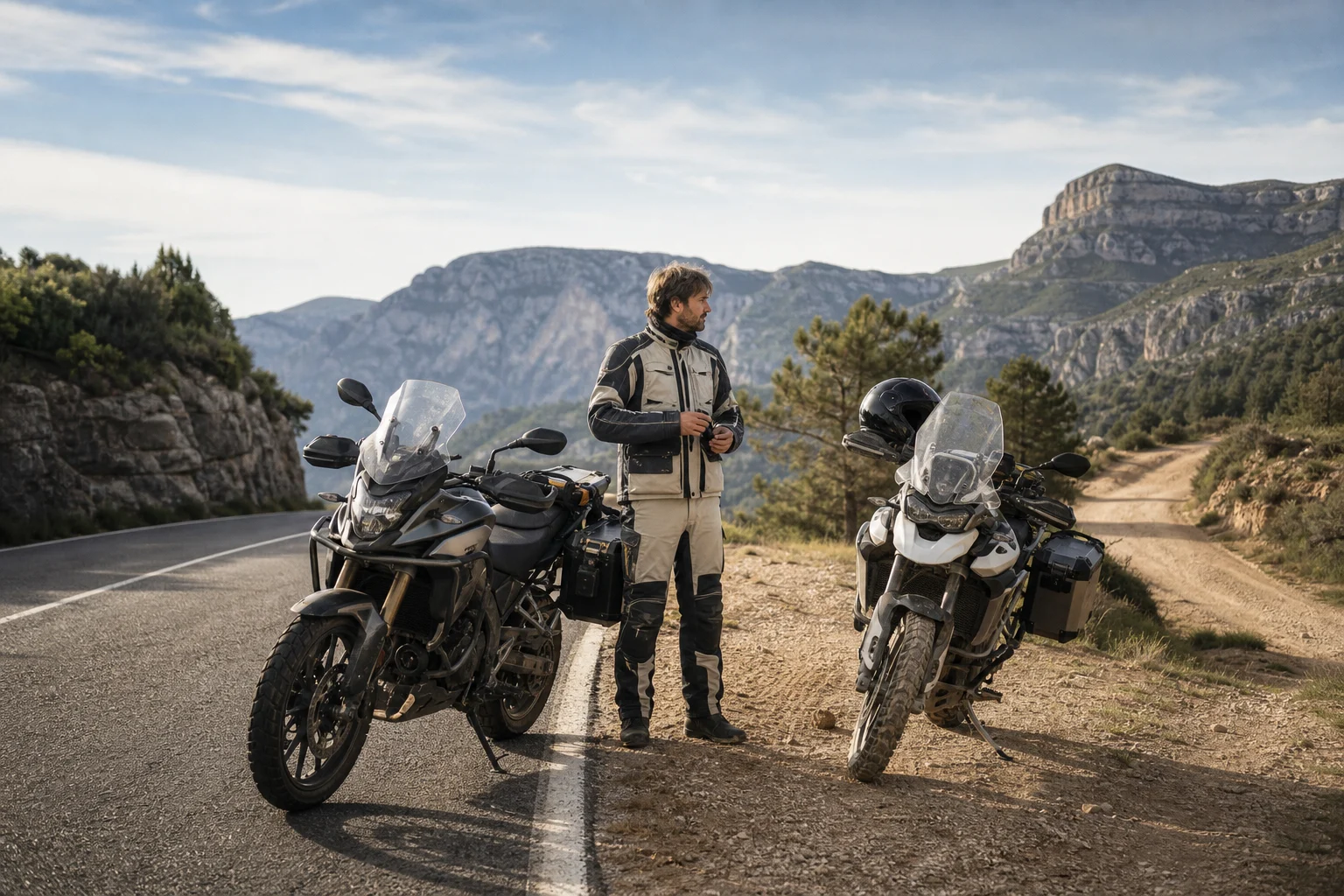
A road-focused or mixed-use adventure bike cannot be reliably identified by appearance: compare wheels, tyres, suspension, dimensions, weight, ergonomics, payload and the approval of the exact version. The right choice starts with your actual routes and your ability to control the bike when stopped, loaded and at low speed.
The short answer: choose according to your riding, not the styling
The terms “road-focused adventure bike” and “mixed-use adventure bike” are commercial labels and do not, on their own, define specific technical characteristics. To compare two motorcycles, check the specifications and documentation for the exact version, as well as the routes you expect to ride.
There is no single figure that settles the purchase. Wheel size, suspension travel, ground clearance and weight must be assessed alongside the rest of the data published for each bike.
It is worth starting with an honest breakdown of your mileage: urban commuting, motorway riding, twisty roads, journeys with a passenger and luggage, and permitted tracks. This list helps you prioritise the specification data and personal checks you need before deciding.
Section references: Reglamento (UE) 168/2013, homologación de vehículos de categoría L ↗ · Honda XL750 Transalp: especificaciones y precio (mercado español) ↗ · Yamaha Ténéré 700 Rally: ficha 2026 en español ↗
- Do not choose based only on the look of spoked wheels, a skid plate or aggressive tyre tread.
- Always compare the same generation, version and market.
- Make a list of the three situations that will account for the most miles, not your aspirational uses.
“Adventure bike” is a commercial label, not a type-approval category
Under European regulations, L3e designates a two-wheeled motorcycle. “Adventure bike” is not a type-approval subcategory that guarantees a particular suitability for road riding, unpaved surfaces or touring. As a result, two motorcycles marketed as adventure bikes can have very different dimensions, weights, tyres and riding positions.
The specification sheet is the basis for comparison, but you must also identify how each figure is expressed. In the European framework, mass in running order includes fluids, standard equipment and at least 90% of fuel capacity. This definition is useful for avoiding comparisons between a weight declared under one criterion and another measured differently.
For the approved version, figures include mass in running order, technically permissible maximum mass and maximum loads per axle. Ask the seller for the documentation corresponding to the bike being offered, and do not automatically apply figures from a Rally edition, an A2-restricted version or a model from another country.
Section references: Reglamento (UE) 168/2013, homologación de vehículos de categoría L ↗ · Reglamento Delegado (UE) 44/2014, masas y dimensiones ↗ · En moto: permisos de conducción ↗
- Note the model, model year, trim level and power output of the bike you are buying.
- Keep mass in running order, maximum mass and luggage separate: they are not interchangeable figures.
- If you hold an A2 licence, check the specific version: the limit is 35 kW and 0.2 kW/kg; it must also not be derived from a motorcycle with more than twice that power.
The measurements you should read together
Start with the wheel and tyre specifications documented for the exact version. Size alone is not enough: also note the load index and speed rating. In Spain, tyres must have the dimensions and characteristics specified by the manufacturer in the type approval or be equivalent under the applicable regulations. Do not assume that a size from another adventure bike, even if it looks similar, is valid for yours.
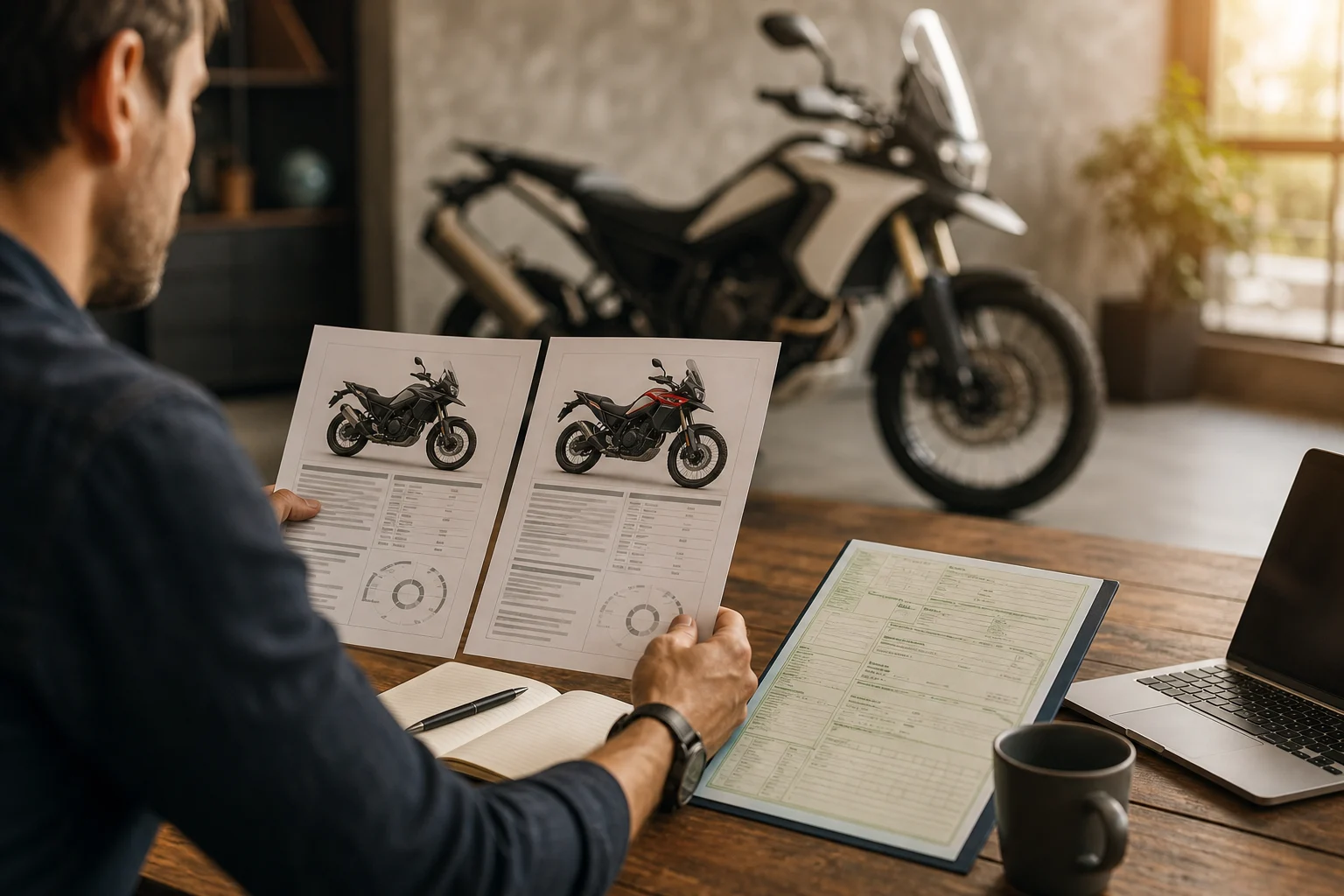
Then check the front and rear suspension travel, ground clearance, wheelbase and mass in running order. Compare these between bikes identified with the same level of detail and according to the mass definition stated on each specification sheet.
Two documented examples show why you need to examine the whole specification sheet. The Honda XL750 Transalp sold in Spain states 21- and 18-inch wheels, 178 and 190 mm of travel, 210 mm of ground clearance, an 850 mm seat height, a 1,560 mm wheelbase and 216 kg in running order. The 2026 Yamaha Ténéré 700 Rally also states 21- and 18-inch wheels, but 230 and 220 mm of travel, 255 mm of ground clearance, a 910 mm seat height, a 1,595 mm wheelbase and 210 kg with oil and fuel tanks full. The figures differ and must be checked against the documentation for each bike.
| Item | Details worth recording | What to check |
|---|---|---|
| Wheels and tyres | Full wheel and tyre sizes | Size, load index, speed rating and legal equivalents |
| Suspension and ground clearance | Front and rear travel, and stated ground clearance | That the figures correspond to the version and market being compared |
| Weight and wheelbase | Stated weight and wheelbase | The mass definition used and the full dimensions |
| Ergonomics and payload | Seat height, maximum mass and maximum axle loads | Documentation for the bike, seat and planned accessories |
Section references: Reglamento Delegado (UE) 3/2014, instalación de neumáticos ↗ · Reglamento General de Vehículos consolidado ↗ · Honda XL750 Transalp: especificaciones y precio (mercado español) ↗ · Yamaha Ténéré 700 Rally: ficha 2026 en español ↗
- Record the size of both rims and the full specification of each tyre before looking for alternatives.
- Compare seat height, ground clearance and weight with the other specification data.
- Check what information the manufacturer publishes for the version you are considering.
Ergonomics: the specification sheet starts to make sense when you sit on it
Seat height is a specification figure that should be checked in person on the specific bike. Before deciding, also review the available seat options and the documentation applicable to that version.
Assess the stationary motorcycle safely, and do not try to hold, lift or move it if you cannot control it safely.
If you plan to travel with a passenger or luggage, check the available space and compatibility of the planned accessories with the dealership. Use this assessment as a personal check that complements the published data.
Section references: Honda XL750 Transalp: especificaciones y precio (mercado español) ↗ · Yamaha Ténéré 700 Rally: ficha 2026 en español ↗
- Go wearing the equipment you would normally use.
- Ask about the seat options available for that version and confirm their documented compatibility.
- Do not attempt to hold or move the bike if you cannot control it safely.
Match the bike to your routes, payload and legal limits
To compare options, identify where you park, your urban journeys, motorway riding, secondary roads, passenger, luggage and permitted tracks that form part of your use. Then compare that list with the specifications and documentation for each version.
Payload is not calculated by adding up the litres of the cases. It must comply with the technically permissible maximum mass and maximum axle loads documented for that version. Before buying accessories, consult the documentation from both the accessory manufacturer and the motorcycle manufacturer: a modification after registration that adds, replaces, alters or removes components may require approval and inspection. The DGT refers to the Vehicle Modifications Manual; the Ministry page cited here identifies Revision 7 as applicable from 1 November 2022.
Finally, an adventure bike does not grant general permission to ride in woodland or open countryside. Spain’s autonomous communities determine the conditions for motor vehicles using tracks outside the road network. The Forest Act classifies riding outside roads, paths, tracks or other usable infrastructure as an infringement, unless expressly authorised. Plan only permitted routes and consult the applicable regional regulations.
Section references: Reglamento Delegado (UE) 44/2014, masas y dimensiones ↗ · Modificación y reformas de un vehículo ↗ · Reglamentación y homologación de vehículos ↗ · Ley 43/2003, de Montes, texto consolidado ↗
- Calculate payload with rider, passenger, luggage and accessories, not just empty cases.
- Before fitting crash bars, mounts, an exhaust, a seat or different wheels, verify their exact application and modification requirements.
- Check the legality of every track and do not leave usable roads, paths or tracks without express authorisation.
Final checklist before signing
Finish the comparison with documents and a static check, not the commercial label. Ask for the specification sheet and manual for the exact version, keep any conditions concerning tyres, accessories or restriction in writing, and verify that the displayed bike matches what is being offered. If an answer depends on a modification, do not treat it as valid until you know how it fits the documentation.
Prioritise the most frequent scenario when ranking your options. For any planned accessory or modification, first check its application to the specific motorcycle and the relevant documentation requirements.
Section references: Reglamento (UE) 168/2013, homologación de vehículos de categoría L ↗ · Reglamento General de Vehículos consolidado ↗ · Modificación y reformas de un vehículo ↗
- Identify the version, model year, market and A2 status where applicable.
- Check mass in running order, technically permissible maximum mass and maximum axle loads.
- Compare the fitted wheels and tyres with the authorised dimensions and characteristics.
- Check the seat, handlebars, footpegs and reach to the ground while wearing your equipment.
- Ask about compatibility and procedures for every planned accessory.
- Decide based on your actual routes, including passenger, payload, garage and legally permitted tracks.
Does a 21-inch front wheel make a motorcycle a mixed-use adventure bike?
No. The term “adventure bike” is not a European type-approval subcategory. A 21-inch wheel must be assessed alongside the other data published for the specific version; two motorcycles with 21- and 18-inch wheels can state different figures.
Can I fit any similar tyre size to my adventure bike?
No. In Spain, tyres must comply with the dimensions and characteristics specified in the vehicle’s type approval, or with their equivalents under the applicable regulations. Check the size, load index and speed rating for the specific version.
What should I check if I travel with a passenger and panniers?
Check the technically permissible maximum mass and maximum axle loads for the version, as well as passenger accommodation and accessory compatibility. Knowing the luggage capacity in litres is not enough.
Does an adventure bike allow me to ride on any forest track?
No. Spain’s autonomous communities set the conditions for using tracks outside the road network. In addition, riding outside roads, paths, tracks or other usable infrastructure is classified as an infringement unless there is express authorisation.