Professional inspection drones: regulations and checks before using them
Before hiring or buying professional inspection drones, it is worth separating three areas: what EASA/AESA regulations allow, which documents the operator must provide and what technical deliverable is actually needed.
What a professional drone inspection is
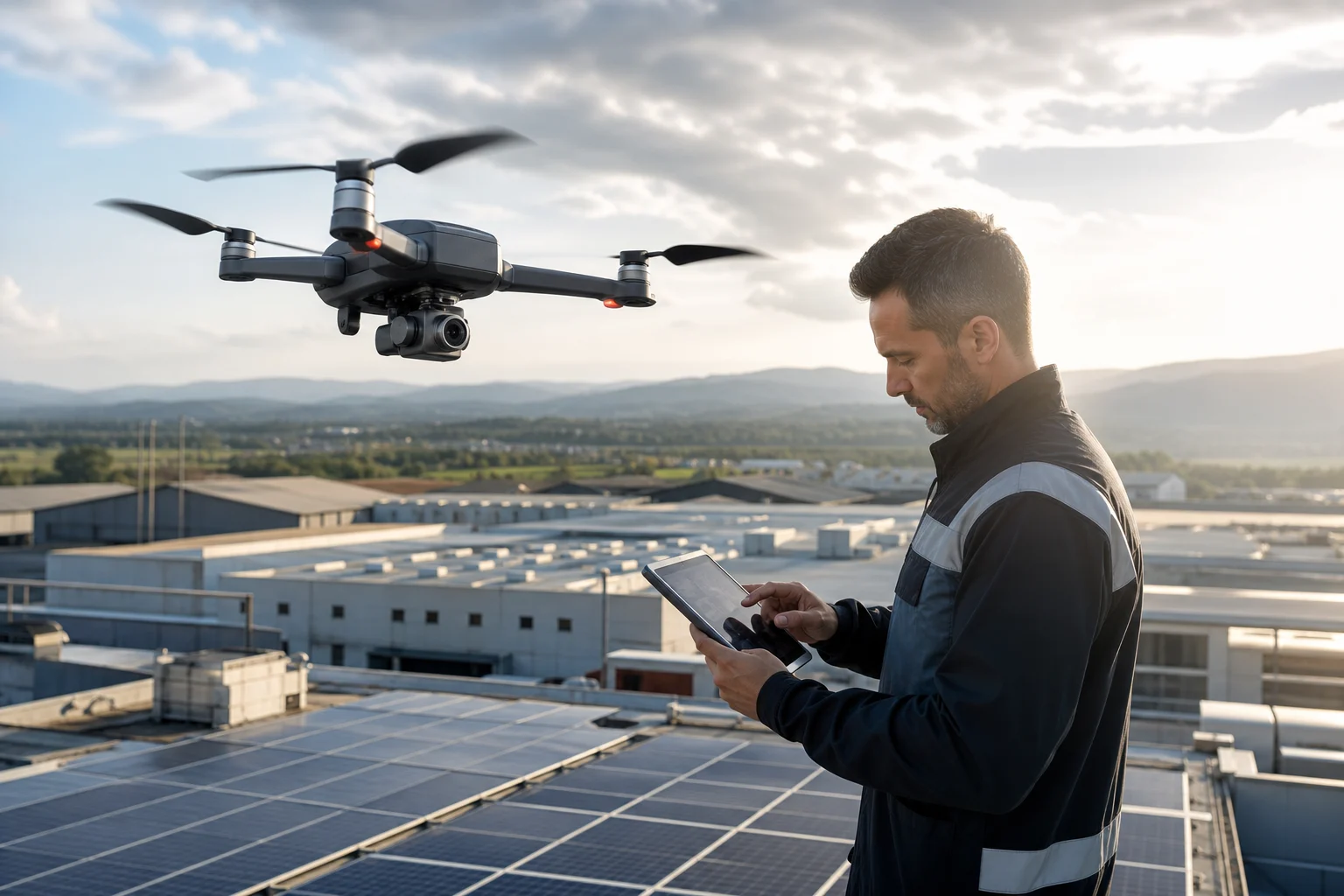
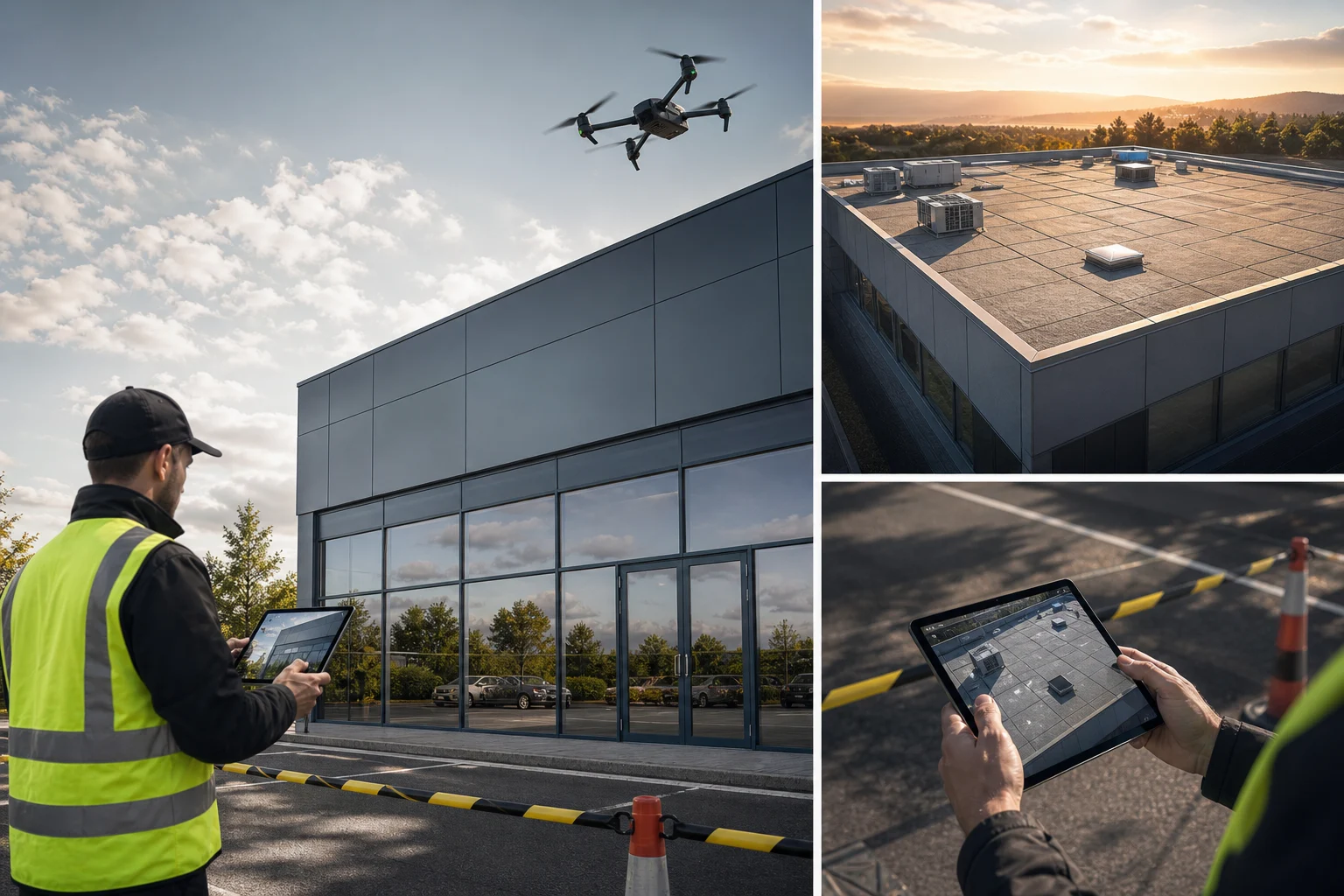
In practical terms, a professional drone inspection is a UAS operation aimed at observing, recording and visually documenting an asset: roofs, facades, solar panels, towers, chimneys, civil works, claims, industrial facilities or hard-to-access areas. Its value lies in reducing physical travel, obtaining an elevated view and generating graphic evidence for maintenance, appraisal or work planning.
From a regulatory point of view, the important factor is not whether the flight is recreational or business-related, but the risk of the operation. EASA includes the open category within low-risk operations, even for certain commercial activities. Therefore, a simple inspection may fit into the open category if it complies with all its limits, while another apparently similar one may fall into the specific category because of the environment, proximity to people or the conditions of the area.
For a company, a residents’ association or an insurer, the first question should not be “which drone are you bringing?”, but “what operation are you going to carry out and under which regulatory framework?”. That answer determines training, documentation, authorizations, insurance, equipment choice and the feasibility of the job.
- Common uses: roofs, solar panels, facades, towers, civil works and visual appraisals.
- A drone inspection does not in itself replace a destructive or instrumental technical inspection if one is necessary.
- The result must be defined as a visual inspection when only images, videos or observation-based reports are delivered.
EASA/AESA framework: operator, pilot and owner are not the same
In Spain, the operational reference is the European EASA framework, applied by AESA as the national authority. Implementing Regulation (EU) 2019/947 establishes the system of operational categories and registration for UAS operations.
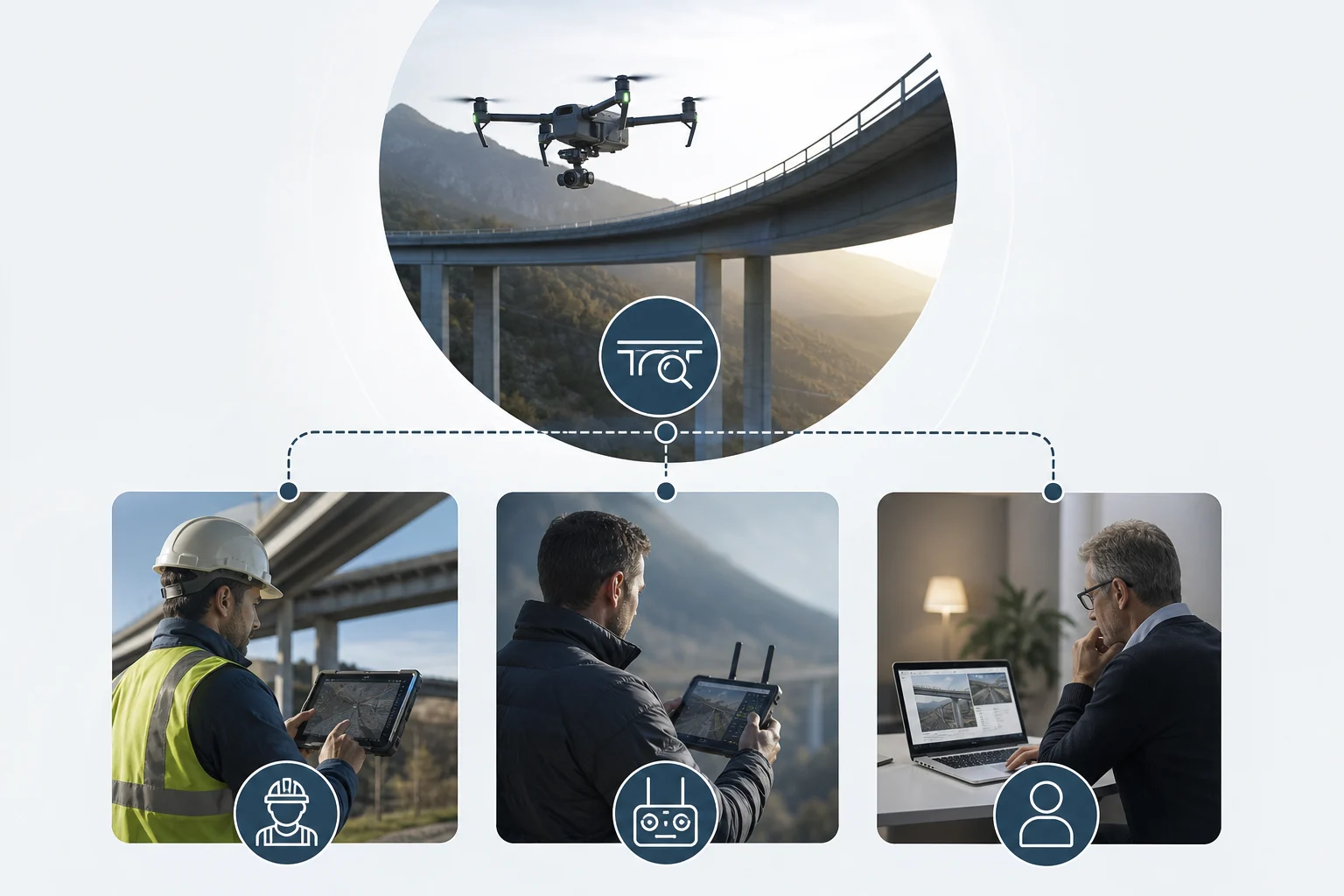
A common source of confusion is mixing up three figures. The UAS operator is the natural or legal person who uses or intends to use one or more drones. This may be an inspection company, a self-employed professional or an entity that organizes its own flights. The remote pilot is the person who controls the UAS during the operation. The owner may or may not be the same as the operator; European regulations distinguish between operator registration and, for unmanned aircraft whose design is subject to certification, aircraft registration by its owner.
In the open category, an operator established in Spain must register with AESA if they use a UAS of 250 g or more, if the equipment can transfer more than 80 J, or if it incorporates a sensor capable of capturing personal data, unless it is a toy compliant with Directive 2009/48/EC. In the specific category, AESA requires operator registration regardless of the aircraft’s mass. In addition, the operator registration number must be displayed on each unmanned aircraft that meets the registration conditions.
- Always ask to identify the UAS operator responsible for the job.
- Do not assume that the owner of the drone is the operator or that the operator will be the person flying it.
- Check that the operator number corresponds to the entity contracted or declared for the operation.
Open or specific category: risk decides, not the budget
The open category covers low-risk operations. AESA indicates that, if its conditions are met, it does not require operational authorization or a prior declaration before the flight. This category is divided into A1, A2 and A3, each with its own operational and training requirements. For the customer, this means it is not enough to ask whether the pilot “has a license”: you need to know in which subcategory they intend to operate and whether the planned flight meets the conditions of the open category corresponding to its class, the environment and the presence of uninvolved people.
The drone’s subcategory and class greatly affect feasibility. A C0 drone or a privately built drone weighing less than 250 g can operate in A1, but it cannot fly over assemblies of people; in the C0 case, it must remain below 120 m above the ground. A C2 falls under A2 and must not overfly uninvolved people; it must maintain 30 m horizontally, reducible to 5 m with low-speed mode activated. C3 and C4 drones in the open category fall under A3 and must maintain 150 m horizontally from uninvolved people and urban areas.
When an operation does not meet the requirements of the open category, it falls into the specific category. AESA describes this as medium-risk operations that cannot be carried out in the open category. In that case, operational authorization is required, unless the operation complies with a standard scenario or the operator has an LUC with appropriate privileges. Since January 1, 2024, declarations of conformity with European standard scenarios STS-01 and STS-02 may be submitted in Spain. STS-01, for example, covers VLOS operations over a controlled ground area in a populated environment with a class C5 UAS.
- A roof in an urban area may require a different analysis from an isolated facility.
- A lightweight drone does not automatically authorize flight near people or in any area.
- Review the planned environment using specific data: uninvolved people, assemblies of people, urban areas and applicable distances.
- If the job does not fit into the open category, there must be an applicable declaration, authorization or privilege in the specific category.
Documentation to request before hiring
Before awarding a drone inspection contract, the professional buyer should request basic documentation consistent with the type of operation. For the open category, AESA lists minimum documentation that includes an operator registration certificate or proof of registration, A1/A3 and A2 pilot training certificates where applicable, an insurance policy where applicable and procedures if the operator has more than one remote pilot.
The check should not be limited to receiving a PDF. It is worth verifying that the documents are in the name of the operator that will provide the service, that the declared training matches the planned subcategory and that the insurance, where applicable, corresponds to the activity and the work period. If the operator states that the operation is specific, ask for the standard scenario declaration, the operational authorization or the LUC reference with the corresponding scope.
It is also essential to review the planned flight environment and the applicable operational conditions in advance. For a residents’ association or an industrial facility, this point is as important as the camera: if the job cannot be carried out within the declared category and conditions, the inspection may not be feasible on the proposed date.
- Minimum checklist: operator registration, pilot training, insurance where applicable and operational fit.
- If there are several pilots, request the operator’s procedures when they are required.
- Ask for evidence of the prior review of the environment and operating conditions before setting the day and time of the job.
- In the specific category, require the applicable declaration, authorization or privilege, not just a commercial promise.
What to look for in the drone: class, camera and suitability for the job
When buying or hiring professional inspection drones, the first technical feature with regulatory effect is the class marking. EASA indicates that UAS marketed for the open category must operate with C0 to C4 marking, be privately built or be unmarked only if they were placed on the market before December 31, 2023. For a drone with class marking, EASA recommends checking that the class identification is on the drone body and that there is an EU Declaration of Conformity. Official C0 to C6 labels are based on Delegated Regulation (EU) 2019/945 and must not be replaced by similar unofficial designs.
Next comes suitability for the inspection. Regulations do not make a camera useful for every job: you have to define what needs to be delivered. To check a roof, a well-stabilized general image may be enough; to document cracks, facade elements or the condition of solar panels, the customer may need more detail, zoom or shots from several angles. The right approach is to agree on the level of visual evidence beforehand, not discover later that the images do not support decision-making.
Autonomy, available batteries, image stability, environmental resistance declared by the manufacturer, filing system and declared redundancies must also be assessed. The point is not to demand the largest drone, but the equipment that makes it possible to operate legally in the planned category and deliver useful images without forcing the operational fit. In many urban inspections, heavier equipment can worsen restrictions if it requires moving from the open to the specific category or maintaining distances incompatible with the objective.
- Check class marking and the EU Declaration of Conformity when applicable.
- Define the result: general photos, detail, video, visual report or file traceability.
- Do not choose only by autonomy or size; weight and class affect operational fit.
- Be wary of unofficial class labels or drones without clear marketing documentation.
Data, privacy and delivery of the job
A visual inspection may capture images unrelated to the objective of the job, such as people, number plates, neighboring homes or private areas. For that reason, as a good professional practice, the assignment should specify how capture will be limited, who will receive the files and how long they will be kept.
In residents’ associations, industrial facilities or insured claims, it is advisable to delimit the inspected area, inform the relevant parties and avoid images unrelated to the purpose of the job. The operator must be able to explain how they manage files, how they deliver the material and what measures they take to avoid disseminating unnecessary images. For the customer, traceability matters: date, location, inspected asset and a clear link between each image and the point observed.
The technical limits of the report must also be established. A visual drone inspection can document signs, apparent damage or points requiring review, but it does not in itself prove what cannot be observed. If the report will be used for maintenance, insurance or contracting repairs, it should distinguish between observed images, visual conclusions and recommendations for additional review.
- Define the capture perimeter and the use of the images.
- Request an organized delivery: files, date, location and description of each inspected area.
- Prevent the visual report from promising diagnoses that cannot be supported by images alone.
Costs and common mistakes when planning an inspection
It is not possible to set a universal rate based solely on regulations. The real cost depends on buying or renting the equipment, batteries, maintenance, image management or processing software, pilot training, insurance where applicable, document preparation and the time spent reviewing the conditions of the operating environment. In the specific category, the administrative burden may be greater than in a simple open operation.
For a company evaluating whether to buy its own drone, the mistake is looking only at the equipment price. It must budget for training, registration as an operator where applicable, internal procedures if there are several pilots, renewal or management of insurance where applicable, file storage and planning time. For those hiring a third party, the cost should be compared against the documentation, legal fit and quality of delivery, not only the number of photos promised.
The most common mistake is believing that a sub-250 g drone can fly anywhere. That is not the case: it may be subject to registration if it incorporates a sensor capable of capturing personal data, and it cannot overfly assemblies of people. Another mistake is confusing recreational use with professional use; the key remains the category and the risk. A third is hiring without verifying whether the planned flight fits into the declared category, which can turn an apparently simple inspection into a limited or unfeasible operation.
- Before buying: define typical operations, usual environments, likely category and necessary documentation.
- Before hiring: request registration, training, insurance where applicable and operational fit.
- Before accepting the report: check that the images are sufficient, dated and traceable.
- Do not base the decision only on the drone being small, modern or fitted with a good camera.
Can a drone weighing less than 250 g be used freely for professional inspection?
No. Although a C0 or privately built drone weighing less than 250 g can operate in A1, it cannot fly over assemblies of people. In addition, in Spain the operator must register if the UAS incorporates a sensor capable of capturing personal data, unless it is a toy compliant with Directive 2009/48/EC.
Is AESA authorization always needed for a drone inspection?
Not always. In the open category, if all its limits are met, AESA indicates that no operational authorization or prior declaration is required. If the operation does not fit into the open category, it moves to the specific category and may require authorization, a standard scenario declaration or an LUC with appropriate privileges.
What documents should a residents’ association or company request before hiring?
At a minimum, operator registration, pilot training appropriate to the operation, an insurance policy where applicable, procedures if the operator has more than one remote pilot and verification that the job fits into the declared category. In the specific category, also the applicable authorization, declaration or privilege.
Does C0-C6 marking guarantee that the drone is suitable for any inspection?
No. Class marking helps fit the UAS into certain operational requirements, but it does not guarantee that the camera, zoom, stability or data delivery are sufficient for the job. The EU Declaration of Conformity must also be checked where applicable.
Is a visual drone inspection equivalent to a full technical diagnosis?
Not necessarily. It serves to visually document signs, apparent damage or areas requiring review, but its conclusions must be limited to what is observable in the images. If measurement, testing or physical access is required, this must be indicated as an additional review.