Regenerative braking on trains: when energy is recovered
What happens to the electricity generated when a train brakes, and why recovering it depends on the grid, other trains and the equipment installed.
Key points
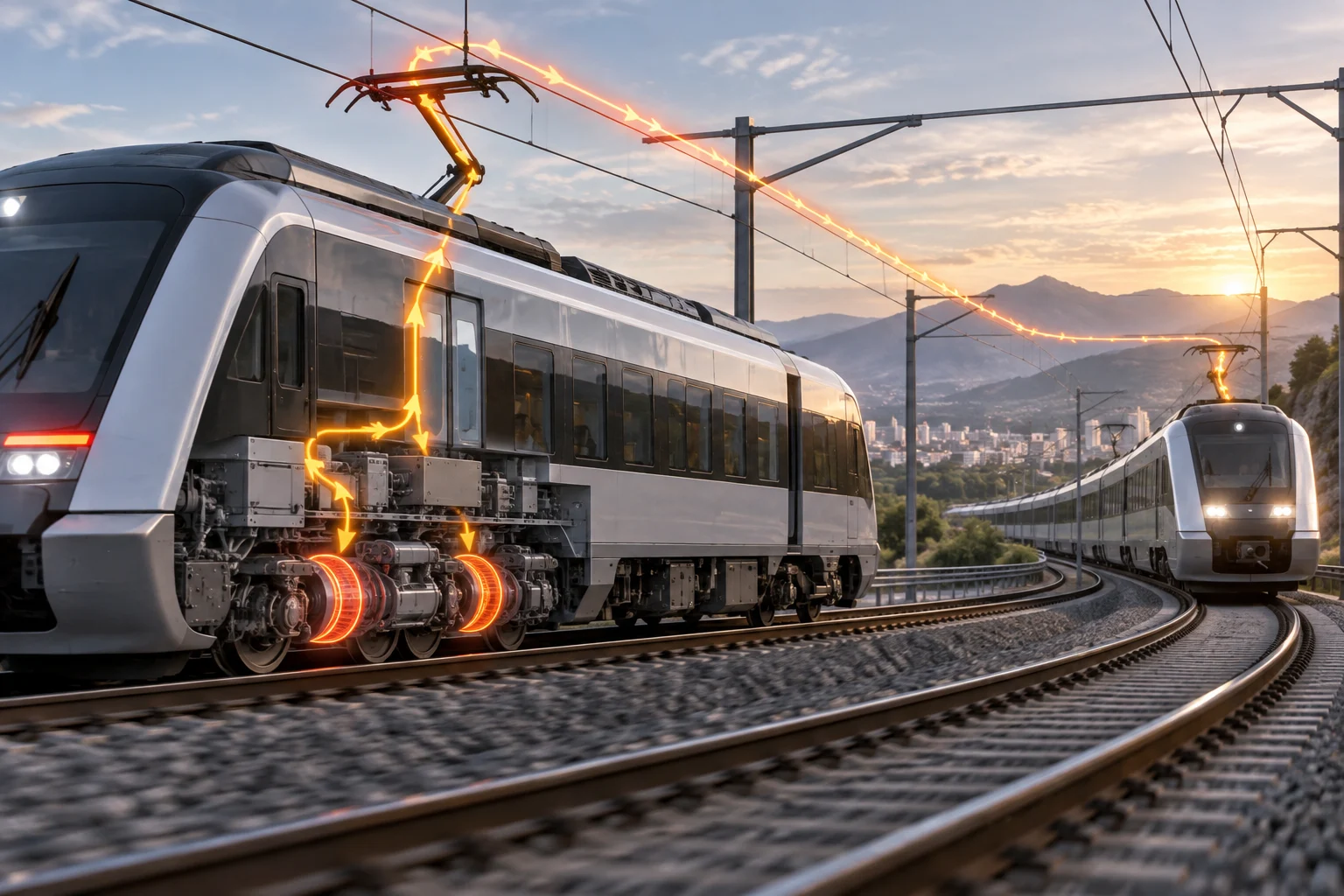
When a train brakes, its traction motors can generate electricity instead of consuming it. That energy may power other trains, be returned to the grid or be stored if the installation allows; any surplus may be dissipated in resistors.
What it means to recover energy when braking
Regenerative braking allows electric traction motors to change function as a train slows down: instead of using electricity to move the train, they can generate it during deceleration. The electricity produced may be used within the railway system, but it is not automatically reused in every case.
It is important to distinguish between two things. One is that the train generates electricity when braking; the other is that there is infrastructure capable of receiving it and demand that can use it. If those conditions do not coincide, the surplus may be dissipated in the train’s own resistors. That is why there is no universal figure for the amount of energy recovered or the savings that can be applied to every line.
Section references: Adif: subestaciones reversibles y recuperación de energía de frenado ↗ · Treatment of regenerative braking for metered operators on the DC network ↗
- Generating electricity while braking does not guarantee that all of it will be used.
- Where the energy goes depends on the power supply system and the demand available.
- Energy that is not recovered may be converted into heat in resistors.
From the traction motor to the electrical system
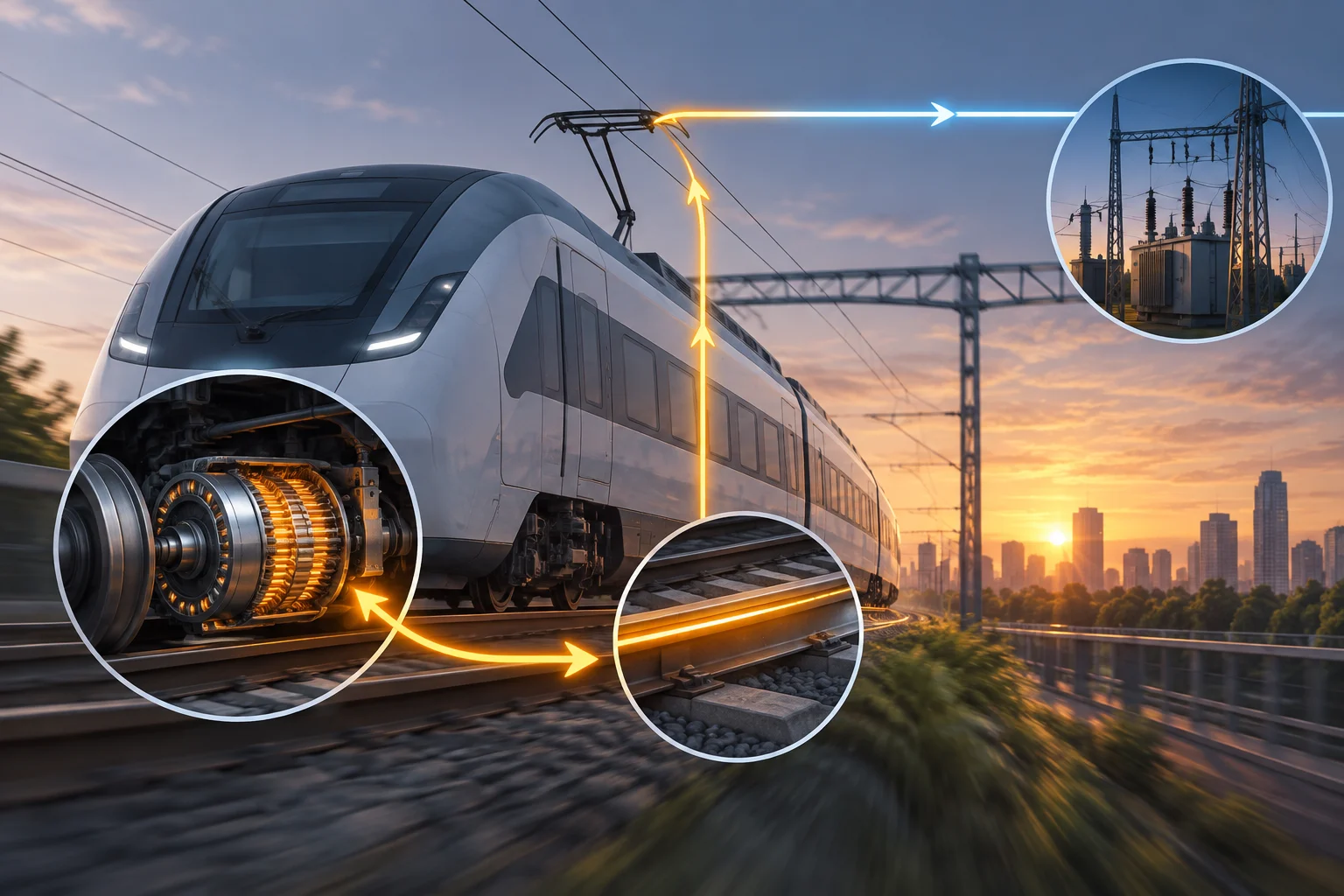
The electricity generated needs a compatible path through the installation. On an electrified line, it can pass into the power supply system and become available for other uses. However, the characteristics and configuration of the grid, as well as what is happening at that moment, determine whether the energy can leave the train and be accepted.
Section references: Treatment of regenerative braking for metered operators on the DC network ↗
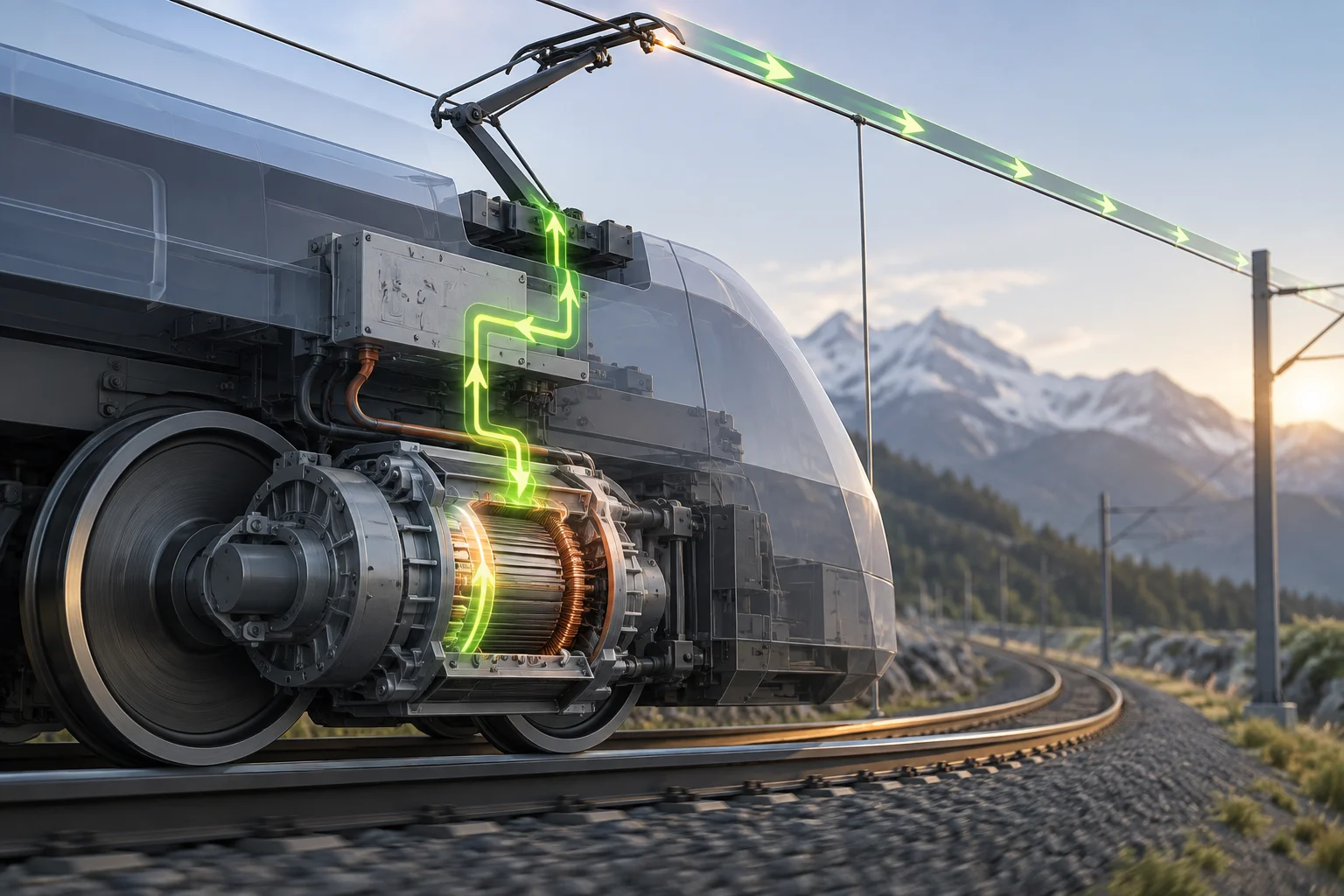
Where recovered electricity can go
One possibility is for the electricity to power another train that is accelerating or running in the same electrical section. For conventional direct-current railways, Adif explains that regenerated energy can be used by other trains in the same electrical section. On a third-rail network described by Network Rail, using the energy also depends on there being another nearby train consuming electricity.
Another option is to return the surplus to the general electricity grid. For this to happen, the infrastructure must allow energy to flow in that direction. Adif describes installing inverters at substations as one way of making the traction power supply reversible and returning to the high-voltage grid energy that would otherwise go unused in the section.
Adif also distinguishes this case from high-speed lines using alternating current, where it describes the return of braking energy to the supply grid as happening naturally. This should not be taken as an identical rule for every installation: the specific design of the line determines how the energy is managed.
Storage is another possibility, but it should not be assumed. Adif has mentioned projects involving the storage of energy generated through regenerative braking; this does not mean that every line has storage systems installed.
Section references: Adif: subestaciones reversibles y recuperación de energía de frenado ↗ · Adif: proyectos de recuperación de energía de frenado ↗ · Third rail ↗ · Memoria medioambiental 2019 ↗
Regenerative braking, resistors and friction brakes
Regenerative braking and resistor braking have one thing in common: the motors generate electricity as the train slows down. The difference is what happens to that energy. If it can be used by the grid, it is recovered; if not, Adif says the surplus may be dissipated in the train’s resistors, turning into heat.
Electrical energy recovery can reduce the use of friction brakes, but it does not eliminate them. So regenerative braking should not be taken to mean that a train relies exclusively on energy recovery.
The following comparison summarises the function of each option without assuming that all trains or lines manage braking in the same way:
| System | What happens | Possible outcome |
|---|---|---|
| Regenerative | The traction motors generate electricity as the train decelerates. | The energy may power other trains or be returned to the grid if the installation allows. |
| Resistor braking | The electrical energy generated is dissipated in the train’s resistors. | It is converted into heat instead of being used by the grid. |
| Friction brakes | Electrical energy recovery may reduce their use. | This does not make them disappear. |
Section references: Adif: subestaciones reversibles y recuperación de energía de frenado ↗ · Virgin Pendolino fleet clicks up 100 million miles ↗
What conditions make it possible to use the energy
To assess a particular line, it is worth checking the power supply conditions, demand and equipment installed:
Section references: Adif: subestaciones reversibles y recuperación de energía de frenado ↗ · Treatment of regenerative braking for metered operators on the DC network ↗ · Third rail ↗
- Does the power supply allow electricity to be returned or shared with other trains?
- Are there nearby loads in the same electrical section when trains brake?
- Does the line have reversible substations or other energy storage solutions?
- Are the electricity generated, delivered to the grid and ultimately used all measured?
How to calculate energy use on a specific line
There is no recovery percentage that applies to every line. To estimate it, you would need to study at least how much energy trains generate when braking, how much reaches the power supply installation, and how much is consumed, returned to the grid or stored. You would also need to identify the line’s electrical configuration and the sections where these flows can be shared.
A practical assessment should compare the energy generated with the energy actually used, over a representative period and using information about train movements and demand. If only the energy produced on board is known, it is not clear how much of it found a load or infrastructure capable of receiving it. And if only a specific period is observed, its results should not be presented as a universal figure.
To interpret a claim about savings, check what is being measured, on which line and with what equipment. Without those details, it is more prudent to explain the mechanism and its conditions than to promise a percentage.
Section references: Adif: subestaciones reversibles y recuperación de energía de frenado ↗ · Treatment of regenerative braking for metered operators on the DC network ↗ · Third rail ↗
- Collect records of energy generated during braking and energy actually received by the grid.
- Document the type of power supply, the electrical sections and the presence of reversible substations or storage.
- Relate braking events to the electricity consumed by other trains during the same period.
- Report separately the energy generated, the energy recovered and the surplus dissipated.
Does all the energy generated when a train brakes go back to the grid?
No. It may be used by other trains or returned to the grid if the installation allows; any surplus may be dissipated in resistors.
Does regenerative braking eliminate mechanical brakes?
No. Electrical energy recovery may reduce the use of friction brakes, but it does not mean they disappear.
Can a savings percentage be given for every line?
Not as a universal figure. Calculating it requires data on the energy generated and used, the line’s power supply and the demand available.