Lane departure warning, lane keeping or lane centring: what each assistant does
Not all lane-assistance systems do the same thing. Learn to distinguish warnings, corrections and centring, their limitations and what to check before buying.
Key points
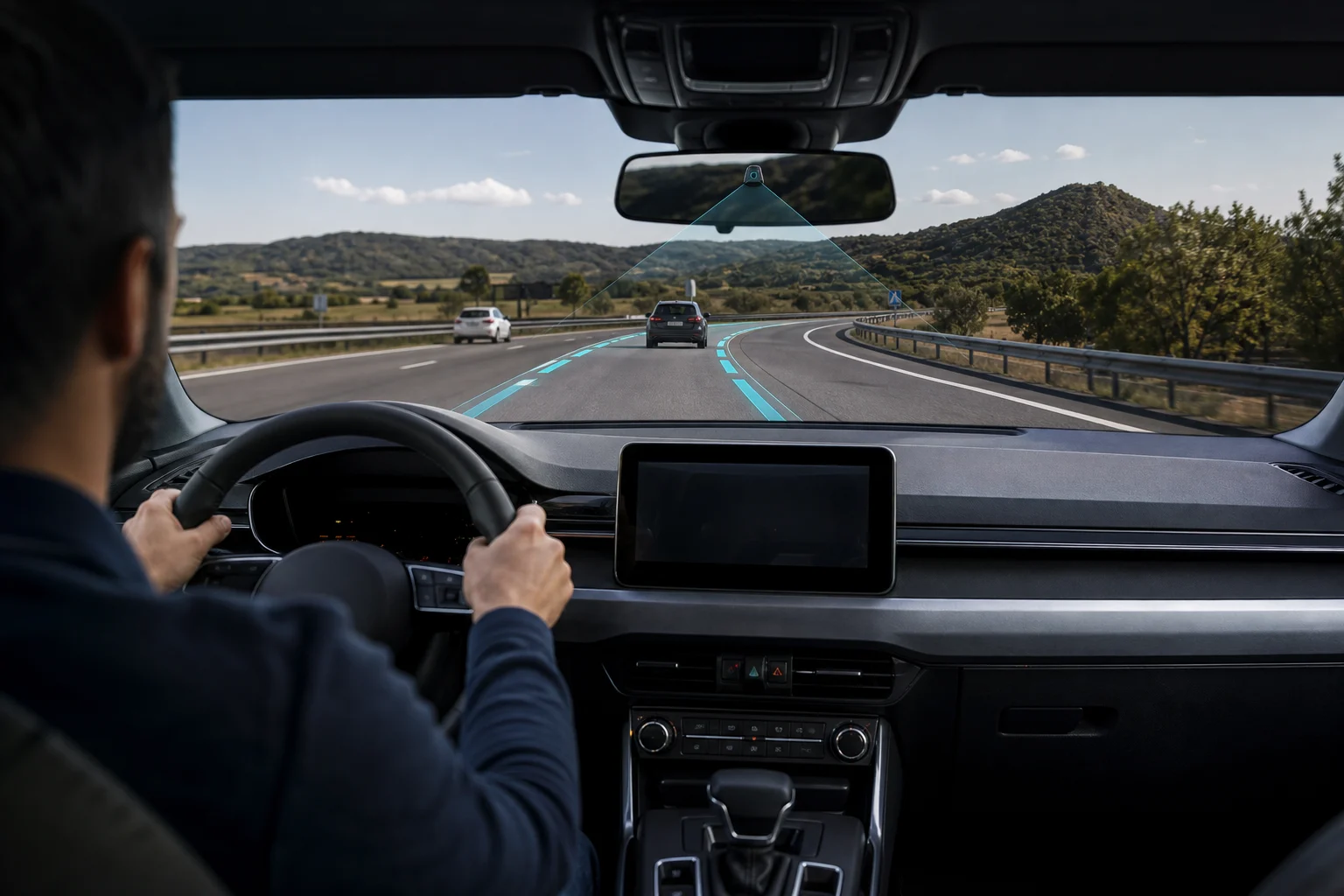
Lane departure warning alerts you; lane keeping can correct a drift; and lane centring provides more sustained lateral assistance. Their names vary by brand, and none removes the driver’s duty to watch the road and remain in control.
Quick answer: warning, correction and centring are not the same
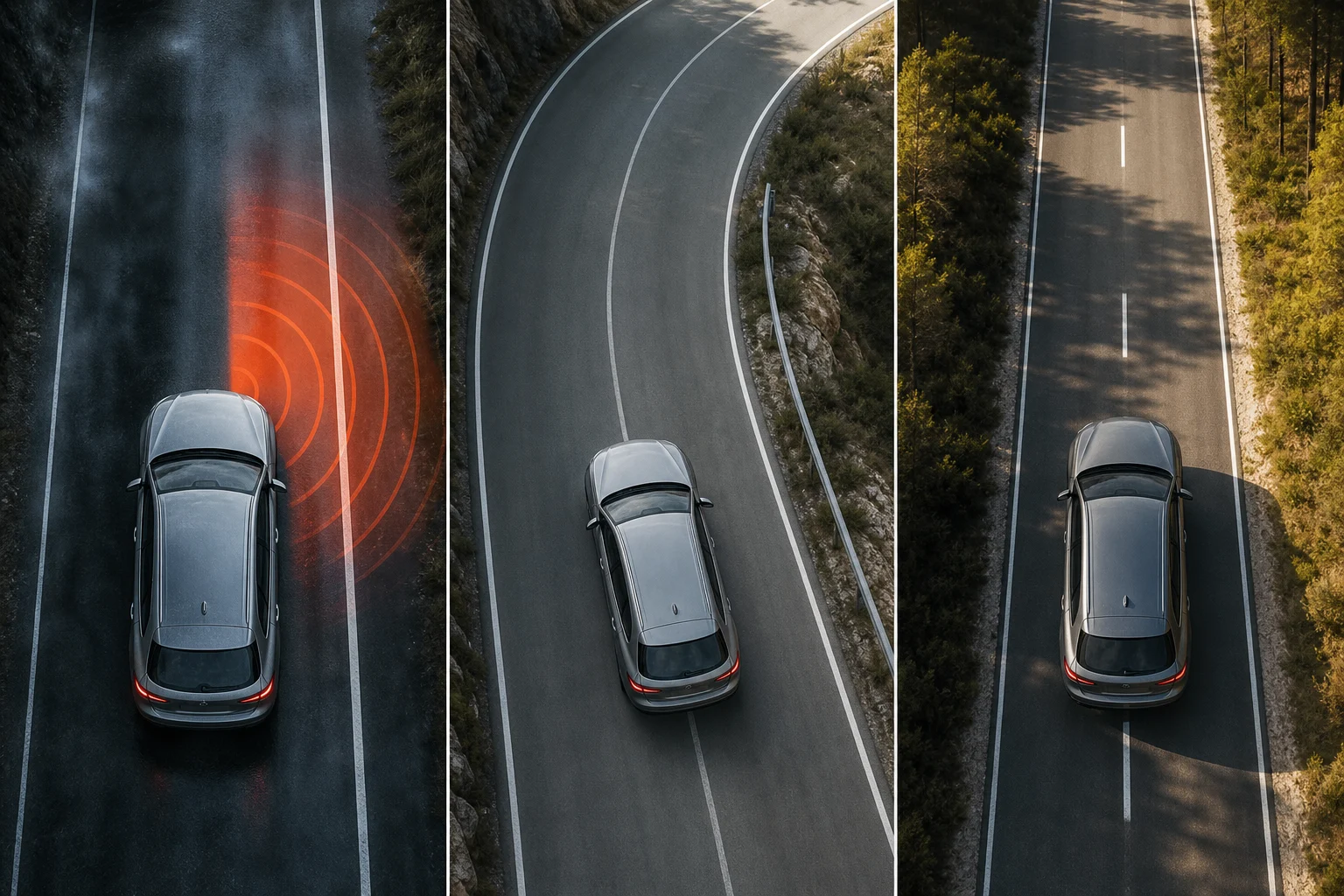
The essential difference is the degree of intervention. A lane departure warning detects that the car is leaving, or is about to leave, its lane and alerts the driver. Lane keeping assist can add a trajectory correction when it detects a drift towards a line. Lane centring, meanwhile, aims to provide more continuous lateral support to keep the vehicle within its lane.
In practice, the boundaries are not always communicated clearly. Spain’s Directorate-General for Traffic (DGT) describes an LKA system that can identify lines with a front camera and gently turn the steering wheel to centre the vehicle if the indicators are not being used. However, the Euro NCAP protocol uses “LKA” for a correction when approaching a line crossing and distinguishes this action from “Lane Centering”, which is sustained lateral assistance. It is therefore best to look at the operating description, not just the initials.
Nor should this group of systems be confused with automated driving. Even systems that combine lateral and longitudinal control require the driver to remain attentive, monitor the surroundings and be able to intervene when necessary.
Section references: DGT: vehículos con conducción asistida y seguridad vial ↗ · Euro NCAP: Assisted Driving gradings ↗ · Euro NCAP: Assisted Driving Protocol v11 ↗ · UNECE: regulación de sistemas de asistencia al control por el conductor (DCAS) ↗
- Warning: communicates an unintended departure; it does not in itself mean that the car will steer.
- Lane keeping: may intervene to prevent or correct a drift towards the edge of the lane.
- Lane centring: provides more continuous lateral assistance within the lane, often alongside other cruise-control aids.
- In all three cases, the driver remains responsible.
Lane departure warning: it detects and warns, but does not necessarily steer
Lane departure warning is the easiest function to identify conceptually. Regulation (EU) 2019/2144 defines it as a system that warns the driver that the vehicle has unintentionally departed from its lane. The key word is “warns”. This definition does not mean that steering-wheel movement or selective braking should be assumed.
What matters to the driver is knowing when it activates, how it alerts them and whether it can be configured. A warning does not replace a correction: it is still necessary to look ahead, hold the steering wheel and deliberately return to a safe position.
Before assessing this aid in a new or used car, check whether it only warns or forms part of a package that includes steering intervention. The DGT specifically notes that the warning may be integrated with a more advanced lane keeping assist system.
Section references: DGT: estudio sobre efectividad de sistemas de seguridad de vehículos ↗ · Reglamento (UE) 2019/2144 ↗
- What to expect: a warning when a departure is interpreted as unintended.
- What not to assume: that the system will turn the steering wheel or return the car to the centre.
- What to ask: activation conditions, settings and whether it can be switched off.

Lane keeping and centring: the difference lies in how much and when they intervene
Lane keeping assist is normally associated with a response to a drift. In the Euro NCAP protocol, LKA is described as a course correction when the vehicle is about to cross a line. In other words, it acts as support to prevent a deviation from becoming a lane departure, rather than necessarily guiding the car continuously through the centre.
Under European regulation, an emergency lane keeping system, or ELKS, must combine a departure warning with a corrective steering-control function. It may correct through changes to the steering angle of the wheels or by individually braking wheels. But ELKS is a specific regulatory category: it is not automatically synonymous with every commercial function called LKA, Lane Assist or lane keeping.
Lane centring adds a more sustained influence on lateral movement to help the car remain within its lane. It may be more noticeable on multi-lane roads and, in some cars, work alongside adaptive cruise control. Even so, it does not promise a perfect trajectory or allow the driver to disengage: Euro NCAP and UNECE regulation are explicit that responsibility and continuous supervision remain with the driver.
| Function | Main purpose | Steering intervention | Conditions and limits to anticipate |
|---|---|---|---|
| Lane departure warning | Warn of an unintended lane departure | Its definition does not imply steering intervention | Depends on lane recognition; check alerts, settings and activation. |
| Lane keeping | Help with a drift towards the lane boundary | May apply a one-off course correction | Does not necessarily mean sustained centring; the exact function depends on the version. |
| Lane centring | Help lateral movement to remain within the lane | More continuous assistance with the lateral trajectory | Requires supervision and readiness to take control immediately. |
Section references: Reglamento de Ejecución (UE) 2021/646 ↗ · Euro NCAP: Assisted Driving gradings ↗ · Euro NCAP: Assisted Driving Protocol v11 ↗ · UNECE: regulación de sistemas de asistencia al control por el conductor (DCAS) ↗
- Corrective lane keeping: usually reacts when approaching or crossing a road marking.
- Lane centring: attempts to maintain a lateral position within the lane, without replacing the driver’s hands, observation or decisions.
- ELKS: a regulatory designation with specific requirements; it should not be used as a generic label for every lane-assistance system.
Why the sales listing is not enough: checks before buying
Names vary by brand and can also change between trim levels, options, model years and markets. An advert saying “lane assist” does not reliably reveal whether that particular car warns, corrects a drift, provides sustained centring or combines several functions. This is especially important for used cars, where the advert description may be incomplete.
A useful check starts with identifying the exact version: model, year, trim, powertrain and market. Then consult the owner’s manual and equipment specification for that configuration. Look for sections covering departure warning, lane keeping, centring, steering assistance, adaptive cruise control and deactivation. ELKS type-approval documentation includes, among other details, commercial names, speed range and means of deactivation; these are precisely the relevant details for distinguishing functions.
When inspecting a used vehicle, checking the controls and instrument-cluster messages while stationary is only a preliminary check and must be compared with the documentation for that version. It should not be turned into a driving test on the assumption that the aid will work on every road: actual road conditions matter.
Section references: DGT: estudio sobre efectividad de sistemas de seguridad de vehículos ↗ · Reglamento de Ejecución (UE) 2021/646 ↗
- Record the vehicle’s VIN, trim level, model year and market.
- Request the relevant manual and the original equipment list, not just the advert text.
- Confirm in the documentation which function is declared, at what speeds it operates and how it is switched off.
- If there are discrepancies, give priority to documentation specific to that version and to a professional pre-purchase inspection.
Predictable limitations and responsible use: the assistance needs an environment it can read
Lane detection has physical and environmental limitations. European regulation recognises that these systems cannot be guaranteed to operate if there are no road markings. Their tests are described on straight, level and dry roads, with markings in good condition and no fog or sensor glare. These references are not a promise of operation in every scenario: they help explain why difficult conditions reduce the level of trust that should be placed in the assistance.
Therefore, use greater caution where there are no markings, where they are in poor condition, in fog or if the sensors are affected by glare. On broken lines, regulation aims to reduce interventions during intentional manoeuvres and requires a warning, not necessarily a correction. Signalling in good time remains essential.
The responsible way to use these systems is to configure them after reading the manual, check their warnings without taking attention away from the road and always keep your hands ready to steer. The driver must continue to control the trajectory and must not wait for a later system response.
Section references: Reglamento de Ejecución (UE) 2021/646 ↗ · UNECE: regulación de sistemas de asistencia al control por el conductor (DCAS) ↗
- Before setting off: check for any warnings in the instrument cluster.
- On the road: look well ahead, keep an effective grip on the steering wheel and signal every lane change.
- Without markings, with poor markings, in fog or with sensor glare: use greater caution and do not expect the assistance to behave consistently.
- If the aid is intrusive or intervenes unexpectedly: check the manual and its settings; do not ignore the issue or delegate driving to the system.
Does lane keeping assist always keep the car in the centre?
Not necessarily. It may consist of a correction when the vehicle approaches a line. Lane centring describes more sustained lateral assistance, but the commercial name alone is not enough to confirm it.
Does a lane departure warning move the steering wheel?
Not by definition. The warning communicates an unintended departure; to find out whether a specific car also corrects its trajectory, consult its manual and equipment specification.
Can I let go of the steering wheel if the car has lane centring?
No. These functions are driving aids. The driver must remain attentive, monitor the surroundings and be ready to intervene.
Why does lane assist stop working?
It may be limited if it cannot detect the markings correctly. No markings, worn markings, fog or sensor glare are situations in which consistent assistance should not be expected.
What should I check on a used car?
Identify the exact version and compare the advert with the manual, equipment specification and the vehicle’s controls. Verify in the documentation which warnings and interventions it offers, the speeds at which it operates, and how it is configured or switched off.