Campervan or motorhome in winter storage: what to check first
A guide to leaving a campervan or motorhome unused for weeks or months without applying one-size-fits-all solutions to water systems, batteries or tyres.
Key points
Before storing a campervan or motorhome for winter, identify the manuals for every system: drain the water circuit according to the equipment fitted, plan the battery around its chemistry and charger, and record tyre checks and 12 V consumption. Avoid universal solutions for water systems, batteries or tyres.
Quick answer: the manual comes before a generic routine
If you are leaving a campervan or motorhome unused for several weeks or months, it is not advisable to treat every system as though it were the same. The priority is to find the vehicle manual and the manuals for the installed equipment, especially the water heater, heating system with hot-water production, leisure battery and its charger. Truma, for example, publishes different procedures for Therme, Boiler and Combi units; a guideline that is valid for one must therefore not be automatically applied to another.
The minimum checklist is straightforward: identify the tanks and water appliance fitted to the vehicle, confirm how the leisure battery is managed, check for 12 V consumers during storage, and note the specified tyre pressure. General housekeeping may include cleaning the living area and removing food and damp textiles. Consult the vehicle documentation for any ventilation guidance. If you notice dampness, stains or a possible water ingress point, consult the relevant documentation and a qualified service provider.
Section references: Guía de vaciado anticongelación de calentadores de agua para caravanas y autocaravanas ↗ · Centro de descargas para instrucciones de producto ↗
- Gather the vehicle manual, the water-system manual, the heating manual, and the charger or BMS manual.
- Record the parking date, state of charge and next inspection date.
- Do not assume that one appliance's frost-protection system protects every tank, pipe or item of equipment.
- See the maintenance section as well to plan periodic tasks.

Water and frost: identify the equipment before draining it
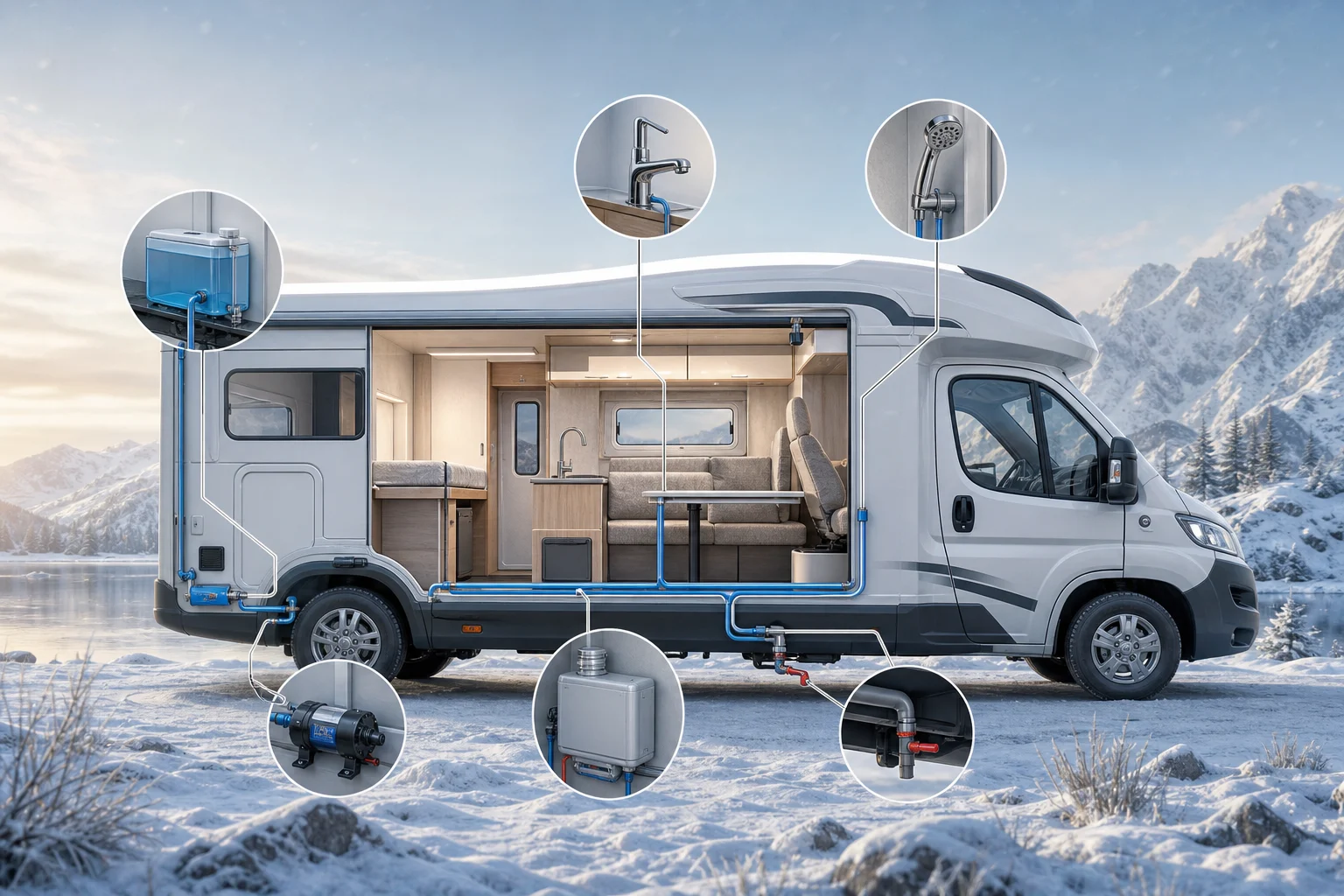
Water is the area that requires the greatest precision where there is a risk of frost. Truma expressly states that the fresh-water tank must be emptied in winter to prevent frost damage. But the tank is not the only component: use the manual to identify the heater or boiler, pump, taps, drain valves and discharge point. Truma’s own documentation covers submersible pumps and pressure pumps, which is another reason to check the actual layout of the installation.
In an installation with a Truma Combi, the manufacturer says to drain the boiler if the caravan or motorhome is not used during the frost period. Its published procedure includes switching off the power supply to the pump unit, opening the hot-water taps and opening the drain valve. In addition, the discharge point must remain unobstructed and you must verify that the contents of the hot-water system have been drained; Truma specifies 10 litres for this procedure.
It is not enough to assume that the boiler will stay empty simply because it is not being used: Truma warns that it can fill even if the cold-water system is operating without it. Nor is it correct to reduce every case to opening a tap. For a Therme, Truma requires it to be drained in freezing conditions, with the caravan level during drainage, and includes disconnecting the pump, emptying the tank or removing the pump, opening drain and ventilation valves, and confirming that 5 litres have been discharged. These are examples of why you should follow the exact document for your equipment, rather than an internet recipe or antifreeze used without the manufacturer’s approval.
| Equipment or situation | Documented information | Practical decision |
|---|---|---|
| Fresh-water tank | Truma says it should be emptied in winter to prevent frost damage. | Identify it and confirm its draining method in the vehicle manual. |
| Truma Combi | For frost conditions, Truma says to drain the boiler and verify drainage from the hot-water system. | Follow the specific Combi sequence; do not replace it with a generic procedure. |
| Truma Therme | It must be drained in freezing conditions, and Truma specifies that the caravan must be level during drainage. | Consult the specific Therme procedure, including the pump, valves and final check. |
| FrostControl on CombiNeo 6 E | It operates automatically at around +3 °C; it can be closed manually when the surroundings return to approximately +7 °C. | Do not assume that another model or installation behaves in the same way. |
Section references: Guía de vaciado anticongelación de calentadores de agua para caravanas y autocaravanas ↗ · Truma Therme: instrucciones de vaciado en condiciones de helada ↗ · Sistema de agua en caravanas y autocaravanas ↗ · CombiNeo 6 E: protección FrostControl ↗
- Find the make, model and version of the water equipment before touching valves or the electrical supply.
- Check where water discharges and that the outlet is not obstructed.
- Follow the sequence and volume checks specified by the applicable manual.
- If your vehicle has a FrostControl valve, confirm what it protects and how it works in its documentation: do not extend that function to the rest of the system.
Starter and leisure batteries: distinguish chemistry, BMS and charger
The leisure battery should not be managed by intuition or by using the same rule as for the starter battery. First identify its chemistry, the BMS where fitted, the charger, and the disconnection instructions from the vehicle manufacturer. In the specific case of the Victron Lynx Ion system, the manual says to disconnect the cables for storage, keep the product in a dry environment, and considers it preferable to store the lithium battery at 60% state of charge. Do not turn those values into a requirement for every lithium battery: they are instructions for that system.
The same Victron manual calls for the voltage of a stored lithium battery to be checked periodically and for it to be recharged if it falls below the cut-off level; it also warns of permanent damage if it is fully discharged. This makes a simple record useful: date, state of charge or voltage according to the available indicator, action taken and next check. If the vehicle remains connected to a compatible charger, consult its maintenance behaviour. The Victron Blue Smart IP67, for example, maintains a configured storage voltage and automatically performs a one-hour absorption charge every seven days.
Do not overlook hidden consumption. The manual for a family of Dometic DM/DMA refrigerators warns that the control system may consume a few milliamps even when switched off and, for winter storage, advises keeping the batteries charged or switching off the main 12 V switch. Check whether this warning appears in the manual for your refrigerator and other equipment; do not disconnect circuits if the manufacturer requires them to remain active.
Section references: Manual BMS Lynx Ion: transporte y almacenamiento de baterías de litio ↗ · Manual de cargador Blue Smart IP67: fase de almacenamiento ↗ · Manual de frigoríficos DM/DMA: consumo en almacenamiento invernal ↗
- Distinguish between the starter battery and leisure battery in your record sheet.
- Record the chemistry, model, BMS, charger and position of the main 12 V switch.
- If the battery is lithium, consult its manufacturer’s cut-off threshold and storage guidance.
- Do not maintain a permanent charge without confirming that the charger is compatible and how its storage phase operates.
Living area, tyres and exterior: inspect without improvised repairs
General housekeeping before storage may include cleaning the interior and removing food and damp textiles. Consult the vehicle documentation for any ventilation guidance. This does not replace a diagnosis for leaks: if you detect recurring dampness, stains or water inside, consult the relevant vehicle documentation and a qualified service provider. The documentation provided does not make it possible to set a universal position for rooflights, windows or vents across all models.
For tyres, avoid inventing a special storage pressure. Spain’s DGT recommends consulting the pressure specified by the vehicle manufacturer, which may appear in the manual, on the driver’s door or on the fuel-filler flap. Michelin notes that the vehicle-tyre combination determines that value and that the front and rear axles may require different figures. Check them when cold and note the values specified for your vehicle.
Complete a visual inspection of all road tyres, including the spare if it is accessible: pressure according to the specification, tread depth and possible uneven wear are the three points cited by the DGT. If you find abnormal wear, visible damage or repeated pressure loss, refer to the relevant vehicle documentation and a qualified service provider.
Section references: Comprobación de neumáticos antes de viajar ↗ · Presión recomendada del neumático ↗
- Record any sign of dampness and its location before storing the vehicle.
- Check the vehicle label or manual for each axle; do not use a figure published for another model.
- Visually inspect tread and uneven wear before storage and before driving again.
- Keep the manual accessible and save photos of any issue to make a later inspection easier.
During storage and before travelling again: a record prevents omissions
Inspection frequency should not be invented: use the frequency specified by the battery, BMS, charger and vehicle manufacturers. For the lithium batteries in the Victron system mentioned, the instruction is to check stored voltage periodically. In practice, schedule the dates set by your documentation in your calendar and retain a record.
When recommissioning the vehicle, work through the same list in reverse order. Consult the manual before filling the water system or reactivating the heater; confirm the battery and 12 V consumption; check the specified pressure for each axle when cold, and inspect tread and wear. If equipment does not respond as its manual describes, there are signs of a water leak or dampness, or the battery has fallen below the limits set by its manufacturer, consult the relevant manual and a qualified service provider. For more context on use, see our Caravaning guide.
Section references: Centro de descargas para instrucciones de producto ↗ · Manual BMS Lynx Ion: transporte y almacenamiento de baterías de litio ↗ · Comprobación de neumáticos antes de viajar ↗
- Preparation date: ___
- Water equipment identified and manual located: ___
- Leisure battery: chemistry, level and next inspection: ___
- Main 12 V switch or charger strategy confirmed: ___
- Specified pressures by axle recorded: ___
- Issues observed, photos and pending professional consultation: ___
Do you always need to drain a motorhome’s water in winter?
According to Truma, the fresh-water tank should be emptied in winter to prevent frost damage. For water heaters, boilers, valves and pumps, follow the manual for the equipment installed: Therme, Combi and other equipment do not necessarily use the same procedure.
Can I leave the leisure battery connected to a charger all winter?
It depends on the battery and charger. A compatible charger may include a storage phase; for example, the Victron Blue Smart IP67 maintains storage voltage and performs a weekly absorption charge. Always check the manual for your specific setup.
What tyre pressure should a campervan have while it is stored?
Check the pressure specified by the vehicle manufacturer, normally in the manual, on the driver’s door or on the fuel-filler flap. There is no universal figure, and values may differ between the front and rear axles.
Is switching off the fridge enough to stop the battery from discharging?
Not always. Dometic warns that the control system in the DM/DMA family can consume a few milliamps even when switched off. Check your refrigerator manual and follow it when deciding whether to keep the battery charged or switch off the main 12 V supply.