Is This Motorcycle Suitable for an A2 Licence? Power, Restrictions and Documents Before Buying
A guide to checking whether a new or used motorcycle can be ridden on an A2 licence: legal limits, original power, power-to-weight ratio and documents to review before completing the purchase.
Key points
To ride a motorcycle on an A2 licence in Spain, an advert stating that it is restricted is not enough. Check that the specific bike complies with the 35 kW, 0.2 kW/kg and original-power limits, and that any modification is correctly recorded in its documents.
The quick answer: do not buy based on the advert alone
A motorcycle can be ridden on an A2 licence in Spain if it meets three conditions at the same time: maximum power of 35 kW, a maximum power-to-weight ratio of 0.2 kW/kg, and it must not be derived from a vehicle with more than twice that power. In other words, if it is restricted to 35 kW, its original power cannot exceed 70 kW.
Therefore, the phrase “restricted for A2” is not sufficient proof. It may describe a version sold that way, a restriction carried out after registration or simply a claim that still needs documentary verification. Engine capacity does not by itself determine eligibility either: it is not among the limits set for A2.
Before paying a deposit, identify the individual motorcycle through its documents, compare its figures and confirm that the current configuration is recorded where a modification has been made. If a document is missing or a figure does not add up, the prudent decision is to stop the purchase until you obtain a verifiable clarification.
Section references: Clases de permisos de conducir ↗ · Reglamento General de Conductores, artículo 4 (texto consolidado) ↗
- Power limit in the eligible configuration: 35 kW.
- Power-to-weight ratio limit: 0.2 kW/kg.
- Original-power limit when restricted to 35 kW: 70 kW.
- Engine capacity does not replace any of these checks.
What the A2 licence allows exactly
Article 4 of Spain’s General Driver Regulations sets the A2 scope for motorcycles with a maximum power of 35 kW and a maximum power-to-weight ratio of 0.2 kW/kg. It adds a third barrier that is especially relevant when assessing motorcycles that can be restricted: they cannot be derived from a vehicle with more than twice their power.
That last requirement means looking at two different points in time. On one hand, there is the power at which the motorcycle is currently recorded to be ridden as an A2 bike. On the other, there is the power of the source or original motorcycle. A unit that reaches 35 kW after restriction does not comply for that reason alone: you must also confirm that the base model did not exceed 70 kW.
The DGT repeats these three criteria in its licence information. They are licence limits applicable in Spain; commercial information from the manufacturer, dealer or seller may help identify a version, but it does not replace checking the individual motorcycle and its documents.
Section references: Clases de permisos de conducir ↗ · Reglamento General de Conductores, artículo 4 (texto consolidado) ↗
- Compare kW, not only commercial names or engine capacity.
- Do not confuse the current restricted power with the original power.
- If the seller provides figures in another unit, ask for the motorcycle’s documents to make it possible to verify the applicable kW.
The three figures to compare before choosing a model and individual motorcycle
Start by separating three concepts that are often mixed together in a sales specification. The power declared for the current motorcycle is what you must compare with the 35 kW maximum. Original power determines whether a restriction to 35 kW starts from an eligible motorcycle: it must not exceed 70 kW. Finally, the power-to-weight ratio of the applicable configuration must remain at 0.2 kW/kg or below.
Do not assume that two motorcycles with the same commercial name have the same A2 status. A name may cover different variants, model years or configurations. Ask for the documents of the specific motorcycle before comparing. The vehicle identification number and the details on the ITV card help prevent information from one version being wrongly applied to another.
The kW-to-hp conversion tool may help you interpret adverts, but the legal verification must retain the values and criteria shown in the documents and regulations. If the original figure is not clearly evidenced, do not conclude that the advertised kit will make the motorcycle eligible.
Section references: Reglamento General de Conductores, artículo 4 (texto consolidado) ↗
- Current power: it must be within 35 kW.
- Original power: it must not exceed 70 kW if the motorcycle is restricted to 35 kW.
- Power-to-weight ratio: it must be 0.2 kW/kg at most.
- Identify the version and the individual motorcycle, not just the make and model.
Factory restriction, restricted version and later kit: what matters in the documents
In sales practice, motorcycles may be described as factory-restricted, restricted versions or units with a kit fitted later. For someone intending to ride on an A2 licence, the label is not decisive. What matters is that the configuration of that individual motorcycle meets all three limits and that its documents reflect its real situation.
When the restriction is carried out after registration and changes vehicle characteristics or details on the ITV card, it falls within the framework for vehicle modifications. Royal Decree 866/2010 provides that, depending on the type of modification defined in the Vehicle Modification Manual, a conformity report and workshop certificate may be required.
In addition, after a modification, the owner must present the vehicle for technical inspection within a maximum of 15 days with the documents specified by the Manual. If the inspection is satisfactory, the ITV card is endorsed or a new one is issued. Therefore, for a used motorcycle with a later restriction, the key point is not merely that a kit or invoice is supplied: the documentary regularisation of the work must be verifiable.
The workshop certificate evidences work carried out on a specific vehicle. Keep it with the ITV card and the remaining supporting documents. To assess whether a specific modification is feasible, the Ministry recommends consulting the manufacturer or its legal representative, or a technical service designated for vehicle modifications.
Section references: Real Decreto 866/2010, sobre reformas de vehículos ↗ · Reglamentación y homologación de vehículos; Manual de Reformas Rev. 7, Corr. 2 ↗ · Preguntas frecuentes sobre reformas de vehículos ↗
- Ask for the individual motorcycle’s updated ITV card.
- If there was a later restriction, request the workshop certificate.
- Check whether a conformity report is required under the applicable Vehicle Modification Manual.
- Do not replace modification documents with a promise to regularise them later.
Checklist for buying a used A2 motorcycle without taking unnecessary risks
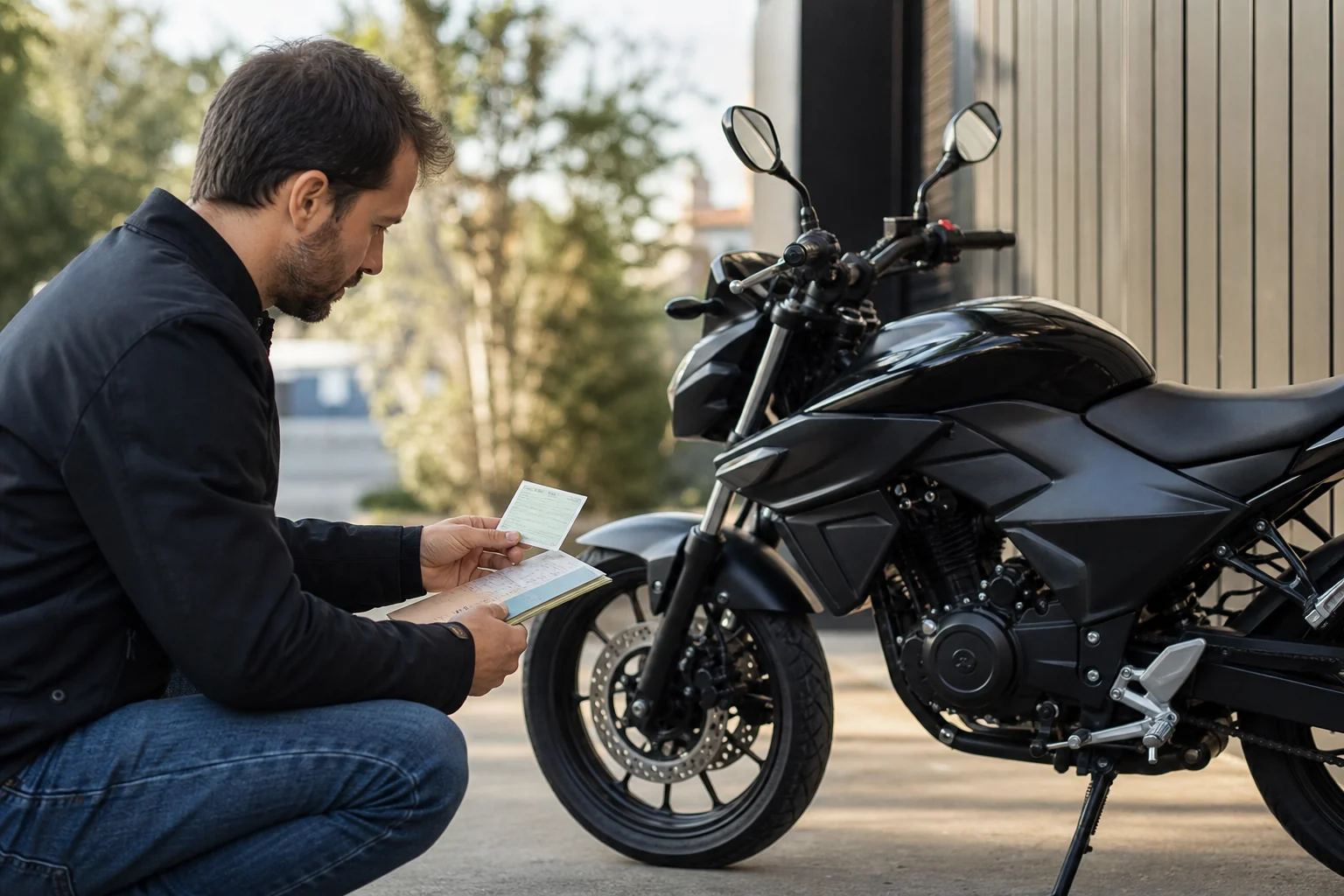
First, ask for a legible copy of the ITV card and registration certificate. Check that they belong to the motorcycle being offered and that the seller can consistently explain its version, current power and, where relevant, original power. Then request the restriction documents if it was carried out after registration.
Carry out these checks before travelling, reserving the motorcycle or paying. You will reduce the risk of discovering at the ITV inspection or after the transfer that the motorcycle is not recorded as you expected. An orderly inspection of a used unit can be supplemented with this used motorcycle buying checklist, but A2 eligibility requires its own verification of power and documentation.
Stop the transaction if the seller does not show the ITV card, if the advertised power does not match the available documents, if they cannot evidence the status of a later restriction, or if their explanation of the version and original power changes. These are not automatic proof of an irregularity, but they are objective reasons to seek confirmation from the manufacturer, its legal representative or a designated technical service before deciding.
| Detail or document | Where to find it | Why it matters | What requires confirmation |
|---|---|---|---|
| Current configuration power | ITV card and the motorcycle’s documents | It must comply with the 35 kW maximum | A different figure in the advert and ITV card |
| Power-to-weight ratio | Applicable motorcycle data and comparison with the legal limit | It cannot exceed 0.2 kW/kg | Inability to check the required data |
| Original power | Reliable version documents or technical confirmation | A motorcycle restricted to 35 kW cannot be derived from more than 70 kW | Original version not identified or power not evidenced |
| Later restriction | ITV card and applicable modification documents | The modification must be regularised in the documents | Missing workshop certificate, required report or ITV endorsement |
| Identity of the individual motorcycle | ITV card and registration certificate | Prevents applying documents from another motorcycle | Details that do not match the motorcycle being offered |
Section references: Real Decreto 866/2010, sobre reformas de vehículos ↗ · Preguntas frecuentes sobre reformas de vehículos ↗
- Request the ITV card and registration certificate before committing any money.
- Check that the documents belong to the same motorcycle being offered.
- Ask whether the restriction was carried out after registration.
- Request the workshop certificate and the documents applicable to the modification where relevant.
- Do not accept an advert, a conversation or a fitted accessory as the sole proof.
Common mistakes and the right order for resolving doubts
The most common mistake is using engine capacity as a shortcut. An engine-capacity figure does not evidence compliance with A2 limits, which concern power, power-to-weight ratio and source power. The second mistake is trusting that any motorcycle can be restricted because a kit is advertised. First, you must check the 70 kW original-power ceiling and the documents applicable to the individual motorcycle.
It is also advisable not to treat derestriction and restriction as interchangeable changes that can be resolved merely by fitting or removing a part. If work after registration changes characteristics or details on the ITV card, it must be assessed as a modification under the current framework and its required documentation.
The useful order is straightforward: identify the version and individual motorcycle; check the three A2 limits; review the ITV card and registration certificate; and, if work was carried out later, gather the workshop certificate and conformity report where required. If a technical doubt remains, consult the manufacturer, its representative or a designated technical service. This sequence is safer than deciding based on the model name or the price of an offer.
Section references: Reglamento General de Conductores, artículo 4 (texto consolidado) ↗ · Real Decreto 866/2010, sobre reformas de vehículos ↗ · Preguntas frecuentes sobre reformas de vehículos ↗
- Do not use engine capacity as an A2 eligibility criterion.
- Do not confuse an available kit with a motorcycle that is already eligible and documented.
- Do not buy expecting to resolve a power or document discrepancy later.
- For a specific technical doubt, request confirmation through the channel indicated by the Ministry.
Can a motorcycle of any engine capacity be valid for A2?
Engine capacity is not among the A2 licence limits. The maximum power of 35 kW, maximum power-to-weight ratio of 0.2 kW/kg and original-power limit must be met.
What is the maximum original power for restricting a motorcycle to A2?
For a motorcycle restricted to 35 kW, original power cannot exceed 70 kW, because the Regulations require it not to be derived from a vehicle with more than twice the power.
Is it enough for the seller to supply the restriction kit?
No. You must check the eligibility of the individual motorcycle and, if the restriction was carried out after registration, the documents applicable to the modification, including regularisation on the ITV card where required.
What should I do if I do not know whether a restriction modification is feasible or properly documented?
The Ministry indicates that you can consult the vehicle manufacturer or its legal representative, or a technical service designated for vehicle modifications.