Motorcycle ITV: when to take it and what to check first
Find out when a motorcycle needs its Spanish ITV inspection, how to calculate its age, which documents to check and how to assess a used bike’s history.

Key points
A standard motorcycle is exempt from the Spanish vehicle technical inspection (ITV) until four years after its first registration or entry into service, then it must be inspected every two years. The ITV card confirms the specific expiry date; for a used motorcycle, the DGT report adds administrative history, but a passed ITV is not a full mechanical inspection.
The quick answer: when a motorcycle needs an ITV
A standard motorcycle must have its first ITV inspection once it is more than four years old. After that, the inspection is required every two years. Its age is not counted from the last ITV or from the day it was bought used, but from the first registration or entry-into-service date recorded in the Central Traffic Headquarters Vehicle Register.
To find the date that actually applies to you, check the ITV card: it must include both the date of the completed inspection and the date until which it remains valid. That second date is the practical reference for booking an appointment and avoiding expiry of the inspection.
This rule should not be extended to every two-wheeled vehicle. An L1e moped is exempt until it is three years old and then requires an ITV every two years. A motorcycle classified as historic has a four-year inspection interval regardless of its age.
| Vehicle | Up to a certain age | Afterwards | Subsequent frequency |
|---|---|---|---|
| Standard motorcycle | Exempt for up to 4 years | More than 4 years | Every 2 years |
| L1e moped | Exempt for up to 3 years | More than 3 years | Every 2 years |
| Motorcycle classified as historic | Not dependent on age | Any age | Every 4 years |
Section references: Real Decreto 920/2017 consolidado: frecuencia, vigencia, resultados y alcance de ITV ↗
- Standard motorcycle: exempt for up to four years; ITV every two years thereafter.
- L1e moped: exempt for up to three years; ITV every two years thereafter.
- Motorcycle classified as historic: ITV every four years.
- Always check the validity date recorded on the ITV card, especially if you have recently bought the motorcycle.
First registration, last inspection and validity: three different dates
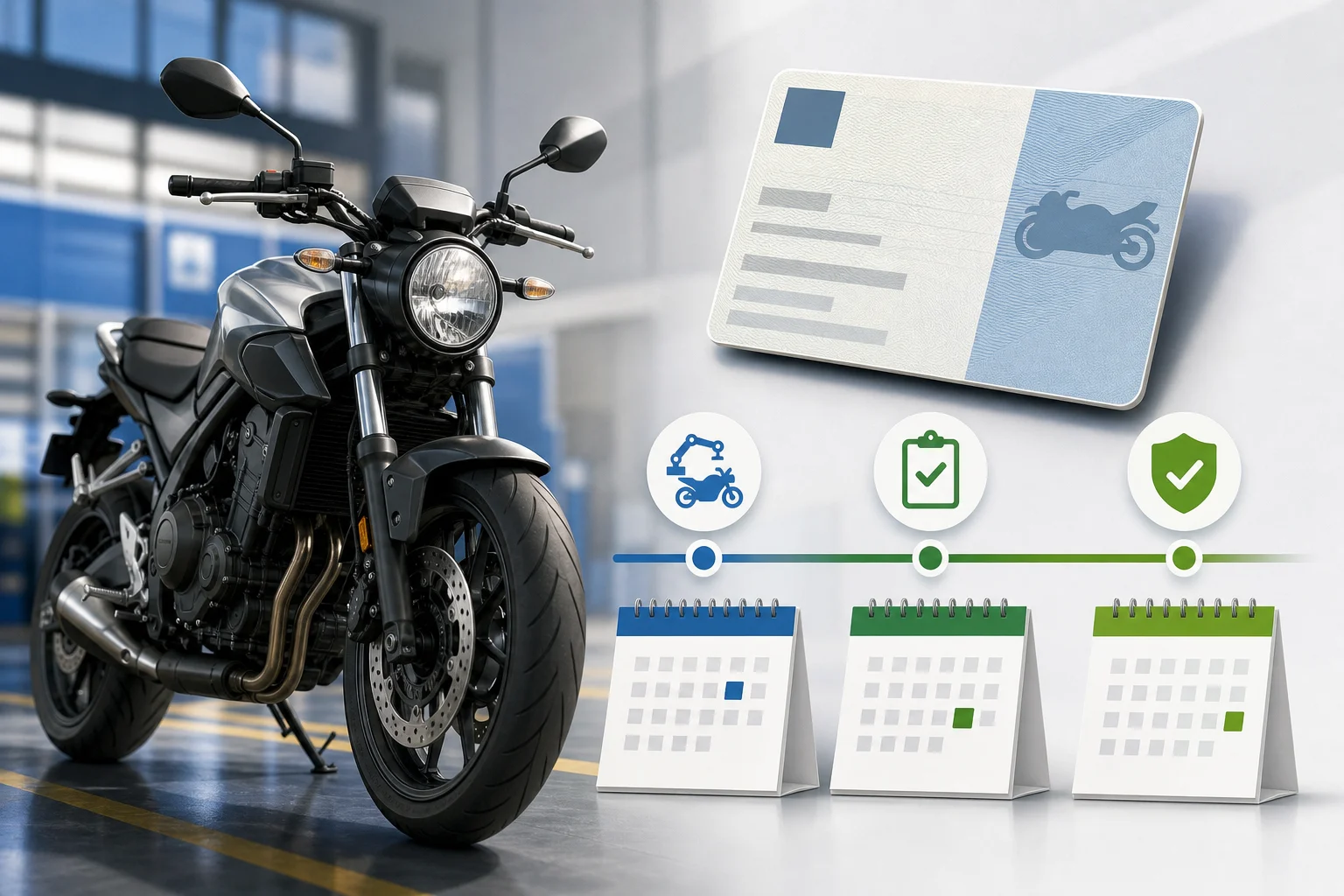
The most common confusion comes from mixing up three concepts. The first-registration or entry-into-service date determines the motorcycle’s statutory age and therefore the inspection interval that applies. It may appear on the registration certificate and is recorded in the Vehicle Register.
The date of the last passed inspection shows when the most recent check was completed. The ITV validity is normally calculated from that date by adding the applicable interval. Therefore, a motorcycle that is already more than four years old does not restart its schedule when it changes owner or because it passed an inspection recently.
There is a useful rule when arranging the appointment: if you attend within the 30 calendar days before expiry, the next validity date is calculated from the previous expiry date. Before booking, verify the date written on the card and check that it matches your motorcycle’s registration number and identification number.
Section references: Real Decreto 920/2017 consolidado: frecuencia, vigencia, resultados y alcance de ITV ↗ · Documentación de un vehículo ↗
- Do not use the purchase date to calculate the first ITV.
- Do not use the date of the last ITV to decide whether the motorcycle has already reached four years of age.
- Use the validity date on the ITV card to identify the specific expiry date.
- If you attend within the 30 calendar days before expiry, the previous expiry remains the reference date for the next period.
Documents and checks to make before the appointment
Before travelling to the station, gather the registration certificate and the technical data sheet or ITV card. The DGT identifies both as documents needed to drive and states that they must be valid. The card is also the document on which inspection and validity dates are recorded.
Compulsory insurance must be evidenced before any technical inspection is carried out. It is also advisable to verify that the identifying details in the documents match those on the motorcycle. If you notice a discrepancy in the registration number, chassis number or administrative data, clarify it before the appointment so the inspection does not become an unsuccessful administrative process.
Preparation should focus on visible items and safe use, not on improvised repairs. Make a visual check with the motorcycle stationary and test the normal operation of its controls and lights. If you detect an issue, the prudent choice is to seek an assessment from a workshop or qualified service.
Section references: Real Decreto 920/2017 consolidado: frecuencia, vigencia, resultados y alcance de ITV ↗ · Documentación de un vehículo ↗
- Registration certificate.
- Technical data sheet or ITV card.
- Proof of compulsory insurance.
- Check that the documents, registration number and motorcycle identification match.
- Check in advance that lighting and signalling components work.
What a motorcycle ITV checks and what you can safely inspect
The regulations establish that the inspection covers, at minimum, vehicle identification, brakes, steering, visibility, lighting and electrical equipment, wheels, tyres and suspension, chassis, and emissions. The latter also include noise, including the sound-suppression system and noise levels above those permitted.
A useful pre-check is to observe that the motorcycle is complete and has no obvious damage to its tyres, lighting components, signalling equipment, chassis or exhaust. Check the usual operation of the lights and indicators. Do not attempt to remove parts, alter adjustments or conceal a fault in order to pass the appointment.
Issues affecting brakes, steering, tyres, suspension, frame, lights or exhaust deserve a professional assessment before attending. It is not only a matter of the result: these areas are among the systems whose condition is inspected. Routine maintenance and an ITV are different checks, although they complement each other.
Section references: Real Decreto 920/2017 consolidado: frecuencia, vigencia, resultados y alcance de ITV ↗
- Identification: documentation and correspondence with the vehicle.
- Safety: brakes, steering, wheels, tyres, suspension and chassis.
- Visibility, lighting and electrical equipment: check that they work before setting off.
- Emissions and noise: avoid arriving with the exhaust system in abnormal condition.
- If there is damage, a fault or irregular operation, seek a qualified diagnosis rather than intervening without technical judgement.
If you are buying a used motorcycle: confirm the ITV, but do not confuse its scope
Before completing a purchase, ask to see the original ITV card and check the date until which it is valid. Also check that the registration number, identification number and document details match the motorcycle being offered. This is the first filter for understanding its inspection status and how soon a future appointment is due.
As a supplement, the DGT provides vehicle information that includes ITV history, mileage recorded at ITV inspections and the inspection expiry date. The full report model includes, within the inspection history, the ITV date, expiry date, station, result, mileage, defects and their severity. These details make it possible to identify expiries, review earlier results and compare the mileage recorded at inspections.
A passed ITV confirms that no defects, or only minor defects, were found during that inspection. It is not a total guarantee of the motorcycle’s mechanical condition, internal wear or maintenance: the ITV is carried out without using tools to dismantle or remove components, except for the stated exception to access parameter readings. A responsible purchase decision should distinguish administrative status from the general technical assessment of the individual motorcycle.
Section references: Real Decreto 920/2017 consolidado: frecuencia, vigencia, resultados y alcance de ITV ↗ · Informe completo del vehículo: modelo y campos de historial ITV ↗ · Información y datos de tu vehículo ↗
- Ask for the ITV card and verify its validity date.
- Compare the registration number and identification with the registration certificate and ITV card.
- Request the DGT report to check ITV history, expiry and recorded mileage.
- Read results, defects and severity in the history as cross-checking information, not as a substitute for a pre-purchase technical inspection.
- Do not pay more for a passed ITV on the assumption that it certifies the complete condition of the engine, transmission or non-dismantled components.
Failed results, modifications and cases requiring confirmation
In Spanish ITV classifications, a defecto grave is an unfavourable result, while a defecto muy grave is a negative result. If a defecto grave is identified, the motorcycle may only be ridden to travel to a workshop, regularise its status or return to an ITV station, and there is a maximum period of two months from the first unfavourable inspection to rectify the defects and return for inspection.
If a defecto muy grave is identified, the result is negative. The motorcycle is prohibited from being ridden and must be moved from the station by means other than the vehicle itself. The distinction between the two results matters: do not plan your journey home in the same way or use the motorcycle normally until its status has been regularised.
Modifications also change the situation. Where safety or environmental-protection components and systems have been altered or modified, an inspection may be required before the periodic due date arrives. Following a modification, the owner or an authorised person must present the vehicle for inspection within a maximum of 15 days, with the documentation specified by the Vehicle Modifications Manual. For a specific modification or special classification, confirm the case with an ITV station or through official channels.
Section references: Real Decreto 920/2017 consolidado: frecuencia, vigencia, resultados y alcance de ITV ↗ · Documentación de un vehículo ↗ · Real Decreto 866/2010 consolidado: reformas de vehículos ↗
- Unfavourable result: correct the defects and limit journeys to those permitted to regularise the situation.
- Negative result: do not ride the motorcycle; it must be transported by means other than the motorcycle itself.
- After a modification, do not automatically wait for the periodic ITV: a specific inspection may be required within a maximum of 15 days.
- With an expired ITV, the documents required for driving are not valid; check the card and regularise the inspection before using the motorcycle normally.
Can I ride a motorcycle with an expired ITV?
The DGT states that a valid registration certificate and technical data sheet or ITV card are required to drive. Check the validity date recorded on the card and regularise the inspection before using the motorcycle normally.
What happens if a motorcycle ITV result is unfavourable?
An unfavourable result applies when at least one defecto grave is found. The motorcycle may only be ridden to go to a workshop, regularise its status or return to the ITV station, and the maximum period to rectify the issues and return for inspection is two months from the first unfavourable inspection.
What if the result is negative?
A negative result means that a defecto muy grave exists. The motorcycle is prohibited from being ridden and must be moved from the station by means other than the vehicle itself.
What happens if I have modified my motorcycle?
Alterations to safety or environmental-protection components or systems may require an inspection before the periodic due date. Following a modification, it must be presented for inspection within a maximum of 15 days with the documentation specified by the Vehicle Modifications Manual.
Where can I check the next ITV for a used motorcycle?
Check the date until which the inspection is valid on the ITV card. As a cross-check, DGT vehicle information includes ITV expiry, inspection history and the mileage recorded at those inspections.