Motorboat, RIB or cruiser: how to choose a boat
Choosing between a motorboat, RIB and cruiser depends less on the brand than on your trips, passengers, nights aboard, berth and the documented limits of each specific boat.
Key points
To choose between a motorboat, RIB or cruiser, start with how you will use it: prioritise deck space and access for day trips, and cabins, storage and protection for overnight stays. Then compare the builder’s plate, manual, dimensions, weight, load, design category and documentation for the specific boat.
Short answer: start with use, not power
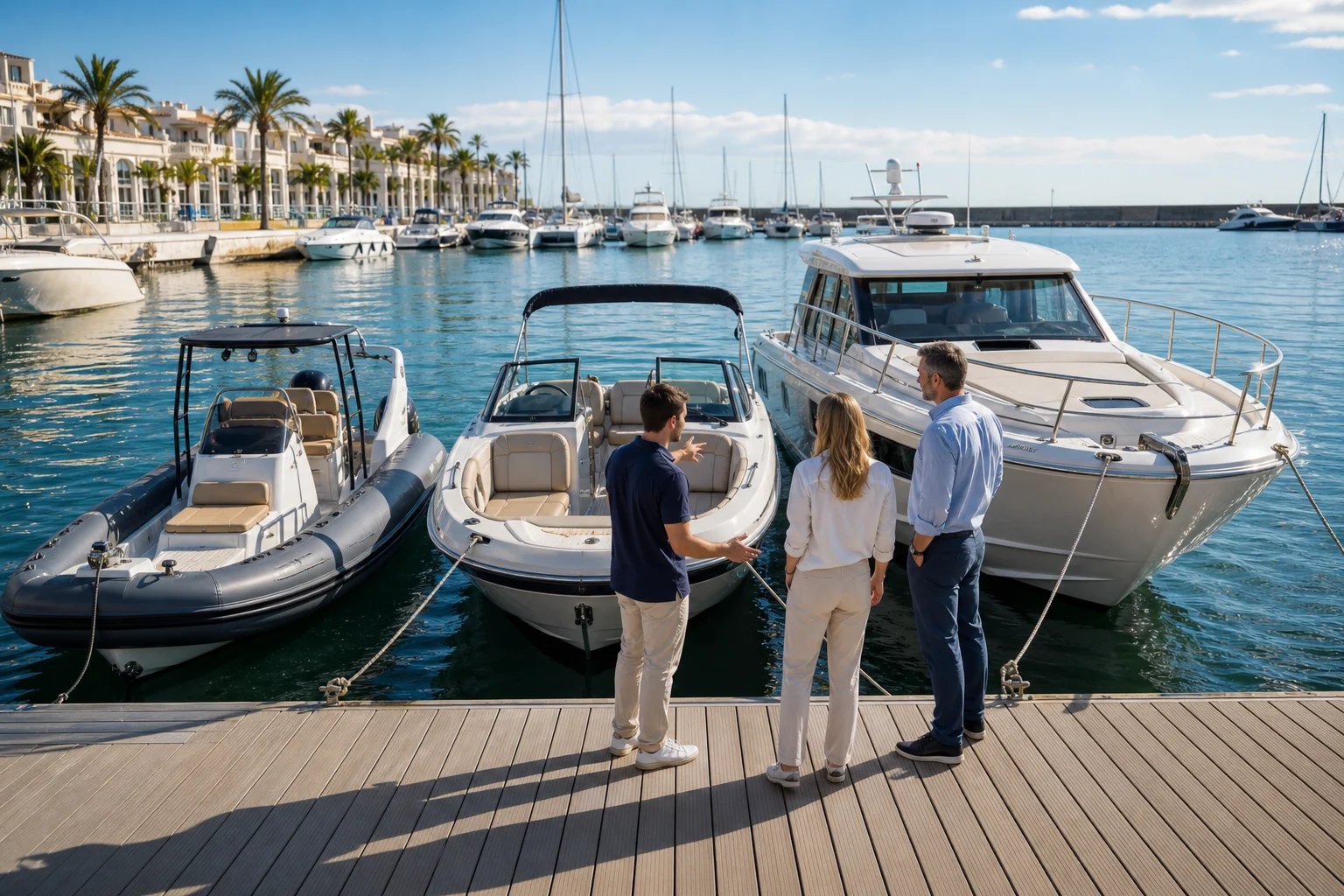
The choice between boats marketed as motorboats, RIBs or cruisers should begin with the boating programme you will repeat most of the time. Define whether you expect day trips, overnight stays or both, then compare the layout, recommended number of people, maximum recommended load, design category and manual for each boat.
These are not categories that guarantee a particular capacity, cruising area or handling behaviour on their own. Two boats of similar length can have very different layouts, load limits, design categories and engine options. Use these labels to make an initial shortlist, but make your decision using the technical specification, builder’s plate, manual and conditions at your berth.
A practical way to organise the comparison is to write down your typical scenario: how many adults will usually go, what luggage they will bring, whether shelter is needed, whether there will be a toilet or fishing gear, and how many nights you intend to sleep aboard. Then compare that scenario with the declared data for each boat.
Section references: RD 98/2016: requisitos de diseño, placa y manual ↗ · Manual del propietario, volumen 1 ↗
- Define whether normal use will be day trips, overnight stays or both.
- Compare the layout of each boat with the expected number of occupants.
- Check the recommended number of people, load and design category on the plate and in the manual.
- Do not choose based on the maximum number of people in an advert: always check the plate and manual.
Motorboat, RIB or cruiser: compare deck space, protection and overnight stays
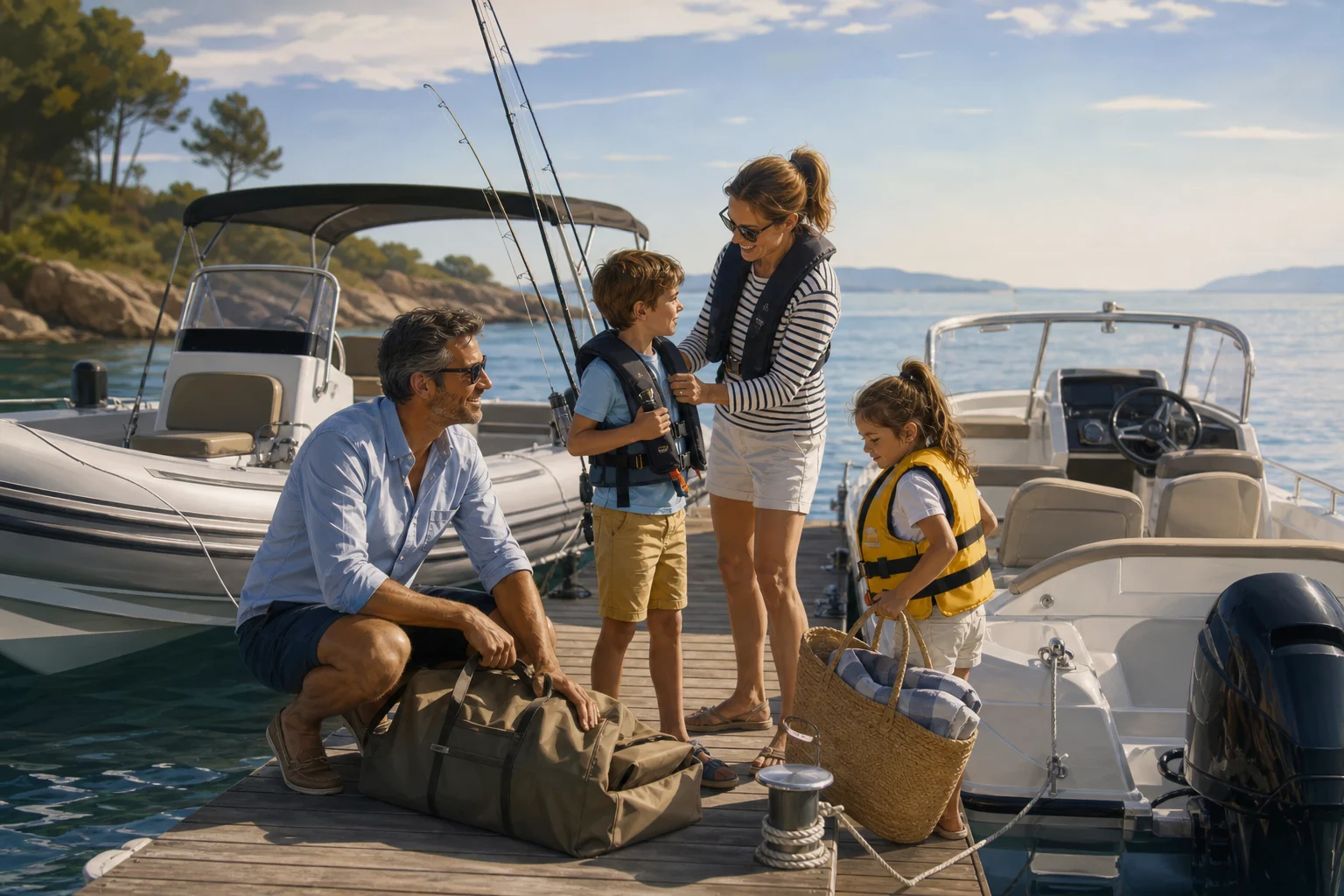
For mainly day trips, shortlist the specific motorboat or RIB that allows your usual group to board, store their equipment and move around the deck without exceeding the load or recommended number of people. Between these two labels, do not assume storage, protection or capacity: the Z Nautic manual notes that the information on the plate states the boat’s limitations and intended use.
If you are considering overnight stays, prioritise a boat whose specification states that it has cabins, and physically check ventilation, storage, access and usable space when everyone is aboard. At the shortlisting stage, a cruiser or a boat with compact accommodation is only suitable if these features meet your expected overnight needs; the commercial label does not guarantee them.
Specifications illustrate just how insufficient the label is. The Jeanneau Cap Camarat 7.5 BR, an example of an open leisure motorboat, declares an overall length of 7.5 m, a beam of 2.55 m, 1,540 kg and CE category C-9. The Merry Fisher 795 declares 7.43 m, 2,150 kg and one cabin. With similar lengths, the latter includes a cabin and also has a higher declared weight. As a specific example of a larger cruiser, the Merry Fisher 38 Fly declares an 11.43 m length, 3.84 m beam, 8,271 kg, two cabins and CE categories B10/C12/D12. For a RIB, likewise request the specification, plate and manual for the boat you are considering before assigning any capacity, load, protection or intended use to it.
| Boat | Declared data | What it helps you check |
|---|---|---|
| Jeanneau Cap Camarat 7.5 BR | 7.5 m overall length; 2.55 m beam; 1,540 kg; CE category C-9. | Layout, deck and access on a specific open motorboat. |
| Specific RIB | Check the specification, plate and manual for the offered model and configuration. | Recommended number of people, load, design category, actual layout, storage and protection. |
| Jeanneau Merry Fisher 795 | 7.43 m overall length; 2,150 kg; one cabin; CE category C9. | Compact accommodation and overnight stays on a specific boat. |
| Jeanneau Merry Fisher 38 Fly | 11.43 m overall length; 3.84 m beam; 8,271 kg; two cabins; CE categories B10/C12/D12. | Cabins, dimensions and weight of a specific larger cruiser. |
Section references: Manual del propietario, volumen 1 ↗ · Cap Camarat 7.5 BR: ficha técnica ↗ · Merry Fisher 795: ficha técnica ↗ · Merry Fisher 38 Fly: ficha técnica ↗
- For day trips, compare the deck, access, lockers and usual number of occupants on the specific motorboat and RIB.
- For overnight stays, confirm cabins, ventilation, storage and usable space in the specification and aboard the boat.
- Do not use the labels RIB, motorboat or cruiser as a substitute for the plate, manual and technical specification.
- Ask which items are standard and which are part of the offered configuration.
Berthing, transport and engine power: the factors that change ownership
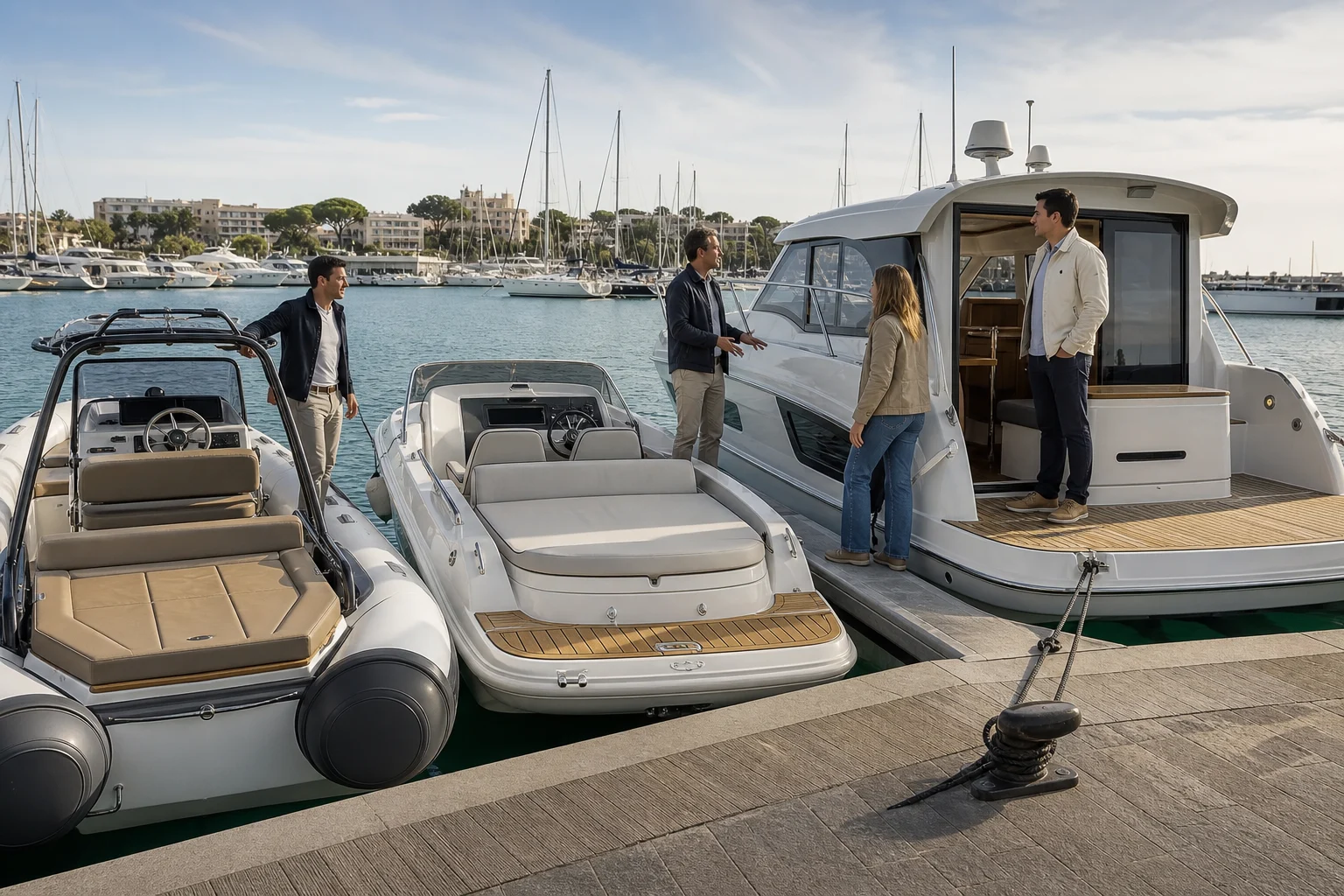
Before completing the purchase, check berth availability and collect the exact specification for the boat: overall length, beam, draught, weight and, where relevant, engine configuration. If you plan to transport it, also identify the data for the configured boat that you will need to check against the requirements applicable to your situation.
Compare engine options using the configuration stated in the manual and offered specification. Do not compare horsepower alone: the Z Nautic manual warns that excessive power can make control more difficult and that insufficient power can leave too little margin in wind and currents. Consider those warnings alongside the documented limitations and intended use of the specific boat.
A recurring mistake is to budget only for the price of the boat and engine. Before placing a reservation, calculate the cost of ownership including berthing, insurance, maintenance, inspections where applicable, fuel or energy, and any equipment you intend to add. The boat tool can help you organise these items; then request prices and conditions in writing from each provider.
Section references: Manual del propietario, volumen 1 ↗ · Cap Camarat 7.5 BR: ficha técnica ↗ · Merry Fisher 38 Fly: ficha técnica ↗
- Check the conditions applicable to the specific boat with the berth provider.
- Collect the declared weight and dimensions of the configured boat.
- Compare offers with the same declared equipment, tank and engine configuration.
- Include insurance, berthing, upkeep and inspections in the annual budget.
Builder’s plate, design category and load: limits a commercial label cannot override
The manufacturer’s permanent plate is a decisive check. Under Royal Decree 98/2016, it must state, among other information, the design category, maximum recommended load and recommended number of people. The maximum recommended load excludes the contents of full fixed tanks; therefore, do not interpret that figure as everything that can be added to the boat when fuel or water have already been loaded. The manual must provide the information needed for fitting out, maintenance, normal use and risk management.
The design category is not a licence to disregard the forecast either. As a regulatory reference, category C is associated with winds up to force 6 and significant waves up to 2 m; category D, with force 4 and 0.3 m. Even category A excludes abnormal situations such as storms and severe weather. In addition, Royal Decree 339/2021 establishes that boats must not navigate in waves and wind exceeding their design conditions and, for CE-marked boats, links the authorised area to the design category and the safety and pollution-prevention equipment carried aboard.
The practical check is simple: photograph the plate, request the manual for the specific boat/version and compare these documents with the offer. If there are discrepancies concerning people, load, category, engine or equipment, stop the decision until you obtain documentary clarification from the seller or boatbuilder.
Section references: RD 98/2016: requisitos de diseño, placa y manual ↗ · RD 339/2021: seguridad, zonas y categorías de diseño ↗
- Photograph the builder’s plate before paying a deposit.
- Add people, luggage and equipment, remembering that full fixed tanks are treated separately from the stated load limit.
- Do not navigate above the wind and wave conditions for which the boat was designed.
- Check that the planned safety equipment corresponds to the area where you intend to navigate.
Documentation, qualifications and insurance in Spain
Documentation should not be left until the end. Spain’s Ministry of Transport provides a special regime for recreational boats up to 12 m which, if both boat and propulsion unit have CE marking, may be exempt from flagging (abanderamiento), registration (matriculación) and clearance (despacho); before entering service, they need a registration certificate. Do not extend this regime to every boat: confirm the status of the boat, its marking and its use with the administration or a specialist agent.
Compulsory third-party liability insurance applies to motor-powered recreational or sports boats, including personal watercraft, and to non-motorised boats over six metres. Cover must be in place while navigating and also while the boat is berthed, for the regulated risks. Request the policy, limits, exclusions and period of validity, not just a quote.
Periodic inspections and onboard-qualification requirements also apply. Boats in Spain’s List 7 registration category of 6 m or more and under 24 m are subject to periodic inspections at intervals of no more than five years. Anyone holding a regulated recreational licence or qualification must carry it aboard when going to sea. Check which qualification, area and equipment correspond to your specific boating plan before hiring or buying.
Section references: RD 875/2014 consolidado: titulaciones de recreo ↗ · RD 607/1999: seguro obligatorio de responsabilidad civil ↗ · RD 1434/1999: reconocimientos e inspecciones ↗ · Inscripción y abanderamiento/matriculación de embarcaciones de recreo ↗
- Check the CE marking, registration certificate or applicable registration regime.
- Verify the third-party liability policy and its validity while the boat is berthed.
- Request the inspection history if you are buying a used boat in Spain’s List 7 category.
- Carry the required licence or qualification aboard when going to sea.
Five questions to complete your shortlist
With the answers above, narrow your search to two or three boats and request comparable offers. A boat is only a good choice if it fits your typical trip, its documented limits and the logistics you can sustain. If you still have doubts, hiring a boat with a similar layout can be a personal way to assess living aboard before committing your budget; this guide on Hiring a Boat in Spain: What to Ask With or Without a Skipper can support that assessment.
Do not accept a seller resolving with a promise what should appear in the documentation. Request the specification, plate, manual, engine configuration, weight, dimensions, delivery conditions, insurance and applicable administrative regime. A prudent decision compares the main use with the capacity, design conditions, berth and budget of the specific boat.
Section references: RD 98/2016: requisitos de diseño, placa y manual ↗ · RD 339/2021: seguridad, zonas y categorías de diseño ↗ · Manual del propietario, volumen 1 ↗
- Will most of my trips be day trips, overnight stays or both?
- How many people, what equipment and what luggage will I normally carry, rather than exceptionally?
- Does the specific boat have the layout, protection, storage and cabins I need?
- Can my berth accommodate its dimensions, and can I afford the full annual cost?
- Are the plate, manual, design category, load, engine, insurance and documentation compatible with my plan?
Is a RIB always better for fishing or towing watersports?
Not necessarily. Check the layout, storage, recommended number of people, maximum load, and engine configuration in the manual and offered specification, while ensuring it is compatible with the documented limits of the specific boat.
Does design category C always allow navigation in two-metre waves?
No. Category C refers to design conditions of up to force 6 and significant waves up to 2 m. Regulations require boats not to navigate in waves and wind exceeding their design conditions; in addition, the area also depends on the safety equipment carried aboard.
Does the load limit on the plate include fuel and water in fixed tanks?
No. The maximum recommended load stated on the plate excludes the weight of the contents of full fixed tanks. You must account for that weight separately when planning people, luggage and equipment.
Does every motorised recreational boat need compulsory insurance in Spain?
Yes. Compulsory third-party liability insurance applies to motor-powered recreational or sports boats. The obligation covers both navigation and the regulated risks while they are berthed.
Does a cruiser guarantee that I can sleep comfortably aboard?
No. Confirm the number of cabins in the specification and physically check access, ventilation, storage and usable space with your occupants. The commercial label does not replace these checks.