Connected V-16 beacon: how to check whether it is valid in Spain
The word “connected” in an advert is not enough. This guide explains which V-16 beacon is legal from 2026, how to check the model with the DGT and what to inspect before you pay.
Key points
Since 1 January 2026, the only legal way to signal an immobilised vehicle in Spain is with a connected, certified V-16 beacon. Before buying one, check that its exact make and model appear on the DGT list, as well as the certificate engraved on the lens and the connectivity expiry date.
Short answer: what you need from 1 January 2026
The transition date has already passed. Since 1 January 2026, the connected V-16 is the only legal means of signalling an immobilised vehicle in Spain. Warning triangles and V-16 light beacons that did not meet the connectivity requirements could only be used until that date.
To make a purchase decision, it is not enough to look for a yellow light, a magnetic base or the word “approved” in a shop. Your decision should be based on three cumulative checks: the exact make-and-model combination must appear on the DGT’s official list of certified devices; the laboratory and certificate number must be engraved on the lens; and both the packaging and the device itself must state the connectivity expiry date.
It is advisable to carry out this check before removing the packaging and to keep proof of purchase. A visually similar V-16, even if advertised as connected, is not proven valid if it cannot be identified on the official list.
Section references: Listado oficial y preguntas frecuentes sobre V-16 ↗ · Real Decreto 159/2021 consolidado: transición y conducta ante avería ↗ · Nota oficial sobre obligación y uso de la V-16 ↗
- Look for the exact model, not just the brand name.
- Check that the certificate on the lens matches the model you looked up.
- Find the date until which the connectivity service is guaranteed.
- Avoid deciding solely on price, claimed battery life or generic advertising wording.

What a connected V-16 does — and does not do
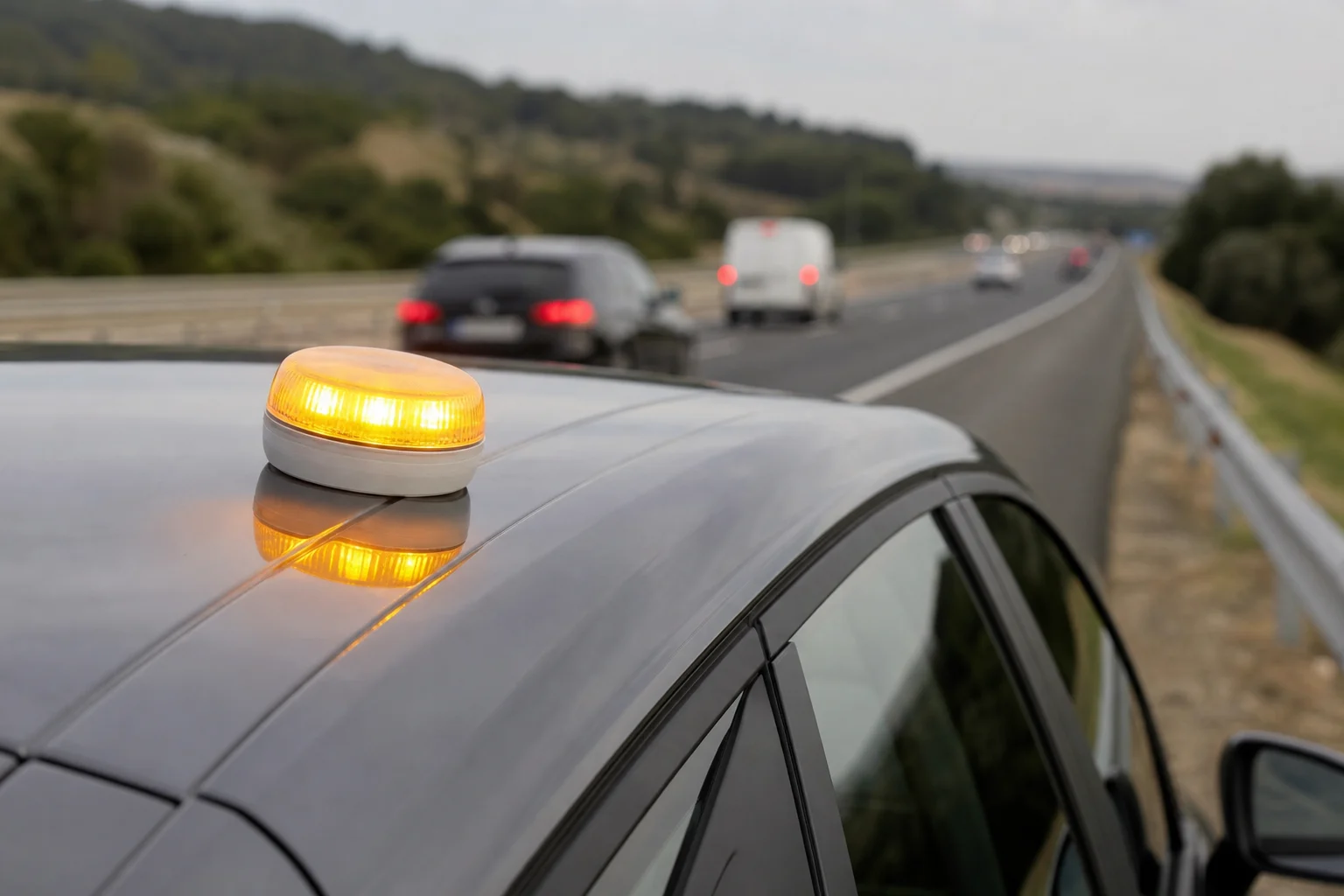
The V-16 signal warns that a vehicle has become immobilised on the carriageway or that its load has fallen onto it. The regulations require it to be amber in colour, provide 360-degree horizontal visibility and maintain the required light intensity for at least 30 minutes.
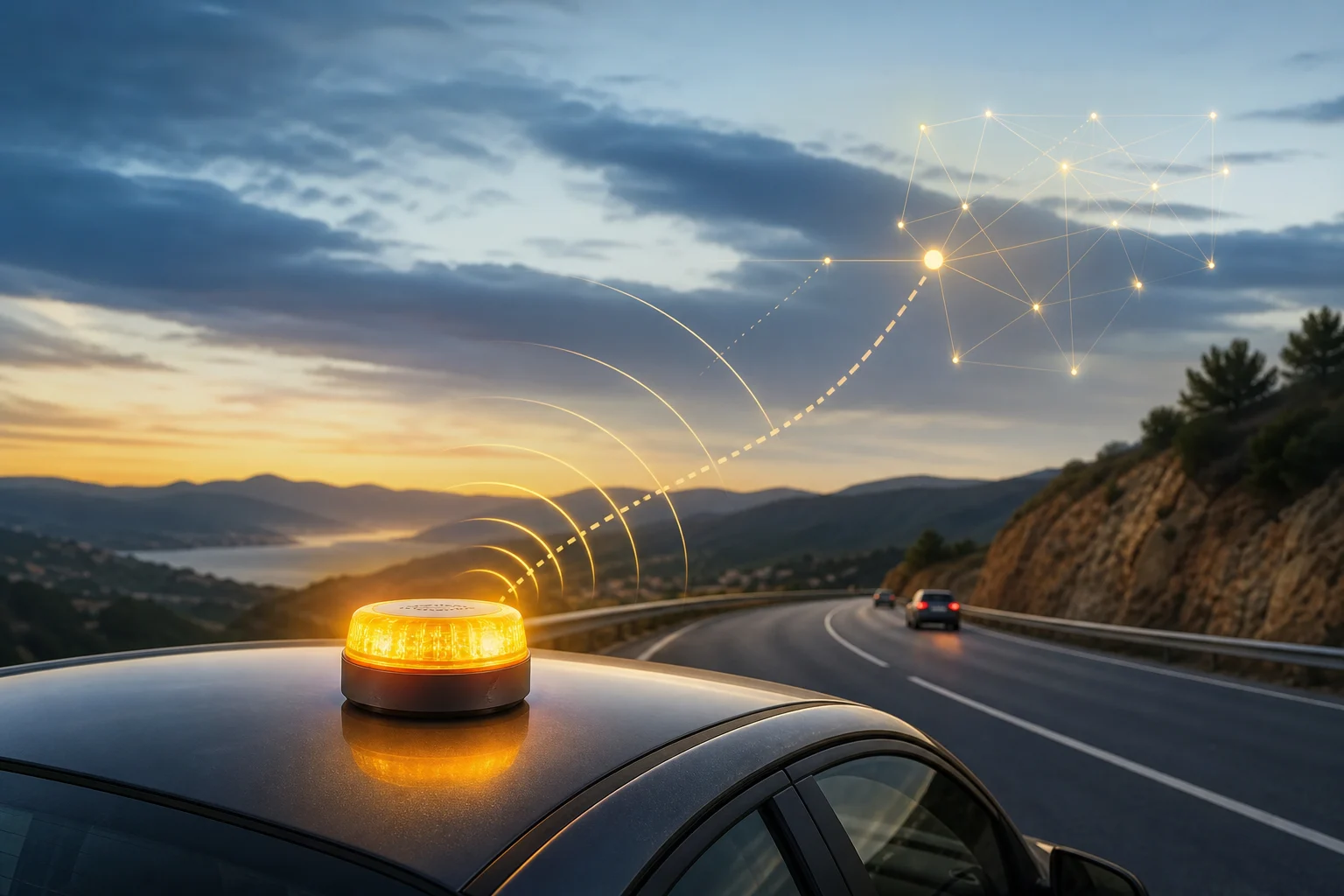
Its decisive difference from a conventional light beacon is communication. When activated, it must report activation, deactivation and geolocation to the National Traffic and Mobility Access Point. While it remains switched on, its location is transmitted every 100 seconds; once deactivation is reported, it stops transmitting.
The communication elements must be integrated into the housing. Therefore, a product that needs to be paired with a mobile phone, requires an app to be opened or needs an external accessory to send its location does not meet this requirement. Connectivity must also be included in the sale price and guaranteed for at least 12 years.
The beacon is not an eCall system and does not replace calling for help. The DGT states that the driver must raise the alarm where possible. Nor does it transmit personal data or vehicle-identifying information: it transmits location only when activated.
Section references: Listado oficial y preguntas frecuentes sobre V-16 ↗ · Reglamento General de Vehículos, anexo XI, señal V-16 ↗
- Built-in connectivity: it must not depend on a mobile app.
- Periodic location while activated: every 100 seconds.
- Service included in the price for at least 12 years.
- It does not replace requesting assistance or reporting the incident where possible.
How to verify the model before buying: a four-step method
The most reliable method starts outside the shop. Go to the DGT’s official list of certified V-16 devices and look for the full reference shown in the seller’s listing, on the packaging or on the beacon itself. Do not accept an approximate match: one brand may sell more than one model.
The list lets you check the certification date, certificate number, model, brand and applicant. Compare them with the product in front of you. During the physical check, make sure that the lens has the laboratory name and certificate number engraved on it. This is useful protection against adverts using generic photos or incomplete product names.
Next, look for the connectivity expiry date in two places: on the packaging and on the beacon itself. The regulations require it to appear on both. This date is not a minor detail, because it determines until when the communications service included with the device is guaranteed.
Finally, check which section the product appears in. The DGT separates certified models from those whose certificates have expired. The latter are still described as valid for people who bought them until the end of their useful life, but this situation should not be confused with that of a new model being offered today. For a new purchase, the clearest option is for the exact model to appear among those with valid certification and for its details to match the unit.
Section references: Listado oficial y preguntas frecuentes sobre V-16 ↗ · Reglamento General de Vehículos, anexo XI, señal V-16 ↗ · Nota oficial sobre obligación y uso de la V-16 ↗
- 1. Note down the exact brand and reference before paying.
- 2. Check the model, brand, certificate number and certification date with the DGT.
- 3. Check the laboratory and certificate number on the lens.
- 4. Confirm the connectivity date on both the box and device.
- 5. Keep the invoice, packaging and documentation identifying the model.
Which marketing claims do not prove it is valid
The most common purchasing mistake is to equate a light-emitting V-16 with a certified connected V-16. Flashing, having a magnet or stating 360-degree visibility may describe some physical features, but none of these proves that it communicates its location in accordance with the regulations or that it is included on the official list.
Nor are messages such as “connected”, “compatible with DGT 3.0”, “geolocated”, “suitable for 2026” or “approved” sufficient on their own. The DGT itself warns that not all beacons advertised as connected are approved. The practical evidence is a match between the unit, its certification details and the DGT register.
Be particularly wary of listings that omit the model, do not show the certificate number or do not state when connectivity ends. The requirement for this service to be included for at least 12 years does not mean that every unit will have the same end date: you need to read the specific date on the device you are buying.
| System | Status from 1 January 2026 | Light and visibility | Location communication |
|---|---|---|---|
| Warning triangles | No longer the legal signalling method after the transition period | Do not emit their own light | No |
| Non-connected light V-16 | No longer valid as a regulatory signal after the transition period | Must be distinguished from a connected V-16; light alone does not prove current validity | Does not meet the connectivity requirement |
| Certified connected V-16 | The only legal means of signalling immobilised vehicles | Amber colour, 360-degree horizontal visibility and intensity requirements for at least 30 minutes | Yes: activation, deactivation and geolocation; location every 100 seconds while activated |
Section references: Listado oficial y preguntas frecuentes sobre V-16 ↗ · Reglamento General de Vehículos, anexo XI, señal V-16 ↗
- Do not buy based only on “approved” or “connected”.
- Do not assume a beacon with an app meets the regulatory connectivity requirement.
- Do not accept an incomplete model reference or one that differs from the DGT listing.
- Do not confuse the minimum 12-year connectivity guarantee with unlimited use.
Use and storage: accessibility rather than improvisation
The best beacon is useless if it is buried under luggage or has no charge. The DGT recommends keeping it charged and accessible, for example in the glove box. Before a journey, check its condition and that it is still accompanied by its identifying information; do not wait for a breakdown to locate it for the first time.
In the event of an incident, the priority is to reduce risk. If the vehicle can continue, it must leave the traffic lanes as soon as possible and head for the first available exit using the right-hand hard shoulder. If it cannot do so, it must stop on the right-hand hard shoulder or in the place that causes the least obstruction.
To signal the incident, the DGT says to switch on the beacon and place it from inside the vehicle in the highest possible position. This guidance is intended to prevent an occupant from having to walk on the road to position a signal. The V-16 is a visual and connected warning, not a solution to every risk involved in an immobilisation: assess the surroundings, request help where possible and follow the instructions of the services attending the incident.
Section references: Reglamento General de Vehículos, anexo XI, señal V-16 ↗ · Real Decreto 159/2021 consolidado: transición y conducta ante avería ↗ · Nota oficial sobre obligación y uso de la V-16 ↗
- Keep it charged and within the driver’s reach, preferably in the glove box.
- Check regularly that the stated connectivity date has not passed.
- If you can continue, leave the traffic lanes and use the right-hand hard shoulder to reach the first exit.
- If you cannot, stop on the right-hand hard shoulder or where you cause the least obstruction.
- Switch it on and place it from inside the vehicle in the highest possible position.
What to do if you already have an older V-16
A beacon bought before 2026 does not automatically become valid simply because it still works. If it is a light-emitting V-16 without regulatory connectivity, it stopped serving as a legal signal when the transition period ended on 1 January 2026. If it is presented as connected, apply the same checks of brand, model, certificate and connectivity date as you would for a new purchase.
The fact that a model appears on the list with an expired certificate does not necessarily mean that an already purchased unit must be discarded: the DGT states that these models are valid for those who bought them until the end of their useful life. However, if you cannot find the model or its identifiers, or if the connectivity shown on the product has expired, there is no documentary basis for considering it a current solution.
The final check can be summarised as follows: identify the unit, consult the register, inspect the lens and connectivity date, and keep it charged in an accessible place. It is a quick check that avoids discovering an incompatibility when you already need to signal an immobilisation.
Section references: Listado oficial y preguntas frecuentes sobre V-16 ↗ · Reglamento General de Vehículos, anexo XI, señal V-16 ↗ · Real Decreto 159/2021 consolidado: transición y conducta ante avería ↗
- Non-connected V-16: not valid from 1 January 2026.
- Older connected V-16: check the model, certificate and connectivity date.
- Model with an expired certificate: consult the specific DGT section and its condition of use until the end of useful life.
- Unidentifiable model or expired connectivity: replace it with a verifiable unit.
When did the connected V-16 beacon become mandatory in Spain?
Since 1 January 2026, it has been the only legal means of signalling immobilised vehicles. Warning triangles and V-16 light beacons without connectivity could only be used during the preceding transition period.
How do I know whether my V-16 beacon is certified?
Look for the exact brand-and-model combination on the DGT’s official list. Then check that the lens includes the laboratory name and certificate number, and that these details are consistent with the product.
Is a V-16 that requires a mobile app valid?
The regulations require communication elements to be integrated into the housing and not to depend on phone apps or other external elements. If it needs an app to provide connectivity, it does not meet that requirement.
How long does the included connectivity last?
It must be included in the purchase price and guaranteed for at least 12 years. The specific expiry date must appear on both the packaging and the device itself.
Does the connected V-16 work where there is no signal?
The DGT states that it uses specialised IoT networks in tunnels or areas without conventional coverage. If no network is available either, it retains its function as a visual signal and stores the data to send it once connection is restored.
Does the V-16 automatically alert the emergency services?
No. The DGT makes clear that it is not an eCall system and does not replace calling for help. The driver must raise the alarm where possible.