How to winterize a jet ski: cleaning, storage and manual
Storing a jet ski for months requires combining cleaning and drying with strict adherence to the manual for fuel, battery and circuits. This guide separates what can be done generally from what should be left to a dealer or qualified mechanic.
Key points
Storing a jet ski for months requires cleaning and drying it, then following the applicable manual for fuel, battery and circuits. This guide separates general steps from work for a dealer or qualified mechanic.
Why winterizing a jet ski is more than just parking it
How to winterize a jet ski depends on the model, how long it will be out of use and the type of water in which it has been used. The Yamaha WaveRunner owner’s manual consulted states that the cooling water passages should be flushed to prevent blockages caused by salt, sand or dirt. This is not a procedure that can be transferred in detail to every make and configuration, but it explains why salt water requires attention to cleaning.
The same manual states that leaving the jet ski in the water for prolonged periods speeds up normal deterioration of the jet pump and hull. For a lay-up lasting weeks or months, its instruction is to take it out of the water, clean it and store it. The specific storage method must follow the manual for the individual unit.
The key is to divide the work into two groups. The first covers documented general operations, such as removing the jet ski from the water, washing the specified areas and drying them. The second covers fuel, cooling, internal engine protection and the battery. In this second group, the exact manual for the unit—make, model, year and market—takes precedence and, when the owner does not know the required maintenance, so does a dealer or qualified mechanic.
Section references: Manual del propietario Yamaha WaveRunner, sección “Care and storage” ↗
- If it has been used at sea, consult the flushing procedure specified for your model.
- If it has remained afloat, follow the manufacturer’s instruction on removing it from the water for long-term storage.
- Do not improvise engine, fuel or cooling procedures.
- Keep a dated checklist of completed tasks for recommissioning later.
Start with the manual, outstanding maintenance and documents
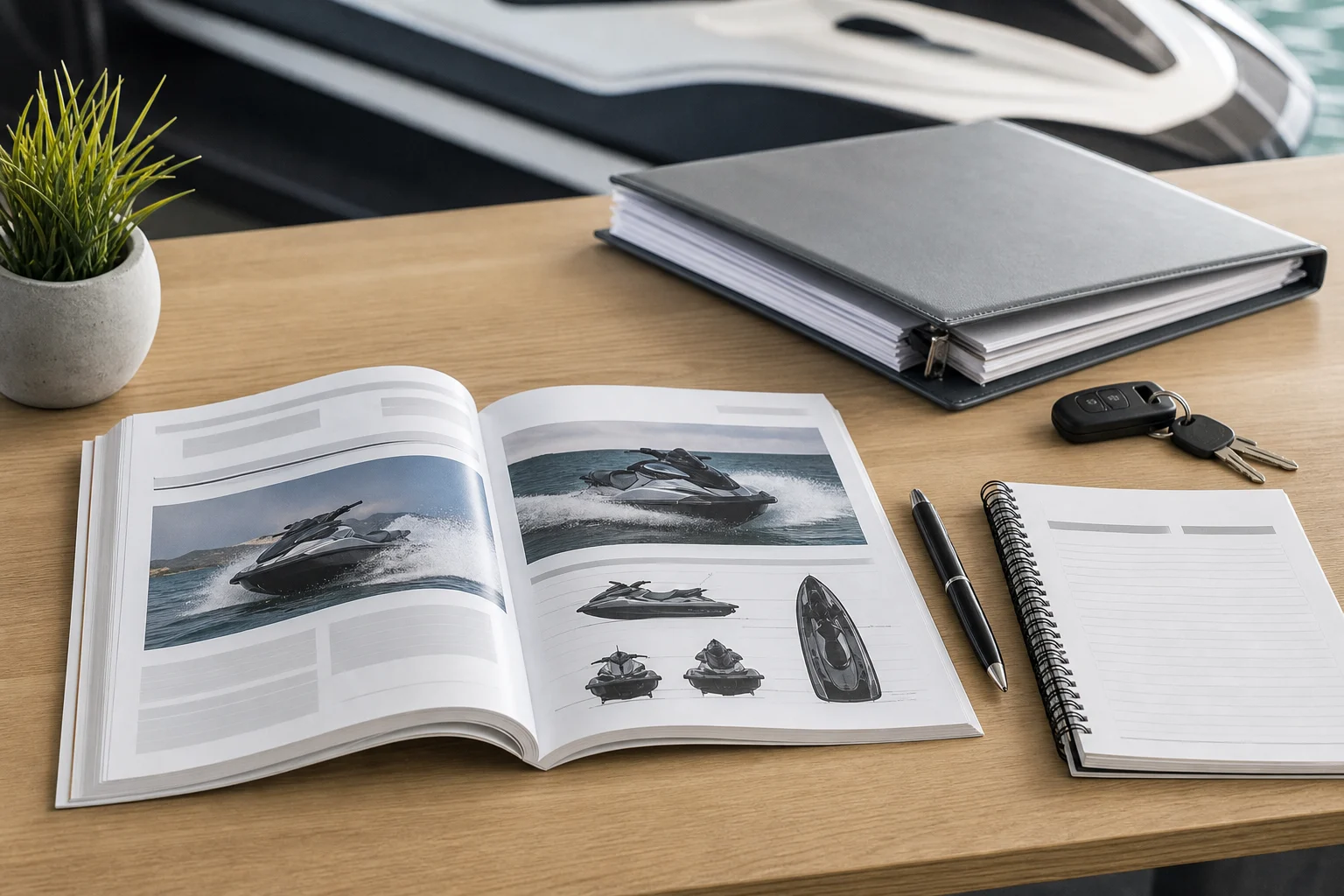
Before opening compartments or connecting a hose, find the owner’s manual that corresponds exactly to your jet ski. The Yamaha manual consulted defines extended storage, such as winter storage, as a situation requiring preventive maintenance and recommends an inspection by a dealer before storing it. This reference sets a prudent rule: the manufacturer’s manual is the governing document, not a generic sequence from another jet ski.
Review the sections on storage, care, battery, fuel and cooling. Note the maintenance operations stated in the manual and those already completed. When an instruction is unclear to the owner or goes beyond their familiarity with maintenance, the Yamaha manual refers them to a dealer or qualified mechanic.
Prepare a physical or digital folder containing the manual, registration record and available maintenance records. Spain’s Ministry of Transport and Sustainable Mobility provides separate procedures for personal watercraft, including registration, change of ownership, change of list, deregistration and duplicate registration records. Keeping that record easy to locate avoids unnecessary searching when the season returns; if it is lost, there is a specific official procedure to request a duplicate.
Section references: Manual del propietario Yamaha WaveRunner, sección “Care and storage” ↗ · Trámites de motos náuticas ↗
- The correct owner’s manual for your model, year and market.
- A record of completed maintenance and of the work specified by the manual.
- The registration record kept somewhere easy to find or securely digitised.
- A note of questions that need to be resolved by a dealer or qualified mechanic.
Exterior cleaning and drying: the general steps worth taking
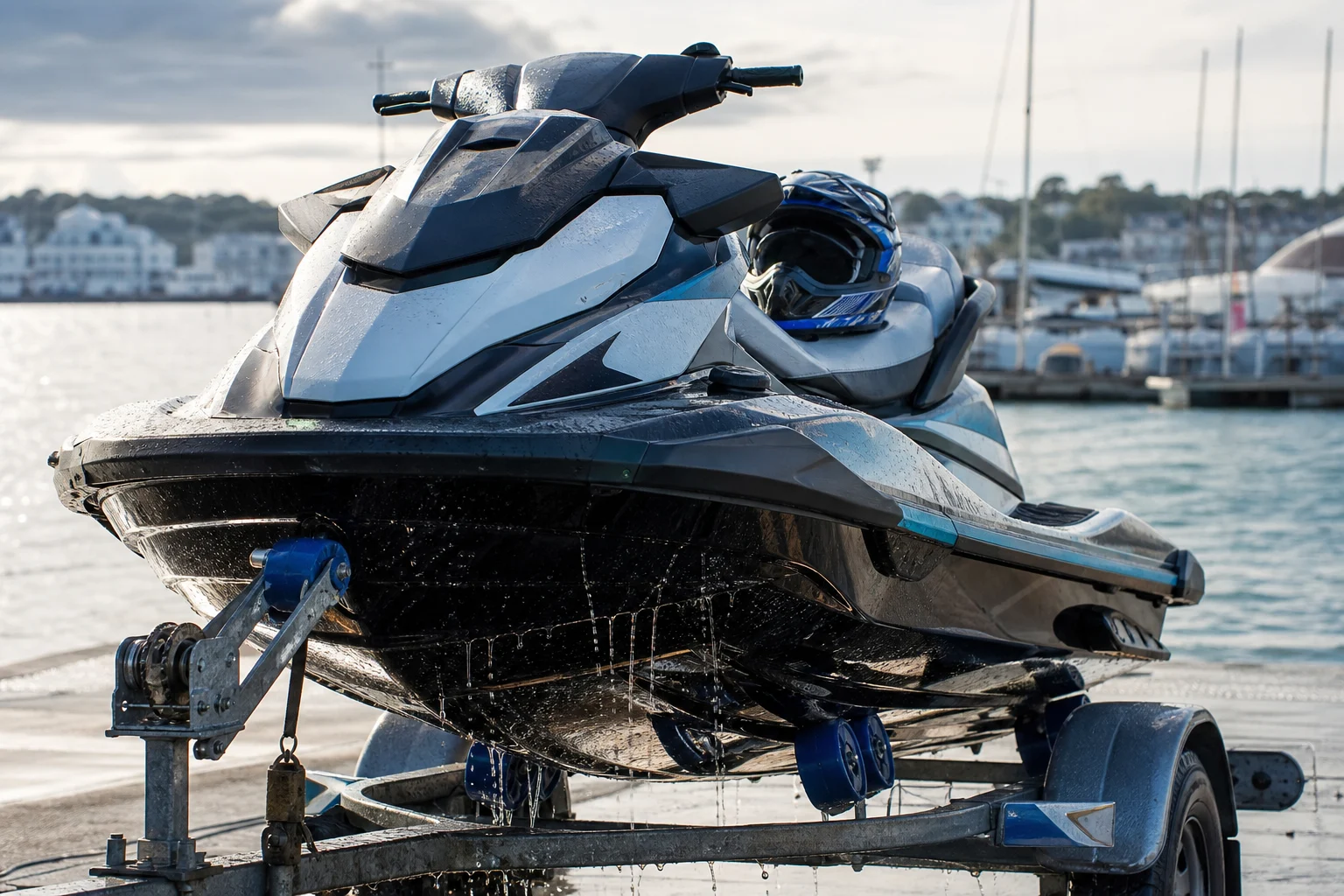
After taking the jet ski out of the water, the documented general approach is to clean the exterior with fresh water and remove any residue left on the hull, deck and accessible areas. The Yamaha manual consulted states that the jet ski should be cleaned and that the engine, engine compartment, hull, deck and jet pump should be dried with a cloth.
Follow the access points, products and operations specified by your unit’s manufacturer. Before finishing, check the areas included in the manual’s cleaning and storage procedure. If the model requires flushing the cooling water passages, follow the specific sequence specified by its manufacturer.
There is an important limit: do not turn this cleaning into a high-pressure procedure on the engine or engine compartment. The Yamaha manual consulted prohibits using high-pressure water to rinse those areas. This specific prohibition should be checked in every manual.
Section references: Manual del propietario Yamaha WaveRunner, sección “Care and storage” ↗
- Remove the jet ski from the water before long-term storage when the manufacturer instructs you to do so.
- Wash the hull, deck and accessible areas in accordance with the manual.
- Remove salt, sand and dirt from the areas covered by the procedure.
- Dry the surfaces and compartments specified by the manufacturer with a cloth.
- Do not use high-pressure water on the engine or engine compartment if the manufacturer prohibits it.
Fuel, battery and circuits: do not copy a universal recipe
The biggest winter-storage mistakes can result from applying universal advice to systems that are not alike. Fuel is a clear example. For the Yamaha model covered in the documentation, the manufacturer instructs users to fill the tank with fresh petrol and add stabiliser and conditioner according to that product manufacturer’s instructions before starting the engine. This does not make a full tank a rule for every jet ski: consult the specific section of your manual.
Nor should the order for connecting a hose, starting the engine or turning off the water be presented as a general guideline. The Yamaha manual warns that supplying water with the engine off may allow water to enter through the silencer and cause serious engine damage. This operation depends on the model. If the manual requires the circuits to be flushed, follow its steps, limits and warnings exactly; if you do not know the required maintenance, use a dealer or qualified mechanic.
For the battery, the documented approach is to store it in a cool, dry place and check it periodically. The same manual warns that storing it discharged can cause permanent damage. For checking voltage or charging it, it recommends consulting a dealer and warns against charging it quickly. Follow the charger and jet ski manufacturer’s instructions.
Corrosion protection for internal engine components should be left to the dealer when the manual says so. The Yamaha manual assigns that work to its dealer. Likewise, mechanical work unfamiliar to the owner must follow the manual or be carried out by a dealer or qualified mechanic.
Section references: Manual del propietario Yamaha WaveRunner, sección “Care and storage” ↗
- Confirm the exact fuel and additive strategy in the manual.
- Follow the stabiliser or conditioner product instructions when the jet ski manufacturer prescribes it.
- Do not begin a cooling-system flush without knowing the sequence specified for your model.
- Store and check the battery in accordance with the manufacturer’s instructions.
- Do not try to charge the battery in a hurry.
- Leave internal engine protection to a dealer or qualified mechanic when the manual says so.
Trailer, cover and space: follow the position specified by the manufacturer
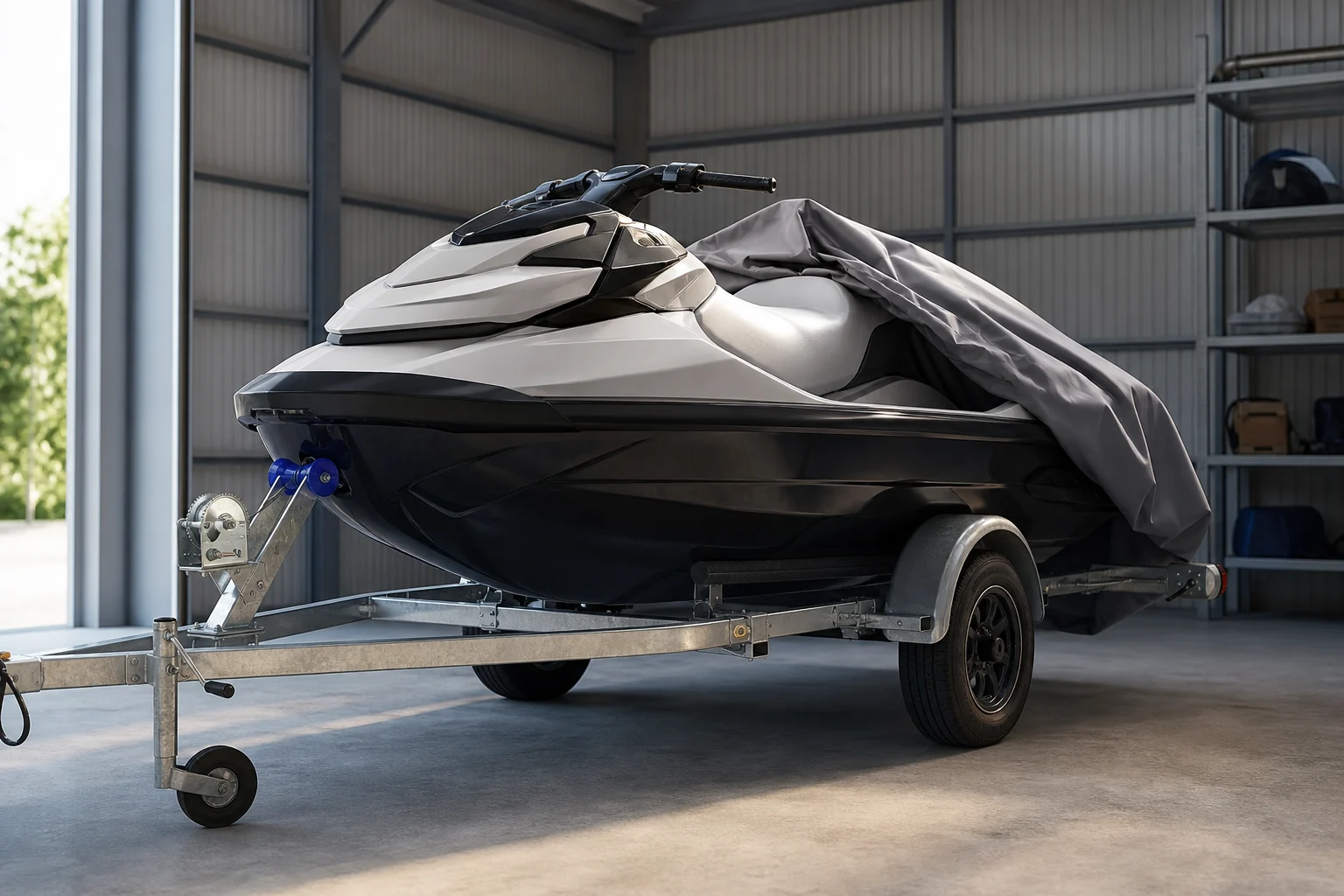
Once cleaned and prepared in accordance with the manual, the jet ski must be placed in the storage position specified by its manufacturer. For the Yamaha model consulted, the manual prescribes a specific position and warns that another one may encourage fuel to leak into the engine or engine compartment and create a fire risk. Do not transfer that instruction to other models: consult the support points, orientation and securing method specified for your unit, especially if it remains on a trailer.
If you use a cover, review the instructions from the jet ski manufacturer or the cover manufacturer itself. The choice of storage location and any conditions for trailer access or placement must comply with the rules of the garage, indoor facility, dry stack or marina.
If the trailer is left on a public road in Spain, Spain’s General Traffic Regulations require that it must not obstruct traffic or create a risk, and that measures must be taken to prevent it from moving in the driver’s absence. Applicable municipal by-laws must also be observed. Do not assume that any street, parking area or coastal location allows such long-term storage.
Section references: Manual del propietario Yamaha WaveRunner, sección “Care and storage” ↗ · Reglamento General de Circulación: estacionamiento ↗
- Follow the storage position specified for your jet ski.
- Consult the manual for the support points and securing method specified for the model.
- If using a cover, follow the instructions applicable to that cover and the jet ski.
- Check the conditions of the facility where it will be stored.
- If parking on a public road in Spain, check municipal regulations and avoid risks or obstructions.
Storage and a checklist for the next season
In a garage, indoor facility or dry stack, consult the site rules on access, trailer placement and storage conditions. Keep the manual and documents easy to find, and check the battery periodically when the manual requires checks during storage.
Do not confuse a storage recommendation with permission to leave the jet ski at any point along the coast. Spain’s national regulations expressly prohibit rental personal watercraft from being beached or parked on the beach. For a privately owned jet ski, the specific conditions of a dry stack, marina, garage or indoor facility depend on the rules of each site, in addition to the applicable general and local rules.
When the new season arrives, retrieve the closing checklist and compare what was done with the manual. Check that the documentation is available, completed maintenance is recorded and technical tasks have been addressed in accordance with the manufacturer’s instructions. Recommissioning must follow the reactivation procedure established for your jet ski.
Section references: Manual del propietario Yamaha WaveRunner, sección “Care and storage” ↗ · Real Decreto 259/2002 consolidado: medidas de seguridad en motos náuticas ↗ · Trámites de motos náuticas ↗
- Note the date and location of storage.
- Keep the manual, registration record and maintenance records somewhere easy to find.
- Check the battery periodically as specified by the manual.
- Check the rules of the garage, indoor facility or dry stack before leaving the jet ski there.
- Before using it again, follow the manufacturer’s recommissioning procedure.
- If you do not know a required maintenance operation, consult a dealer or qualified mechanic.
Should the fuel tank of a jet ski be left full or empty over winter?
There is no single rule that applies to all jet skis. For that Yamaha model, the manual consulted prescribes filling the tank with fresh petrol and adding stabiliser and conditioner according to the product instructions. Consult your model’s manual before deciding.
Can I flush the circuits with a hose by following a generic video?
It is not advisable. The sequence depends on the model. The Yamaha manual consulted warns that supplying water with the engine off can allow water to enter through the silencer and cause serious engine damage. Follow only the relevant manual or use a dealer or qualified mechanic.
Can I leave my jet ski in the water all winter?
For long-term storage, the Yamaha manual consulted instructs owners to take it out of the water, clean it and store it. It also states that keeping it in the water for long periods speeds up normal deterioration of the jet pump and hull.
What should I do with the battery during months of non-use?
The Yamaha manual consulted states that it should be stored in a cool, dry place and checked periodically, because storing it discharged can cause permanent damage. For charging, follow the charger and manufacturer’s instructions or use a dealer or qualified mechanic.
Can I park the trailer with the jet ski on any street?
In Spain, it must not obstruct traffic or create a risk, and it must be positioned so that it cannot move in the driver’s absence. You must also comply with applicable municipal by-laws.