Buying a used personal watercraft: paperwork, insurance and pre-purchase checks
Before buying a used personal watercraft, it is advisable to check its identification, the watercraft’s Licencia de Navegación, the ownership transfer, insurance and trailer. This guide sets out the key paperwork steps in Spain.
A personal watercraft is not bought or registered like a car
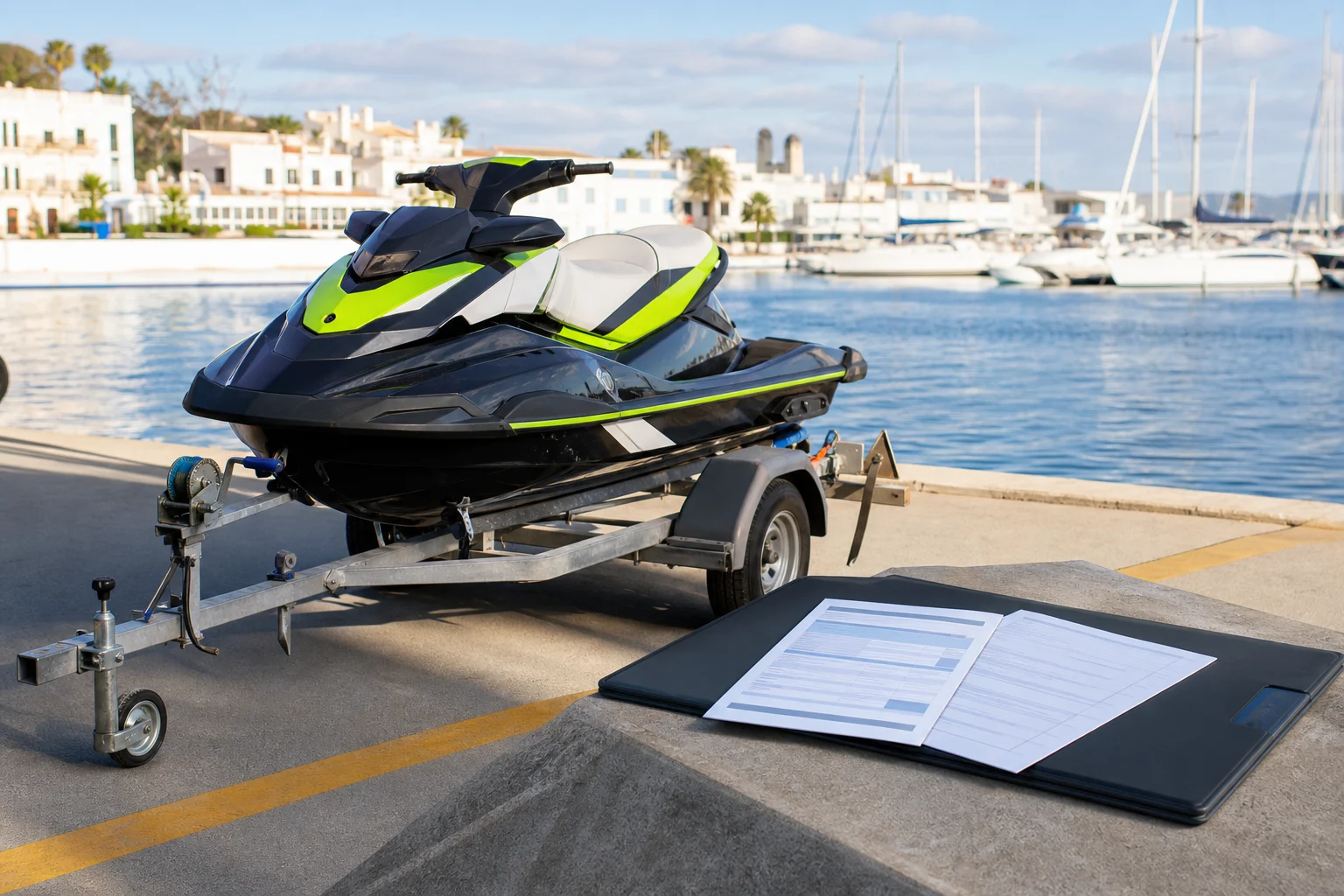
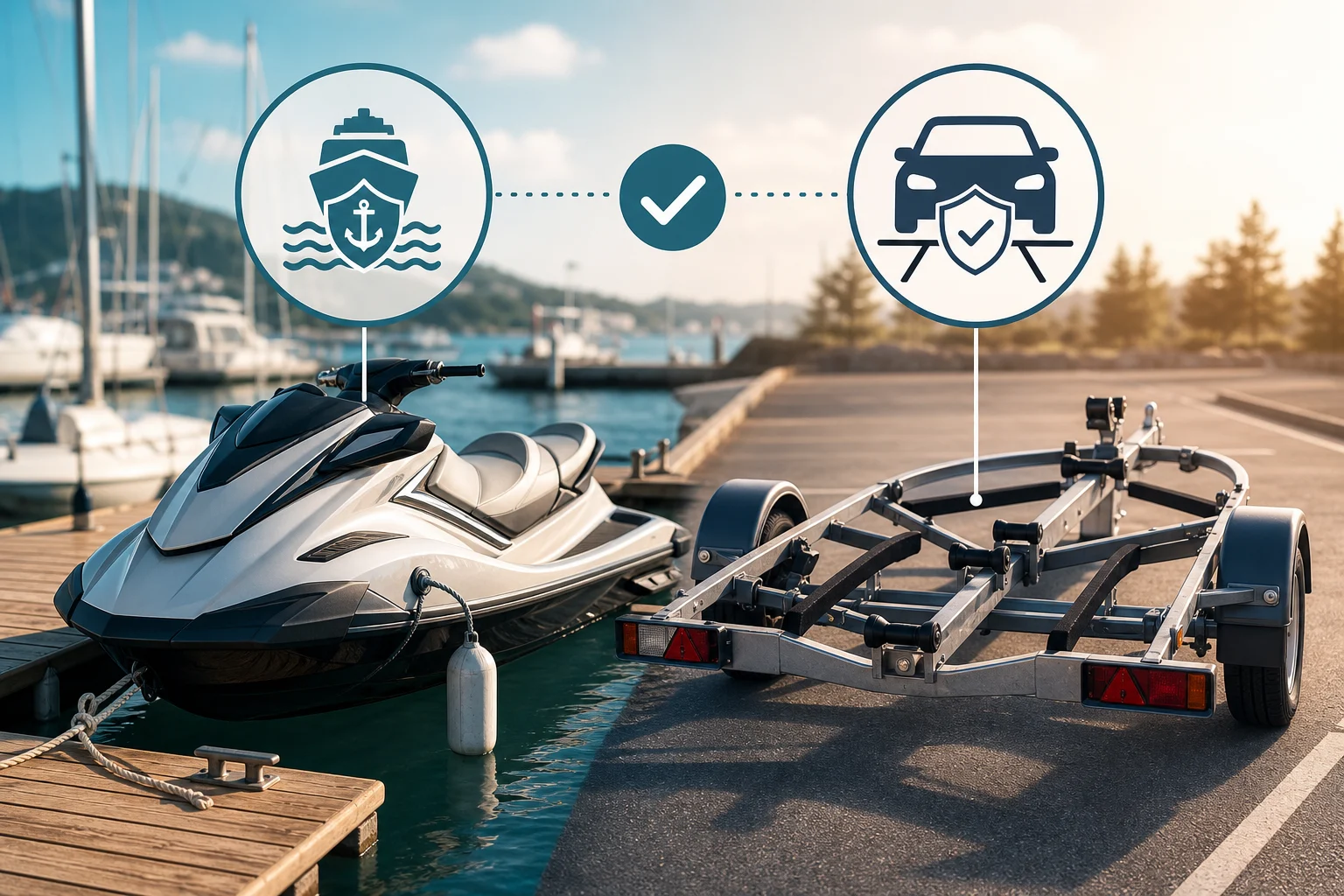
Buying a used personal watercraft requires checking two elements that are often confused: the personal watercraft itself and, if included, the trailer. In Spain, personal watercraft intended for recreational use are subject to a specific registration, record-keeping and identification procedure, under List Six or Seven of the Vessel Registration Register.
For this reason, an orderly transaction does not end when the price is agreed or the watercraft is collected. It is advisable to check that the unit being offered, its paperwork and the person selling it all show consistent details. Navigating without an identification marking is a serious administrative offence.
The trailer, on the other hand, must be checked separately. Its paperwork, maximum authorised mass and relationship with the towing vehicle may affect whether the combination can be transported on the road.
- Do not pay a deposit before receiving legible photographs of the documents and the unit’s identifiers.
- Separate the value of the watercraft from the value of the trailer in the agreement and inventory.
- Do not treat a registration number or identification marking as sufficient proof of ownership: compare the details with the watercraft’s Licencia de Navegación (Navigation Licence) and the seller’s identity.
What to request before travelling and how to compare the identification
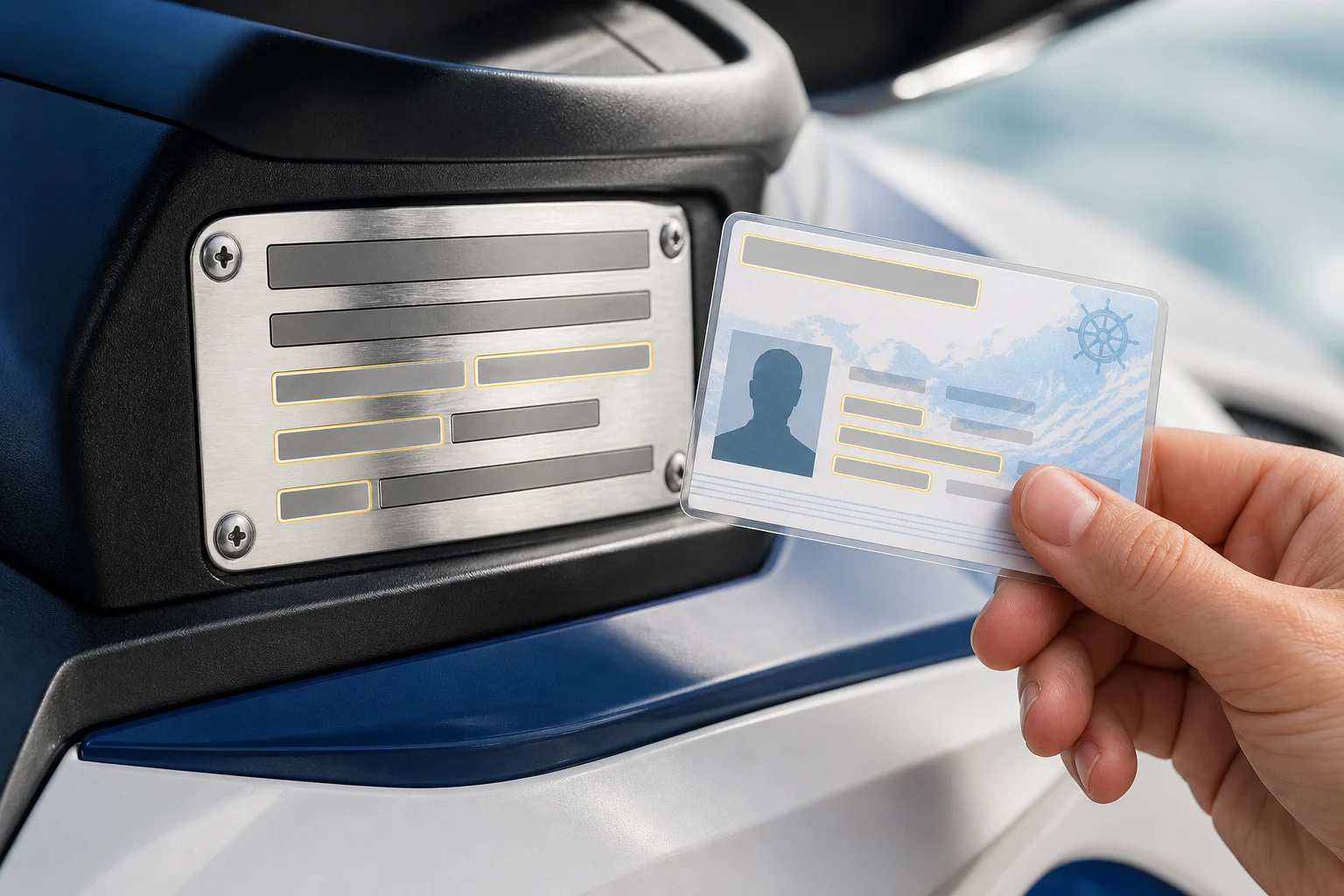
Before seeing the watercraft, ask the seller for a copy or clear photographs of the watercraft’s Licencia de Navegación and a document that identifies them. Also request images of the identification marking and the hull and/or frame number. Visually comparing the documents with the unit helps reduce the risk of mistaking one watercraft for another or starting an ownership transfer with incorrect details.
The Licencia de Navegación issued for the watercraft includes the holder’s identification, the identification number allocated, and the make, model, and hull and/or frame number. During the visit, compare each of those fields with the watercraft one by one. Check that the number located on the hull or frame is legible and can be read reliably.
Also confirm that the seller is the holder shown on the licence or can clearly justify their authority to sell. If there are differences in the name, make, model or identifiers, stop before signing and ask for the discrepancy to be clarified by the Capitanía Marítima where it is registered.
- Request the watercraft’s Licencia de Navegación, the seller’s identification, and photographs of the identification marking and hull and/or frame number.
- During the visit, compare the holder, identification number, make, model, and hull and/or frame number.
- Record the details exactly as they appear, without abbreviations or unexplained handwritten amendments.
- If any detail does not match, do not sign a contract that reproduces it as though it had been verified.
Ownership, registration and contract: the order of the transaction
A change of owner is not completed simply by handing over the watercraft. The buyer must notify the change of ownership to the Capitanía Marítima where the watercraft is registered so that the new owner can be recorded and a new Licencia de Navegación issued. The online office of the Ministry of Transport and Sustainable Mobility provides a specific procedure called “Change of ownership of a personal watercraft”.
When the transfer is formalised through a sale and purchase contract, the application must be accompanied by a certified copy of the legal purchase invoice or the official payment form for Transfer Tax and Stamp Duty. It is therefore advisable to obtain the applicable proof before submitting the file.
The contract can accurately record what has been agreed, but it does not replace the administrative record. It is advisable to identify the buyer and seller, describe the watercraft using the details on the licence—make, model, identification number, and hull and/or frame number—state the price and delivery date, and list the items handed over. If there is a trailer, include it in a separate inventory.
Do not confuse the Licencia de Navegación issued to identify and document the watercraft with any personal qualification that may be required to operate it. This guide focuses on the unit’s paperwork, ownership, insurance and trailer. The document serving as the Licencia de Navegación must be kept on board when the watercraft is navigating.
- The contract and licence must show the watercraft’s identifiers consistently.
- Keep a copy of the contract, the previous licence, the applicable tax proof and the ownership transfer application.
- Agree in writing when the watercraft will be handed over and which documents and accessories are included.
- Do not navigate relying on the contract alone: keep the document serving as the Licencia de Navegación on board.
Compulsory insurance: what it proves and what it does not cover by itself
To check that compulsory third-party liability insurance is valid, request proof that the premium has been paid. It must sufficiently identify the insurer and the insured watercraft, as well as the coverage period, including its start and end date and time. Check that the document’s identification enables it to be linked unequivocally to the purchased unit.
This insurance relates to third-party liability. It should not be assumed to cover damage to the watercraft itself or damage while the unit is towed or transported by road, as these situations fall outside its scope. Before using the watercraft after purchase, confirm with the insurer how cover is arranged for the new holder.
For races, trials, competitions and training, special insurance is required. If this is the intended use, expressly confirm that the required cover has been taken out before participating.
- Check the insurer, watercraft identification, coverage start and end, and proof of payment.
- Do not confuse third-party liability with own damage or road transport cover.
- Ask the insurer about the handling of the ownership transfer before using the watercraft.
- For trials or competition, confirm that the required special insurance has been taken out.
Watercraft paperwork and conditions of use: do not mix up the concepts
The Licencia de Navegación used in the registration procedure identifies and documents the personal watercraft. When buying second-hand, its practical purpose is to check that the holder’s and unit’s details match what is being offered and the paperwork submitted for the ownership transfer.
The requirements applicable to the person who will operate the watercraft and to its specific use must be checked separately before navigating. It is not prudent to infer them solely from the unit’s registration paperwork or the seller’s statements.
Before completing the purchase, consider the intended use realistically: who will use the watercraft, where it will be stored, how it will be transported and what paperwork will be needed to complete the transaction. If there is any doubt about registration or the applicable file, seek guidance from the competent Capitanía Marítima before signing.
- Use the watercraft’s Licencia de Navegación to compare the holder and the unit’s identifiers.
- Do not treat that document as a substitute for the checks applicable to the person who will operate the watercraft.
- Do not complete the transaction if documents are missing or details conflict.
- Contact the competent Capitanía Marítima when you need to clarify a registration or ownership issue.
Trailer, handover and pre-purchase inspection: final checklist
If the package includes a trailer, check its paperwork independently and confirm that the towing vehicle can tow it in accordance with its specifications. Spain’s Directorate-General for Traffic states that trailers with a maximum authorised mass over 750 kg must be registered, display their own registration plate and that of the towing vehicle, and have additional insurance. Do not apply this rule to every trailer without first checking its specific maximum authorised mass.
The buyer’s checks have limits. Comparing paperwork, identity, identification markings, insurance and trailer does not amount to assessing the watercraft’s overall condition. If the transaction is significant for your budget or you find identifiers that are difficult to read and paperwork that does not match, it may be sensible to request an independent inspection before deciding.
Handover is the time to complete the documentary trail. Sign the contract with the inventory, keep photographs of the identifiers and the visible condition at handover, collect the agreed documents and submit the ownership transfer. Before using the watercraft, confirm that you have the appropriate paperwork and insurance cover.
- Watercraft: consistent Licencia de Navegación, holder, identification marking, and hull and/or frame number.
- Procedure: signed contract, applicable tax proof and application to record the ownership transfer.
- Insurance: valid proof identifying the watercraft, insurer and period; prior enquiry about the ownership transfer.
- Trailer: maximum authorised mass checked; if it exceeds 750 kg, registration, plates and additional insurance verified.
- Handover: accessory inventory, a copy for each party and a file of supporting documents.
Which document can be used to check who is listed as the holder of a personal watercraft?
The Licencia de Navegación issued for the watercraft includes the holder’s identification, the identification number allocated, and the make, model, and hull and/or frame number. These details must match the unit being offered and the identity of the person selling it.
Is signing a contract enough to put the personal watercraft in my name?
No. The buyer must notify the change of ownership to the Capitanía Marítima where the watercraft is registered so that the new owner is recorded and a new Licencia de Navegación is issued. In a sale, the application must be accompanied by the purchase paperwork or applicable tax proof.
Does compulsory insurance cover a breakdown or damage during transport?
It should not be assumed to do so. Compulsory insurance relates to third-party liability and excludes damage to the watercraft itself and damage when it is towed or transported by road.
What should I check on the insurance proof?
Proof that the premium has been paid must sufficiently identify the insurer and the insured watercraft, and state the coverage start and end date and time. Check that it relates to the purchased unit.
What happens if the included trailer has a maximum authorised mass over 750 kg?
According to Spain’s Directorate-General for Traffic, it must be registered, display its own registration plate and that of the towing vehicle, and requires additional insurance. Check the trailer’s specific maximum authorised mass and its compatibility with the vehicle you intend to use.