Motorcycle parked for weeks or months: what to check when storing it and using it again
A guide to preserving a combustion motorcycle during seasonal storage: battery, fuel, tyres, moisture and procedures in Spain, with a manual-based checklist.
Key points
To store a motorcycle for weeks or months, clean and dry it, choose a cool, dry place, and always consult the manual for your specific version before working on the battery or fuel. These two tasks do not have universal guidance: the battery type and fuel system change the procedure. When bringing it back into use, inspect it according to how long it has been parked and follow the checks stated in its manual; consult a workshop if you find problems during that inspection.
The short answer: prepare the motorcycle and let the manual decide the details
If the motorcycle is going to remain unused for several weeks, and especially if the break is close to a full season, it is not enough to park it and cover it. Basic preservation means preventing dirt or moisture from remaining on its materials, reducing the effects of a battery that loses charge when unused, and preventing the tyres from bearing the weight in the same spot all the time.
However, the decisive instruction is the owner's manual for the specific version. Honda expressly distinguishes between short- and long-term storage and refers owners to the manual or dealer for further guidance. This matters because two motorcycles may require opposite measures for items as important as fuel, and because the suitable charger depends on the fitted battery.
The practical rule is simple: apply general storage measures and note the specific tasks required by the manufacturer. If the manual is unavailable or an instruction is unclear, the prudent alternative is to consult the dealer or a workshop, rather than improvise a maintenance procedure.
Section references: Storage Advice – Caring for Your Motorcycle ↗
- Storage for weeks: prioritise cleaning, drying, a cool and dry location, and checking the storage section of the manual.
- Storage for several months: add the manufacturer's specific guidance for the battery, fuel and tyre support.
- Do not apply a procedure from another motorcycle, even if it is the same brand or has similar use.

Define how long and where it will be stored
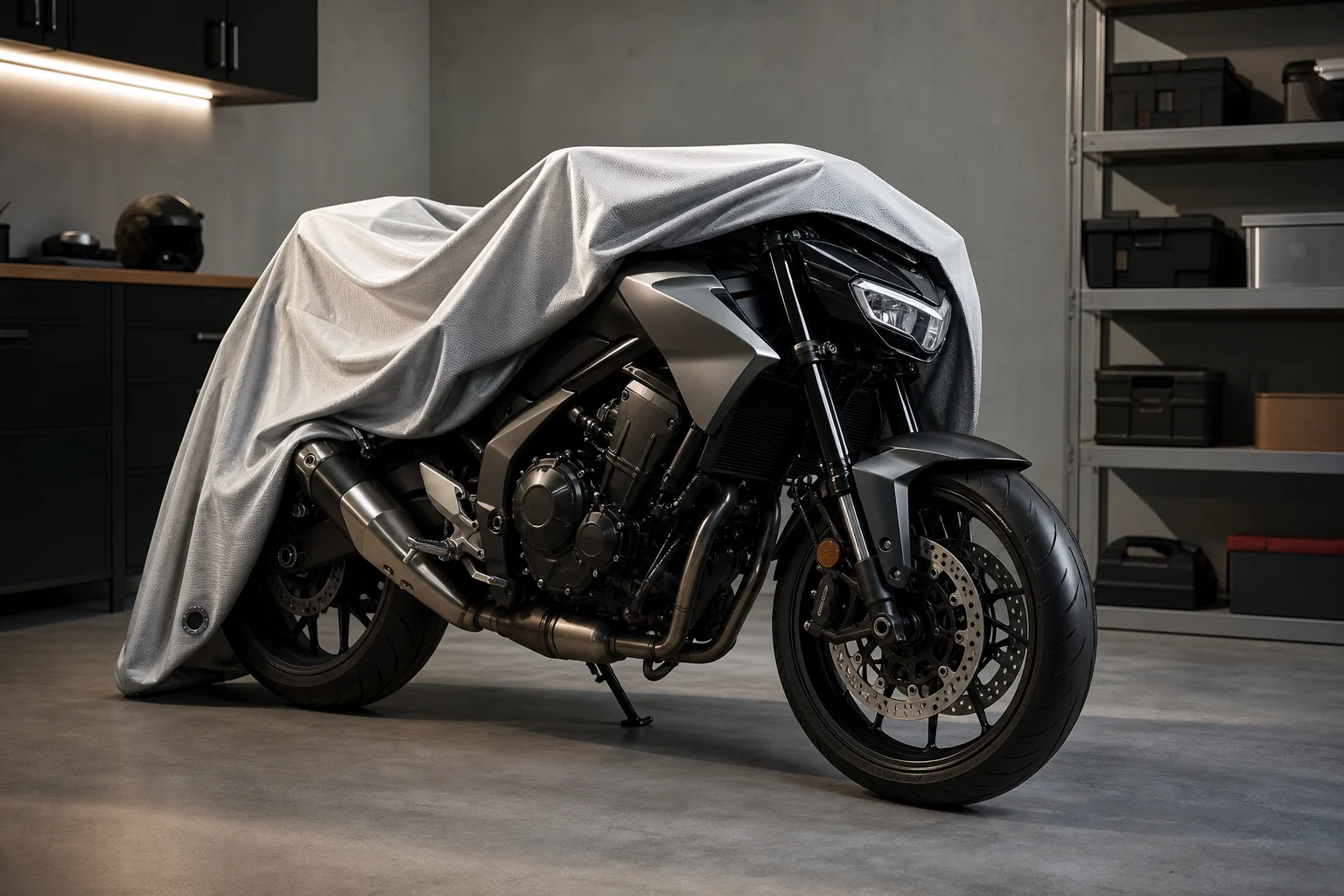
Before preparing anything, set an approximate date for using it again and confirm where it will be parked. Yamaha documentation for short-term storage specifies a cool, dry location; it also allows for a porous cover where necessary. In a shared garage space, the objective is the same: the motorcycle should remain indoors without being exposed to dampness or poor ventilation.
Avoid storing the motorcycle wet under a cover. Yamaha warns that covering it while still wet or keeping it in a poorly ventilated enclosure can introduce water and moisture, encouraging corrosion. Cleaning is therefore not an isolated cosmetic step: the motorcycle must be allowed to dry before it is covered.
It is also advisable to plan how you will access it during storage. If the manual requires periodically moving the motorcycle or checking an item, the parking space and its position should allow this without forcing the vehicle or blocking shared areas. Note the parking-space number, parking date, and the location of the key, documents and manual to avoid searching or making rushed decisions when you return.
Section references: Motorcycle Care and Storage ↗ · Mantenimiento y conservación de motocicletas ↗
- Choose a cool, dry location.
- Clean and dry the motorcycle before covering it.
- If you use a cover, follow Yamaha's requirement: it should be porous, and it should only be fitted when the engine and exhaust are cold.
- Record the storage start date and expected return date.
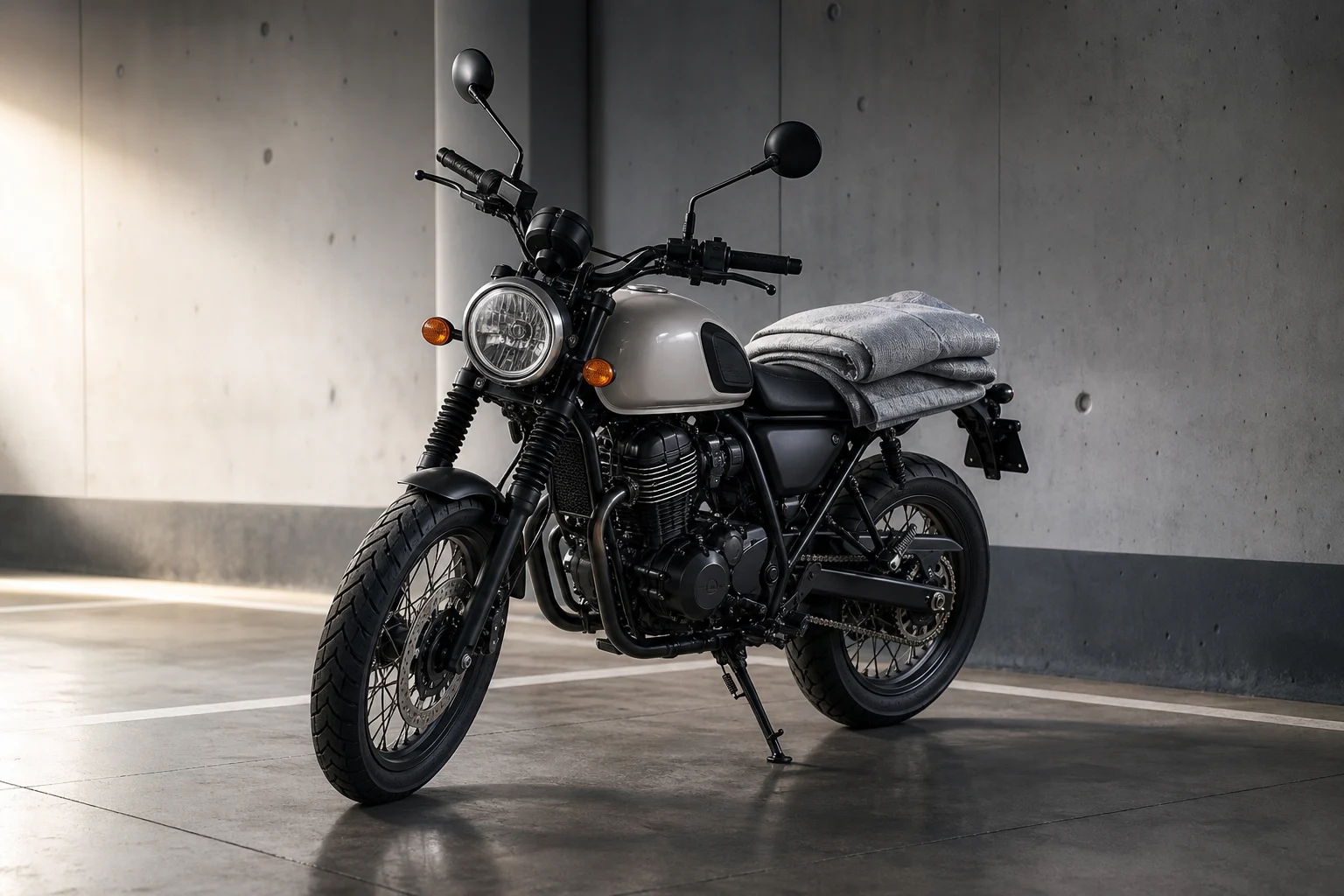
Battery: check the type before disconnecting it or connecting a maintainer
A battery can discharge even when the motorcycle is not ridden. It should therefore be expressly included in your storage plan, but there is no reason to choose a charger or maintainer without first identifying which battery your motorcycle has and what its manual requires.
A Yamaha manual states that a VRLA battery needs a special constant-voltage charger and warns that a conventional charger can damage it. This warning is enough to rule out the general advice of connecting any available maintainer. Check the manual for the battery type, charging-equipment compatibility and the connection method authorised by the manufacturer.
For prolonged storage, Honda considers removing and charging the battery. If it is left installed, it states that the negative terminal should be disconnected. These are examples of documented procedures, not an instruction applicable to every motorcycle: your version's manual determines whether you should remove it, disconnect it or take another measure.
| Check | Why it matters | Safe decision |
|---|---|---|
| Battery type | According to Yamaha, a VRLA battery requires a constant-voltage charger. | Use only the compatible equipment and method specified in the manual. |
| Battery installed or removed | Honda considers both possibilities for prolonged storage. | Follow the procedure specific to your motorcycle. |
| Negative terminal | Honda states that it should be disconnected if the battery remains installed. | Do not disconnect or reconnect it without checking the model's guidance. |
Section references: Storage Advice – Caring for Your Motorcycle ↗ · Motorcycle Care and Storage ↗
- Find the battery and storage section in the manual.
- Identify the battery type before buying or using a charger or maintainer.
- Check that the charger is compatible with the battery type and the method specified by the manufacturer.
- Record what was done, the date and where the battery was stored if it was removed.
Fuel, tyres and surfaces: three risks with different solutions
Fuel requires the greatest caution when following general advice. For one Yamaha motorcycle, the manual says to fill the tank and add stabiliser before storing it for several months. By contrast, another Yamaha manual for a motorcycle with a fuel tap and carburettor instructs owners to turn off the fuel and drain the tank, lines and carburettor float chamber. The difference shows that there is no rule valid for every tank or fuel system.
Before deciding, identify what the manual requires for your model and fuel system. Do not turn storage into a repair: your task is to find the applicable instruction, obtain the products authorised by the manufacturer, and seek professional help if the process requires a task you do not know how to carry out.
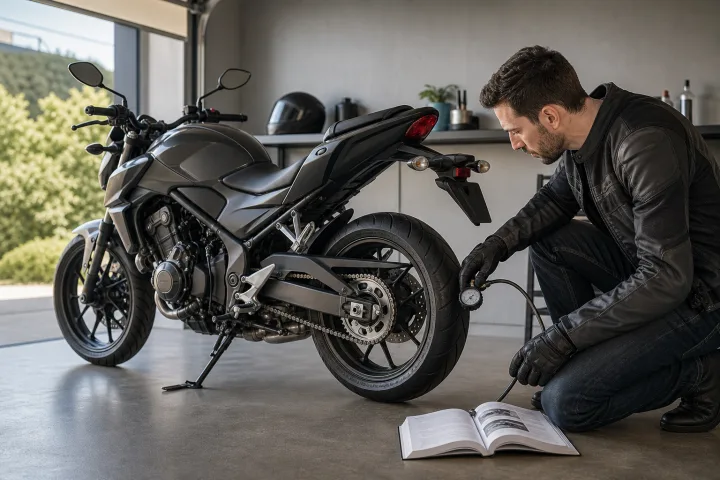
Tyres also need planning. Honda warns that they can become deformed when they bear the motorcycle's weight in the same spot all the time. Its recommendation is to raise the motorcycle or move it periodically, according to what is possible and the method permitted by the vehicle. Finally, cleaning followed by drying helps avoid leaving dirt in place for months: Honda notes that not washing the motorcycle before storage can affect rubber parts and encourage rust on metal components.
Section references: Storage Advice – Caring for Your Motorcycle ↗ · Motorcycle Care and Storage ↗ · Motorcycle Care and Storage ↗
- Fuel: find an instruction specific to your model; do not assume either “full” or “empty” by default.
- Tyres: check whether the manual considers raising the motorcycle or periodically moving its contact point.
- Surfaces: do not leave dirt or moisture beneath the cover.
- Chain and brakes: consult your manual's storage plan; do not assume that the same product or interval is suitable for every motorcycle.
Documents, insurance and temporary deregistration if storage is long
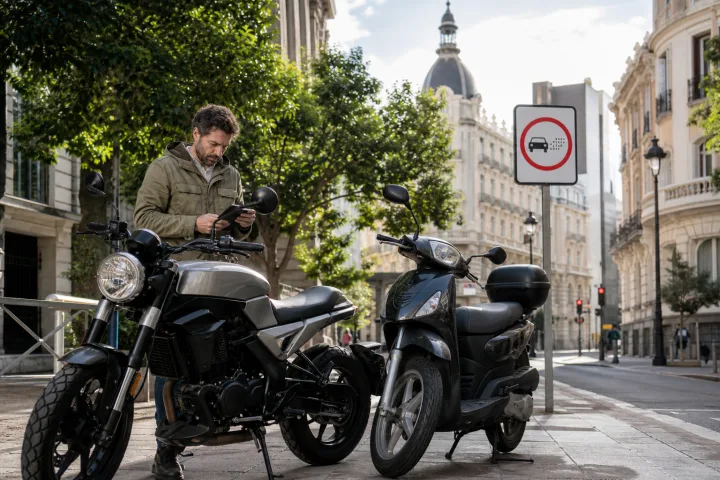
In Spain, a motorcycle can be temporarily deregistered if it will not be used for a long period and is kept on private property. Spain's Directorate-General for Traffic (DGT) expressly includes motorcycles among the vehicles eligible for this procedure. Deregistration has a maximum duration of one year and can be extended annually; to ride again, reinstatement must be requested.
Do not confuse a garage space with the public road. The DGT specifies that a vehicle parked on public roads must have valid insurance and roadworthiness inspection (ITV). For a deregistered vehicle kept on private property, the DGT itself states the exception that these do not have to be up to date. Outside this specific case, the general rule under the Law on Civil Liability and Insurance in the Circulation of Motor Vehicles requires the owner of a vehicle normally based in Spain to take out and keep valid insurance for each vehicle.
If you apply for temporary deregistration, keep the receipt: the DGT states that it must be submitted to the insurance company to suspend the policy. Also check that the storage location meets the private-property requirement, and keep a copy of the receipt with the motorcycle's records.
Section references: Baja temporal ↗ · Ley sobre responsabilidad civil y seguro en la circulación de vehículos a motor ↗
- Decide whether long-term storage justifies applying for temporary deregistration.
- If it is processed, keep the receipt and submit it to the insurer as stated by the DGT.
- Do not ride a deregistered motorcycle: you must request reinstatement first.
- Always distinguish between parking on private property and on public roads.
Record-keeping checklist and inspection before using the motorcycle again
The day you bring the motorcycle back into use, it is not advisable simply to start it. Honda states that its components should be inspected according to how long it has been stored. Begin with a careful external inspection and compare what you see with the list you prepared when storing it: what was done with the battery, which fuel procedure was followed, when storage began, and what specific instructions the manual gave.
Visually check for persistent moisture, visible corrosion, accumulated dirt, cover damage or unusual changes in the tyres. Then consult and follow only the checks stated in your model's manual for returning it to use. If you find problems during this inspection, if the battery does not respond, or if you cannot confirm that the correct fuel procedure was followed, consult a workshop before using it again.
The best tool against forgetfulness is a single paper or digital sheet kept with the manual. It does not replace its instructions, but it allows the next inspection to begin with information rather than assumptions.
Section references: Baja temporal ↗ · Storage Advice – Caring for Your Motorcycle ↗
- Storage start date and actual duration.
- Location where the motorcycle and, where applicable, the battery were stored.
- Manual page or section used for the battery, fuel and tyres.
- Tasks carried out and manufacturer-authorised products used.
- Result of the visual inspection: moisture, corrosion, tyre condition, cover and cleanliness.
- Checks required by the manufacturer for the specific model before returning it to use.
- Temporary deregistration receipt and reinstatement status, where applicable.
- Consult a workshop if you find problems during the manual-specified inspection or have significant doubts.
Should I leave the tank full or empty if I am storing my motorcycle for months?
There is no universal rule. One Yamaha manual says to fill the tank and add stabiliser for several months, while another, for a motorcycle with a fuel tap and carburettor, instructs owners to drain the tank, lines and float chamber. Consult your model's manual before deciding.
Does a motorcycle battery discharge even when it is not used?
Yes. Honda states that it can discharge by itself or become depleted even when the motorcycle is not ridden. The manual should state whether it is advisable to remove it, disconnect the negative terminal or use compatible charging equipment.
Can I use any battery maintainer?
No. Yamaha warns that a VRLA battery requires a constant-voltage charger and that a conventional charger can damage it. Check the battery type and the compatibility required by the manufacturer.
Is it mandatory to keep insurance if the motorcycle is parked?
As a general rule, the law requires insurance to be kept for every vehicle normally based in Spain. The DGT provides a practical exception for a motorcycle that is temporarily deregistered and kept on private property; a vehicle parked on public roads must have valid insurance and roadworthiness inspection (ITV).
What should I do before riding again after several months?
Inspect the components taking account of the storage period, as stated by Honda. Visually inspect the motorcycle and follow the checks set out in your model's manual. If you find problems during that inspection or have doubts about the battery or fuel, consult a workshop before using it again.