How to Obtain a PPL(A) Licence in Spain: Requirements, Training, Exams and Limitations
The PPL(A) allows you to fly aeroplanes privately in non-commercial operations, but requires regulated training, a medical certificate, examinations and valid ratings. This guide sets out what to check before choosing a school in Spain.
What the PPL(A) is and what it allows you to do
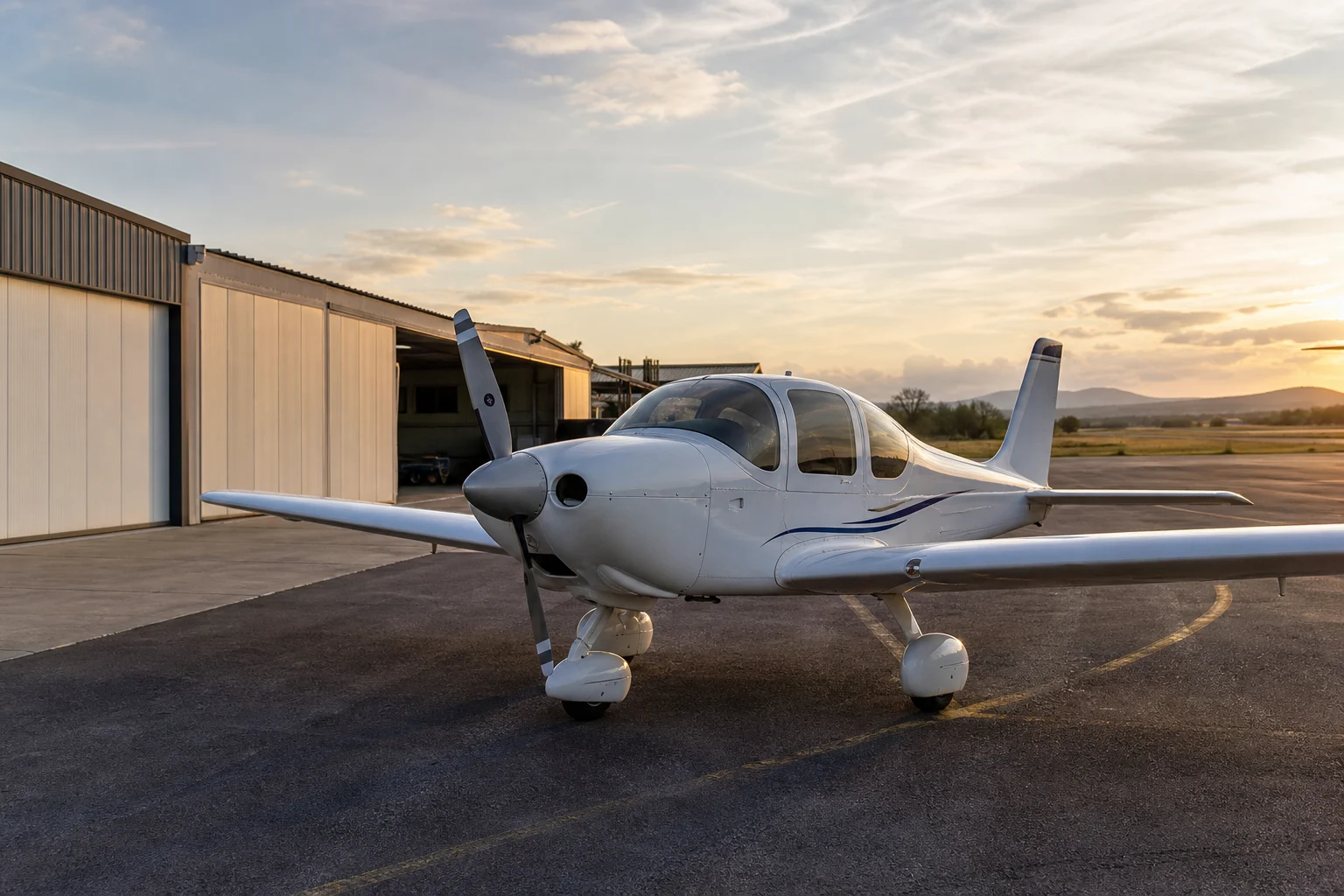
The PPL(A), or Private Pilot Licence for Aeroplanes, is a licence for flying aeroplanes or TMGs, a category provided for under the regulations, in non-commercial operations. Its privileges allow you to act as pilot in command or co-pilot without remuneration. It is therefore suitable for anyone wishing to start recreational or private flying, but it is not equivalent to a professional licence that qualifies the holder to work in commercial operations.
It is worth starting with this distinction because it avoids a common expectation: completing a PPL(A) course does not make the holder a professional pilot or remove the requirements that may apply to future training pathways. It also avoids another oversimplification: the licence is not a blanket authorisation for any aeroplane or any flight condition. The effective privileges depend on holding the required class or type rating and on that rating being valid.
- The PPL(A) is a licence; a class or type rating is an additional privilege linked to an aircraft or group of aircraft.
- The PPL(A) permits unpaid private activity, not employment in commercial operations.
- Before comparing schools, define whether your aim is to fly by day in visual conditions or whether you expect to expand your privileges later.
Prerequisites: age, medical fitness and documentation
The minimum age for the issue of a PPL is 17. This should not be understood as the only entry requirement: the process also requires meeting the applicable training, examination and documentation conditions when applying for the licence.
The point worth checking before committing to a large package of hours is the medical requirement. AESA states that private PPL pilots require a Class 2 medical certificate, and the regulations require the appropriate medical certificate before carrying out solo flight. Booking an appointment early helps identify whether additional information must be provided and prevents reaching the solo phase without the necessary certification.
AESA’s issue documentation also provides for a language proficiency certificate where applicable. The school should explain whether it applies in the specific case and which document the Agency will accept. It is preferable to request that clarification in writing rather than assume that a conversation in a given language replaces formal certification.
- Confirm that you will be at least 17 before the licence is issued.
- Obtain or check your Class 2 aeromedical certificate in good time.
- Ask the school which documentary checks it will carry out before solo flight and the final application.
- If you are told there is a language requirement, request the documentary reference and the method of proving it.

Choosing a school: ATO and DTO are not interchangeable terms
PPL(A) training can be completed at an Approved Training Organisation (ATO) or a Declared Training Organisation (DTO). It is not enough for a centre to advertise itself generically as “approved”: you must check its status and, above all, ensure that the course it offers appears in AESA’s official information.
AESA’s ATO list identifies approved courses and training bases. Its DTO list shows the declared courses for each organisation; both may include PPL(A) courses under the SEP land designation and, in certain cases, distance learning. The specific offering must match the list and the contract.
The check should be made immediately before enrolment, not only using an old screenshot or a link sent by the school. Search for the organisation’s name in the current list and verify that PPL(A) and the advertised delivery method are expressly shown. If it is an ATO, also check the stated training base. If there are discrepancies, ask for an explanation before making a payment.
- Find the centre in AESA’s official ATO or DTO list.
- Verify the specific course, not only the school’s trading name.
- If the centre is an ATO, check the base from which the instruction will be delivered.
- Keep the version of the quotation, course programme and contractual terms you receive.
How theoretical and practical training is structured
The PPL(A) programme combines theoretical knowledge and flight training appropriate to the privileges sought. The theoretical part includes air law, human performance, meteorology, communications, navigation, principles of flight, operational procedures, performance and planning, and general aircraft knowledge. It is a broad syllabus: assess how the centre organises classes, materials and progress monitoring rather than judging an offer solely by the advertised number of flight hours.
The general regulatory minimum experience for a PPL(A) is 45 hours of flight instruction in aeroplanes or TMGs. Up to five of those hours may be completed in a flight simulation training device, known as an FSTD. The minimum includes at least 25 hours of dual instruction and ten hours of supervised solo flight, with specific solo navigation requirements.
These minimums are neither a fixed budget nor a guarantee of completion in a particular number of sessions. Training progress, aircraft and instructor availability, and other organisational factors affect the actual course. A common mistake is to purchase a set number of hours without knowing how many are in an aircraft, how many are planned in a simulator, and what happens if additional activities beyond the minimum are needed.
- Request a breakdown of theory, flight instruction, simulator time and test preparation.
- Ask for the part of the price that covers dual instruction and the part that covers supervised solo flight.
- Check whether study materials, internal assessments and administrative management are included.
- Avoid deciding solely on an initial price that does not describe the scope of the 45 minimum hours.
Examinations, skill test and licence application
The process includes passing theoretical knowledge examinations and a practical skill test. For the PPL, the practical test requires demonstrating the ability to act as pilot in command in the appropriate category. In addition, the applicant must have received instruction in the same aircraft class or type used for the test. The school should clearly state which aircraft it plans to use and which documentary requirements it will check beforehand.
According to AESA, theoretical examination results are valid for 24 months for the issue of a private pilot licence. This is a timeframe worth monitoring: plan the course and application without allowing the theoretical part to become disconnected from the practical and administrative stages for too long.
For the first issue of a PPL(A), AESA’s form lists, among other documents, the course completion certificate issued by the ATO or DTO, proof of flight experience and the skill test form. Language proficiency evidence may also be required where applicable. AESA maintains a specific form for the PPL(A) skill test, and the current version must be used by the school and examiner.
- Before the test, confirm the aircraft class or type that will be used.
- Check the validity of your theoretical results: AESA publishes 24 months for PPL issue.
- Request a list of the documents the school will issue and when it will provide them.
- Check AESA’s current application form and skill test form before submitting the application.
After issue: ratings, night flying and IFR
Receiving the PPL(A) does not mean you can use any available aeroplane. To exercise the privileges, you must meet the requirements of the relevant class or type rating, and the ability to use that rating depends on it remaining valid. Before booking or hiring an aircraft, identify the required rating and confirm that it appears as valid on your licence.
There are also limitations linked to flight conditions. To fly at night under visual flight rules, known as VFR, specific night training and a night rating are required. This course is completed at an ATO or DTO and includes theoretical instruction and at least five hours of night flying. To operate under instrument flight rules, known as IFR, the regulations require an instrument rating, called an IR, appropriate to the aircraft category, with the regulatory exceptions provided for dual instruction or a skill test.
The practical decision is straightforward: if your initial aim is daytime private flying, the PPL(A) may be the starting point. If you want to operate at night or progress towards IFR from the outset, ask the school for a separate pathway for those ratings. Do not assume they are included in the PPL(A) course.
- Always check which class or type rating is required for the aircraft you intend to use.
- Do not assume that the PPL(A) includes night flying.
- Do not confuse a night rating with an IR instrument rating.
- Keep the initial licence and future privilege extensions separate in your planning.
Costs and timeframes: how to compare offers without false equivalences
The official information consulted sets training, test and documentation requirements, but does not establish a universal price or timeframe for obtaining a PPL(A). Therefore, one financial offer cannot be compared with another unless they cover exactly the same items. The useful figure is not an isolated amount, but the contractual scope and the conditions that could generate additional payments.
Request a written quotation and check what it includes: theoretical training, how many aircraft and simulator hours it covers, fees, examinations, the skill test, materials, fuel, insurance and landing charges. Ask specifically about aircraft and instructor availability, cancellation arrangements, and the cost or procedure that applies if hours beyond the regulatory minimum are required.
Before enrolling, complete a final check using current AESA sources. This is the best protection against two common errors: paying for a course whose PPL(A) does not appear in the applicable register, and assuming essential services are included because they appeared in abbreviated advertising. If the centre is an ATO, also check that the advertised training base appears on its list.
- Check the ATO or DTO and the PPL(A) course in AESA’s current lists.
- If the centre is an ATO, verify the advertised training base.
- Check the Class 2 medical certificate before committing to the solo phase.
- Request a written breakdown of theory, aircraft, simulator, fees, skill test, fuel, insurance and landing charges.
- Confirm the planned aircraft, availability and issues arising from cancellation or rescheduling.
- Ask which documents the centre will issue for the first PPL(A) application.
- Review the current forms and requirements directly on AESA before submitting the application.
What is the minimum age to obtain a PPL(A) in Spain?
The regulatory minimum age for the issue of a PPL is 17.
What medical certificate is required for a PPL(A)?
AESA states that private PPL pilots require a Class 2 aeromedical certificate. In addition, the appropriate medical certificate must be obtained before carrying out solo flight.
How many minimum hours are required for a PPL(A)?
The general minimum is 45 hours of flight instruction in an aeroplane or TMG. That total includes at least 25 hours of dual instruction and 10 hours of supervised solo flight; up to 5 hours may be completed in a flight simulation training device, or FSTD.
Does a PPL(A) allow you to fly at night or under instruments?
Not on its own. Night flying under visual flight rules, or VFR, requires specific night training and a night rating, while operations under instrument flight rules, or IFR, require an IR instrument rating appropriate to the aircraft category.
Can the course be taken at any flight school?
PPL(A) training must be completed at an ATO or DTO. Before enrolling, it is advisable to check AESA’s current lists to ensure that the organisation and PPL(A) course appear consistently. In the case of an ATO, the stated training base can also be checked.