Car insurance in Spain: how to compare cover, excesses and exclusions before buying
Commercial labels can provide guidance, but the contents of each policy are what matter. This guide brings together the questions and documents worth reviewing before taking out or renewing car insurance.

Key points
To compare car insurance in Spain, it is not enough to compare prices or choose based on the label “third party” or “fully comprehensive”. Request the pre-contractual information document and the applicable terms for each quote, then compare cover by cover: scope, limits, exclusions, excess, territorial scope and driver details. Compulsory insurance covers third-party liability, but not damage to the insured car or injuries to the at-fault driver.
The short answer: compare the contract contents, not just the premium
The useful way to compare car insurance is to turn each quote into a shared checklist. A lower annual price alone does not tell you what will happen in the event of theft, broken glass, damage to your own car or a breakdown far from home. Nor is it enough for two quotes to be called “extended third-party” or “fully comprehensive”: those labels do not replace the specific list of cover, limits and exclusions.
Before deciding, request the product’s pre-contractual information document and the terms that apply to your quote. Regulations require pre-contractual information to be provided before taking out non-life insurance, summarising cover, excluded risks, the sum insured where applicable, geographical scope and obligations. It is a very valuable starting point, but it does not replace the full pre-contractual and contractual documentation.
The Insurance Contract Act requires general and special terms to be clear and precise. In addition, clauses that limit the policyholder’s rights must be highlighted and specifically accepted in writing. If a sales response does not match the document that will form part of the contract, ask for written clarification before signing.
Section references: Ley de Contrato de Seguro (texto consolidado) ↗ · Real Decreto-ley 3/2020: distribución de seguros y documento de información previa ↗ · IPID Allianz Auto Completo con franquicia alta ↗
- Compare quotes using the same list of questions, not their commercial labels.
- Write down the exact response or the page where it appears, rather than simply marking “yes” or “no”.
- Review the general terms, special terms and the final quote together.
- Check that the declared details are current, correct and truthful, and report any changes that affect the contract.
What compulsory insurance covers and what it excludes
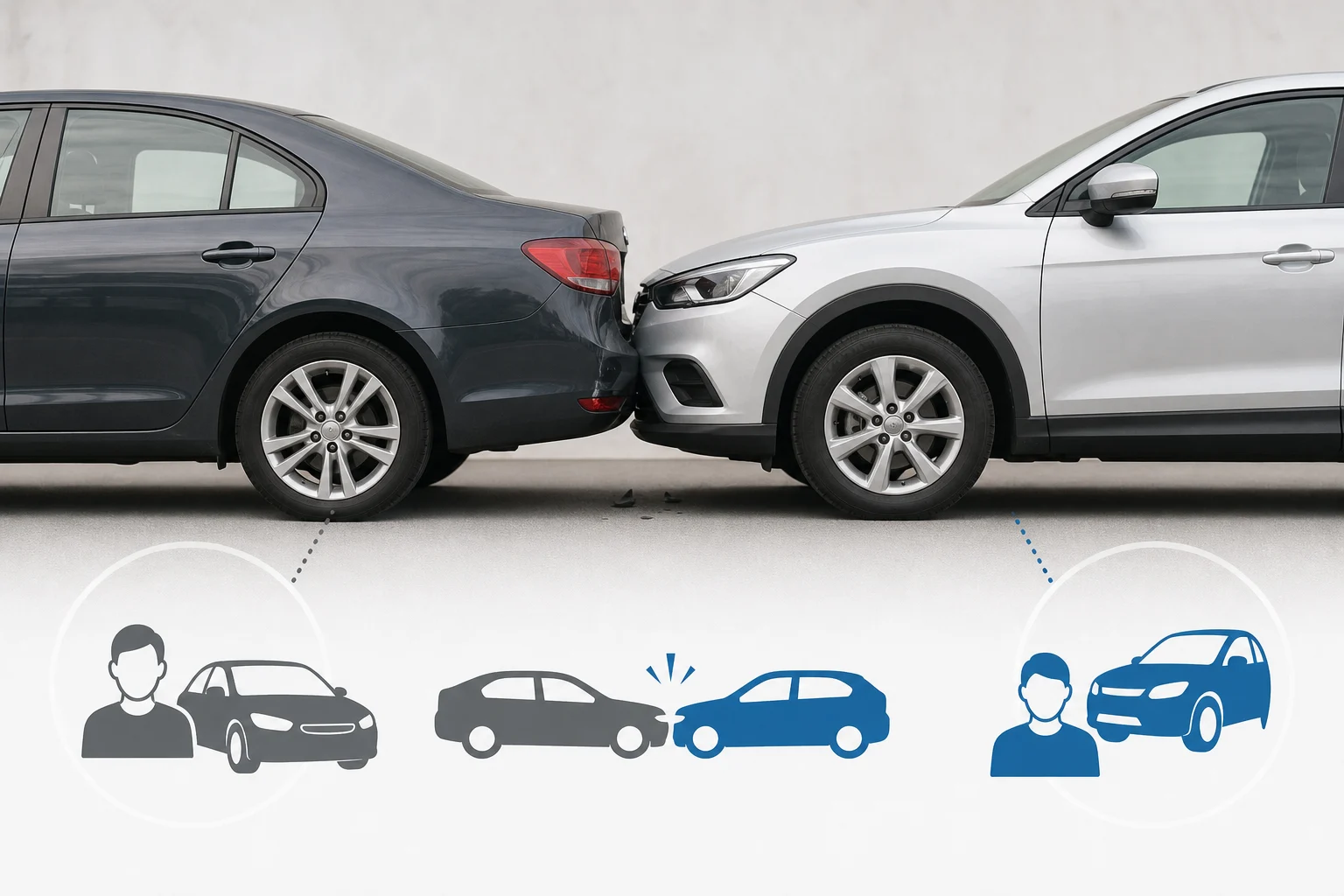
Every owner of a motor vehicle with its habitual parking place in Spain must take out and keep valid insurance for each vehicle. Its core is the legally required third-party liability cover for damage caused to others; it is not cover for repairing the insured car.
The law excludes injuries to or the death of the driver of the at-fault vehicle from this compulsory cover. It also excludes material damage to the insured vehicle and to items carried in it, as well as certain assets linked to the policyholder, insured person, owner or driver. Therefore, anyone who wants to protect their own vehicle or add other services must review the optional cover included in each policy.
Following the 2025 amendment, the legal limits for compulsory insurance are €70 million per accident for personal injury and €15 million per accident for property damage. The insurer cannot invoke the existence of an excess in compulsory insurance against the injured party.
Section references: Ley sobre responsabilidad civil y seguro en la circulación de vehículos a motor (texto consolidado) ↗ · Ley 5/2025: modificación de los importes del seguro obligatorio ↗ · Preguntas frecuentes sobre contratación del seguro obligatorio de automóvil ↗
- Do not confuse third-party liability with own-damage cover.
- Check what additional protection the policy provides for the driver and the insured vehicle.
- Distinguish the legal limits of compulsory insurance from the limits, sums or scope of optional cover.
Third-party, extended third-party and fully comprehensive: use labels only as an index
Commercial policy types help organise a quote, but their content is not uniform across the market. The same insurer may publish, for example, basic third-party, third-party with glass cover, extended third-party, fully comprehensive with an excess and fully comprehensive without an excess versions. The decisive step is to open the documents for the exact version quoted.
As a specific example, a published Allianz extended third-party product offering states third-party liability, breakdown assistance, glass cover and claims recovery, and adds theft, fire, natural phenomena and collisions with animals. This does not make those elements a universal definition of “extended third-party”: it demonstrates precisely why the contents of every proposal must be compared.
For a decision tailored to your situation, start with the risks you want to cover and check whether they are expressly included. If you need theft, fire, glass, own-damage, breakdown assistance, legal defence, claims recovery or a replacement vehicle, look for its exact scope in each insurer’s document. If it does not appear, do not assume it is part of the quote.
Section references: Real Decreto-ley 3/2020: distribución de seguros y documento de información previa ↗ · Allianz Auto Plus – Terceros ampliado ↗ · Documentos legales de seguros de coche ↗
- Identify the policy type’s full name and version, not just the advertising headline.
- Separate included cover from cover offered as an option or add-on.
- Request documentary confirmation of the scope of any cover that is decisive for you.
- Consider personalised advice only once your requirements and needs have been identified.
Excesses, limits and exclusions: the terms that change the outcome
The excess deserves a review separate from the type of insurance. Do not stop at “with excess” or “without excess”: find its amount and the clause that determines how it applies to the cover you are interested in. In a pre-contractual information document for a specific Allianz product with a high excess, the excess for own damage may range from €500 to €700 depending on the insured vehicle. This is a product example, not an amount that applies to all policies.
Also check the scope of each type of cover. The policy must describe the guarantees and cover granted, their exclusions and limitations, as well as the sum insured or scope of cover. This allows you to compare specific wording rather than rely on a general promise of assistance, repair or compensation.
Pay particular attention to the stated territorial scope and to the obligations to provide correct information and report changes. If other people will drive, the car’s use will change or there are items whose declaration is relevant to taking out the insurance, disclose this before accepting the quote and keep the documentary confirmation. This will allow you to check that the available documentation reflects the information provided before taking out the policy.
Section references: Ley de Contrato de Seguro (texto consolidado) ↗ · Real Decreto-ley 3/2020: distribución de seguros y documento de información previa ↗ · IPID Allianz Auto Completo con franquicia alta ↗
- Excess: note the amount, the affected cover and the application rule stated in the terms.
- Limits: copy the sum insured or the expressly stated scope for each relevant cover.
- Exclusions: do not summarise them from memory; identify the clause and read its full terms.
- Territory and assistance: check where cover is provided and its documented limits.
- Risk details: verify the vehicle, use, declared drivers and any reported changes.
A table for comparing three quotes without losing details
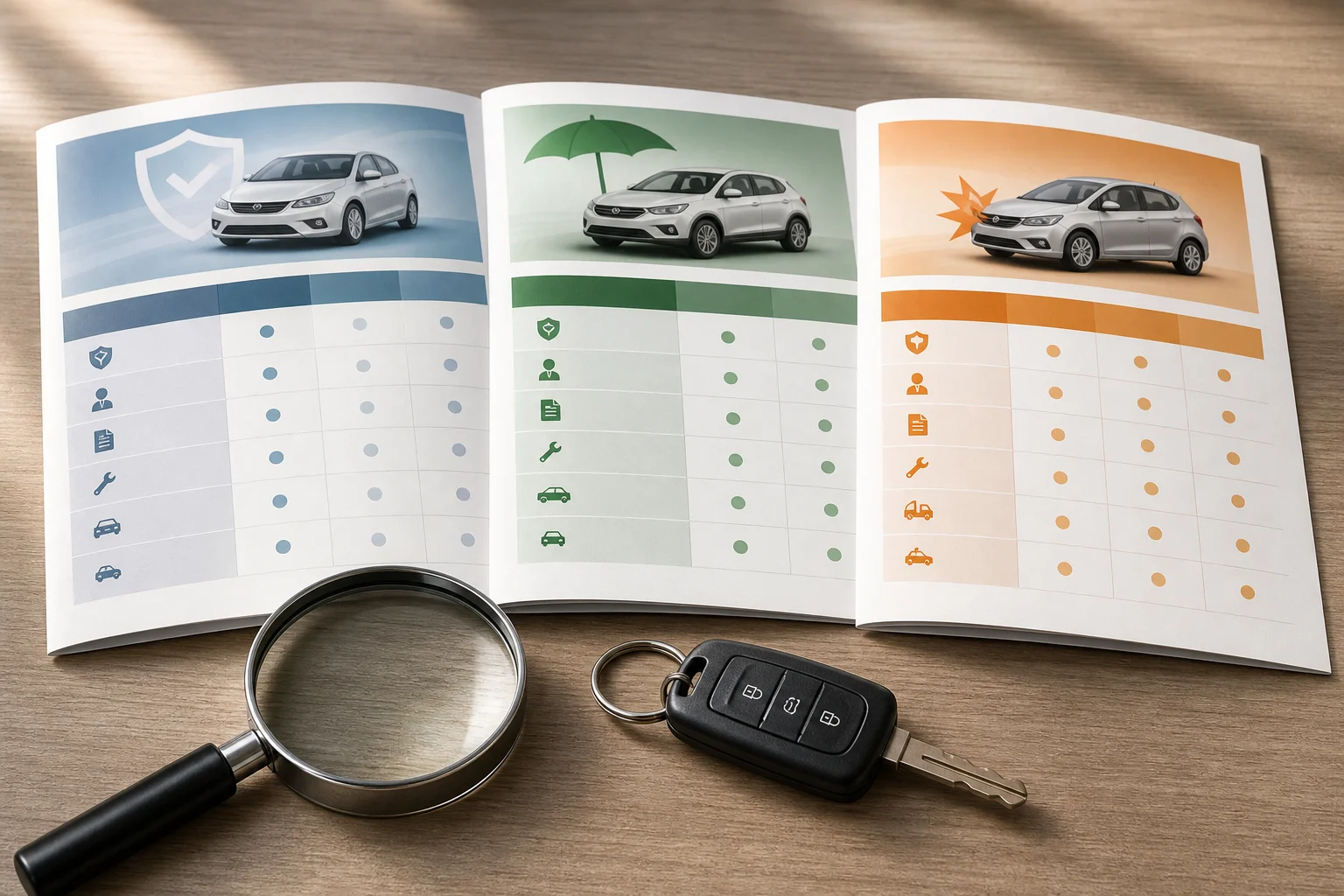
Print or copy this table and complete it with the exact wording from each proposal. The purpose is not for every box to have the same answer, but to quickly identify which quote meets your priorities and which leaves unresolved questions. When cover is decisive, add the page or clause that supports it.
Do not decide until you have resolved the blank cells. The distributor must provide objective, understandable information after establishing the customer’s requirements and needs. If they make a personalised recommendation, they must explain why the proposed product best meets those needs.
| What to check | Quote A | Quote B | Quote C |
|---|---|---|---|
| Exact policy type and product version | ________________ | ________________ | ________________ |
| Third-party liability and stated scope | ________________ | ________________ | ________________ |
| Theft, fire, glass and own damage: inclusion and scope | ________________ | ________________ | ________________ |
| Breakdown assistance and stated territorial scope | ________________ | ________________ | ________________ |
| Legal defence and claims recovery: stated scope | ________________ | ________________ | ________________ |
| Excess: amount, cover and application rule | ________________ | ________________ | ________________ |
| Relevant exclusions and limitations: clause or page | ________________ | ________________ | ________________ |
| Sum insured or scope of each relevant cover | ________________ | ________________ | ________________ |
| Declared details, drivers and reported changes | ________________ | ________________ | ________________ |
| Documents received and version date | ________________ | ________________ | ________________ |
Section references: Ley de Contrato de Seguro (texto consolidado) ↗ · Real Decreto-ley 3/2020: distribución de seguros y documento de información previa ↗
- Compare quotes issued using the same vehicle and policyholder details.
- Do not confuse included cover with an option that has not yet been added to the final price.
- Keep a dated copy of the three documents compared and of the accepted final quote.
What to request, what to keep and how to complete the purchase
Before taking out the policy, gather at least the pre-contractual information document, the general terms and the special terms for the final quote. The first summarises essential aspects; the policy and applicable contractual documentation must describe the cover, exclusions, limitations and scope. Check that the policy type, selected cover and the details that determine the quote match what you are going to accept.
Also keep any endorsement, amendment or later communication that affects the declared risk. It is particularly important to retain proof of reported changes and of the response received. A policy is a contract that may include cover different from another quote with a similar name.
Finally, identify the insurer’s customer service and complaint channels in the documentation. If a limiting clause is difficult to find or understand, ask for clarification before taking out the policy and do not treat that point as a mere formality. The most robust decision is one that sets out in writing what is covered, with what limits and under what conditions.
Section references: Ley de Contrato de Seguro (texto consolidado) ↗ · Real Decreto-ley 3/2020: distribución de seguros y documento de información previa ↗ · IPID Allianz Auto Completo con franquicia alta ↗
- Product pre-contractual information document.
- General terms and special terms for the accepted quote.
- Final quote showing the policy type, cover and price.
- Copies of communications about risk details or changes.
- Endorsements or documents that amend the cover taken out.
- The insurer’s contact information and complaint channels.
Does compulsory insurance cover damage to my own car?
No. Compulsory insurance covers third-party liability for damage to others. The law excludes material damage to the insured vehicle and to items carried in it. For own damage, you need to review the optional cover taken out.
What should I compare besides the insurance price?
The included cover, its limits, exclusions, territorial scope, sum insured or scope, excess and the details declared in the policy. Consult the pre-contractual information document and the general and special terms for each quote.
Is extended third-party insurance the same at every insurer?
It should not be assumed to be. Insurers may sell policies with that name but different contents. For example, a published Allianz product offering adds theft, fire, natural phenomena and collisions with animals, but every quote must be checked against its own documentation.
What is important to review about an excess?
Find the amount, the cover it affects and the application rule stated in the policy terms. Do not extrapolate amounts between insurers: a specific Allianz product with a high excess states between €500 and €700 for own damage depending on the vehicle.
Does the pre-contractual information document replace the policy?
No. It summarises cover, exclusions, geographical scope and obligations, but full pre-contractual and contractual information is provided in other documents. Review the applicable terms before taking out the policy.