How to choose a personal watercraft for your intended use
Recreational, touring or sport labels are useful guides, but they do not replace the technical specification sheet or Spanish regulations. This guide helps you choose based on passengers, cargo, towing, transport and planned navigation.
Key points
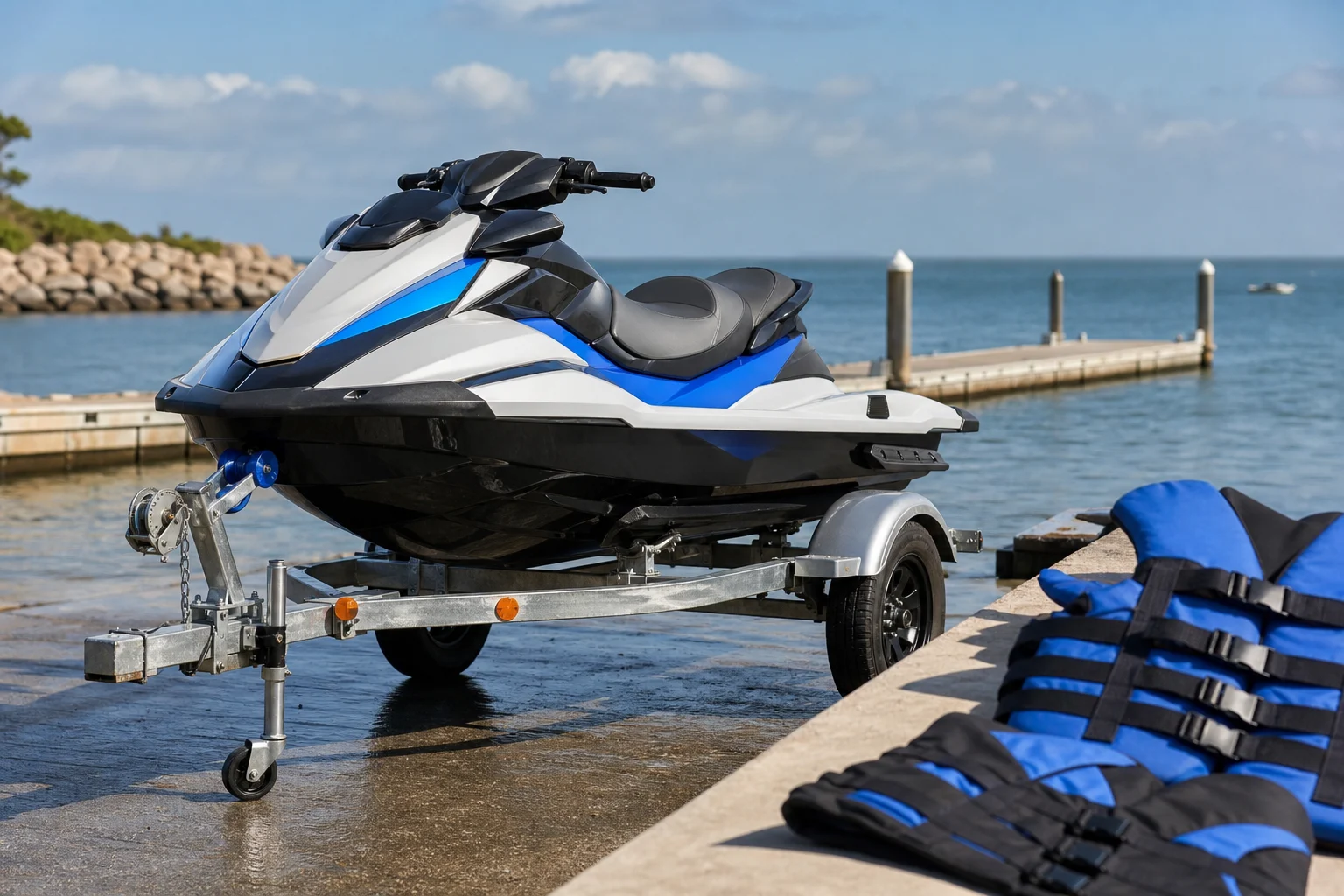
Recreational, touring or sport labels are useful guides, but they do not replace the technical specification sheet or Spanish regulations. This guide helps you choose based on passengers, towing, transport and planned navigation.
What counts as a personal watercraft and why the specification sheet matters
In Spain, the regulatory definition of a personal watercraft does not depend on whether a brand presents it as recreational, sport, cruiser or touring. It is a floating craft under four metres in length, fitted with an internal combustion engine and a water-jet pump, and operated from a position on top of its hull. Commercial names can therefore help organise a range, but they do not by themselves determine either actual capabilities or operating requirements.
Your choice should start with your most frequent plan, not the advertised category. Someone taking short trips with one passenger needs to check the manufacturer's declared occupant capacity; someone planning to carry equipment should look at whether the manufacturer declares storage; and someone wanting to tow needs to verify both the declared equipment and the legal conditions. For towing, the legal limit based on authorised seating is a separate check from the manufacturer's declared occupant capacity. An appealing label does not replace those details.
Before comparing price, colour or power, ask for the specification sheet for the exact model, model year and version sold in Spain. Figures may vary between trims and markets. It is also wise to separate what the manufacturer declares from what the rules allow: having a tow hook, for example, does not by itself authorise every towing activity.
Section references: Real Decreto 259/2002, texto consolidado ↗ · Real Decreto 875/2014, texto consolidado ↗
- Always check the number of occupants and any fuel or storage figures declared by the manufacturer.
- If the specification sheet states a weight capacity, ask the manufacturer or consult the unit documentation to understand its definition and the applicable limits.
- Check whether it declares a braking and reverse system, and do not assume that function is fitted to another version.
- Confirm that the documentation corresponds exactly to the unit you are going to buy or hire.
Compact recreational models: prioritise simplicity and onboard use
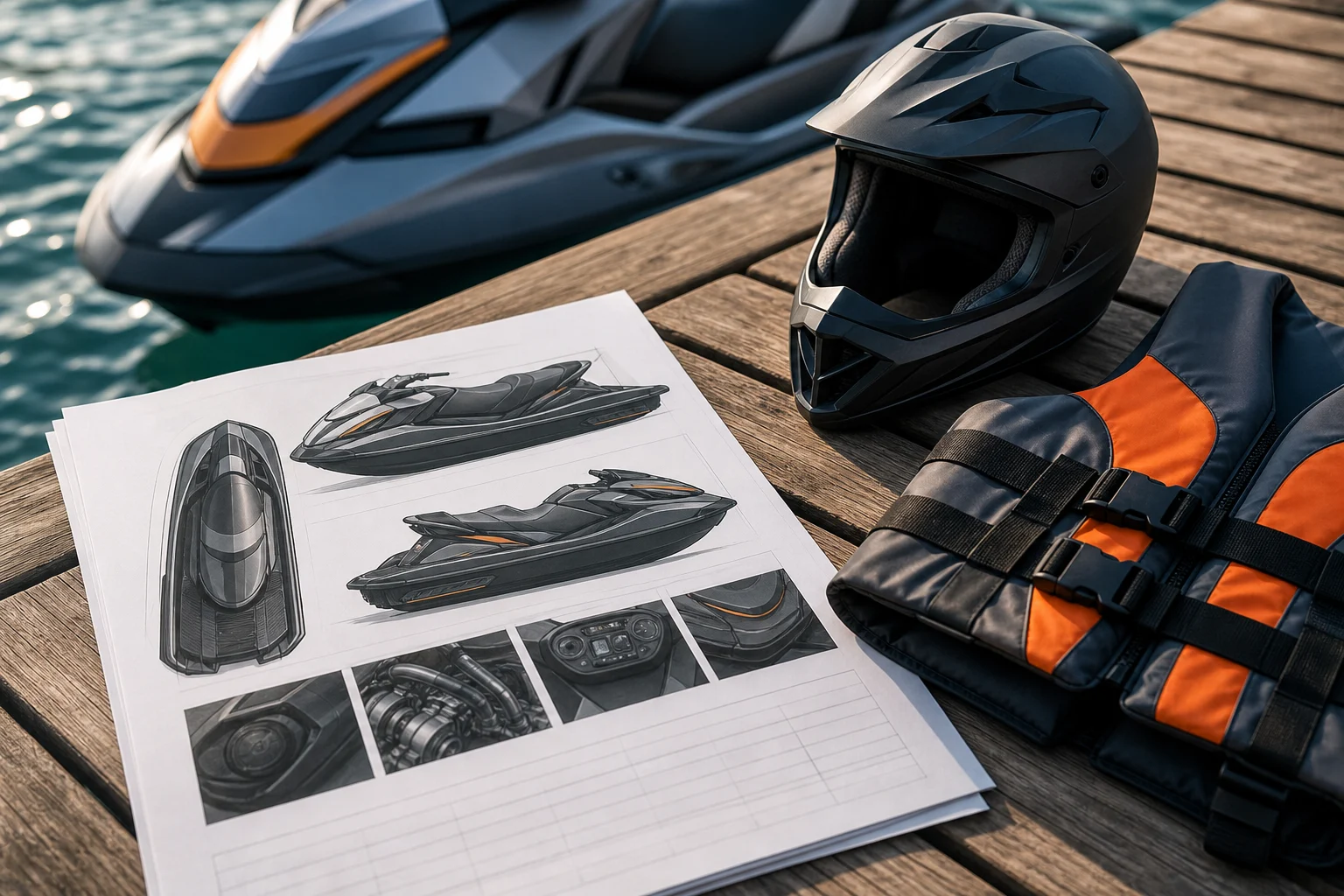
For short outings, the practical criterion is that the watercraft accommodates the intended number of occupants and that the applicable limits for that unit are checked, without confusing the manufacturer's declared occupant capacity with the legally authorised seating figure.
A three-seat unit may be more suitable for a couple with a child or for carrying an observer during a towing activity, but the decisive factor remains the legally authorised seating figure applicable to that unit. As a reference for why figures must be checked, a 2026 Sea-Doo GTI SE 170 EMEA declares three occupants, a 272 kg weight capacity, a 70-litre fuel tank and 152.8 litres of total storage. This is an example, not a specification that can be applied to every watercraft.
When considering family use, check that the watercraft has enough seats and storage space for passengers and equipment. Ask the manufacturer or consult the unit documentation about the definition of any declared weight limit and the applicable conditions.
Section references: GTI SE 170, ficha técnica EMEA en español, modelo 2026 ↗
- For outings with one or two people, prioritise the manufacturer's declared occupant capacity and check the legally authorised seating figure applicable to the unit separately.
- Do not interpret three seats as automatic capacity for three adults: check the legally authorised seating figure applicable to the unit.
- Ask which items are standard and which are accessories, especially the braking system, reverse and cargo solutions.
Touring or cruising: more than a label for longer trips
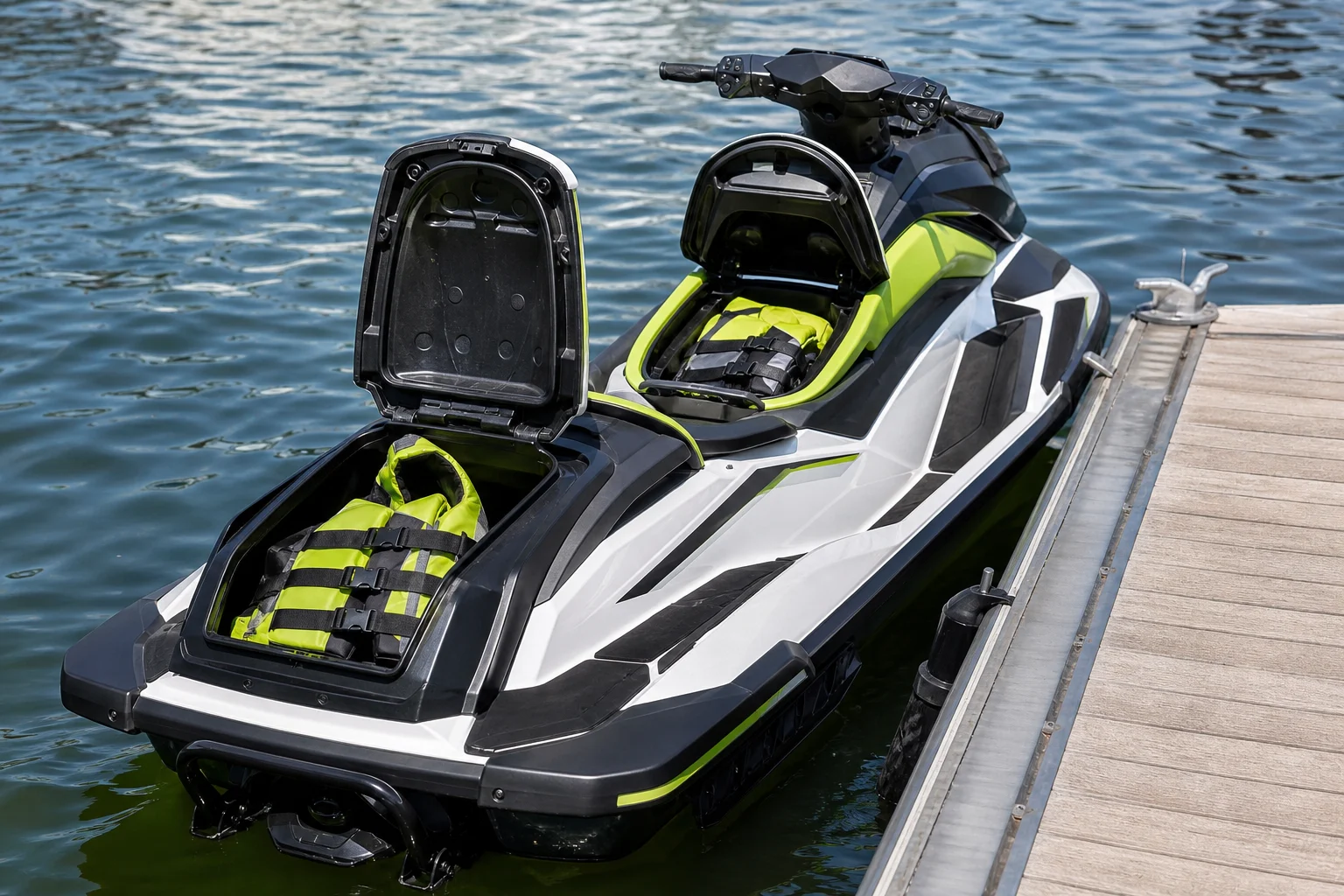
To assess a candidate intended for spending more time on the water, compare verifiable figures declared by the manufacturer, such as seating capacity, weight capacity, litres of fuel, litres of storage and, where declared, the presence of systems that help with low-speed manoeuvring. If a weight capacity is stated, ask for its definition and the applicable limits for that unit.
Fuel capacity is a tank figure, not a promise of distance. Use it to compare the declared figures of specific models, without turning it into an estimated range figure that does not appear in the documentation.
There is also an operating limit that no commercial classification changes: personal watercraft may only be navigated during daylight hours. Before planning a trip, check the applicable local access, channel and navigation conditions, and whether refuelling or beaching is possible. A watercraft with more space may make sense for luggage and passengers, but it must still comply with the same coastal and safety rules.
Section references: Real Decreto 259/2002, texto consolidado ↗
- For longer outings, check the declared tank, seating and storage figures where the manufacturer provides them.
- Ask for the definition and applicable limits of any weight capacity stated in the specification sheet.
- Plan navigation exclusively during daylight hours and confirm local conditions before setting off.
Sport and high-performance models: when they make sense
A watercraft marketed as sport-focused may suit someone seeking a more performance-oriented riding response, but the decision should be based on the specifications of each unit rather than on the product name alone.
This type of purchase makes sense if the main use will be solo or with few passengers and the buyer accepts that performance does not by itself make up for family, luggage or towing needs. Declared power should be read alongside weight, fuel capacity, occupant capacity and the control or manoeuvring systems actually fitted to the chosen version.
The risk is not only buying more performance than you need, but trying to use it where regulations prohibit it. You may not navigate within buoyed bathing areas. To cross a buoyed bathing area from or towards the beach, you must use the designated channel and not exceed three knots. Where there is no buoy marking, there is a 200-metre strip adjacent to the coast where navigation is prohibited, except when launching or beaching perpendicularly and at a maximum of three knots.
Section references: Real Decreto 259/2002, texto consolidado ↗
- Do not make power your only buying criterion.
- Check the legally authorised seating figure before planning to carry passengers.
- Check access points, channels and restrictions in the intended navigation area in advance.
Water-skiing or wakeboarding towage: conditions that change the purchase
To tow water-skiers, wakeboarders or other sporting equipment, first check whether the specification sheet for the exact watercraft declares a tow hook. The 2026 GTI SE 170 EMEA, for example, declares a tow hook. However, this product detail does not replace Spain's mandatory operating conditions.
The most important rule for sizing the watercraft is that the total number of people onboard and being towed must not exceed the authorised seating capacity. In addition, towing must take place outside bathing areas, and both watercraft occupants and towed people must wear life jackets. For any user, rider or passenger, the life jacket must be approved or CE-marked; as a general rule, regulations set a minimum buoyancy of 100 N.
Therefore, power or a hook alone is not enough. Ask the seller about the manufacturer's declared occupant capacity, check the legally authorised seating figure applicable to the unit separately, and consider the total number of people taking part. If you are looking for a watercraft for two people onboard plus one towed participant, the authorised seating capacity is an upfront check, not an afterthought. Also check the applicable local and operating conditions before towing.
Section references: Real Decreto 259/2002, texto consolidado ↗ · GTI SE 170, ficha técnica EMEA en español, modelo 2026 ↗
- Verify whether the specification sheet for the exact version declares a tow hook.
- Add the rider, passengers and towed person: the total must not exceed the authorised seating capacity.
- Use suitable life jackets for everyone, tow outside bathing areas and check applicable local and operating conditions.
Paperwork, navigation and road transport in Spain
For private use, anyone operating a personal watercraft must hold a qualifying boating licence. The regulations list the PNB, PER, yacht skipper and yacht captain qualifications, and also allow operation without a power limit under the licence regulated in Article 11 of Royal Decree 875/2014. The general minimum age is 18; from age 16, it is allowed with documented consent from parents or guardians. It is advisable to confirm the required documentation before booking a course or completing a purchase.
A watercraft belonging to Spanish individuals or legal entities, or to foreign residents in Spain, must be registered, recorded and identified before it is used. It must also have the third-party liability insurance required for recreational or sport craft. For rentals, accident insurance is also required. These steps are part of the cost and timeline of buying, not optional extras.
For road transport, check the maximum authorised mass (MAM) of the trailer and the combined outfit. With a category B vehicle, the B licence permits trailers up to 750 kg, as well as trailers over 750 kg where the combined outfit does not exceed 3,500 kg. For combinations over 3,500 kg and up to 4,250 kg with a trailer over 750 kg, B96 authorisation is required. B+E permits a trailer up to 3,500 kg with a category B towing vehicle. Trailers over 750 kg require their own registration.
Section references: Real Decreto 259/2002, texto consolidado ↗ · Real Decreto 875/2014, texto consolidado ↗ · Clases de permisos de conducir ↗ · Reglamento General de Vehículos, texto consolidado ↗ · DGT: Con caravana, remolque o autocaravana ↗
- Before buying: licence, applicable age, registration, recording, identification and insurance.
- Before navigating: applicable local access, channel and navigation conditions.
- Before towing on the road: trailer MAM, registration requirements and driving licence.
What to ask the rental company or dealer
Before hiring, confirm the contracted arrangement. Article 4.4 of Royal Decree 259/2002 allows users without a licence to use watercraft on a circuit or on group excursions, subject to the conditions of Article 7; it is not limited exclusively to a circuit. Rental watercraft used on a circuit or group excursion have a 60 CV (metric horsepower) limit. Confirm the route, supervision and applicable conditions with the company.
When buying, request the specification sheet and documentation for the offered unit before paying a deposit. State your intended use — outings, family use, daytime trips, towing or frequent transport — and rule out options that do not fit because of seating, declared storage figures or administrative requirements. This screening avoids comparing only offers that do not suit the real plan due to their configuration or regulations.
Section references: Real Decreto 259/2002, texto consolidado ↗ · GTI SE 170, ficha técnica EMEA en español, modelo 2026 ↗
- What manufacturer's declared occupant capacity does this exact unit have, and what legally authorised seating figure applies?
- What fuel and storage volume does the specification sheet declare?
- How does the manufacturer define any declared weight capacity, and what limits apply?
- Does it include or declare braking, reverse and a tow hook?
- What insurance is included, and what additional cover applies to rentals?
- Where can you navigate, launch, beach or tow in the intended area?
- What is the trailer's MAM, and which licence does the combination require?
Are recreational, touring and sport personal watercraft legal categories?
No. They are commercial descriptions. In Spain, the regulatory definition of a personal watercraft is based on its configuration: under four metres in length, an internal combustion engine, water-jet pump propulsion, and operation from a position on top of its hull.
Can I carry a towed person if my watercraft has three seats?
A three-seat description alone does not establish that towing is permitted. Check the legally authorised seating capacity separately from the manufacturer's declared occupant capacity: the total number of people onboard and being towed must not exceed that authorised capacity. Towing must take place outside bathing areas and everyone must wear a life jacket, but you must also check the applicable local and operating conditions.
Do I need a licence to operate a personal watercraft in Spain?
For private use, a qualifying boating licence is required. The regulations provide for the PNB, PER, yacht skipper, yacht captain and the licence regulated under Royal Decree 875/2014, without a power limit.
Can I hire a personal watercraft without a licence?
Yes, on a circuit or on group excursions that meet the conditions of Articles 4.4 and 7 of Royal Decree 259/2002. This exception does not permit unrestricted private navigation without a licence.
What should I check to transport a personal watercraft on a trailer?
Check the maximum authorised mass (MAM) of the trailer and the combined outfit. The B licence is not limited to trailers below 750 kg: it also permits other combinations within its limits. For heavier combinations, check the B96 or B+E requirements with the DGT.