Your first motorcycle: how to choose it safely
Licence, low-speed handling, safety, ergonomics and document checks: the criteria for buying your first motorcycle with less uncertainty.
Key points
Your first motorcycle should not be chosen by engine size or looks: it must match your licence, allow controlled footing and manoeuvres, and have verifiable documentation and safety features. This guide structures the decision for daily riding and short trips in Spain.
Quick answer: choose the motorcycle you can control before choosing the one that appeals to you most
A suitable first motorcycle meets three conditions, which you should check in this order: you can legally ride it with your licence, you can hold and move it at low speed with control, and its real-world use suits your journeys. Looks, style or a particular engine size can help narrow down the options, but they do not replace those three checks.
Before comparing adverts or sales specifications, define the journeys you make in a normal week: urban mileage, ring roads or faster roads, usual parking, hills, the need to carry an occasional passenger and luggage. Then, while stationary, check that the riding position and controls feel natural to you.
The stated kerb weight, seat height and width, and turning radius are useful for comparing candidates, but they do not by themselves summarise ease of use. Use them to rule out motorcycles that do not meet your needs before looking more closely at the stationary test.
- Priority 1: compatible licence and exact version.
- Priority 2: control while stopped and at very low speed.
- Priority 3: standard safety equipment and verifiable condition.
- Priority 4: suitability for journeys, passenger, parking and luggage.
- Later preferences: design, colour, accessories or a particular engine size.
Start with your licence and verify the version, not just the engine size
In Spain, an A1 licence allows you to ride motorcycles up to 125 cm³, with a maximum output of 11 kW and a maximum power-to-weight ratio of 0.1 kW/kg. An A2 licence allows motorcycles up to 35 kW and a maximum power-to-weight ratio of 0.2 kW/kg; in addition, the motorcycle cannot be derived from a vehicle with more than twice that power. Therefore, saying that a motorcycle is “a 125” or “restricted” is not enough to confirm that it is suitable.
A valid category B car licence held for more than three years entitles the holder to ride, within Spain, motorcycles permitted under A1. That territorial entitlement should not be assumed to apply in other countries. If the purchase involves travel outside Spain, confirm the licence required in the destination country beforehand.
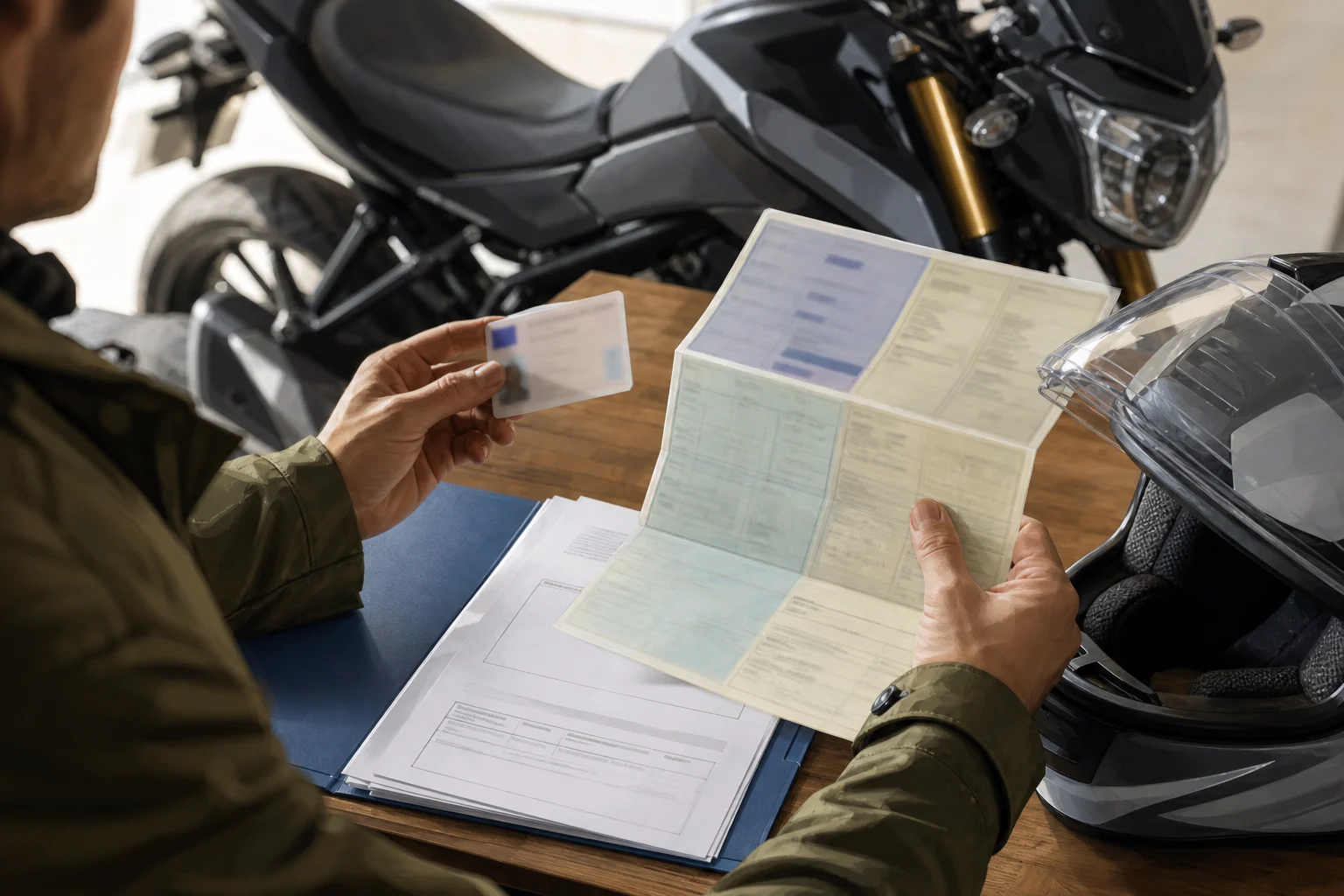
Ask for the documents for the specific motorcycle, not just a screenshot of the specification for a similar model. For A2, pay particular attention to the original output and whether the declared restriction corresponds to that version. If there are doubts about output, power-to-weight ratio or a modification, do not complete the purchase until the documents resolve them. The guide on whether a motorcycle is suitable for an A2 licence helps structure that check.
Section references: Reglamento General de Conductores — modificación de 2020 ↗
- A1: up to 125 cm³, 11 kW and 0.1 kW/kg.
- A2: up to 35 kW and 0.2 kW/kg; not derived from more than twice the power.
- Category B held for more than three years: A1 equivalence only within Spain.
- Check the licence, output, power-to-weight ratio and version before comparing price or accessories.
Define your use and compare formats by their practical limits
There is no universally best format for a beginner. To guide your search, compare how each type responds to your journeys and the manoeuvres you will perform frequently. A scooter, lightweight naked bike and retro-style motorcycle can all be sensible options, but their differences need to be assessed on the specific motorcycle: riding position, declared load capacity, wind protection, available space and ease of moving it while parked.
City riding usually brings stops, turns, parking and the ability to carry items into focus. Ring roads and short trips add importance to perceived stability, aerodynamic protection and comfort. If you expect to carry a passenger or luggage, do not take it for granted: check the approved seating capacity and load in the documentation, and find out how the luggage is secured.
A purchase often goes wrong when it is chosen for an occasional trip and then proves uncomfortable every day, or when it is bought with only city riding in mind without testing the position at the speed and for the duration required for trips. It is more useful to prioritise the most frequent use and confirm that the secondary use is manageable than to seek a perfect solution for every scenario.
| Format | May suit you if you prioritise | Limit to check | Use to validate before buying |
|---|---|---|---|
| Scooter | Everyday journeys and the need to carry items | Foot position, stationary manoeuvrability and declared load capacity | Parking, urban journeys and ring-road riding |
| Lightweight naked bike | An upright riding position and varied city and short-trip use | Wind exposure, reach to controls and sustained comfort | Usual routes and trip duration |
| Retro style | A preference for a particular riding position and look with everyday use | Specific ergonomics, turning and luggage suitability | Urban stops, interurban roads and parking |
- City riding and parking: prioritise manoeuvrability, turning and where you will store your helmet or belongings.
- Ring roads and open roads: check the riding position, wind exposure and usual journey duration.
- Passenger: verify seating capacity, posture and authorised load; do not improvise luggage fastening.
- Garage or street: simulate the entry, exit and turn you will need to repeat.
Handling and ergonomics: the stationary test that prevents a poor choice
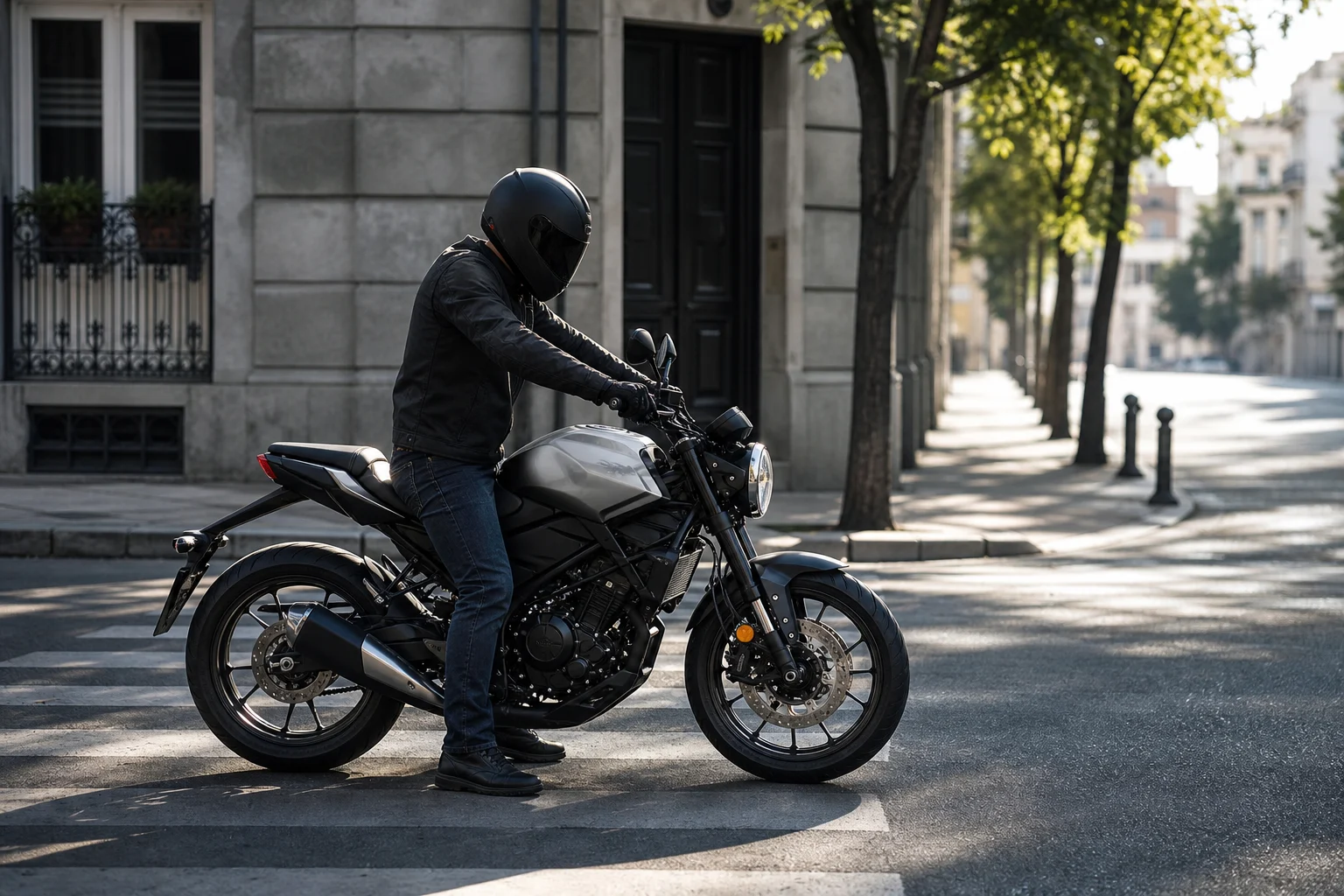
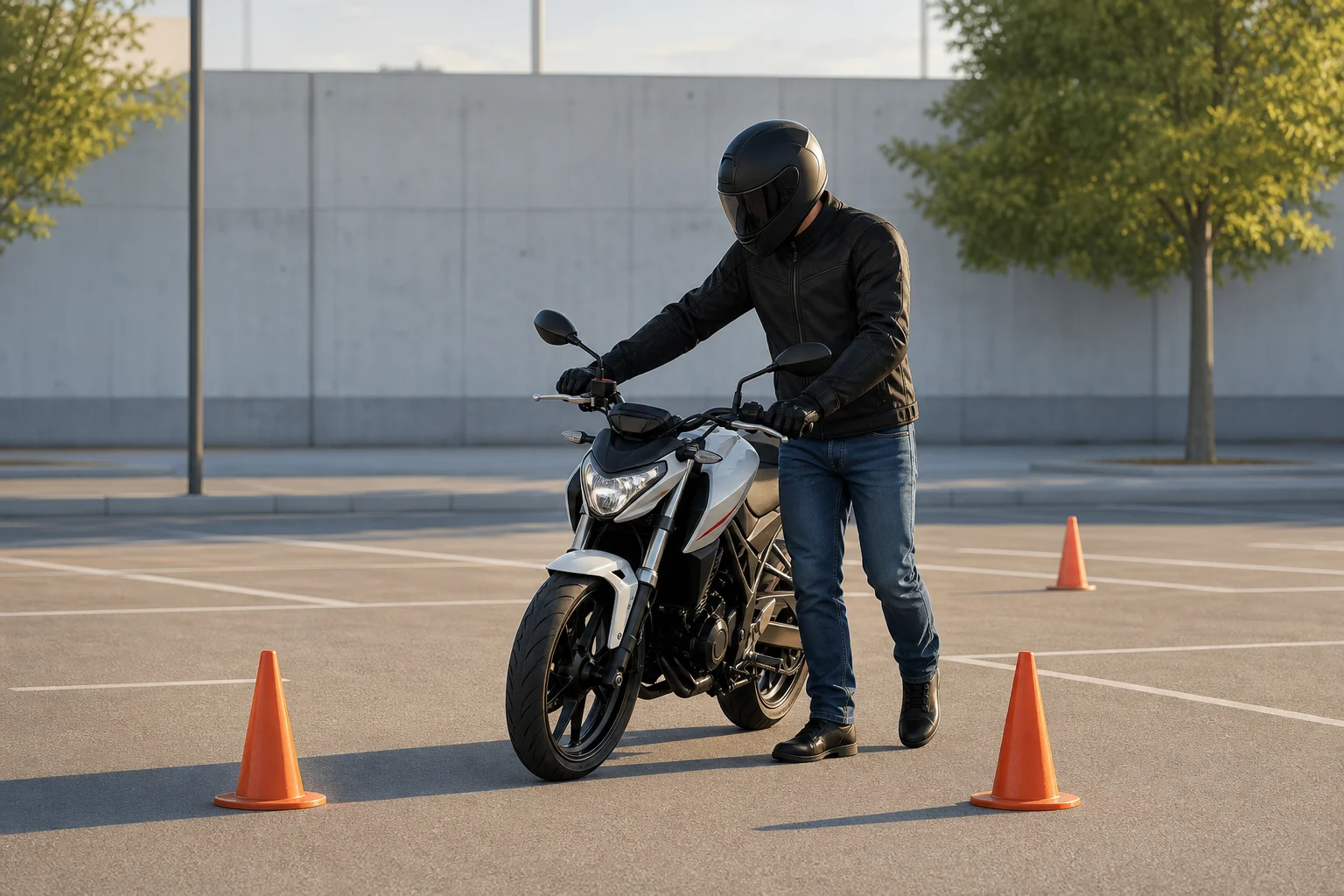
The stationary check deserves time because it recreates frequent situations: taking the motorcycle out of a parking bay, stopping at traffic lights, turning in a narrow street or parking on a sloping surface. Check the stated kerb weight and dimensions to compare candidates, but carry out the test on ground as similar as possible to your usual parking area.
With the seller's or dealer's permission, sit on it wearing the motorcycle footwear you will use. Check your foot placement, whether you can reach the levers without stretching your arms, the position of the footpegs and whether the handlebars turn without interfering with your body. Then, with the engine off, move the motorcycle a few metres forwards and backwards. If you need to apply force you cannot control, cannot naturally reach the controls, or the position forces you into uncomfortable compensations, that motorcycle requires a second assessment or should be ruled out.
Do not mistake “being able to reach the ground” for the only measure of safety. Seat width, leg position, perceived weight distribution and the terrain all affect confidence when stopping. Nor does a very low motorcycle guarantee comfort: check that the space for your legs, feet and hands is reasonable for your build and intended use.
- Bring a helmet, jacket, gloves and footwear similar to what you will actually use.
- Test foot placement, reach to levers, full handlebar lock and footpeg position.
- With permission, move the motorcycle forwards and backwards with the engine off.
- Ask about kerb weight, seat height and width, and turning radius.
- Do not decide only while sitting upright: simulate parking and stopping.
Standard safety features and equipment: what to check before signing
ABS must be verified in the specification and the declared equipment of the specific motorcycle. European rules allow new L3e-A1 motorcycles to have ABS, combined braking or both; it is therefore incorrect to assume every new A1 motorcycle has ABS. For L3e-A2 and L3e-A3 categories, the rules require ABS, except for the stated exception for two-wheeled enduro and trials motorcycles. A sales label does not replace checking exactly what the motorcycle you are buying declares.
Also check the condition and compliance of tyres, lights, mirrors and the exhaust, particularly on used motorcycles. These are items that DGT information lists among ITV inspection checks. If you spot wear, visible damage or components that do not match the technical specification or registration card, include the cost and regularisation in your decision, or request a professional inspection.
An approved or certified helmet is compulsory for motorcycle riders and passengers on both urban and interurban roads, except for the regulatory exception linked to a self-protection structure, seat belts and a documentary entry. Include the helmet and the rest of the equipment you will use in the total budget; buying a motorcycle without setting aside this amount distorts the comparison. Also see how to check an ECE 22.06 motorcycle helmet.
Section references: Reglamento (UE) 168/2013 — anexo VIII, frenado avanzado ↗ · ITV motos ↗ · Reglamento General de Circulación — artículo 118 ↗
- Confirm the braking system fitted to the specific motorcycle; do not assume it from engine size.
- Check tyres, lights, mirrors and the exhaust against the technical specification.
- Check tyre tread depth and condition.
- Set aside a budget for a helmet and equipment, not just the motorcycle.
- If there are accessories or changes, ask whether they are documented as modifications.
New or used: complete the purchase with clear documents, condition and modifications
For a used motorcycle registered in Spain, request a full DGT report before buying. It lets you check, among other matters, the ITV history, mileage, number of keepers, encumbrances, technical data and outstanding recalls. DGT recommends this report to identify seizure orders, impoundment notices, insolvency proceedings and other administrative or judicial encumbrances. Compare it with the documents and the motorcycle in front of you.
Check its age from the recorded first registration or date of entry into service. For category L motorcycles other than mopeds, periodic ITV inspection is every two years once they are over four years old. A consistent history does not replace a professional inspection, but it helps decide whether it is worth proceeding. If you cannot interpret damage, a noise, a modification or the condition of a wear item, make the transaction conditional on an independent inspection.
Modifications made after registration require an ITV inspection and the subsequent update of the registration certificate to record the changes. Do not accept the claim that an exhaust, mirrors, tyres or another component is “approved” as sufficient: ask for it to be linked to the documentation for that motorcycle. This checklist helps you arrive prepared for the viewing, but it does not replace the judgement of a professional.
Section references: Informe de un vehículo ↗ · Modificación y reformas de un vehículo ↗ · Real Decreto 920/2017 — inspección técnica de vehículos ↗
- Ask for the registration certificate, technical specification or ITV card, and any available supporting documents.
- Request the full DGT report before paying a deposit.
- Compare the VIN, technical data, mileage and ITV history with the motorcycle.
- Check tyres, lighting, mirrors and exhaust against the documentation.
- Verify that every modification has been regularised; if not, pause the purchase until it is clarified.
- If an ITV inspection is due because of the motorcycle's age, confirm that it is valid.
Can I choose a motorcycle simply because it is 125 cm³?
No. For A1, you must also check that it does not exceed 11 kW or a power-to-weight ratio of 0.1 kW/kg. With a category B licence held for more than three years, entitlement to ride these motorcycles applies within Spain.
Does every new first motorcycle have ABS?
It should not be assumed. For L3e-A1, the rules allow ABS, combined braking or both. For L3e-A2 and L3e-A3, they require ABS, except for the stated exception for two-wheeled enduro and trials motorcycles.
What should I request before buying a used motorcycle?
At minimum, the registration certificate, technical specification or ITV card, and a full DGT report. Compare the documents with the motorcycle, and check its ITV history, mileage, encumbrances, outstanding recalls and possible modifications.
When does a motorcycle need an ITV inspection?
Category L motorcycles other than mopeds are exempt until they are four years old; after that, they undergo an ITV inspection every two years. Age is counted from the recorded first registration or date of entry into service.