Car for reduced mobility: what to check before choosing or adapting one
A guide to assessing access, transfers, transport of mobility aids, adaptations and paperwork before buying or modifying a car in Spain.
Key points
The right car for a person with reduced mobility is one that enables safe access, travel and, where applicable, driving, without incompatibilities between the person, vehicle, driving licence and possible modifications. Before choosing a body style or adaptation, confirm real-world use and the required documentation in Spain.
The short answer: start with the person and their use, then the car
No one body style is inherently suitable for every person with reduced mobility. A passenger car, estate car, SUV or MPV is only a good choice if it lets that person get in, sit down, carry out the necessary transfers, travel safely and, when they will be driving, use controls that are compatible with their condition and driving licence.
For that reason, the decision should not begin with “I need an automatic”, “I want an SUV” or “I am looking for one already adapted”. These solutions may suit some situations, but they do not replace a functional assessment or a review of the administrative route. A later adaptation may count as a vehicle modification and require paperwork and an ITV inspection (Spain’s vehicle inspection); in addition, restrictive conditions on the driving licence may determine which adaptations are needed to drive.
The prudent way to reduce mistakes is to follow this order: define who uses the vehicle and how; test access and seating position in person; confirm whether a wheelchair or other aid will travel in it; and obtain written confirmation of documentary feasibility before paying a deposit. The final choice must solve the whole situation, not just one part of it.
Section references: Accesibilidad en el permiso de conducir ↗ · Tramitación de las reformas de vehículos (Real Decreto 866/2010) ↗
- Do not confuse ease of getting in with the ability to drive the vehicle.
- Do not assume that an automatic transmission meets every control-related need.
- Do not order an adaptation without knowing the conditions that apply to the driver.
- Do not buy based only on photos, stated height or boot capacity.
Define the usage scenario before looking at models
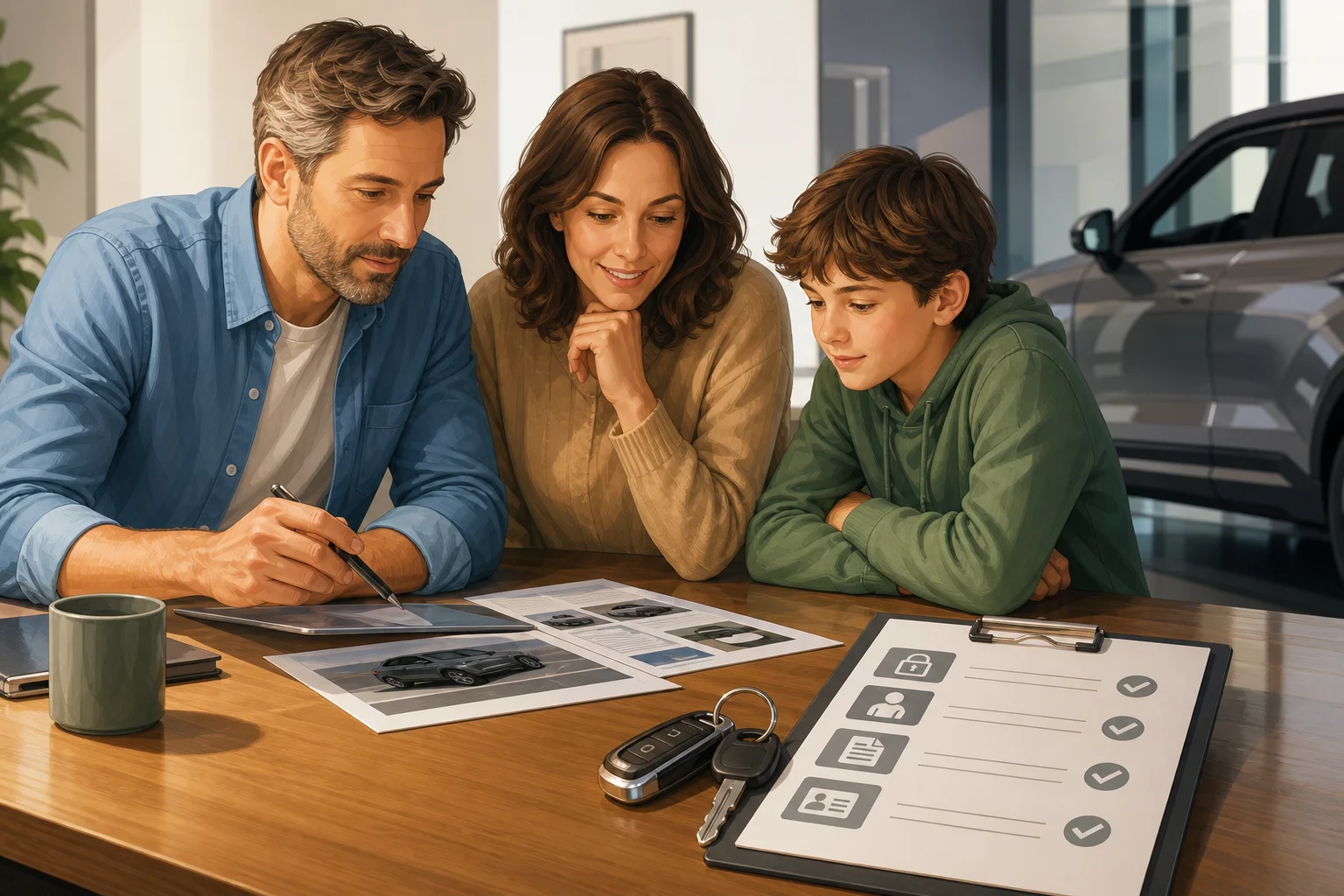
It is helpful to define the need through recurring situations rather than a general description. A driver who transfers to the front seat every day has different requirements from a passenger who travels with someone else and needs to carry a folding wheelchair. Urban use involving frequent entry and exit also has different requirements from long journeys, medical trips or family travel.
Have this conversation with the user, family members and carers who genuinely take part in journeys. If you are buying a used vehicle, this definition also avoids spending time on cars whose configuration or documentary status already makes them unsuitable.
- Who will drive and who will usually travel in the car?
- Does the person get in by walking, with assistance, by transferring, or remain in their wheelchair?
- Who helps with access, if needed, and from which side of the vehicle?
- Which mobility aids always travel with the car, and which are only used on certain trips?
- How many times a day is the car opened, loaded and unloaded?
- Are there narrow parking spaces, a garage, kerbs, frequent journeys or a need to carry more passengers?
- Is the need stable, or could it change in the short term?
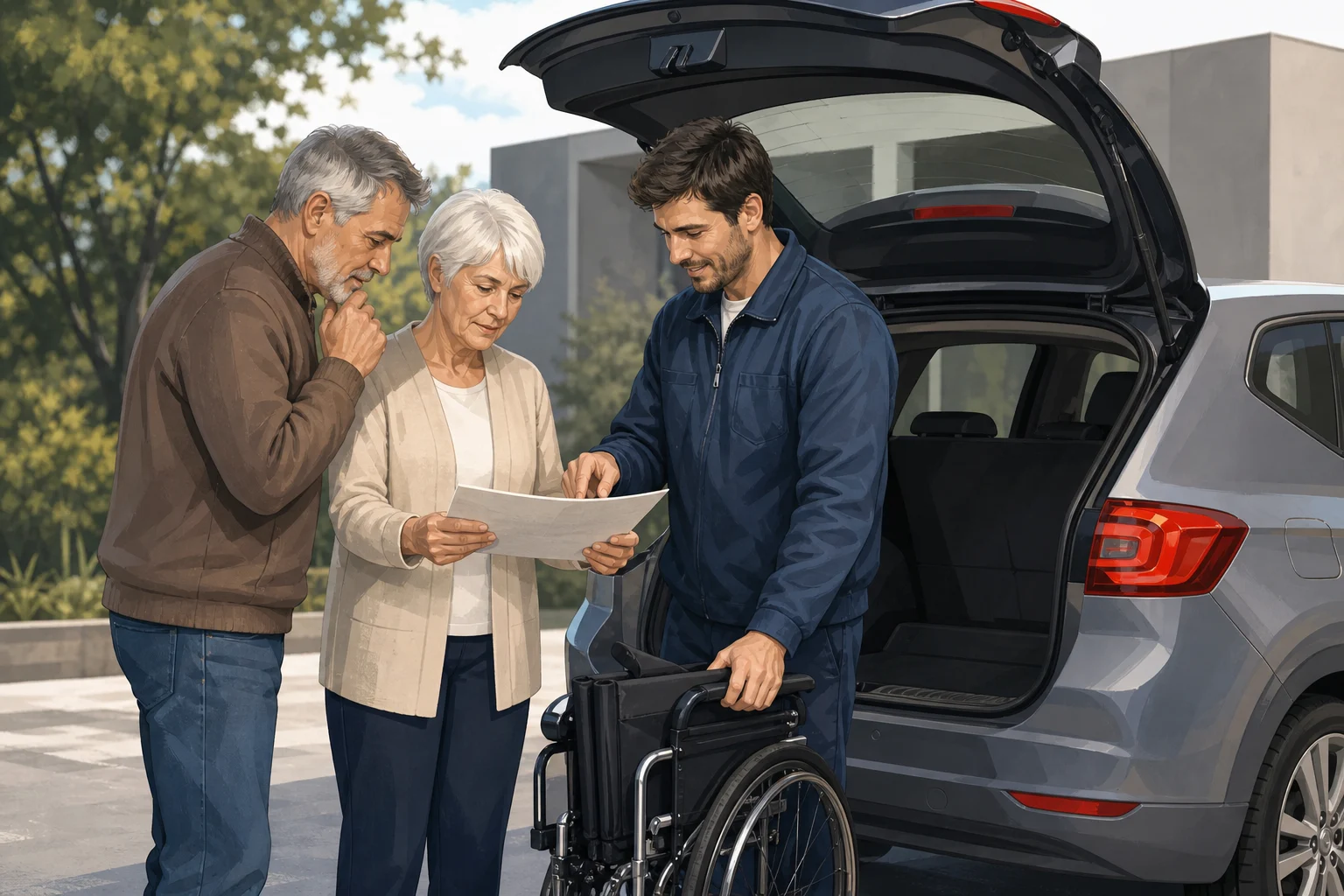
Access, transfers and ergonomics: an in-person test is decisive
A vehicle’s published dimensions can guide the search, but the check must be carried out with the specific person. During the visit, review the height and shape of the seat, foot space, door opening and clearance beside the parked car. Also check the available grab handles, the position of the seat belt and controls, and the final posture.
Set aside an unhurried visit and recreate the usual routine. If the person uses a walking aid, wheelchair, transfer board or another item, bring it to the check. Test both getting in and getting out. Transfers should not be forced or improvised during the test.
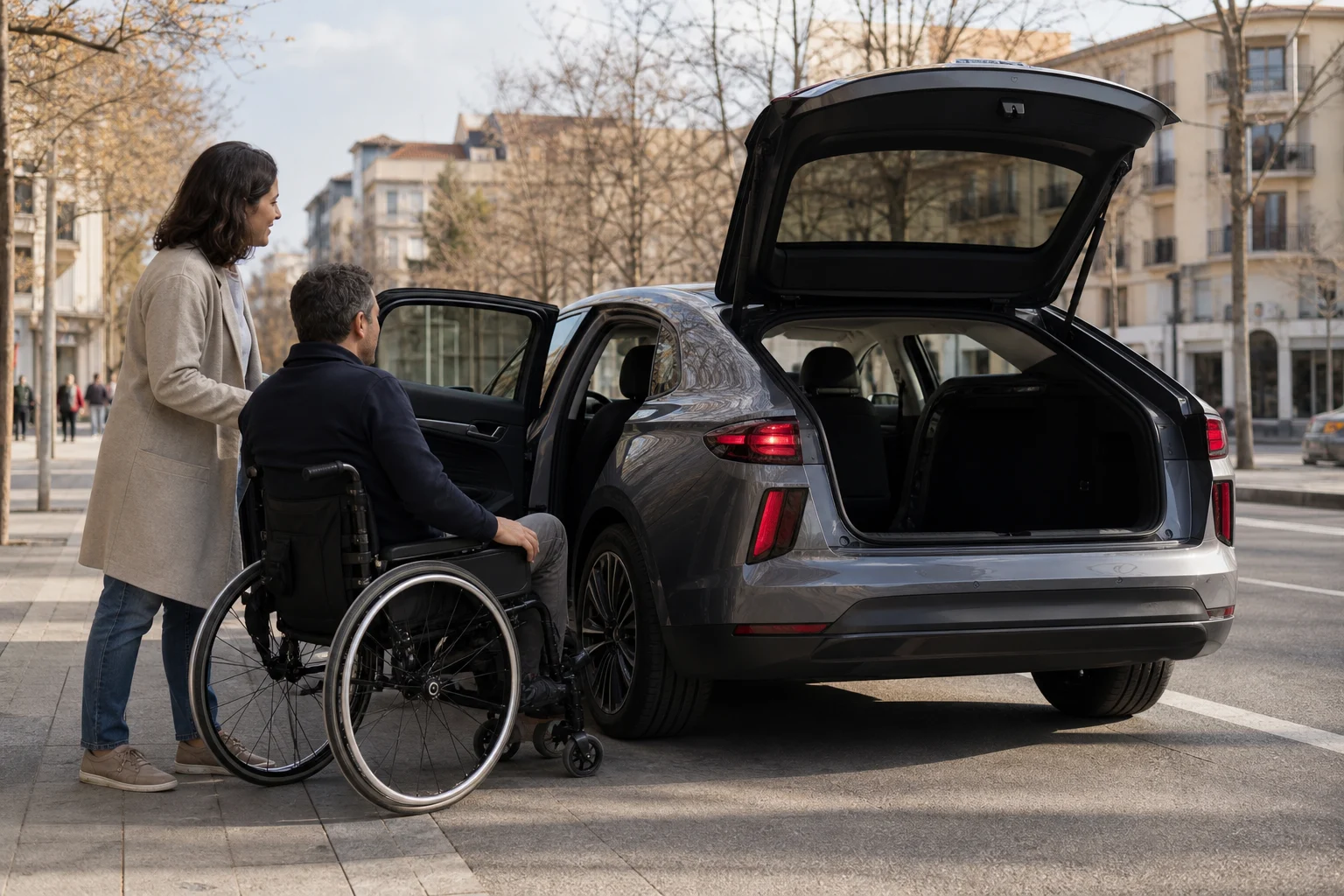
Check access through the rear door, front seat and boot separately, according to the intended use. The valid criterion is being able to complete the planned manoeuvre repeatedly with the person, mobility aid and available space.
- Test getting in and out on both sides if the intended use requires it.
- Check door opening in a normal parking space, not only with clear space all around.
- Verify the transfer, seat-belt positioning and return to a comfortable posture.
- Check whether the passenger and driver retain room to manoeuvre without interfering with each other.
- Confirm visibility from the final position, including mirrors and the area ahead.
If a wheelchair travels in the car: compare the loading manoeuvre, not just the boot
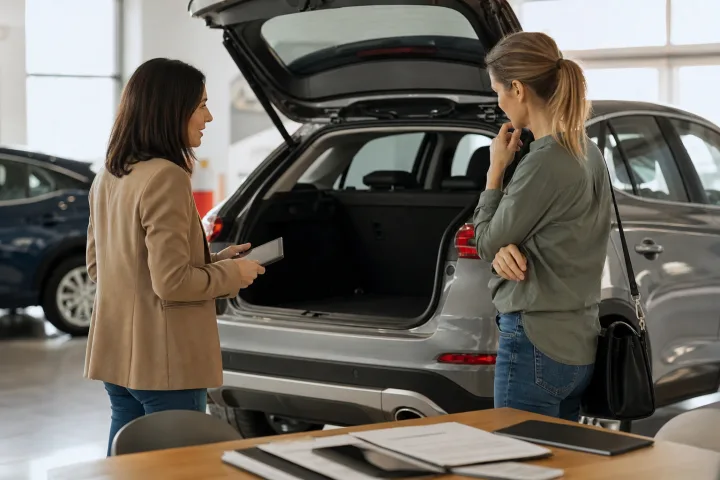
To transport a wheelchair, the advertised volume is not enough. You need to check the interior shape, loading-lip height, tailgate or door opening, route to the loading position and available space when other items are already in the car. The wheelchair should be tested folded or in the configuration in which it will usually be carried.
For any additional equipment planned for the vehicle, ask the relevant provider what documentation applies to the specific solution. Also check the maximum masses shown in the car’s documentation before adding equipment or regular loads. If the person needs to travel in their wheelchair, ask the relevant provider to verify the specific solution for that intended use.
The following table does not classify body styles as good or bad: it is intended to organise a visit and compare several vehicles using the same criteria.
| Vehicle type | What to check in person | Risk if it is not tested |
|---|---|---|
| Passenger car | Boot opening, loading lip, interior shape and room for loading. | The manoeuvre may not suit the intended use. |
| Estate car | Tailgate access, usable length and how the load fits with usual luggage. | The manoeuvre may not suit the intended use. |
| SUV | Loading height, reach to the back and manoeuvring space beside the tailgate. | The manoeuvre may not suit the intended use. |
| MPV | Side and rear access, interior space and seat configuration. | The manoeuvre may not suit the intended use. |
Section references: Informe de un vehículo ↗
- Measure and test with the actual mobility aid; do not settle for a visual estimate.
- Repeat loading and unloading to check effort, reach and room to manoeuvre.
- Ask which documents will accompany any item fitted to the vehicle.
- Review the maximum masses shown in the car’s documentation before adding equipment or regular loads.
Driving, adaptations and driving licence: confirm compatibility before spending
When the person will drive, three elements must be kept separate: the car’s original equipment, any adaptation that may be fitted and the conditions that apply to the driving licence. The vehicle’s original equipment does not remove the need to verify any prescribed adaptations and the driving-licence conditions that apply to the driver.
Spain’s DGT states that, before starting training, an applicant with a disability must visit a Spanish Driver Recognition Centre (Centro de Reconocimiento de Conductores). The report may find them fit, fit with restrictive conditions, unfit or interrupted. If they are fit with restrictive conditions, it recommends consulting a Traffic Headquarters or Traffic Office before starting training or adapting the vehicle, to verify or specify the prescribed adaptations. If the disability arises after obtaining the driving licence, the process also starts at the Spanish Driver Recognition Centre and, where applicable, continues with the Traffic authority.
This means you should not interpret driving-licence annotations yourself or buy a vehicle assuming that “it will be approved later”. Before completing the purchase, ask the specialist workshop for written confirmation that the planned adaptation is compatible with that vehicle, and ask which documents and actions will be needed. The specific requirement depends on the applicable modification under the Vehicle Modifications Manual.
Section references: Accesibilidad en el permiso de conducir ↗ · Tramitación de las reformas de vehículos (Real Decreto 866/2010) ↗ · Resolución que aprueba la corrección segunda de la revisión séptima del Manual de Reformas de Vehículos ↗
- Consult a Spanish Driver Recognition Centre first when applicable.
- If restrictive conditions exist, verify the adaptations with the Traffic authority before ordering work.
- Ask the workshop to identify the vehicle, planned adaptation and applicable paperwork.
- Check that the driving position allows the controls to be operated while maintaining sufficient visibility.
- Always distinguish between a factory option and a later modification.
Used car, already adapted car or later modification: documents you should require
A used vehicle can be a good starting point, but it requires an additional documentary check. Ask for the tarjeta ITV (Spain’s vehicle inspection card) and permiso de circulación (Spanish registration certificate), and review all documentation for modifications it already has. The DGT notes that a vehicle needs a permiso de circulación and a valid ficha técnica or tarjeta ITV to drive legally. If the ITV has expired, it cannot be driven and must be taken to the ITV station by tow truck or another authorised means.
Also request any available manuals, operating instructions, maintenance records and repair receipts for adapted equipment. It is not enough for a platform, control or other item to be physically fitted: review the documentation required for the specific modification and check that it matches the tarjeta ITV. A DGT vehicle report can provide, among other data, technical information, maximum masses, ITV history, recall notices and, where recorded in the system, entries from the electronic maintenance logbook.
For a modification, Royal Decree 866/2010 establishes that, depending on the case set out in the Vehicle Modifications Manual, a technical project and final works certificate, conformity report and workshop certificate may be required. After the modification, the registered keeper must present the vehicle for an ITV inspection within a maximum of fifteen days, with the required documentation. If the inspection is passed, the tarjeta ITV is endorsed or a new one is issued; the DGT then states that a permiso de circulación reflecting the changes should be requested.
The final check is simple: before paying, gather the permiso de circulación, tarjeta ITV and modification documents in one folder; check that they describe the same vehicle and the configuration you are buying. If documentation is missing or the seller cannot clarify a discrepancy, stop the transaction until it is resolved.
Section references: Tramitación de las reformas de vehículos (Real Decreto 866/2010) ↗ · Modificación y reformas de un vehículo ↗ · Informe de un vehículo ↗ · Comprar un vehículo de segunda mano ↗
- Valid tarjeta ITV and permiso de circulación.
- Documentation for every modification already carried out, matching the tarjeta ITV.
- Available manuals, maintenance records and repair documents for adapted equipment.
- A DGT vehicle report before completing a used-car purchase.
- Written confirmation from the workshop if the car will be adapted afterwards.
- A plan for the ITV and permiso de circulación update once the modification is completed.
Is an automatic car always the best option for a person with reduced mobility?
Not necessarily. It may be suitable in some cases, but it does not replace checking access, posture, controls and driving-licence conditions. If an adaptation is planned, it is advisable to consult a Spanish Driver Recognition Centre first and, where restrictive conditions exist, the Traffic authority.
What documents should I check when buying an adapted used car?
Ask for the permiso de circulación, tarjeta ITV, documentation for all modifications and any available maintenance documents for the adapted equipment. Check that the fitted configuration matches what is stated on the tarjeta ITV, and request a DGT vehicle report.
Does a car need an ITV inspection after it is adapted?
Modifications are subject to the procedure set out in Royal Decree 866/2010 and the Vehicle Modifications Manual. After a modification, the registered keeper must present the vehicle for an ITV inspection within a maximum of fifteen days with the required documentation; if it passes, the tarjeta ITV is updated.
When must the permiso de circulación be updated?
The DGT states that, once the modification has been verified at the ITV inspection, a new permiso de circulación reflecting the changes made must be requested from the Traffic authority.