High or low motorcycle windscreen: how to choose without mistakes
More height does not automatically mean greater comfort. Check how the windscreen interacts with your riding position and helmet, what options your motorcycle supports, and what documentation you need before changing it.
Key points
Height alone cannot predict whether a windscreen will reduce noise or turbulence. Compare fit, riding position and use, and confirm with the manufacturer which approval requirements apply to your motorcycle.
Height matters, but it is not the only deciding factor
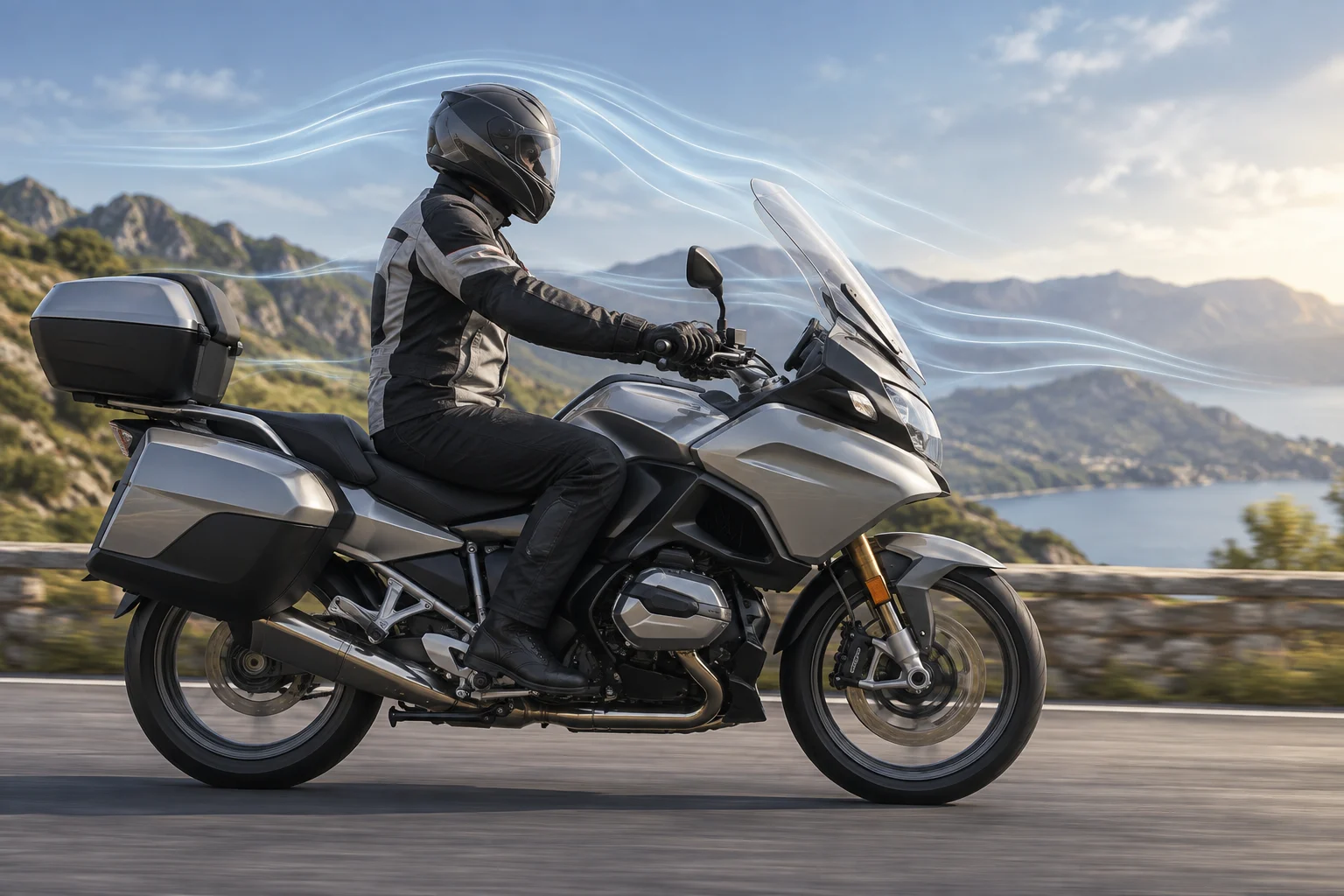
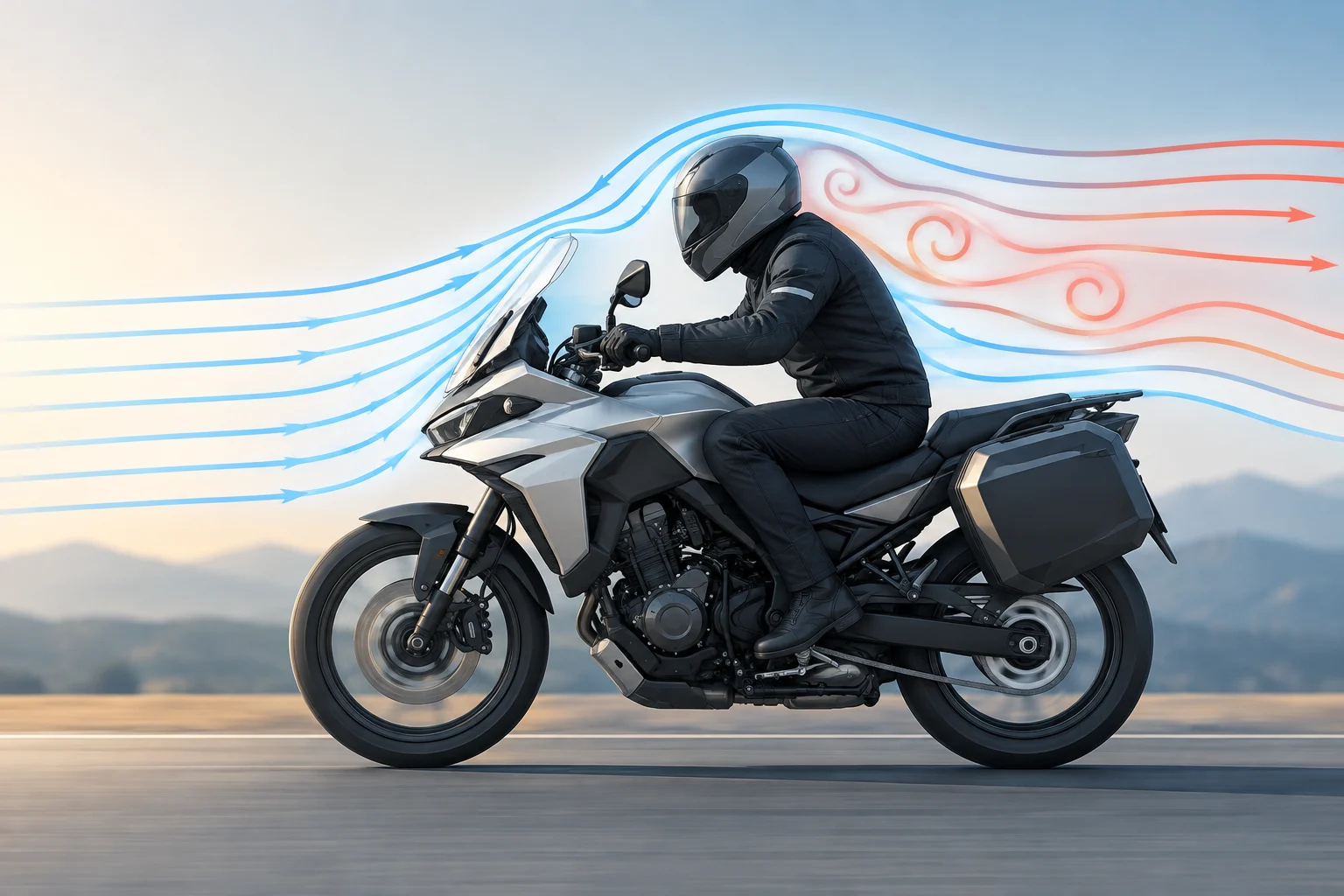
Choosing between a high or low windscreen is not simply a matter of seeking maximum protection. The windscreen’s shape and position change how the air reaches the rider, but the result also depends on riding position, height, helmet and how the motorcycle is used. So it is not possible to guarantee that a higher windscreen will eliminate noise or turbulence.
A technical study presented at SAE describes aerodynamic comfort as a balance between wind protection, pressure on the rider, noise, visibility and handling characteristics. In other words, improving one aspect does not guarantee that all of them will improve at the same time. The useful approach is to compare the complete setup and look for a configuration suited to both the rider and their motorcycle, rather than a universal windscreen height.
Section references: CFD Analysis of Airflow around the Rider of a Motorcycle for Rider Comfort Improvement (2009-01-1155) ↗
- First, identify the discomfort you want to reduce: wind on your torso, airflow around your helmet, noise, rain or a combination.
- Check that the specific windscreen is made for your model and version; do not infer compatibility from its appearance or general dimensions.
- Also consider visibility and how easy it is to maintain a comfortable riding position.
High and low windscreens: what to compare
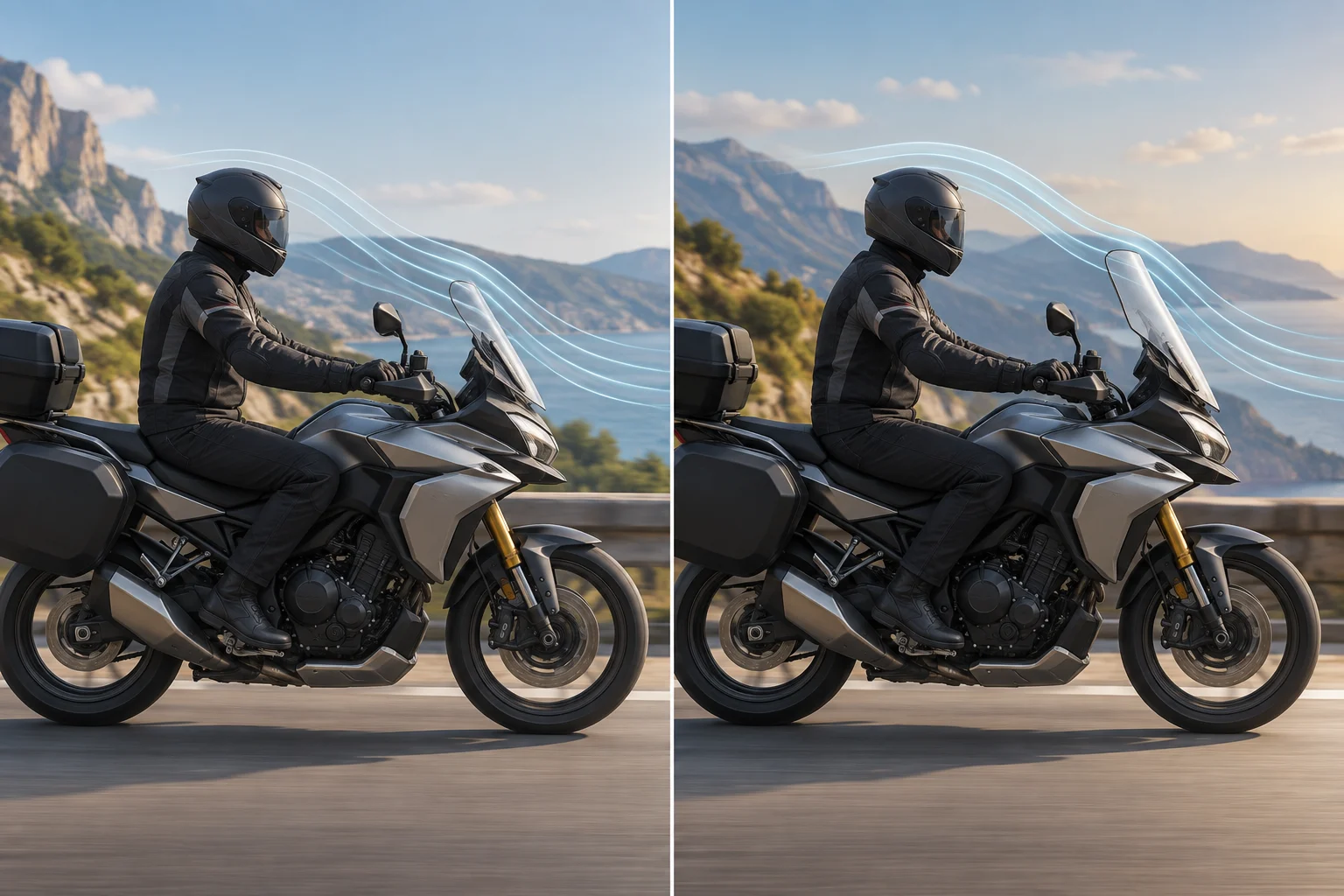
A higher windscreen may change where the air meets the rider; a lower one leaves the rider exposed in a different way. But the labels “high” and “low” do not, on their own, describe the airflow the helmet will receive. Two riders of different heights, or one rider sitting in different positions, may be positioned differently in relation to the same windscreen.
An SAE technical paper on a high-performance motorcycle studied two head heights in relation to the windscreen and several speeds. It does not establish an ideal measurement for every motorcycle; instead, it illustrates why the rider’s position and riding conditions matter. Use the table as a guide to framing your comparison, not as a promise of results.
| Aspect | What to check | What not to assume |
|---|---|---|
| Wind protection | Where the air hits your body and helmet in your usual riding position | That a higher windscreen protects everyone equally |
| Noise and turbulence | Whether the airflow around the helmet feels more or less bothersome | That more frontal protection means less noise |
| Visibility | That the windscreen does not obstruct your view in your riding position | That a larger surface is always more comfortable |
| Compatibility | Exact application, fitment and manufacturer instructions | That a similar-looking windscreen will fit your motorcycle |
Section references: Simulation-Driven Aerodynamic Development of a High-Performance Motorcycle (2022-32-0112) ↗
Riding position, helmet and discomfort: identify the problem
Before buying, think about how you actually ride: upright, leaning forward or changing position during a journey. The position of your head in relation to the windscreen’s edge is relevant when comparing options, but measuring the part alone is not enough: what matters is the relationship between the windscreen and the rider. The helmet is also part of the overall aerodynamic setup.
Separate the different types of discomfort. Feeling pressure on your chest is not the same as getting uneven airflow around your helmet; noise is not the same as turbulence either. If you want to feel less tired on the road, note what happens, at what speed or in which position you notice it, and whether it occurs in a crosswind or when carrying luggage. This description will help you ask the manufacturer or seller a specific question without assuming that one windscreen height will solve everything.
If your motorcycle allows the windscreen to be adjusted, follow only the manual for that model. The linked BMW manual, for example, states that the windscreen should not be adjusted while the motorcycle is moving. This is an instruction specific to that manual, not a rule that should be applied to every motorcycle.
Section references: CFD Analysis of Airflow around the Rider of a Motorcycle for Rider Comfort Improvement (2009-01-1155) ↗ · Simulation-Driven Aerodynamic Development of a High-Performance Motorcycle (2022-32-0112) ↗
- Note whether the discomfort affects your torso, helmet, visibility or several areas.
- Describe your usual riding position and the type of journey on which it occurs.
Compatibility and fitment: check the exact application
Before comparing shapes or prices, confirm the applicable make, model, version and year. Also check what brackets and fasteners the windscreen needs, whether original parts are retained, and whether the instructions call for any adjustments. A Puig fitting sheet, for example, identifies a windscreen that fits the Yamaha TMAX 530 and specifies original fasteners: this is a specific reference, not proof of compatibility with other motorcycles.
Do not force a fit or assume that a universal windscreen will fit just because some mounting points line up. Check the windscreen manufacturer’s instructions and the motorcycle manual, and ask if you have questions about the fairing, adjustment system or accessories already fitted. Keep the part and fitment documentation so you can check its application and the conditions specified.
Section references: Montageanleitung / mounting instructions: windscreen for Yamaha TMAX 530 ↗
- Check the windscreen part number against the fitment details for your exact motorcycle.
- Review the instructions and fasteners, and check whether the use of original parts is specified.
- Before buying or fitting, ask the manufacturer or seller about anything you are unsure of.
Approval in Spain: check before making changes
Spain’s Vehicle Modifications Manual includes fairings, windscreens and cúpulas among the bodywork components of two- and three-wheeled vehicles. For cúpulas (windscreens, in the terminology used by the Spanish manual), it lists cases that are not considered a modification: when they do not exceed the maximum height in the type approval, or when they can be removed without tools. This is a specific exception for cúpulas, not one that should automatically be applied to every windscreen, vehicle or fitment.
The Ministry says that the regulations on vehicle modifications include Royal Decree 866/2010 and the latest version of the Vehicle Modifications Manual in force. For a specific case, it recommends consulting the vehicle manufacturer or legal representative, or an appointed technical service. So if a windscreen changes dimensions, mountings or configuration, do not assume on your own that it is exempt: confirm what applies to your motorcycle and keep the relevant response and documentation.
Section references: Manual de Reformas de Vehículos, 7.ª revisión, corrección 2.ª ↗ · Preguntas frecuentes: reformas de vehículos ↗
- Ask whether the windscreen and its fitment alter your vehicle’s approved configuration.
- Do not generalise the exception for certain screens referred to in the Spanish manual as cúpulas to every accessory.
- If you are unsure, consult the manufacturer, legal representative or appointed technical service about the specific modification.
Final decision: a useful checklist before buying
For city riding, road use or touring, start with how you use the motorcycle and the discomfort you want to address; do not choose based on a generic recommendation about windscreen height. If you use the motorcycle for different types of journeys, prioritise an option documented for your model and check whether the manufacturer offers adjustable positions. When touring with luggage, reassess the whole setup and your usual riding position, but do not attribute a guaranteed effect on turbulence to the windscreen.
Before paying, gather the exact part number, fitting instructions and information on the applicable approval requirements. If you can compare options, do so using consistent criteria: the same motorcycle, riding position and conditions of use. The available technical evidence confirms that comfort depends on several factors; it does not provide a universal size or allow anyone to guarantee that a high or low windscreen is better for everyone.
Section references: Preguntas frecuentes: reformas de vehículos ↗ · CFD Analysis of Airflow around the Rider of a Motorcycle for Rider Comfort Improvement (2009-01-1155) ↗
- Is the part for my exact make, model, version and year?
- What specific discomfort do I want to reduce, and where do I notice it?
- Have I considered my riding position, height and helmet without assuming windscreen height will solve the noise?
- What fasteners and fitting steps do the manufacturers specify?
- Have I confirmed whether the change affects my motorcycle’s approval in Spain?
- Will I keep the windscreen’s instructions, part number and documentation?
Does a high windscreen always reduce helmet noise?
There is no guarantee. Comfort depends on several factors, including airflow, riding position, head position, noise and visibility. Height alone does not predict the result.
How do I check whether a windscreen is compatible with my motorcycle?
Verify the exact application for the make, model, version and year, and review the fitting instructions and fasteners. If you are unsure, ask the manufacturer or seller before buying.
Could changing the windscreen be considered a vehicle modification in Spain?
It depends on the vehicle and the change. The Vehicle Modifications Manual covers specific cases for cúpulas (windscreens, in the terminology used by the Spanish manual), but these are not a universal exemption. Consult the manufacturer, legal representative or appointed technical service.
Can I adjust the windscreen while riding?
Follow the manual for your model. The cited BMW manual says that its windscreen must not be adjusted while the motorcycle is moving; that instruction applies to that manual and should not be generalised.