Changing a Motorcycle Exhaust: Type Approval, Documents and ITV
A guide to checking what a motorcycle exhaust marking proves, how to review the manufacturer’s information and when a modification process and ITV inspection may be required in Spain.

Key points
An exhaust advertised as approved is not automatically authorised for every motorcycle. Before buying one, distinguish between the part’s marking, the manufacturer’s application information and whether the change must be processed as a modification and inspected at an ITV station.
The quick answer: “approved” does not mean “valid for every motorcycle”
Changing a motorcycle’s original exhaust should not be decided solely on the basis of an advert, a marking engraved on the silencer or the promise that the accessory is approved. Type approval is the procedure through which a vehicle type, system, component or separate technical unit is certified as meeting the applicable requirements. You must therefore distinguish between a part’s marking or approval, the manufacturer’s information on its application, and the possible need to process a modification on the specific motorcycle.
The useful check follows this order: identify the motorcycle and exhaust exactly; inspect the physical marking; request the information the manufacturer supplies for that reference and application; and determine, before fitting it, whether the change may be a modification. If it is, the specific documentary requirements are set out in the Vehicle Modifications Manual, and the motorcycle must be presented for ITV inspection after the work.
This caution also matters during the inspection. Version 7.9 of the ITV Station Inspection Procedure Manual is listed as applicable from 1 January 2026. It is also prohibited to ride if noise limits are exceeded, if there is an unauthorised major modification, or if exhaust gases do not pass through an effective and suitable silencer.
Section references: Real Decreto 866/2010, de 2 de julio, sobre reformas de vehículos ↗ · Inspección Técnica de Vehículos (ITV) — manuales y normativa ↗ · Reglamento General de Circulación — emisiones contaminantes, ruido y reformas no autorizadas ↗
- Do not buy based solely on the word “approved”.
- Do not assume that a reference is valid for a similar motorcycle that differs in version or configuration.
- Keep the original exhaust until you have confirmed that the new assembly is correctly documented.

Gather the details before buying or removing anything
The simplest preventive step is to work from identifying data rather than generic descriptions such as “fits this model”. Keep Spain’s vehicle inspection card (ITV card) at hand and accurately note the make, model, variant or version shown on it, together with the motorcycle’s identification details. Then ask the seller for the exhaust’s exact make and reference, not just the commercial name of the range.
It is also advisable to document the starting condition. Photograph the original fitted exhaust and retain any paperwork that already came with the motorcycle. If it is a second-hand unit, the absence of manufacturer information about the accessory should be treated as a reason to pause the purchase or request it from the manufacturer or seller. A used silencer with a visible marking does not, by itself, establish that it applies to that motorcycle.
Before paying, compare the motorcycle’s identifiers with those shown in the instructions, technical catalogue or information supplied for the exhaust. If those materials do not establish a specific application, do not treat them as sufficient evidence that the change will not require further checks.
Section references: Real Decreto 866/2010, de 2 de julio, sobre reformas de vehículos ↗ · Reglamento n.º 41 de las Naciones Unidas — homologación de motocicletas respecto al ruido ↗
- Motorcycle vehicle inspection card.
- Vehicle make, model, variant or version, and identification details.
- Exhaust make and full reference.
- Available manufacturer information and instructions.
- Photographs of the silencer marking and the original exhaust.
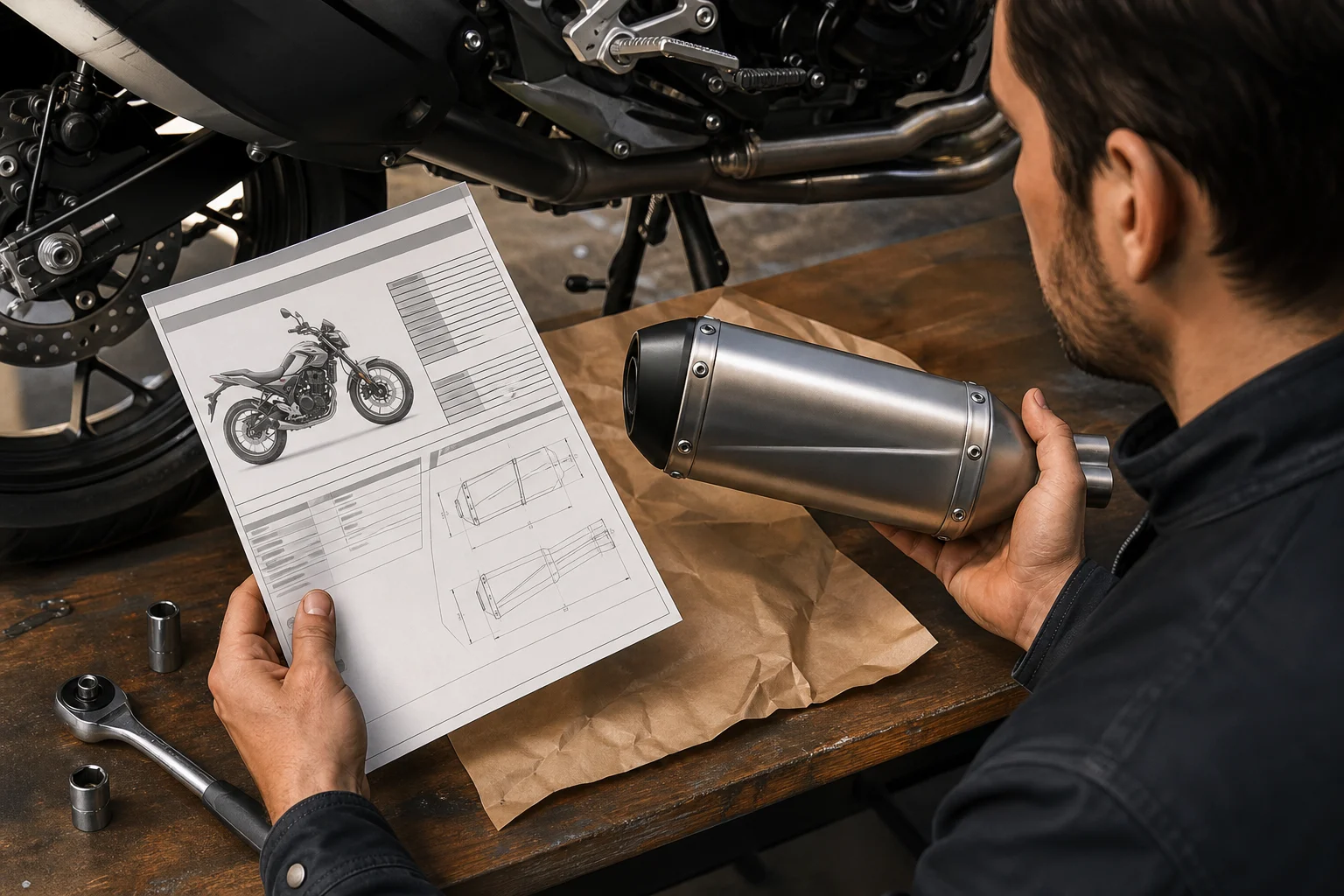
What to look for on the silencer marking and what it proves
The marking is a checkpoint, but not a shortcut to close the matter. United Nations Regulation No. 41 provides that original silencers for motorcycles type-approved for noise carry an “E” mark accompanied by the identification of the country that granted the approval. The regulation requires markings to be legible and indelible: check that the engraving or plate can be read, and photograph it before installation.
For original replacement systems, the regulation also provides for the packaging to state “original part” and display make and type references alongside the E mark. This helps identify the nature of the part within that scenario, but it does not extend the scope of that rule to every replacement exhaust or remove the need to check the reference and information applicable to your motorcycle. The isolated word “approved” on a box, advert or invoice does not itself explain for what type of system or application approval was granted.
Do not alter the silencer once it is installed. Spain’s General Traffic Regulations require an effective, complete and suitable silencer. A perforated, damaged or modified part is no longer in a condition comparable to that identified by its manufacturer.
Section references: Reglamento n.º 41 de las Naciones Unidas — homologación de motocicletas respecto al ruido ↗ · Reglamento General de Circulación — emisiones contaminantes, ruido y reformas no autorizadas ↗
- Look for a legible and indelible physical marking, not just an advertising claim.
- Match the marking to the product reference and the available manufacturer information.
- Do not interpret an E mark intended for an original silencer as universal authorisation for any motorcycle model or replacement exhaust.
- Avoid subsequent modifications to the silencer or other system components.
Compatibility: check the whole assembly, not just the pipe
The relevant question is not merely whether the exhaust physically fits. You should check whether the manufacturer provides that reference for the motorcycle’s exact configuration. It is advisable to compare the mounting points, system configuration and manufacturer instructions with the vehicle identified in the vehicle inspection card. If the accessory requires work other than a replacement envisaged in its own instructions, the risk increases that the result will have to be assessed as a modification.
The legal definition of a modification is broad: it includes any modification, replacement, action, addition or removal that changes vehicle characteristics or may alter the regulatory requirements that apply. For that reason, it is not prudent to state that every exhaust replacement falls outside the modification process, nor to state the opposite without reviewing the Modifications Manual applicable to the case.
Where there is a genuine doubt, review the applicable Vehicle Modifications Manual before installation and retain the vehicle inspection card, the exhaust reference and all available information for the process, if required. The Ministry’s official webpage lists version 7.9 of the ITV Station Inspection Procedure Manual as applicable from 1 January 2026. For the classification of a possible modification, Royal Decree 866/2010 refers to the Vehicle Modifications Manual for the specific requirements of each type of modification.
| Item | Practical use | What it does not guarantee on its own |
|---|---|---|
| Legible marking on the silencer | Match it to the product reference and available information | That it applies to every motorcycle or configuration |
| Exhaust reference | Identify the specific product being assessed | That no additional check is needed for your motorcycle |
| Manufacturer instructions or information | Compare the application or installation stated by the manufacturer | That there is no modification if the work alters regulatory requirements |
| Vehicle inspection card | Compare the motorcycle’s details with the available exhaust information | An automatic conclusion about a part that has not been verified |
Section references: Real Decreto 866/2010, de 2 de julio, sobre reformas de vehículos ↗ · Inspección Técnica de Vehículos (ITV) — manuales y normativa ↗
- Check whether the manufacturer’s instructions mention the application that corresponds to your motorcycle.
- Review the installation instructions before buying.
- Seek advice in advance if documents are missing or the work changes elements beyond the silencer.
- Do not confuse the fact that a part can be fitted with the fact that it requires no further checks.
If the change is a modification: documents, ITV and deadline
When the work is considered a modification, Royal Decree 866/2010 establishes that the specific requirements and documents for each type are determined in the Vehicle Modifications Manual. As a general rule, the process includes a compliance report and workshop certificate. Do not wait until after fitting the exhaust to request these documents: confirm first which documentation applies to the specific scenario.
Once a modification has been carried out, the registered keeper is required to present the motorcycle for technical inspection within a maximum period of fifteen days, providing the documentation established by the Manual. ITV should not be approached as an opportunity to discover whether the accessory was suitable: it is preferable to resolve the classification and documentation before making the change.
As a recommended precaution, keep a physical or digital folder containing the vehicle inspection card, invoice or proof of purchase, instructions, manufacturer information and images of the marking. These documents may help with a subsequent check, but they do not replace the documents required for a modification; where applicable, the compliance report and workshop certificate must be added.
Section references: Real Decreto 866/2010, de 2 de julio, sobre reformas de vehículos ↗ · Inspección Técnica de Vehículos (ITV) — manuales y normativa ↗
- Consult the Modifications Manual before installation if there is uncertainty.
- If it is a modification, obtain a compliance report and workshop certificate.
- Present the motorcycle for ITV within fifteen days after the modification.
- As a recommended measure, retain the information linked to the fitted reference.
Common mistakes and a final checklist before riding
The most common mistake is to equate advertising with evidence. Another is buying a second-hand part without sufficient information, fitting it and discarding the original exhaust before the case has been verified. Subsequent modifications to a component that was initially identified also create problems. Version 7.9 of the ITV Station Inspection Procedure Manual is applicable from 1 January 2026.
Before riding, carry out a documentary and visual review. Except for the compliance report and workshop certificate where they apply to a modification, the points on the list are recommended precautions to check and support the case, not a list of documents required for every exhaust change. If any point remains unanswered, do not replace it with an assumption: review the applicable official modification requirements before using the motorcycle. In matters of noise and modifications, the consequence is not limited to an unfavourable inspection result; Spain’s General Traffic Regulations prohibit riding in the indicated cases of excessive noise levels, an unauthorised major modification, or an ineffective, incomplete, unsuitable or damaged silencer.
For more content on vehicle obligations, see Regulations and procedures, and to identify your motorcycle’s version correctly, you can check Makes, models and versions.
Section references: Inspección Técnica de Vehículos (ITV) — manuales y normativa ↗ · Reglamento General de Circulación — emisiones contaminantes, ruido y reformas no autorizadas ↗
- The vehicle inspection card identifies the motorcycle exactly.
- The exhaust make and reference match those shown in the available information.
- The silencer marking is legible and has been photographed.
- The instructions and manufacturer information are retained.
- It has been checked in advance whether the change may be a modification.
- If a modification applies, a compliance report and workshop certificate are available.
- The exhaust is securely fixed and shows no damage.
- The original exhaust is kept until all checks are complete and, where applicable, the ITV inspection has been carried out.
Is an exhaust with an E mark automatically allowed on my motorcycle?
Not necessarily. Regulation No. 41 provides for the E mark on original silencers for motorcycles type-approved for noise. You must check the scope of the marking and the manufacturer’s information for the specific motorcycle, and assess whether the work may constitute a modification.
What does the ITV inspect on the exhaust?
Version 7.8 of the ITV Station Inspection Procedure Manual provides for a visual inspection of the pipe and silencer, including leaks, corrosion, cracks or perforations, their attachment to the frame, and unauthorised modifications, replacements or removals. In that manual, unauthorised modifications, replacements or removals are classified as a major defect. Version 7.9 is listed as applicable from 1 January 2026, but this guide does not assume that it retains those specific checks unchanged.
When do I have to go to ITV after changing the exhaust?
If the change is processed as a modification, the registered keeper must present the motorcycle for technical inspection within a maximum of fifteen days from when it is carried out, with the documentation required by the Modifications Manual.
What exhaust documents should I keep?
As a recommended precaution, retain the vehicle inspection card, product reference, instructions, manufacturer information and photographs of the marking. If a modification applies, the compliance report and workshop certificate must be added in accordance with the applicable Manual.
Can I ride with a damaged or modified silencer?
Spain’s General Traffic Regulations require an effective, complete and suitable silencer, and prohibit riding when it is incomplete, unsuitable or damaged.