Trail motorcycle tyres: choosing road or mixed use
A guide to replacing trail motorcycle tyres without mistaking an off-road look for technical compatibility or public-road approval.
Key points
To choose trail motorcycle tyres, first follow the size, construction and ratings approved by the manufacturer; then choose a road-focused or mixed-use option that suits your real use. Tread pattern alone does not prove that a tyre is compatible or road approved.
The quick answer: compatibility first, then the percentage of tarmac
The right choice does not start by counting tread blocks. On a trail bike, the first filter is always the documented specification for that motorcycle: front and rear tyre size, maximum load and speed rating. Manufacturers approve these details for each vehicle, so a tyre that looks suitable because of its size or appearance may not be technically suitable.
Once that filter has been met, define your use honestly. If the bike spends almost all its life on tarmac, prioritise road options within the specified sizes and ratings. If it alternates between roads and permitted tracks, look for a compatible mixed-use option. If a more off-road orientation is intended, documentary checks become even more important: a tread pattern resembling a road tyre proves neither public-road approval nor compatibility with the motorcycle.
Do not change a size, construction or rating simply because another trail bike uses it. Without documentation specific to your version, it should not be treated as a direct replacement.
Section references: Índice de carga y velocidad de neumáticos de moto ↗ · Requisitos de la F.I.M. para Enduro ↗
- Decision order: motorcycle specification → rim compatibility and TT/TL system → public-road-use markings → actual type of use.
- The product name, tread appearance and informal advice do not replace approved sizes and ratings.
- For a safe purchase, keep a photo of both sidewalls of each tyre and of the motorcycle documentation.
What to read before comparing tyres
Gather three sources: the motorcycle's vehicle inspection card (ficha técnica), its manual and the details of the fitted tyre. It is important to distinguish between what is currently fitted to the bike and the manufacturer's documented specification: on a used motorcycle, the two may not match.
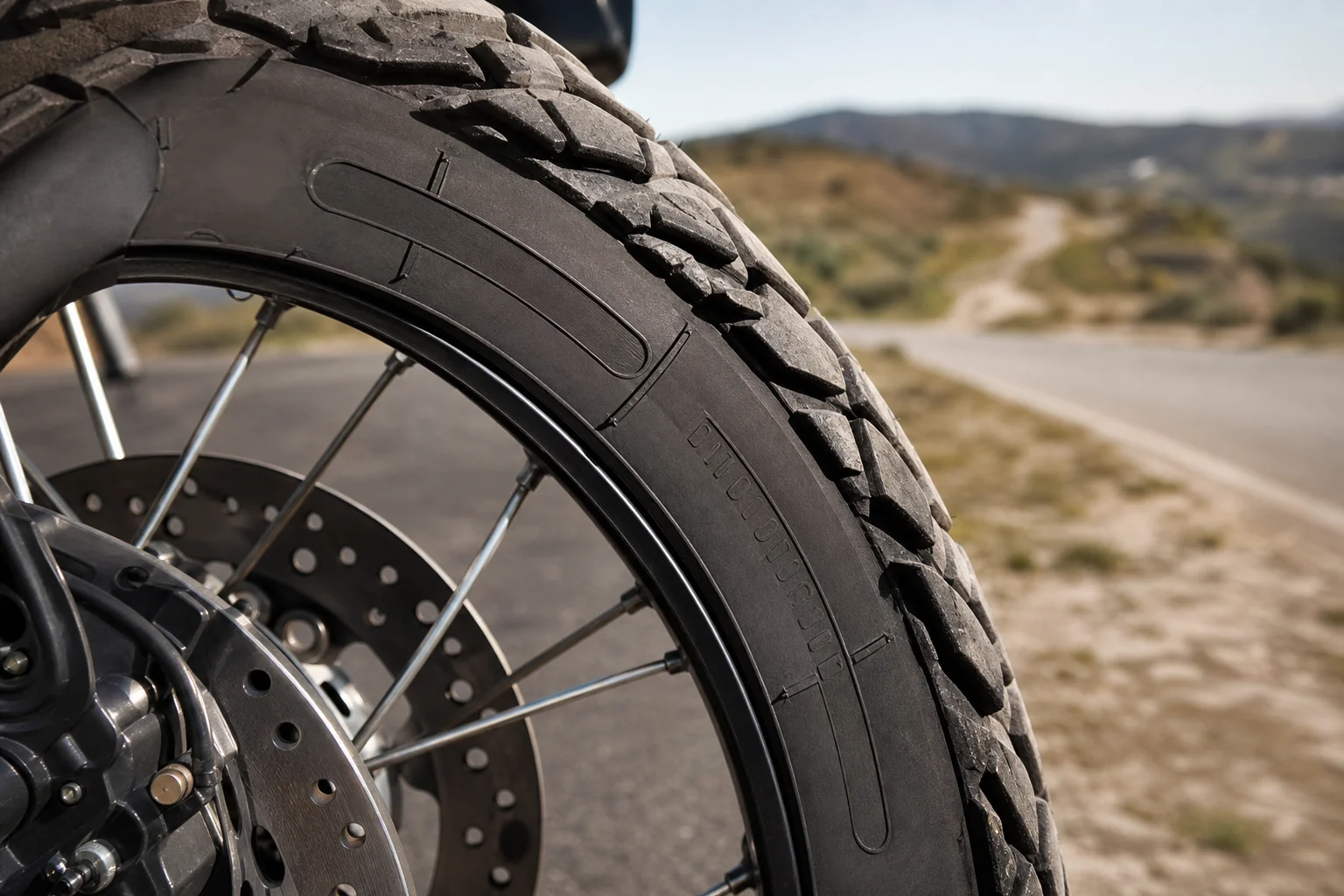
The sidewall inscription condenses essential information. For example, 180/55 ZR 17 M/C (73W) identifies nominal width, aspect ratio, construction, rim diameter, motorcycle use, load index and speed rating. The letter R identifies radial construction and B identifies belted bias construction; these are not details to omit when looking for a size that appears identical.
The number immediately before the speed symbol is the load index. It must cover the load the tyre will carry, including the motorcycle, rider, passenger and luggage, not just the bike's mass. Do not oversimplify the speed code either: the meaning of W and (W), for example, differs.
Section references: Cómo leer la dimensión de los neumáticos de moto ↗ · Índice de carga y velocidad de neumáticos de moto ↗
- Record the front and rear separately: full size, construction, rim diameter, load index and speed rating.
- Check the vehicle inspection card (ficha técnica) and manual for notes that apply to tyres, where applicable.
- Do not shorten the marking when searching: “same width” does not necessarily mean the same specification.
- If you regularly carry a passenger or luggage, assess the load index using that expected load.
Road, mixed use or more off-road focused: decide without promises the tread cannot keep
Road, mixed-use and more off-road-focused categories help organise a usage need; they do not allow you to bypass the original specification. Before choosing, estimate how many kilometres will be covered on tarmac and how many on tracks where riding is permitted. Also identify what matters most in your case: regular commuting, loaded travel or occasional riding off tarmac.
A more open tread pattern may suggest a different orientation, but it certifies nothing on its own. The documentation reviewed expressly shows that two tyres with similar tread can differ on a decisive point: one may not comply with Regulation No. 75 or carry E approval marking for road use. Therefore, the decision must be based on markings and compatibility, as well as expected use.
Avoid extremes chosen for appearance. Fitting an option more suited to tracks when the motorcycle runs almost exclusively on tarmac, or a clearly road-oriented alternative for the off-tarmac use you actually do, may not meet your priority. The useful criterion is the dominant use, allowing for occasional use, always within the applicable documentation.
| Usage profile | Selection priority | Compromise to avoid | Documentary check |
|---|---|---|---|
| Mostly road | A compatible tyre for that dominant use | Choosing solely by appearance or width | Full size, construction, ratings and markings |
| Roads and permitted tracks | A compatible mixed-use alternative | Assuming an open tread proves public-road use | Manufacturer specification, vehicle inspection card (ficha técnica) and manual, where applicable |
| Greater off-tarmac use | Compatibility and intended riding conditions | Fitting an NHS tyre for road riding | Sidewall markings and approval status |
Section references: Reglamento n.º 75 CEPE/ONU para neumáticos de motocicletas y ciclomotores ↗ · Requisitos de la F.I.M. para Enduro ↗
- Predominantly tarmac use: compare compatible road-focused alternatives.
- Alternating use: look for a mixed-use solution documented for your motorcycle's sizes and requirements.
- Use with a greater presence of permitted tracks: confirm public-road approval and full compatibility especially carefully.
- Do not use the tread pattern as proof of approval.
Rim, tube and fitting compatibility: details not to overlook
The choice between a tube-type and tubeless tyre requires checking two elements: the tyre marking and the rim construction. TT means Tube Type, for use with an inner tube, and TL means Tubeless. Do not infer the system solely from the fact that the rim is spoked.
On some spoked rims, the spokes pass through the central area and the rim is not airtight; on others, the spokes are secured in a way that maintains airtightness and the rim can be TL. That difference makes it impossible to generalise from the wheel's appearance. Before buying, confirm your rim system and the marking of the tyre under consideration.
Include verification of front and rear size, ratings, construction and TT/TL system in the fitting check. If you cannot confirm any of these points from the documentation and markings, stop the purchase and consult a professional.
Section references: Cómo leer la dimensión de los neumáticos de moto ↗ · Cómo elegir una cámara de aire para moto ↗
- Do not assume that a spoked rim requires an inner tube.
- Check TT or TL both on the tyre and in the rim configuration.
- Give the workshop a photo or note of the required specification for both axles.
Markings, approval and checks on a used trail motorcycle
For public-road riding, do not confuse competition approval, appearance and road authorisation. UNECE Regulation No. 75 requires, among other inscriptions on at least one sidewall, the trade name and size designation; for certain rim sizes it also specifies the M/C marking. The NHS marking, meanwhile, identifies tyres not approved for road use according to the manufacturer's documentation.
In Spain, check any inspection-related doubt against the applicable edition of the ITV Inspection Station Procedure Manual. The Ministry identifies version 7.9 as applicable from 1 January 2026. Do not apply to a motorcycle the 1.6 mm minimum tread depth cited for M1, N1, O1 and O2 categories: the text of Order PJC/528/2026 does not assign it to category L.
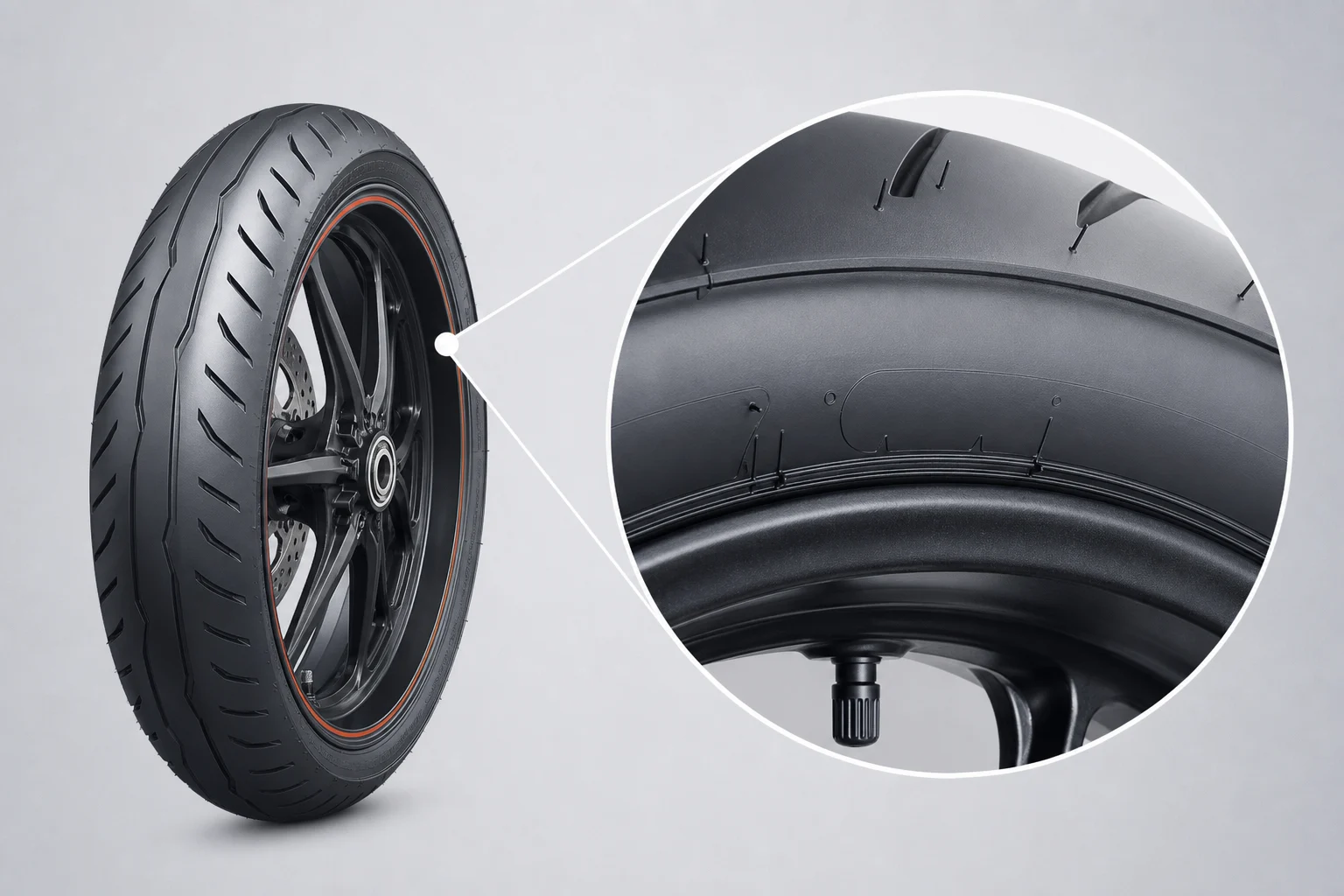
If you are examining a used trail bike, inspect both sides of the tyres. The final four-digit TIN code indicates the production week and year, although it may appear on only one sidewall. Do not treat it as an isolated verdict: the date alone cannot predict service life. Combine it with the actual condition and the match between the tyre and the manufacturer's documented specification.
Section references: Manual de Procedimiento de Inspección de las Estaciones ITV, versión 7.9 ↗ · Reglamento n.º 75 CEPE/ONU para neumáticos de motocicletas y ciclomotores ↗ · Orden PJC/528/2026, modificación del Reglamento General de Vehículos ↗ · Cómo leer la dimensión de los neumáticos de moto ↗ · Las marcas de neumáticos explicadas: cómo leer un neumático ↗
- Used motorcycle inspection checklist:
- Photograph sizes, construction, ratings, TT/TL and any NHS marking.
- Four-digit TIN code: the first two numbers are the week and the last two are the year.
- Compare both tyres with the manufacturer's documented specification, and check the vehicle inspection card (ficha técnica) and manual where applicable.
- Check for uneven wear in the centre or shoulders; it may indicate incorrect pressure.
- Seek professional advice if there is visible damage, abnormal wear, doubts about equivalence or documentary discrepancies.
Final checklist before paying
A successful replacement is one that fits your motorcycle, the way you use it and its documented requirements. Compare carefully before removing the current tyres: you can then check the inscriptions directly, but you should not rely on what is fitted to a used bike as your only reference.
Consult a professional if there is visible damage, uneven wear, doubts about size equivalence or an incompatibility between the documentation and the tyre. Unusual wear in the centre or shoulders may be associated with incorrect pressure and deserves an inspection rather than simply changing the tyre.
Section references: Índice de carga y velocidad de neumáticos de moto ↗ · Desgaste de los neumáticos de moto: cuándo cambiar mis neumáticos de moto ↗
- I have confirmed the manufacturer specifications for my exact version.
- I have checked the full size, construction, load index and speed rating on each axle.
- I have verified the TT or TL system of the tyre and rim.
- I have ruled out NHS tyres if I will use the motorcycle on the road.
- I have chosen according to dominant use, not tread pattern alone.
- I have checked condition, TIN and uneven wear if the motorcycle or tyres are used.
Can I fit a tyre of the same width but with a different construction on a trail bike?
It should not be assumed. The letter R or B forms part of the tyre designation and must be compared with the specification applicable to the motorcycle, together with the rest of the size and ratings.
Is a tyre with tread blocks or an open pattern approved for road use?
Not necessarily. A similar tread pattern does not itself prove compliance with Regulation No. 75 or road approval marking. Check the markings and documentary compatibility.
Do all spoked rims use inner tubes?
No. Some spoked rims are not airtight and require a tube-type configuration, but there are also TL spoked rims with a fastening system that retains airtightness. Verify both the rim and tyre.
Does the tyre date code determine whether it needs replacing?
Not by itself. The four-digit TIN identifies the production week and year, but the date alone cannot predict service life. Assess it together with wear, damage and suitability according to the documentation.