Does an electric truck fit your delivery operation? Calculate route, payload and charging before investing
Before buying an electric truck, compare the real work with usable battery capacity, the weight of the bodied configuration and the charging you can use without compromising the service.
Key points
An electric truck can suit delivery work if the required energy, payload and charging fit within the real shift with a verifiable margin. The catalogue range figure does not replace analysis of each route, its weight, stops and available infrastructure.
The short answer: decide by the shift, not an isolated range figure
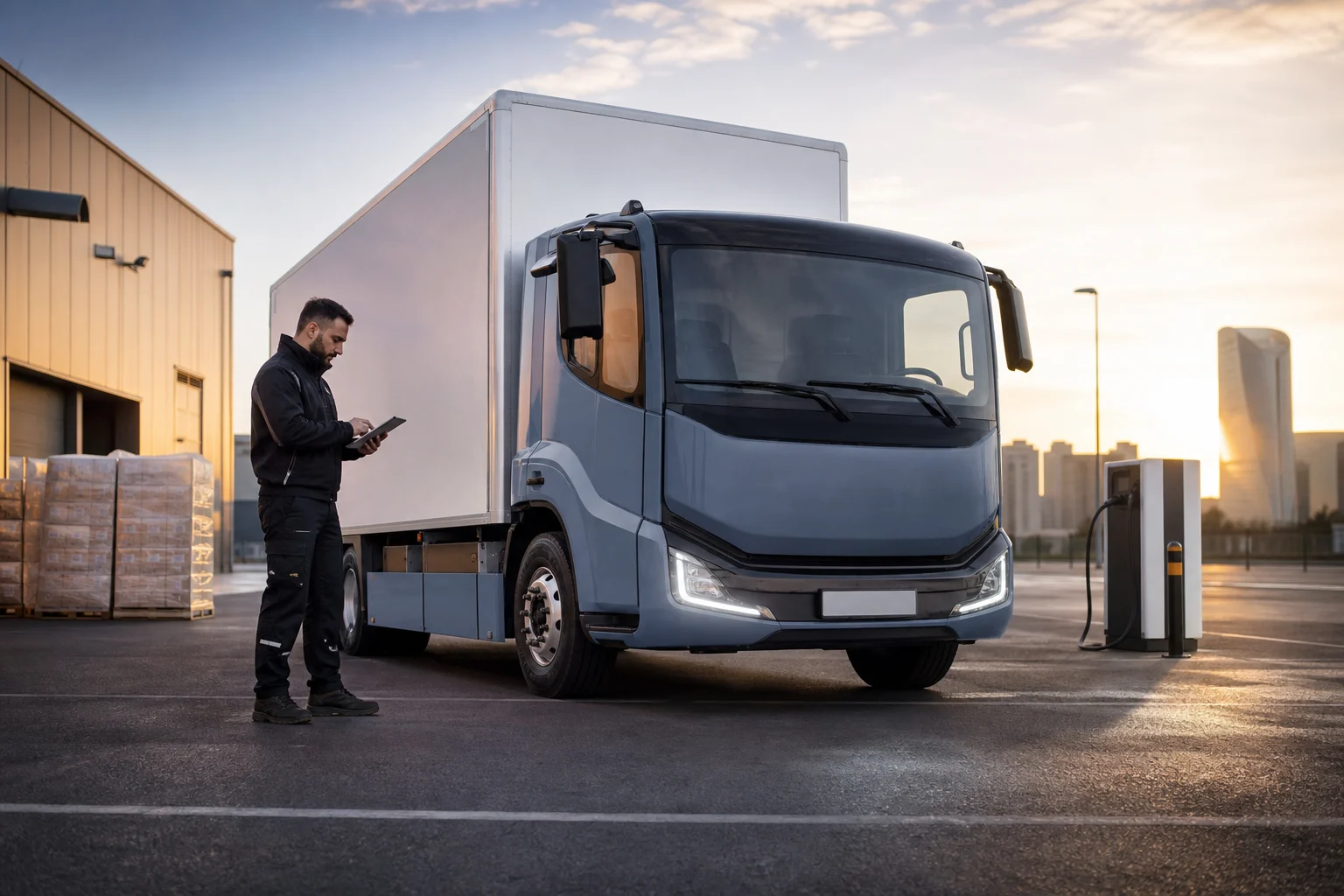
An electric truck can work for deliveries when you can demonstrate that it completes the planned shift with the planned goods and recovers the required energy within its stopping times. The starting point is not the advertised range, but the duty cycle: kilometres, number of runs, transported weight, traffic, gradients, climate control, auxiliary equipment, timetable and whether it returns to base—or not.
For heavy-duty vehicles, European certification links consumption and range to mission profiles and load combinations. Regulated documentation may include the profile, payload, simulated total mass, average speed, consumption in kWh/km and electric range. This is a practical reason not to compare two offers solely by nominal battery size or a single kilometre figure.
Separate two questions that are often mixed together. Technical feasibility answers whether the vehicle can provide the service without running out of energy, exceeding weight limits or relying on impractical charging. Profitability answers whether the full cost of the vehicle, bodywork, infrastructure, energy, maintenance, finance and possible grants is worthwhile compared with the alternative. Resolve feasibility first: a theoretical saving does not fix a route that cannot be operated.
As your own validation criterion, repeatable routes that usually return to base and have enough dwell time may be easier to verify, provided the required energy and charging have been checked. Greater caution is needed if operations change every day, the truck makes several runs without a certain stop, or they rely on public charging that has not been physically checked.
Section references: Reglamento (UE) 2022/1379: certificación de consumo y autonomía de vehículos pesados, incluidos eléctricos ↗
- Do not approve a purchase using catalogue range as the only figure.
- Analyse each route or route family separately when loads and schedules differ.
- Require technical data to refer to the offered configuration, not a generic chassis.

Map the real work before requesting a quote
Gather data from several representative weeks, not just one quiet day. If demand is seasonal, include the period with the highest load or the one that puts service delivery under the most pressure. The most demanding route is not always the longest: a combination of high load, elevation change, many stops and auxiliaries can matter more than kilometres.
Also record where the vehicle is parked overnight, how long it remains stationary and whether that time coincides with the need to charge. A route that returns to base makes it possible to design charging as a controlled part of the operation. However, if the return is late, uncertain or does not happen, you will need to validate an alternative charging option and its effect on the timetable.
Request the technical specification and itemised quote for the exact vehicle: usable battery capacity, declared consumption or range and the cycle to which it relates, maximum authorised mass (MAM), unladen weight of the specific configuration, bodywork, fixed equipment, charging power and connectors. If it is supplied with a tail lift, refrigerated body or other auxiliary equipment, the weight and energy demand must correspond to that complete set-up or be expressly pending confirmation.
Section references: Reglamento (UE) 2022/1379: certificación de consumo y autonomía de vehículos pesados, incluidos eléctricos ↗ · VECTO: herramienta oficial europea para vehículos pesados ↗
- Daily kilometres, kilometres per run and number of runs.
- Usual and maximum weight, plus load distribution by axle.
- Stops, average speed, gradients, temperature and use of climate control or auxiliaries.
- Departure and arrival times, time at base and intermediate charging windows.
- Address, access, connectors and published power of any planned public charging point.
Payload: calculate from the completed vehicle and check the axles
Available payload cannot safely be calculated by subtracting a generic commercial figure from the weight limit. In Spain, unladen weight is the mass of the vehicle with its authorised fixed equipment, without crew, passengers or load. MAM, meanwhile, is the maximum mass for operating the loaded vehicle on public roads; it is not the same as the manufacturer’s technically permissible maximum mass.
For the specific configuration, start with the applicable MAM and subtract the actual mass of the completed vehicle: chassis, bodywork, fixed equipment and other fitted items. The result is the theoretical allowance for crew, occupants and load that must be considered in the operation; the supplier should clarify in writing which masses are included in each figure. Then check the maximum authorised axle masses: keeping the total mass within the limit does not guarantee that a particular distribution of goods is permissible.
Under certain conditions, regulations allow alternative-fuel vehicles to have their MAM increased for the additional weight of the technology, up to a maximum of one tonne. Do not automatically add this to payload: confirm that it applies to your vehicle’s category, configuration and authorisation. This is a legal and documentary matter, not a commercial allowance.
The common mistake is to budget for the chassis payload and later discover that the bodywork or an auxiliary system reduces it. Avoid this with a mass sheet signed by the supplier or included in the quote before ordering the vehicle.
Section references: Reglamento General de Vehículos: definiciones de masa ↗ · Reglamento General de Vehículos: tabla de masas máximas y excepción para combustible alternativo ↗
- Request the MAM and unladen weight of the bodied unit, not just the chassis cab.
- Identify the body, tail lift, refrigeration, shelving, load restraint and all other fixed equipment separately.
- Check axle mass with the real load and its usual position.
- Do not use a possible MAM exemption without documentary confirmation that it applies.
Estimate energy per shift using three scenarios
Build the estimate from documented consumption for a comparable profile or, preferably, from an operational test of the same service using an equivalent vehicle. The calculation is straightforward: approximate route energy equals route kilometres multiplied by consumption in kWh/km. What matters is that both figures describe the same load, route and operation; using consumption from another cycle can lead to a misleading conclusion.
Prepare three scenarios. The favourable one should represent a short route or low load; the typical one, the most frequent service; and the demanding one, the plausible combination of higher weight, gradients, stops, traffic, temperature and auxiliaries. VECTO, the official European tool for heavy-duty vehicles, considers factors such as masses, auxiliary power, rolling resistance and aerodynamics. This illustrates why delivery energy use does not depend only on distance.
Compare the result for each scenario with the declared usable energy and reserve an operational margin defined by your company. The margin is not an invented range: it is energy you do not allocate to the route in order to absorb operational variation and incidents. If the demanding scenario only works by exhausting the margin or requires charging that is not guaranteed, the route must be redesigned or kept on another solution.
Section references: Reglamento (UE) 2022/1379: certificación de consumo y autonomía de vehículos pesados, incluidos eléctricos ↗ · VECTO: herramienta oficial europea para vehículos pesados ↗
- Favourable: short route or low load, without turning it into the purchasing benchmark.
- Typical: representative average of kilometres, weight and conditions.
- Demanding: a plausible day with more load, gradients, auxiliaries and delays.
- Record the source, date, profile and configuration for every consumption figure used.
Charging must fit the operation, not just the map
First calculate the energy you need to replenish after each shift, then validate how long this requires at the point that is actually available. Charger power affects charging time. Therefore, published power must not be treated as a promise of charging time for any battery without checking it in the planned operation.
At the base, document contracted and available power, the number of vehicles charging simultaneously, power allocated to each one, connection schedule and priority order. Check that the planned sequence allows the necessary charging to be completed before the next shift. Also define what happens in the event of a late arrival, an occupied point or incomplete charging: plan B must support the service, not be an assumption.
If a route depends on public charging, verify the specific point. MITECO open data include location, connector type and power, but you must confirm compatibility, physical access for the truck and operational availability before including it in the plan. AFIR sets public coverage targets dedicated to heavy-duty vehicles, but it does not prove that a particular location is already operational or suitable for your vehicle.
| Observed situation | Operational interpretation | Required check |
|---|---|---|
| Repeatable route, return to base and enough dwell time | Makes it possible to validate technical feasibility using operational data | Schedule records and a charging plan for the entire fleet |
| Energy in the demanding scenario fits with margin | Supports service continuity | Documented consumption or an equivalent-service test |
| Payload and axle masses comply | Electrification does not compromise the planned goods | Completed-unit specification and mass verification |
| Several units charge at the same time | Requires the charging plan to be validated before the next shift | Available power, load sharing and sequencing |
| Public charging is essential | Adds operational dependency | Connector, power, access and availability of the specific point |
| The demanding scenario uses the entire margin | Do not approve the route without changes | Route redesign, reliable charging or alternative technology |
Section references: Reglamento (UE) 2023/1804 (AFIR): objetivos de recarga pública para vehículos pesados ↗ · Datos abiertos de puntos de recarga de acceso público ↗ · Guía de infraestructura de recarga ↗
- Check the connector and power of both the vehicle and the charging point.
- Validate truck access, manoeuvring and dwell time at the site.
- Simulate all fleet vehicles charging at the same time.
- Define a plan for unavailability, delays or lower effective power.
Buy only after a pilot and a comparable total cost assessment
Request a documented pilot with a vehicle and bodywork equivalent to those quoted. During the test, record kilometres, transported weight, energy consumed, energy replenished, connection and disconnection times, incidents, observed power and completion of the final delivery. Repeat the typical and demanding scenarios if possible. The aim is not to achieve an attractive figure, but to discover whether the service is delivered with margin.
In the financial comparison, separate the vehicle price, bodywork, charging infrastructure, energy costs, maintenance, finance and residual value if a justifiable assumption is available. Date every assumption and apply the same timeframe, kilometres and service level to each alternative. Use ownership, energy and charge tools as calculation support, not as a replacement for supplier data and your own operational data.
Do not count a grant that has not been awarded and is not applicable to your case as certain income. As of 15 September 2026, the state programme announced six days earlier for roadside charging was in prior public consultation, so it should not have been included as an awarded subsidy in a total cost of ownership assessment.
Before signing, set out in writing the configuration, masses, usable battery capacity, charging power and connectors, consumption or range data together with their cycle, bodywork scope, deadlines and pilot conditions. If any of these elements is missing, postpone the decision or limit the order to a pilot deployment.
Section references: Reglamento (UE) 2022/1379: certificación de consumo y autonomía de vehículos pesados, incluidos eléctricos ↗ · Consulta pública de un programa de ayudas para recarga en carreteras ↗
- Proceed: route, weight, energy and charging are validated with margin and documentation.
- Redesign: the vehicle fits, but the route, charging sequence or transported load does not.
- Keep another technology: there is no energy margin, sufficient payload or reliable charging for the service.
- Do not finalise TCO without separating investment in the vehicle, bodywork and infrastructure.
Is it enough for the declared range to exceed daily kilometres?
No. It must correspond to a comparable load and operating profile, and the energy required for the shift must leave an operational margin. You must also check that the planned charging fits the real timetable.
How do I calculate the payload of a bodied electric truck?
Start with the applicable MAM and subtract the actual mass of the completed unit, including the chassis, bodywork and fixed equipment. Also confirm the maximum axle masses and the usual distribution of the goods.
Can I count on an announced grant to justify the investment?
Not as certain income. Include it only when it applies to your case and has been awarded, or under the applicable conditions. A prior public consultation is not the same as an awarded subsidy.
What should I measure in a test before buying?
Kilometres, transported weight, energy consumed and replenished, charging times, observed power, incidents and timetable compliance. Do this on typical and demanding routes with a configuration equivalent to the one quoted.