Climate Control and Electric Car Range: What to Check
Heating, air conditioning, heat pumps and preconditioning: how to interpret the data that genuinely helps you plan an EV’s range in winter and summer.
Key points
Climate control can affect an electric car’s energy consumption and available range, but there is no fixed percentage loss that applies to every model or journey. Useful planning is based on the car’s displayed range, the thermal equipment fitted to that version, its manual and the specific conditions of use.
The quick answer: there is no fixed range loss
Climate control can affect energy consumption and, therefore, the available range, but it is not accurate to express that effect as a universal percentage. The specific vehicle and the climate-control settings used can change the outcome. Two journeys covering the same distance do not require the same forecast unless they are completed with the same settings.
WLTP range is a reference for comparing vehicles under a defined procedure for determining electric energy consumption and range. It is not a guarantee of kilometres for every day, route, temperature or climate-control setting. The WLTP regulation provides for the use of air conditioning and other auxiliary devices to reflect typical on-road use and to be documented; moreover, if air conditioning or heating is used, the windows must remain closed.
The most useful check before setting off is not to apply a figure from a test seen online, but to look at the range estimated by the car itself with the current settings. Hyundai, for example, documents that the remaining distance may be displayed according to the current climate-control setting and warns that this information may not match the actual range. This is an important warning: as a cautious approach, the onboard estimate should be used to make decisions with a margin, not as an exact promise.
Section references: Reglamento de ejecución (UE) 2025/1706 — procedimiento WLTP ↗ · Reglamento ONU n.º 154 — dispositivos auxiliares durante WLTP ↗ · Manual europeo Hyundai — menú de vehículo eléctrico ↗
- Use the WLTP figure to compare models and versions under the same reference, not to predict a specific day.
- Check the estimated range after adjusting the temperature and before starting the journey.
- Do not extrapolate the result from another vehicle, battery or route to your car.
What energy uses to separate before drawing conclusions
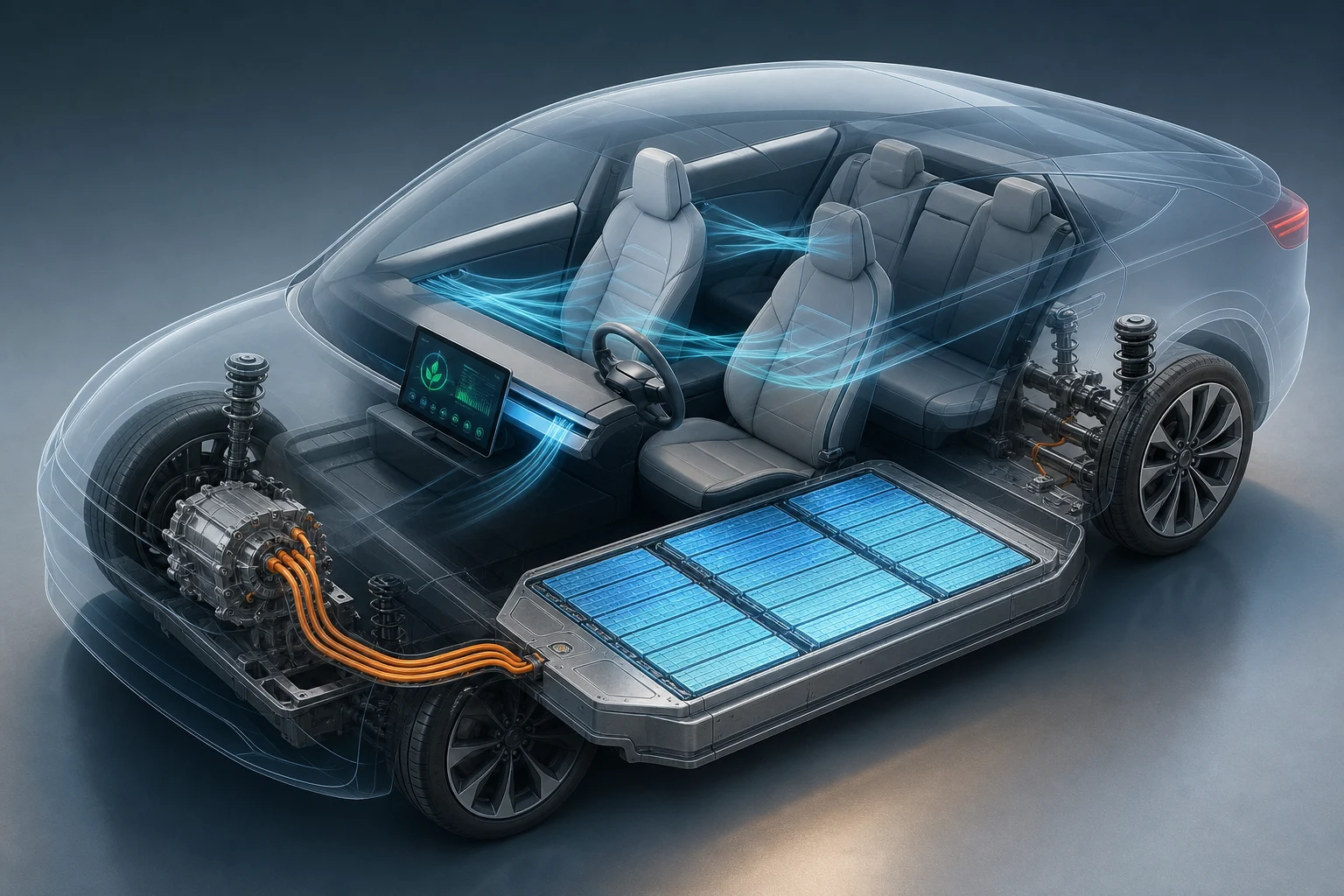
When discussing “climate-control consumption”, several functions are often mixed together. On one hand, there is cabin conditioning: heating, cooling and the settings selected by occupants. On the other, there is battery thermal management, which responds to the needs of the propulsion and charging systems. Auxiliary devices covered by the type-approval procedure also play a role. Separating these concepts avoids attributing every range change to air conditioning or heating.
Battery management deserves particular attention. In Hyundai’s European manual, battery conditioning is described as a function intended to optimise rapid charging, and the manufacturer itself warns that it may reduce range. Therefore, a drop in range forecast or displayed by the car may not relate solely to cabin comfort.
The practical conclusion is to review the energy menus available in the specific vehicle. In the documented Hyundai systems, the estimate may be linked to the climate-control settings, and the manufacturer indicates that the vehicle’s electricity consumption should be checked. When buying, ask for an explanation of the information displayed by the screen in that version and the conditions under which it is updated.
| Item | What it is for | Caution when interpreting it |
|---|---|---|
| Estimated range | To guide planning using the car’s current settings | It may not match actual range. |
| Climate-control setting | To check whether the estimate takes the current settings into account | It does not allow the result to be converted into a rule valid for every car. |
| Battery conditioning | To understand functions linked to rapid-charging optimisation | It may reduce range, according to Hyundai documentation. |
| Electricity consumption | To review the energy information available in the vehicle | It should be read in the context of the journey and current settings. |
Section references: Manual europeo Hyundai — menú de vehículo eléctrico ↗
- Distinguish between cabin climate control and battery conditioning.
- Check whether the vehicle reports electricity consumption and the range associated with the current settings.
- Do not assume that every reduction in range has a single cause.
Heating, air conditioning and heat pumps: what to ask when comparing versions
The relevant question is not simply whether a car has climate control. You need to confirm how that specific version handles thermal management. Volkswagen describes a heat pump as a solution that can require less energy for heating or cooling because it powers a compressor rather than using an electric heater. This may offer an efficiency advantage, but it does not mean climate control is free or that all range variation disappears.
It is also not wise to assume that a heat pump is included. The sales specification is a guide, but the decisive document for a car you intend to buy is the configuration of that version and, especially for a used car, the equipment actually fitted.
For the same reason, there is no basis for generically stating that air conditioning uses more or less energy than heating. The actual effect depends on the car and conditions of use. Rather than looking for an absolute winner, compare the stated technology, the functions available and the estimate offered by the vehicle in the usage scenario that matters to you.
Section references: Bomba de calor en el automóvil ↗
- Confirm whether there is a heat pump and whether it is fitted to the chosen version.
- Consult the manual for the car’s model year and market.
- Avoid comparing the ranges in two adverts unless they precisely identify the battery, version and thermal equipment.
Why urban driving, motorways and short journeys do not behave alike
It is not advisable to apply a single range-loss rule to urban driving, motorways and short journeys. WLTP range makes it possible to compare vehicles under a defined procedure, but it does not guarantee a figure for every route or climate-control setting. As a cautious planning method, start with the information available in the specific car rather than a percentage from someone else’s test.
In the documented Hyundai systems, the remaining distance may be displayed according to the current climate-control settings, and the manufacturer warns that the information displayed may not match actual range. This makes it possible to use the vehicle’s indication as a reference linked to those settings, without turning it into an exact forecast or extrapolating it to other models.
For planning, set a conservative forecast rather than a guaranteed range. As an editorial method, before setting off, adjust climate control to what you genuinely intend to keep using, check the displayed range and compare the journey with the planned charging stop. During the trip, check the information available in the system again if your plan changes. If the forecast is no longer sufficient, the sensible decision is to adapt the charging plan, not rely on a fixed loss figure being met.
Section references: Reglamento ONU n.º 154 — dispositivos auxiliares durante WLTP ↗ · Manual europeo Hyundai — menú de vehículo eléctrico ↗
- As a cautious method, plan using the comfort temperature you will actually use, not with climate control switched off.
- On journeys involving charging, check the information available in the vehicle again if the plan changes.
- Keep a margin between the displayed range and the distance to the next charging stop.
- Keep the windows closed when using air conditioning or heating, as required by the WLTP procedure.
Preconditioning: check the function before relying on it
Preconditioning and scheduling can help prepare the car for a departure time, but they do not work in the same way in every electric vehicle. Hyundai documents the ability to schedule battery charging or climate-control settings according to a preset departure time, and expressly warns that screens and functions vary depending on the model and specifications.
Therefore, the correct step is to open the manual, the app and the menus for the specific vehicle. Check whether departure-time scheduling is available, which elements can be configured and which requirements the manufacturer sets. If you plan to use this function regularly, test it beforehand at home or where you charge, rather than discovering its limits on the day of a trip.
Can it work while unplugged? There is no answer that applies to every car. The Tesla Model Y manual cited as an example states that preconditioning works when the vehicle is not plugged in, provided it is not in Low Power Mode, and adds that it can reduce energy consumption when driving begins. This information should not be automatically transferred to another model: always confirm the behaviour described by your manufacturer.
Section references: Manual europeo Hyundai — programación de carga y climatizador ↗ · Manual Model Y — preacondicionamiento programado ↗
- Find the charging and climate-control scheduling information in the manual for your version.
- Review the options in the app and on the vehicle screen.
- Do not assume that the function requires the car to be plugged in or that it works unplugged: both possibilities depend on the model.
- Check the conditions or modes that may limit preconditioning.
Buying checklist and a method for a cautious forecast
When comparing two electric cars, begin with the WLTP range of each version, because it is the common approved reference. Then check the standard and optional thermal equipment, including the heat-pump system where it is advertised. Complete the comparison with the manual and app: it is not enough for the car to have climate control; it matters to know what information the specific vehicle displays and whether it allows the cabin to be scheduled.
For a winter or summer journey, use a simple method. Configure the car as you will use it, check the displayed range and available electricity-consumption information, note the distance of the leg and the planned charging point, and keep a margin. Update your decision if the route plan changes. This provides an operational reference that can be reviewed, without turning it into a promise of range.
This review is also useful for anyone considering a used vehicle. Ask for access to the car’s documentation and menus before completing the purchase. If the advert specification does not state the thermal technology or scheduling functions, treat this as information that still needs to be confirmed. To compare energy costs across different scenarios, you can use the energy tool, without replacing the vehicle’s actual estimate with it.
Section references: Reglamento de ejecución (UE) 2025/1706 — procedimiento WLTP ↗ · Manual europeo Hyundai — menú de vehículo eléctrico ↗ · Manual europeo Hyundai — programación de carga y climatizador ↗ · Bomba de calor en el automóvil ↗
- WLTP range for the exact version.
- Thermal system and presence of a heat pump, where applicable.
- The correct manual for the car’s year, market and specifications.
- Estimated range with climate control configured.
- Electricity-consumption information on the screen.
- Climate-control scheduling and the conditions of use stated by the manufacturer.
- A charging plan and sufficient margin for the journey.
Does air conditioning use more energy than heating in an electric car?
There is no universally documented answer for every model and condition. In the documented Hyundai systems, the remaining distance may be displayed according to the current climate-control settings, but this information should not be extrapolated to other cars. Check your vehicle’s estimated range with climate control set as you intend to use it.
Does a heat pump eliminate range loss?
No. Volkswagen states that a heat pump requires less energy for heating or cooling by powering a compressor instead of an electric heater, but climate control still requires energy. You must also confirm that this solution is fitted to the specific version.
Can an electric car be preconditioned while unplugged?
It depends on the model. The Tesla Model Y manual states that it can operate while unplugged as long as the vehicle is not in Low Power Mode, and that it can reduce energy consumption when driving begins, but this function should not be extrapolated to other cars. Consult your vehicle’s manual and app.
Does WLTP range already include climate-control use?
Range and consumption are determined through the WLTP procedure. Under that procedure, the use of air conditioning and other auxiliary devices must correspond to typical use and be documented. The WLTP figure remains a comparison reference, not a guarantee for a specific temperature, route or setting.